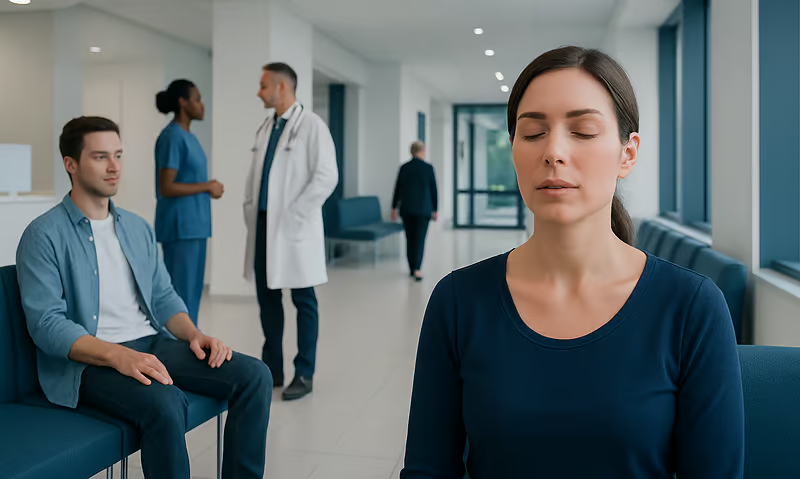
What Is a Classically Conditioned Response?

A classically conditioned response is learned, automatic, and triggered by a cue. It develops through repeated pairing of a neutral stimulus with a meaningful stimulus.
Key Takeaways
- A classically conditioned response is learned, automatic, and triggered by a cue.
- It develops through repeated pairing of a neutral stimulus with a meaningful stimulus.
- Classical conditioning can influence emotions, habits, and physical reactions.
- Conditioned responses may fade over time, return after stress, or be changed with therapy.
- Persistent fear or distress linked to conditioning can benefit from professional mental health support.
A classically conditioned response is an automatic, learned reaction that develops when a person repeatedly links one stimulus with another. It is a basic concept in psychology that helps explain habits, emotions, fears, and some body responses.
Overview
A classically conditioned response is a learned reaction that happens automatically after a person or animal repeatedly connects one signal with another. In simple terms, something that once had no special meaning becomes a trigger for a response because it has been paired with another stimulus often enough. This idea comes from classical conditioning, a core principle in psychology and behavioral science.
A common example is feeling hungry at the smell of food, or feeling tense when hearing a sound that has become linked to an unpleasant event. The response is not usually a deliberate choice. Instead, it is automatic, like salivating, feeling anxious, relaxing, or becoming alert.
Classical conditioning is a normal part of learning. It helps people adapt to their environment by recognizing patterns and predicting what may happen next. At the same time, it can also contribute to unhelpful reactions, such as fear responses, avoidance habits, or strong emotional associations.
How classical conditioning works

To understand a classically conditioned response, it helps to know the basic parts of classical conditioning. An unconditioned stimulus naturally causes an unconditioned response without learning. For example, the smell of food may naturally cause salivation. A neutral stimulus, such as a bell or a certain place, does not cause that response at first.
If the neutral stimulus is repeatedly paired with the unconditioned stimulus, the brain begins to connect them. Over time, the once-neutral stimulus becomes a conditioned stimulus. When that conditioned stimulus appears alone, it can trigger a conditioned response. In this example, the bell alone may lead to salivation.
This process can happen with physical reactions, emotions, and behaviors. It may explain why someone feels calm when hearing a familiar song, uneasy in a medical setting, or suddenly joyful when noticing a scent linked to a positive memory. The brain learns associations efficiently, often outside conscious awareness.
- Unconditioned stimulus: naturally causes a response
- Unconditioned response: the natural automatic reaction
- Neutral stimulus: initially does not trigger the response
- Conditioned stimulus: the formerly neutral cue after learning
- Conditioned response: the learned automatic reaction to that cue
Examples in everyday life

Classically conditioned responses are part of everyday experience. A person may feel relaxed after entering a room where they regularly meditate, simply because that setting has become linked with calm. Another person may feel uncomfortable when they smell a food that once made them sick, even if the food is now safe.
Emotional learning often involves conditioning. Children and adults can develop positive or negative associations with sounds, places, people, or routines. School bells, hospital smells, traffic noises, and even phone notifications may trigger automatic reactions because of repeated past experiences.
Classical conditioning also plays a role in health care and mental health. For example, some people develop fear responses linked to injections, dental visits, or previous pain. Others may notice conditioned cravings related to eating patterns or substance use cues. In some cases, these learned reactions overlap with concerns such as anxiety disorders or specific phobias, especially when the response becomes strong or disruptive.
Why conditioned responses develop
Conditioned responses develop because the nervous system is designed to detect patterns. Learning that one event predicts another can be useful for safety, comfort, and survival. If a cue reliably comes before something important, the brain may begin reacting early in preparation.
Several factors affect how strongly a conditioned response forms. These include how often the pairing happens, how intense or meaningful the original stimulus is, and how closely the two events occur in time. Emotionally important experiences, especially those involving fear, pain, relief, or reward, may create stronger associations.
Personal history matters as well. Previous experiences, stress levels, attention, and temperament can influence how a person learns associations. That is why the same event may create a strong conditioned response in one person and very little response in another. In mental health care, understanding these patterns can help explain certain symptoms and guide support.
When it becomes a problem
Many conditioned responses are harmless or even helpful. However, some become problematic when they cause distress, avoidance, or interference with daily life. A person may begin to fear situations that are objectively safe because those situations have become linked with a painful or frightening memory.
Examples include avoiding medical care because the clinic environment triggers panic, feeling nauseated before treatment because of earlier unpleasant experiences, or experiencing strong fear after a dog bite when seeing any dog. In these cases, the response may be understandable, but still burdensome. Problems can also arise if conditioning contributes to unhealthy habits, compulsive routines, or persistent stress reactions.
Conditioned responses can be involved in conditions such as phobias, trauma-related symptoms, and some forms of avoidance behavior. Assessment by a qualified professional may be helpful when reactions are intense, long-lasting, or hard to control. Depending on the symptoms, clinicians may also evaluate related concerns such as depression or other emotional health conditions.
Diagnosis and assessment
A classically conditioned response itself is not usually diagnosed as a disease. Instead, clinicians look at the broader pattern: what triggers the reaction, what the person feels in the body and mind, how long it has been happening, and whether it affects work, school, relationships, sleep, or health care. The goal is to understand the learned association and its impact.
Assessment often includes a detailed history of symptoms, recent stressors, past experiences, and situations that bring on the reaction. A mental health professional may ask about fear, avoidance, panic-like symptoms, mood changes, or trauma exposure. In some cases, a physical examination or medical review is also important to rule out other causes of symptoms such as palpitations, nausea, or dizziness.
When the conditioned response is part of a larger mental health concern, treatment planning is based on the underlying condition rather than the conditioning concept alone. Clear assessment helps identify whether the main issue is a specific phobia, anxiety, trauma-related distress, or another pattern of learned response.
Treatment and ways to change conditioned responses
Conditioned responses can often be reduced, reshaped, or replaced. One common approach is gradual exposure, in which a person safely and slowly encounters the trigger without the feared outcome. Over time, the brain can learn a new association. This process may weaken the old conditioned response and build a calmer, more realistic one.
Psychological therapies are often effective when conditioning contributes to anxiety or avoidance. Approaches such as cognitive behavioral therapy can help people recognize triggers, challenge unhelpful expectations, and practice coping strategies. Relaxation training, breathing techniques, mindfulness, and stress management can also reduce the strength of automatic reactions.
For some people, treatment may involve a broader plan if the conditioned response is part of panic, trauma, depression, or another mental health condition. In selected cases, a doctor may discuss psychiatric care or other therapies as part of ongoing support. Near the end of a patient’s care journey, it may be helpful to know that Acibadem International’s multidisciplinary specialists and JCI-accredited hospitals evaluate and treat mental health concerns for international patients when appropriate.
Change is often gradual rather than immediate. A learned response may improve with repeated safe experiences, but it can sometimes return under stress. Consistent follow-up and guided practice are important for long-term improvement.
Self-care and when to seek professional help
Self-care can support recovery, especially when symptoms are mild. Helpful steps include identifying triggers, keeping a simple symptom journal, practicing relaxation regularly, and limiting avoidance when it is safe to do so. Good sleep, physical activity, and supportive routines may also improve resilience and reduce stress-related reactions.
It may help to approach triggers gradually rather than forcing sudden exposure alone. Learning grounding techniques, slow breathing, and realistic self-talk can make automatic responses easier to manage. Family support and professional guidance can be especially useful when the trigger is linked to fear, past distress, or medical settings.
A person should consider seeing a doctor or mental health professional if conditioned responses are intense, worsening, or interfering with daily life. Professional support is also important if there are panic symptoms, persistent sadness, trauma-related distress, substance use concerns, or avoidance of needed medical or dental care. Early help can make these learned patterns easier to understand and treat.
Frequently asked questions
What is a classically conditioned response in simple terms?
It is a learned automatic reaction to a cue that did not originally cause that reaction. After repeated pairing with another meaningful stimulus, the cue begins to trigger the response on its own.
Is a classically conditioned response the same as a reflex?
Not exactly. A reflex is an inborn automatic response, while a classically conditioned response is learned through experience. Both can happen automatically, but only one develops through association.
Can emotions be classically conditioned?
Yes. Feelings such as fear, comfort, tension, or pleasure can become linked to places, sounds, smells, or situations. This is one reason memories and environments can strongly affect mood and behavior.
Can a conditioned response go away?
Yes, it can weaken over time, especially if the trigger occurs repeatedly without the expected outcome. However, the response may return during stress or after a long gap, so ongoing coping skills can be helpful.
Is classical conditioning always harmful?
No. Many conditioned responses are normal and useful, such as preparing the body for daily routines or helping someone anticipate important events. It becomes a concern mainly when it causes distress, avoidance, or disruption.
How is a problematic conditioned response treated?
Treatment depends on the symptoms and their cause. Common options include talk therapy, especially approaches that gradually change learned associations and reduce fear or avoidance. A clinician may also address any related anxiety, trauma, or mood symptoms.
References
- American Psychological Association
- National Institute of Mental Health
- National Health Service
- Merck Manual
- Encyclopaedia Britannica
This article is for general information only and is not a substitute for professional medical advice. Please consult a qualified doctor about your individual situation.
Explore treatments in Turkey — costs, top hospitals & a free quote
JCI-accredited · board-certified surgeons · reply within 24h
Add us as a Preferred Source to see more of our trusted health content across Google Search, AI Overviews and Discover.