

Arriving in Turkey with Mobility Equipment: Wheelchairs, Walkers, and Assistance

You can bring a wheelchair, walker, or powered mobility device into Turkey, and major airports provide assistance when it is requested in advance. The journey works best when you notify the airline at booking, reconfirm 48–72 hours before departure, pre-book a suitable transfer vehicle, and send the same written summary of your equipment and needs to everyone involved, airline, transfer provider, hotel, and hospital coordinator.
Will your wheelchair make it to Istanbul in one piece? Will someone help you through passport control after a four-hour flight, and will the vehicle waiting outside actually fit your chair? These are the questions most travellers ask first, and every one of them has a practical answer, provided you ask it before you fly, not after you land.
This guide covers what actually happens when you are arriving in Turkey with mobility equipment: what airlines need to know, how airport assistance works on the ground, what transfers and hotels can and cannot accommodate, and how to plan hospital visits so your first days are not more tiring than they need to be. None of it is complicated. Most of it simply needs to be said in writing, early, to the right people.
At a glance
- Best time to arrange assistance: At booking, then reconfirm 48–72 hours before departure
- What to carry with you: Medical note, equipment specifications, battery details for powered devices, medication, charger and removable parts
- Who to inform: Airline, transfer provider, hotel, and hospital coordinator, with the same written summary
- Key airport support: Wheelchair assistance from aircraft door through passport control, baggage claim, and to your meeting point
- Most useful preparation: Photograph your equipment before check-in and label it with your name and destination
- Biggest avoidable mistake: Assuming a standard taxi will fit a non-folding wheelchair
Start with one written plan, sent to everyone
The single most useful step before arriving in Turkey with mobility equipment is a one-page summary of your needs. Write down what you use, manual wheelchair, powered chair, scooter, walker, rollator, crutches, whether it folds, its dimensions and weight if it does not, whether you can walk short distances, whether you can transfer from chair to seat independently, and whether a companion travels with you.
Then send that same summary to everyone involved: the airline, the transfer provider, the hotel, and your hospital coordinator if you are travelling for treatment. Airports, airlines, and hotels each handle mobility needs slightly differently, and most problems on arrival day come from one party working with different information than another. Where Acibadem’s international patient services are involved in a treatment journey, arrival details such as transfers, meeting points, and interpretation are typically coordinated in advance using exactly this kind of information: the more specific it is, the better the preparation.
Be precise about mixed needs. Many travellers use more than one aid: a walker for short distances but an airport wheelchair for the long corridors of an international terminal, or a manual chair for daily use but an accessible van because stepping up into a standard car is not possible. Spelling this out prevents assistance teams from guessing, and guessing is where things go wrong.
Flying with a wheelchair, walker, or scooter
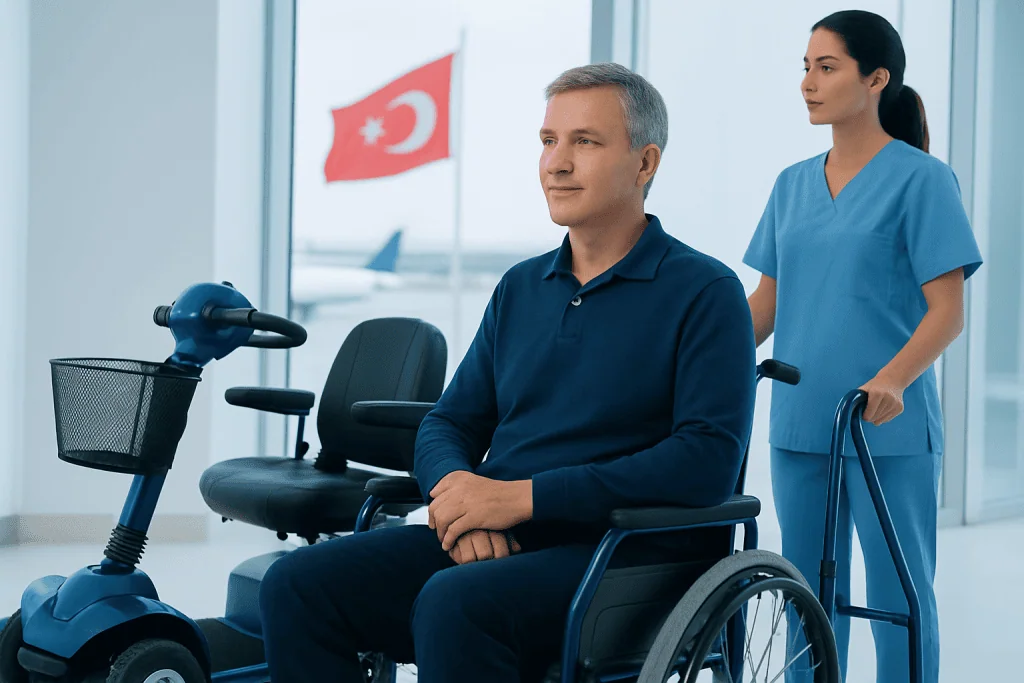
Mobility equipment is carried by airlines as assistive equipment, usually in addition to your normal baggage allowance, but the handling process differs by device. Contact your airline as soon as you book and ask them to add mobility assistance to your reservation. Tell them exactly what you are bringing: manual or powered, foldable or rigid, dimensions, weight, and, for powered devices, the battery type and watt-hour rating.
Manual wheelchairs and walkers
Ask whether you can keep your own chair to the aircraft door and transfer to an airport chair there, or whether you will be asked to transfer at check-in. Most travellers prefer to stay in their own chair as long as possible, and airlines can usually accommodate this if it is noted on the booking. Walkers are often taken at the gate and either stored in the cabin, if small enough, or loaded last and returned first. Confirm which applies before travel day rather than negotiating it at the gate.
Powered chairs and scooters
Powered equipment attracts extra rules because of the batteries. Airlines apply limits and handling requirements that vary by battery chemistry, lithium batteries in particular may need to be removed, have terminals protected, or travel in the cabin depending on the airline’s policy. Ask for the airline’s written battery requirements when you book, and carry the battery specification sheet or a photo of the battery label with you. If the airline needs the device keyed off, freewheeled, or the joystick protected, find out how before you reach the check-in desk.
Before you hand anything over
Label your equipment with your name, phone number, destination, and a short handling notefolds here, remove cushion before loading, do not lift by armrests. Photograph the equipment from several angles at the airport, so its pre-flight condition is documented. Keep removable cushions, footrests, joystick covers, chargers, tools, and fragile accessories in the cabin with you if the airline permits it. If anything is delayed or arrives needing reassembly, having the small parts and the photos in your hand luggage makes the situation far easier to manage.
- Reconfirm assistance with the airline 48–72 hours before departure.
- Arrive at the airport earlier than usual, especially with powered equipment.
- Keep medication, medical documents, and essential comfort items in hand luggage.
What to expect at the airport when arriving in Turkey
Major Turkish airports, Istanbul Airport, Sabiha Gökçen, and the large regional airports, provide wheelchair assistance for passengers who have requested it in advance through their airline. On arrival, assistance staff typically meet the aircraft and accompany you through disembarkation, passport control, baggage claim, and out to your driver or meeting point. The exact route and timing depend on the airport, the hour, and whether your aircraft parks at a gate or a remote stand requiring a bus or lift vehicle.
Two honest points worth knowing. First, international terminals in Turkey involve genuinely long walking distances, arriving in Turkey with mobility equipment often means corridors measured in hundreds of metres before you reach passport control. Request assistance even if you can manage some walking; treat it as energy management after a long flight, not an admission of anything. You can decline parts of the service on the day, but you cannot conjure it up at short notice. Second, at busy periods there can be a wait for assistance staff after landing. Building slack into your onward schedule, a transfer that is not booked to the minute, removes the stress from this entirely.
If you are travelling for treatment, a clear meeting plan after customs matters more than almost anything else: a named pickup point, a driver holding a sign, or a direct phone number. Save every key contact offline before you fly, because mobile data does not always work in the first minutes after landing. The practical details of requesting and using this support are covered in more depth in our guide to arranging airport wheelchair and mobility assistance in Turkey.
Transfers, taxis, and the journey to your hotel or hospital
The stretch between the arrivals hall and your accommodation is where planning most often breaks down. A standard Istanbul taxi is a saloon car: it may have limited boot space, a relatively high step, and no practical way to carry a rigid, non-folding wheelchair. Do not assume it will work. Instead, tell whoever is arranging your transfer exactly what the vehicle needs to do: carry a folded chair in the boot, accommodate a non-folding chair (give exact dimensions), offer low entry height, or provide a driver who will help with loading.
For most patients, a pre-arranged transfer is simply better than finding transport after arrival. It removes the language barrier at the kerb, guarantees the right vehicle type, and means someone is accountable for the plan. When booking, state whether you can transfer independently from chair to car seat, whether you need a ramp or lift vehicle, and whether a companion travels with you. Then think one step further: a vehicle that fits your chair but drops you fifty metres from a stepped hotel entrance has only solved half the journey. Plan door to door, not leg by leg. Our guide on airport, transfer, and hotel planning with limited mobility walks through this in detail.
Choosing accommodation that actually works
“Accessible” means different things to different hotels, so ask specific questions rather than trusting the label. Confirm: are there steps at the entrance? Is there a lift, and is it large enough for your chair? Are the room and bathroom doors wide enough, ask for centimetres, not reassurance? Does the bathroom have a walk-in shower, grab bars, a shower chair, and turning space? Recent photos answer these questions more reliably than a booking-site tick box.
Think about your whole daily routine, not just the room. A step-free room above a stepped breakfast area still costs you energy every morning. If you will visit a hospital repeatedly, a closer hotel with easier transfers may be worth more than a cheaper one across the city, conserving energy matters when you are managing appointments or early recovery. If you have non-standard needs, such as space for a larger chair, hoist considerations, or a companion’s bedding, raise them early so alternatives can be found before you travel rather than improvised after check-in. There is a fuller walkthrough in our hotel check-in guide for patients arriving in Turkey.
Renting equipment in Turkey instead of bringing your own
Some travellers prefer to rent a wheelchair, walker, or scooter locally rather than risk their own equipment in an aircraft hold. This is realistic in the larger Turkish cities, where medical supply firms and some hotels offer rentals. What a rental costs depends on the device type (a basic manual chair versus a powered scooter), the rental duration, whether delivery and collection are included, and whether a deposit is required, so the sensible approach is to request a written quote that itemises all of these before you commit, rather than comparing headline figures.
The trade-off is fit. A rented chair will not be configured to your posture, cushioning, or pressure-relief needs, which matters more the longer you use it each day. Renting works best as a supplement, a scooter for sightseeing distances, a spare chair while yours is repaired, rather than a replacement for well-fitted personal equipment. The options, questions to ask, and pitfalls are covered in our dedicated guide to renting a wheelchair, walker, or crutches in Turkey.
How accessible is Turkey, honestly?
A fair answer has two halves. Modern infrastructure: the major airports, newer hospitals, large shopping centres, metro systems in Istanbul and other big cities, and recently built hotels, is generally designed with step-free access, lifts, and accessible toilets. Airport assistance is established and routinely used. Within hospital campuses, wheelchairs, ramps, and lifts are standard.
Older urban fabric is harder. Historic districts have cobbles, steep gradients, high kerbs, and narrow or obstructed pavements. Smaller shops and older restaurants often have entrance steps. Dolmuş minibuses and older buses are largely impractical with a wheelchair. The practical conclusion for a patient journey: the airport-to-hotel-to-hospital corridor can be made genuinely smooth with planning, while spontaneous exploration of old neighbourhoods takes more effort and, ideally, a companion. Plan the essential routes tightly and treat everything beyond them as optional.
Hospital access, appointments, and pacing yourself
Before a first hospital visit, tell your coordinator what support you may need on site: a wheelchair from the entrance, help between departments, the easiest entrance to use, a quieter waiting area, or extra time for registration. Large hospital campuses involve long corridors and sometimes multiple buildings, and knowing the layout in advance makes the day markedly less tiring. Acibadem’s international patient services include interpreters and practical orientation inside the hospital, and coordinators can advise where equipment can be stored during tests and whether a companion should stay with you.
Pace yourself in the first days. Jet lag, heat, unfamiliar surfaces, and long periods of sitting all compound fatigue, and mobility that is manageable at home can feel harder after a long journey. Keep essentials within reach, medication, water, phone charger, transfer board if you use one, and any cushion that protects your posture or skin. If you are arriving ahead of a procedure, our guide to your first 48 hours in Turkey before surgery explains how those early days typically unfold.
Back-up planning: delays, damage, and changing needs
Even careful plans meet unpredictable travel. Flights are delayed, equipment reaches the belt late, and mobility can be worse after a long journey than expected. A small back-up plan costs little: spare medication in hand luggage, a written note of your equipment make and model, copies of prescriptions, and offline contact details for your airline, hotel, transfer provider, and hospital coordinator.
If your wheelchair or walker is damaged in transit, report it to the airline before leaving the airport wherever possible: a report filed at the terminal carries more weight than one made later. Keep photos, baggage tags, and any written reference number. Then tell your hotel or hospital coordinator promptly, because temporary solutions, a loaned or rented chair, an adjusted transfer, are far easier to arrange when people know about the problem early.
Needs also change during a stay. You may arrive using a walker and need a wheelchair after a procedure, or find longer distances harder than expected. Say so promptly; transport, scheduling, and practical support can usually be adjusted. And before you book your return, note that flying home can involve its own arrangements, fitness-to-fly considerations, seating, and assistance, covered in our guide to flying home with a cast, brace, or limited mobility after treatment.
Step by step
- Book your flight and request mobility assistance at the same time. Be specific: wheelchair, walker, powered chair, or scooter; how far you can walk; whether you can transfer independently.
- Send the same written summary to everyone involved. Airline, transfer provider, hotel, hospital coordinator. Include dimensions, folding details, battery specifications, and any help you need at boarding, arrival, or vehicle transfer.
- Prepare your equipment and hand luggage. Label the equipment, photograph it at the airport, and keep chargers, removable parts, medication, and documents with you.
- Confirm the pickup and the vehicle. Do not rely on a standard car unless you know it works for you. Confirm the meeting point, vehicle type, and that the driver understands your requirements.
- Check accommodation access in detail. Entrance steps, lift size, door widths, bathroom setup, and the route from drop-off to reception. Request recent photos rather than guessing.
- Plan the first hospital visit before arrival. Easiest entrance, on-site wheelchair availability, interpreter needs, and how much walking or waiting the day will involve.
- Keep a back-up plan. Contacts saved offline, copies of key documents, and a habit of reporting problems, delays, damage, changed needs, early rather than working around them alone.
Your checklist
- Request airline mobility assistance when you book
- Reconfirm assistance 48–72 hours before departure
- Carry a medical note, equipment details, and battery specifications
- Photograph your wheelchair or walker before check-in
- Pack chargers, spare parts, and removable accessories safely
- Pre-book a transfer vehicle that fits your equipment
- Verify hotel entrance, lift, door widths, and bathroom access
- Save hospital, driver, hotel, and airline contacts offline
- Keep medications and essential items in hand luggage
- Report any transit damage before leaving the airport
Key takeaways
- Arrange mobility assistance at booking and reconfirm it 48–72 hours before flying.
- Give exact equipment details, dimensions, weight, battery type, rather than general descriptions.
- Pre-book suitable transport instead of assuming a standard taxi will work.
- Ask hotels detailed access questions, especially about bathrooms and step-free routes.
- Keep fragile parts, chargers, medication, and documents in hand luggage, and photograph equipment before check-in.
- Report damage or changed needs early; adjustments are far easier when people know in time.
Frequently asked questions
Can I bring my wheelchair or walker on the plane to Turkey?
Yes, in almost all cases. Mobility equipment is carried as assistive equipment, usually in addition to your baggage allowance. Walkers are often taken at the aircraft door; manual wheelchairs are typically checked at the gate; powered chairs and scooters have additional battery and handling rules that vary by airline. Confirm the specific process with your airline when you book.
What is not allowed to bring into Turkey?
Mobility equipment itself poses no customs problem. The areas that need care are medications, some substances that are routine at home are controlled in Turkey, so travel with original packaging, your prescription, and a doctor’s letter, and check current Turkish customs guidance before flying, plus standard restrictions on items such as weapons and certain foodstuffs. When in doubt, check official Turkish customs information for your specific items before travel.
Is Turkey disabled friendly?
Modern infrastructure, major airports, newer hospitals, metro systems, shopping centres, and recently built hotels, is generally accessible, and airport assistance is well established. Older districts are harder: cobbles, steep streets, high kerbs, and stepped entrances are common, and older public transport is largely impractical with a wheelchair. A planned airport–hotel–hospital route can be made very smooth; spontaneous exploration takes more effort.
How much does it cost to hire a mobility scooter in Turkey?
There is no single figure, because rental pricing depends on the device type, rental duration, whether delivery and collection are included, and whether a deposit is required. Rental firms operate in the larger cities and some hotels can arrange equipment. Ask for a written quote that itemises all of these elements before committing, so you are comparing complete offers rather than headline rates.
Do tourists get free healthcare in Turkey?
No. Turkey’s public health insurance covers residents enrolled in the national system, not visitors. Tourists and international patients pay for care privately or through insurance, which is why comprehensive travel or medical insurance documentation is worth carrying throughout your stay. Planned treatment is arranged and quoted in advance through the treating hospital.
Should I request airport assistance even if I can walk short distances?
Yes, on international routes it is usually sensible. Turkish international terminals involve long corridors and queues, and travel days are tiring even for people whose mobility is normally good. Assistance requested in advance can be partially used or declined on the day; assistance not requested cannot be produced at short notice.
Will a normal taxi in Istanbul be suitable for my wheelchair or walker?
Often not. Standard taxis are saloon cars with limited boot space, a relatively high step, and no way to carry a rigid, non-folding chair. If you need extra space, low entry, a ramp, or help with loading, arrange a suitable transfer vehicle in advance and give exact equipment dimensions when booking.
What if my wheelchair is damaged during the flight?
Report it to the airline immediately, ideally before leaving the airport, and keep photos, baggage tags, and any written report or reference number. Then inform your hotel or hospital coordinator so they understand the practical impact. Temporary solutions, a loaned or rented chair, adjusted transfers, are much easier to arrange when the problem is flagged early.
Add us as a Preferred Source to see more of our trusted health content across Google Search, AI Overviews and Discover.

Update history
- PublishedAugust 6, 2026
- Medical review approvedSeptember 1, 2026
- Last content updateSeptember 1, 2026
References2
More Patient Guides

GHIC and EHIC in Turkey: Why They Do Not Cover You
The blue card that quietly covers you across Europe stops working at the Turkish border, and every summer, travelers discover this…

Do You Need Vaccinations for Turkey?
Here is the answer travel clinics give every day: no vaccinations are required to enter Turkey from anywhere in the normal course…

Flying With a Broken Leg or Cast: Airline Rules and Comfort
A broken leg does not cancel a flight, airlines carry passengers in casts every single day. What surprises travelers is that…

Travel Insurance After Cancer: What Patients Should Know
A cancer diagnosis changes how insurers read your name, but it does not end your traveling life. Thousands of people with…