

Bariatric Accessibility Planning for Treatment in Turkey

Bariatric accessibility planning for treatment in Turkey means arranging flights, transfers, accommodation and hospital details around your actual mobility, size and comfort needs before you travel. Start four to eight weeks ahead where possible, put your mobility needs in writing alongside your medical records, confirm airline assistance directly with the carrier, and hold off on non-refundable bookings until your treating team confirms timing.
Worried about how far you will have to walk through the airport, whether the aircraft seat will be workable, or what the hospital bathroom will be like? Those are the right questions to ask now, not after you land.
Bariatric treatment abroad goes more smoothly when your mobility, comfort, privacy and support needs are worked out before you travel, not improvised on arrival. This guide walks through bariatric accessibility planning for treatment in Turkey in practical order: the information worth preparing, airline and airport assistance, ground transfers and hotels, what to think about inside the hospital, and how to plan a safe journey home. It sits alongside our general step-by-step planning guide for medical travel to Turkey, which covers the broader process from first enquiry to follow-up.
At a glance
- Best time to plan: Start 4-8 weeks before travel where possible; airlines and hotels respond better to early requests
- Key support areas: Flights and seating, airport assistance, transfers, hotel layout, hospital room setup, companion role
- Helpful documents: Medical summary, medication list, a written mobility profile, equipment details, passport information
- Who to involve: Your treating specialist, the international patient team, the airline, your hotel, your companion
- Important reminder: Do not book non-refundable travel until your care team confirms treatment timing
Start with your access needs, not just your treatment date
Bariatric accessibility planning for treatment in Turkey begins with an honest, practical account of what makes travel and hospital stays easier for you. That may include walking distance, wheelchair use, seat width, breathing support during sleep, privacy preferences, bathroom setup, how you prefer to get in and out of vehicles, or how much help you expect to need after anaesthesia. None of this is an inconvenience to raise. It is exactly the information a hospital and its bariatric and metabolic surgery unit use to prepare properly.
Concrete descriptions work better than general ones. “I can walk about 100 metres before I need to rest” is more useful than “I struggle with walking”. Useful details include whether you can walk the length of an airport terminal, climb steps into a minibus, lie flat comfortably, use a standard bathroom, or stand through security screening. If you use a cane, walker, wheelchair, CPAP device or other equipment, note the model or dimensions where relevant: a folding wheelchair and a powered one create very different transport requirements.
It also helps to write down what has been difficult on previous trips or hospital visits. Long queues, narrow seating, low beds, hot environments, unclear instructions or a lack of privacy all add strain that good planning can reduce. The more specific your notes, the more accurately airport assistance, hospital access, interpreter support and accommodation can be aligned with your real needs rather than an assumed average.
Preparing your medical and mobility information
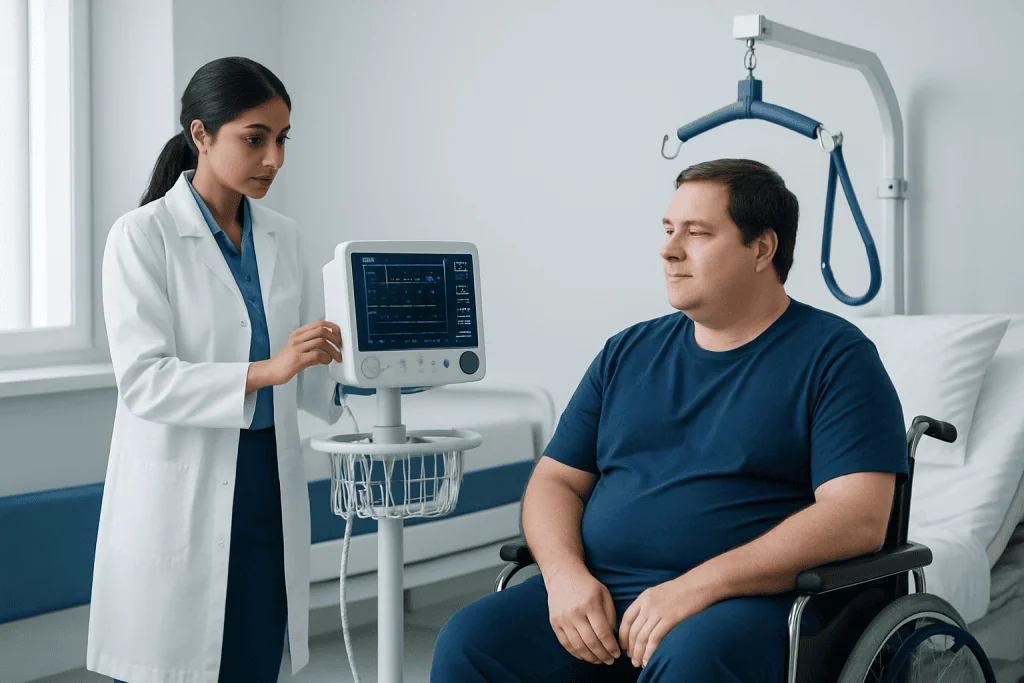
Before travel arrangements are finalised, a treating team needs enough information to assess whether travel is appropriate for you and what precautions may be sensible. That review usually draws on recent medical records, current medications, allergies, previous surgeries, weight and height, relevant test results, and any known heart, lung, diabetes or sleep-related conditions. The records do not need to be perfectly organised, but legible copies with dates make the review faster and reduce back-and-forth. If you live with diabetes, flag it clearly in your records: it adds extra preparation your treating team will want to plan for.
Alongside the medical documents, prepare a short mobility profile, half a page is usually enough. Cover how far you can walk without stopping, whether you need help standing up, whether a standard car seat belt fits, and whether you become breathless walking, lying flat or climbing stairs. If you have sensitive skin, a pressure sore risk or difficulty sleeping flat, include that too. Questions about anaesthesia fitness, fasting and medication timing belong to your treating doctor; your job at this stage is simply to give them accurate raw material.
A practical mobility profile can include:
- Your usual mobility aids and equipment, with sizes or models where relevant
- Your preferred way to transfer from bed to chair or into a vehicle
- Any previous problems with anaesthesia, flying or long car journeys
- Dietary requirements and your usual medication schedule
- Emergency contact details and your companion’s information
Keep one paper copy and one digital copy. Documents in your hand luggage survive lost checked bags; documents on your phone survive lost paper.
Flight and airport assistance for bariatric travellers
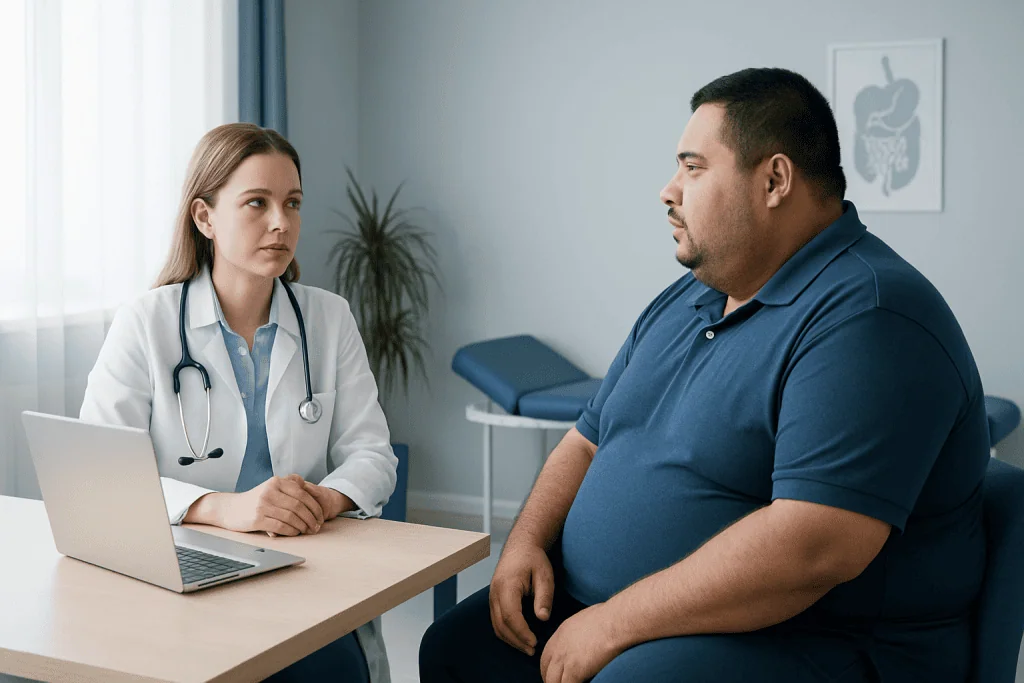
Airports involve long walking distances, standing queues, security checks and boarding procedures that can be genuinely tiring. If mobility is limited, request wheelchair or buggy assistance from the airline when you book, not on the day. Airlines need advance notice, and many will ask specific questions: can you walk to your seat, can you manage aircraft stairs, can you move independently in the cabin. Answer accurately: the assistance you receive is built from those answers. Our guide to flying to Turkey with limited mobility goes deeper into airport assistance codes and how transfers connect to it.
Seat comfort deserves direct questions to the carrier. Ask about seat width between armrests, whether armrests lift, seat belt extender policy, and the airline’s rules for passengers who may need additional space or a second seat. These policies vary widely between airlines and even between routes, and they change, so confirm in writing with the specific carrier and keep the confirmation with your travel documents. A rule that applied on your outbound airline may not apply on a different carrier home.
Long flights raise practical questions about movement, hydration, compression wear and medication timing across time zones. These are individual matters, and the right approach depends on your health: they belong in your pre-travel discussion with your treating doctor rather than in a general guide. What a guide can tell you is this: plan your arrival around realistic energy levels. After an overnight flight you may be tired, swollen and uncomfortable, and that is a poor moment to negotiate transport in an unfamiliar terminal. Arrival logistics arranged in advance: a named driver, an agreed meeting point, a vehicle you already know you can get into, remove most of that friction. If you are travelling with a companion, agree beforehand who handles luggage, documents and communication at each step so that neither of you improvises while exhausted.
Accessible transfers, hotels and daily movement in Turkey
Ground transport should be settled before you arrive, because the wrong vehicle is difficult to fix at the kerb. Depending on your mobility, you may need lower entry height, extra seat space, working air conditioning, room for mobility aids, or simply a driver who understands that you need time to get in and out safely. If you cannot climb into a standard car or a high-floor van, say so plainly before any transfer is booked. Our guide to the airport-to-hospital journey in Turkey covers how to sequence that first leg after a long flight.
Accommodation is the other half of daily movement. Useful questions for any hotel: Is there step-free entry? Is the lift large enough for a wheelchair or walker? What is the bed height and is the frame solid? How large is the bathroom, and is the shower walk-in or over a bath? Are there grab rails or a shower seat? How far is the hospital by car, and is the route hilly? Is room service available for days when going out is too much? A hotel that looks close on a map can still be hard work if it sits up a slope, behind steps, or at the end of a long corridor from the lift.
Many international patients stay near the hospital around admission, discharge and follow-up appointments, which shortens the most tiring journeys. Patient services teams can advise on practical accommodation and transport considerations, including companion arrangements and interpreter coordination, but confirm accessibility details directly with the hotel as well, room layouts vary within the same building, and the accessible room you were promised needs to be the room actually held for your dates. Ask for written confirmation and, where possible, photos. If your dates fall in high summer or around public holidays, availability tightens, so book the essentials earlier than you otherwise would.
Hospital arrival, room setup and dignity during your stay
A good hospital accessibility plan protects safety and dignity at the same time. International patient teams coordinate arrival, registration, interpreter support and movement between departments, and they do this best when they know your needs before admission day rather than discovering them during it. Practical details worth raising in advance include bed access and any transfer help you need, gown sizing, privacy during weighing, bathroom assistance, how call bells and nursing support work, and whether specific equipment, a wider chair, a suitable bed, transfer aids, should be ready in your room.
If you will need help transferring, bathing, dressing or walking after treatment, this belongs in the pre-admission conversation. Hospitals plan far better from a known baseline. The same conversation is the place to clarify your companion’s role: whether they can stay with you, what they may help with, and what remains the nursing team’s responsibility. Clear boundaries protect everyone, including the companion, who will also need rest.
Interpreters and understanding your instructions
Interpreter support matters most when the subject is pain, nausea, mobility, breathing, wound care or discharge instructions, moments when a misunderstanding has consequences. Even if you speak some English or Turkish, medical conversations under stress are harder than everyday ones. Ask for clarification whenever anything is unclear, and repeat key instructions back in your own words so the team can confirm you understood. Writing instructions down, or asking for them in writing, gives you something to check later when the details blur.
Equipment that travels with you
If you use a CPAP machine, keep it in hand luggage with the appropriate plug adaptor, and mention it in your pre-admission information so its use during your stay can be planned. Mobility aids, special cushions and other daily equipment should stay accessible rather than packed deep in a case: you will want them in the vehicle, at the hotel and at the bedside, not at the bottom of checked baggage.
Planning discharge, recovery accommodation and return travel
Accessibility planning does not end at the hospital exit. After bariatric treatment you may have temporary limits on movement, diet, lifting and energy. A discharge plan typically covers follow-up appointments in Turkey, medications, diet stages, wound care, activity guidance and the question of when flying home may be considered: a timing decision that rests on your condition and your doctor’s assessment, not on the date printed on a ticket. Building flexibility into your return booking is cheaper than rebooking under pressure.
Think about where you will recover between discharge and the flight. A workable recovery base usually means a quiet room, easy bathroom access, space to walk short distances, simple food that fits your diet plan, and a companion or support arrangement for the first days. If longer or more structured recovery is expected, our guide to rehabilitation planning after treatment in Turkey covers how that phase is organised.
Before the flight home, reconfirm airline assistance and seating, set a generous transfer time to the airport, and check which documents you should carry: a medical report, a fit-to-fly note if the airline requires one, prescriptions and contact numbers, all in hand luggage. Follow-up can be coordinated from Turkey, but you should also have a doctor or specialist contact arranged in your home country for ongoing care. Flying with fresh restrictions is its own subject: our guide to returning home with new medical restrictions covers seating, lifting limits and the first days back.
Step by step
- Write down your mobility and comfort needs early. Describe how you move, what equipment you use, and what has been difficult on previous journeys or admissions. This written profile is what allows transfers, appointments, room setup and interpreter support to be planned around you rather than around an average.
- Have your medical records reviewed before committing. Recent reports, medication lists, test results and details of existing conditions let the treating team advise whether travel and timing are appropriate. Firm arrangements come after that review, not before.
- Coordinate airline assistance before booking flights. Ask the carrier about wheelchair assistance, seat dimensions, armrests, seat belt extenders and any policies on additional space. Keep written confirmation, and avoid non-refundable bookings until the hospital plan is settled.
- Choose accommodation on practicality, not star rating. Check lift access, bathroom layout, bed height, step-free routes and distance to the hospital. Ask for photos or written confirmation of the specific room’s features.
- Plan airport and hospital transfers around your body and equipment. Request a vehicle that suits your size, mobility aids and luggage, and build in extra time so nothing at check-in, security or admission is rushed.
- Define your companion’s role. Agree who carries documents, manages luggage, helps with communication and supports you after discharge. Your companion also needs their own accommodation, meals and rest planned, and should know the hospital’s visiting rules.
- Confirm discharge and return-flight timing with your doctor. Travel home when your treating team considers it appropriate, reconfirm airline assistance for the return leg, and carry discharge documents, prescriptions and contact numbers in your hand luggage.
Your checklist
- Passport, visa or entry documents, and travel insurance details
- Recent medical records, test results and medication list
- Written mobility profile: walking distance, transfer needs, equipment sizes
- Airline wheelchair assistance and seating confirmation in writing
- Accessible airport-to-hospital or airport-to-hotel transfer arranged in advance
- Hotel accessibility details confirmed in writing, with photos where possible
- CPAP device, plug adaptor, chargers, mobility aids and comfort items packed accessibly
- Companion contact details and agreed support responsibilities
- Discharge report, prescriptions and follow-up instructions for the journey home
- A home-country doctor or specialist contact arranged for ongoing care
Key takeaways
- Bariatric accessibility planning for treatment in Turkey starts before flights and hotels are booked, ideally 4-8 weeks ahead.
- A written mobility profile alongside your medical records is the single most useful document you can prepare.
- Airline assistance, seating policies, accessible transfers and hotel details all need direct, written confirmation in advance.
- Hospital planning should cover equipment, privacy, interpreter support and your companion’s role before admission day.
- Return travel follows your doctor’s assessment, with assistance reconfirmed and discharge documents in hand luggage.
Frequently asked questions
Can I travel to Turkey for bariatric treatment if I have reduced mobility?
Many people with reduced mobility travel for care when planning is careful and a medical review supports it. The treating team needs to understand your health status, mobility level and travel route before advising on timing, which is why firm travel bookings should wait until that review is complete.
Should the hospital know my weight and mobility limitations before I arrive?
Yes. This information shapes transfer arrangements, equipment, room setup and appointment flow. It is used for safety and dignity, not judgment, and knowing it in advance prevents avoidable discomfort on admission day.
What airport support should I request?
If long walking distances are difficult, request wheelchair or mobility assistance from your airline before travel. Ask about boarding support, seat belt extenders, seat dimensions and any policies on additional seating space, and confirm the answers directly with the airline in writing, because rules vary by carrier and route.
Do airlines require a second seat for larger passengers?
Policies differ between airlines and are not standardised. Some carriers have specific rules on seat belt extenders, armrests and additional seating; others assess case by case. The only reliable answer comes from the specific airline for the specific route, in writing, before you book.
Can Acibadem International help with transfers and interpreters?
Patient services teams help coordinate practical aspects such as airport transfers, interpreter support and appointment navigation when these are arranged in advance, and can advise on what to confirm with hotels and airlines. Some services depend on availability and on your individual treatment plan.
What should my companion prepare for?
A companion typically helps with luggage, documents, communication and daily support after discharge, and needs their own rest, meals, transport and accommodation planned. Before admission, it helps to clarify visiting rules and whether overnight companion arrangements are possible.
When can I fly home after bariatric treatment?
Return-flight timing depends on the procedure, your recovery, test results and your doctor’s assessment. A fixed date should not be relied on without medical confirmation, which is why flexible return bookings are worth the extra planning.
What if my hotel room is not accessible when I arrive?
Raise it with reception and your patient coordinator as soon as possible, especially where safety is affected. Written confirmation, photos and a backup option agreed before travel make this far easier to resolve. For essential needs, confirm twice: once when booking and again shortly before arrival.
Add us as a Preferred Source to see more of our trusted health content across Google Search, AI Overviews and Discover.

Update history
- PublishedJune 8, 2026
- Medical review approvedSeptember 13, 2026
- Last content updateSeptember 12, 2026
References2
- NHS: Weight loss surgery nhs.uk
- MedlinePlus: Weight Loss Surgery medlineplus.gov
More Patient Guides

Airport Wheelchair Assistance: How to Book It for a Medical Trip
Airport wheelchair assistance is free, it exists at every commercial airport, and airlines are legally required to provide it, yet half…

Travelling With a Stoma: Flights, Supplies and Airport Screening
Traveling to Turkey with a stoma is manageable with the right supplies, airport screening plan, and recovery support in Istanbul or Turkey.
Mobility Aids in Turkey: Renting a Wheelchair, Walker, or Crutches
Mobility aids in Turkey can be rented through medical suppliers, pharmacies, and hospital-linked services in Istanbul and other cities.

Traveling to Turkey with Food Allergies or Special Diet Needs
Traveling to Turkey with food allergies or special diet needs is manageable with planning, translated allergy cards, and hotel and hospital support…