

Bringing Pathology Slides and Tissue Blocks to Turkey for Review

Ask the laboratory that made your diagnosis for the original pathology report, the stained slides and, where release is permitted, the paraffin tissue blocks, together with a written inventory. Hand-carry them in rigid protective packaging in your cabin bag, away from heat and pressure, with a short medical letter. In Turkey, the receiving pathology team registers the materials, reviews them and, where tissue allows, requests further tests.
You have your pathology report in hand, and a team in Turkey has asked for the slides as well. What exactly do you request? Who releases it? And can you really put fragile glass and wax blocks in your hand luggage? Yes, and this guide explains how to do it without losing time or damaging the materials.
If your diagnosis or treatment plan rests on a pathology result, bringing pathology slides and tissue blocks to Turkey for review lets specialists examine the original evidence, not just a summary of it. This guide covers what to request from your home laboratory, what you are legally entitled to, how to pack and carry the materials, what airport staff may ask, and what happens after the package reaches the hospital.
At a glance
- Best for: Patients whose diagnosis or treatment plan in Turkey depends on a pathology result
- Main items: Original pathology report, stained slides, unstained slides, paraffin tissue blocks, inventory list
- Before travel: Request materials early, laboratories may need forms, approvals or loan agreements
- Transport: Hand-carry in rigid packaging in your cabin bag; protect from heat, pressure and breakage
- Good to know: Slides and blocks are usually part of your medical record; blocks are often released only on loan
Why bringing pathology slides and tissue blocks to Turkey for review matters
Pathology is often the foundation of a diagnosis. For many cancers and complex conditions, the treatment plan depends not only on imaging and blood tests but on what a pathologist saw under the microscope in tissue taken at biopsy or surgery. When you travel for a consultation or second opinion, the medical team may ask to see the original pathology materials so they can assess your case at first hand rather than relying entirely on another laboratory’s description.
Bringing pathology slides and tissue blocks to Turkey for review is different from bringing a paper report. A report summarises what another laboratory concluded. Slides let a pathologist examine the actual tissue sections again. Paraffin blocks go further: because they contain remaining embedded tissue, they can, where enough tissue exists, support additional stains, immunohistochemistry or molecular tests that were not done originally. This matters most when a diagnosis is rare, when results are ambiguous, or when the planned treatment involves surgery, oncology, radiotherapy or targeted therapy where the exact tumour subtype changes the approach.
At Acibadem, a review of physical pathology materials is handled by the pathology department and considered alongside imaging, operation notes and laboratory results, not in isolation. If you are travelling specifically for this purpose, it helps to understand what happens before treatment is confirmed, because the pathology review is usually one step in a longer assessment, not a same-day formality.
Are pathology slides part of your medical records?
In most countries, yes. Slides, tissue blocks and the associated reports are generally treated as part of your medical record, held in the archive of the laboratory that processed the specimen. That has two practical consequences. First, you or your treating doctor can normally request access to the materials for review elsewhere: this is a routine, recognised request, not an unusual favour. Second, the laboratory usually retains legal responsibility for the archive, which is why many institutions release slides and especially blocks only on loan, with a stated return date.
The exact rules differ by country and by institution. Some laboratories release original stained slides freely and keep the blocks. Others prepare duplicate or unstained slides instead of releasing anything original. A few require a signed release form, proof of identity, or a formal request from the receiving hospital. None of this should discourage you; it simply means the request takes longer than photocopying a report, so start early, several weeks before travel where possible.
What to request from your hospital or laboratory
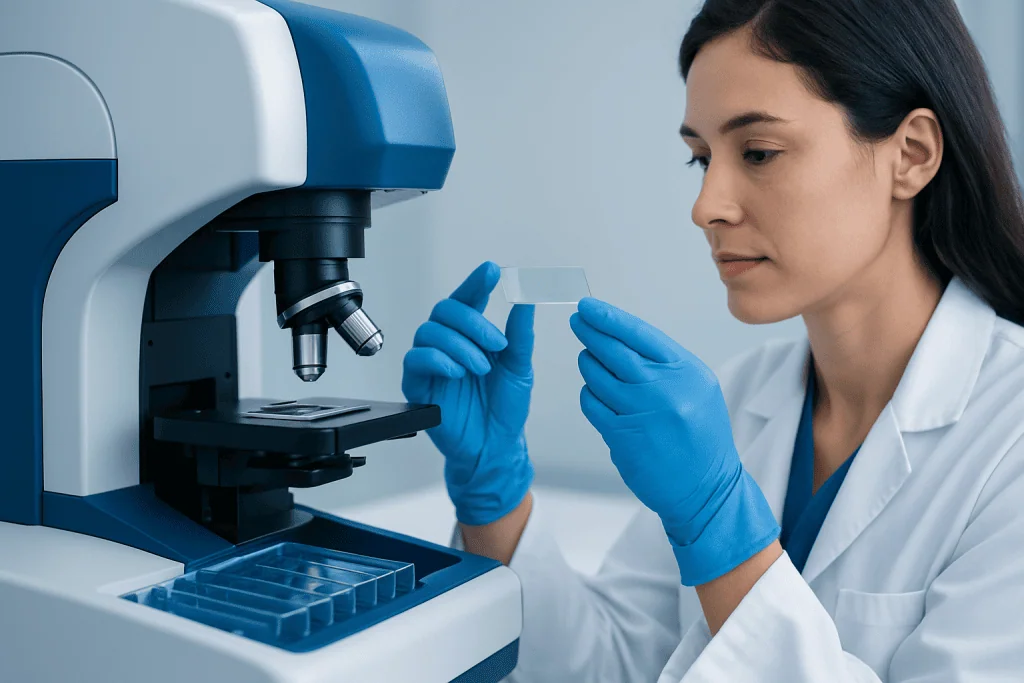
Contact the hospital, pathology laboratory or clinic where your biopsy or surgery was performed and use precise wording: you are requesting your pathology slides and, if available, paraffin tissue blocks for review by another medical institution. Vague requests for “my results” often produce only the written report, which you probably already have.
The most useful package usually contains:
- The original pathology report and any amended or supplementary reports
- All stained glass slides used for the diagnosis
- Unstained slides, if the laboratory can prepare them
- Paraffin tissue blocks, where release is permitted
- Immunohistochemistry, molecular or genetic test reports, if already performed
- An inventory list stating case numbers, block numbers, dates and tissue sites
If the laboratory will not release blocks, ask whether it can cut extra unstained slides instead. Unstained slides preserve the option of some additional testing at the reviewing hospital, though they are more limited than a block. Whatever is released, ask for the inventory in writing and check that it matches the physical labels before you leave the building. If the materials are a loan, get the return conditions and deadline in writing too.
While you are gathering pathology materials, it is worth assembling the rest of your file the same way, imaging, operation notes, treatment summaries. Our guide on organising your medical records for a faster review covers that side in detail.
How long are slides and tissue blocks kept?
Retention periods vary by country, by regulator and by laboratory policy, but pathology archives are built to last. In many health systems, stained slides and paraffin blocks are kept for around ten years, and some laboratories keep them considerably longer, sometimes decades for cancer diagnoses. Reports are usually retained longer still.
The practical point for you: even if your biopsy was years ago, the materials very likely still exist and can still be requested. Paraffin-embedded tissue remains usable for microscopy and many modern tests long after processing, which is precisely why laboratories archive it. If your original laboratory has closed or merged, its archive has usually been transferred to a successor institution; the hospital that treated you can normally say where.
Keeping labels, reports and identity details consistent
Small mismatches cause real delays. Before you travel, compare the patient name, date of birth, pathology accession number and biopsy date across every document and every physical label. Check them against your passport too: if your name is transliterated differently in another alphabet, ask the releasing laboratory to note both versions on the paperwork.
Every slide and block carries a label, typically a case number, block number, stain type or tissue site, that links it to the report. Do not remove, rewrite, cover or “tidy” these labels, however cryptic they look. If a label seems unclear or does not match the inventory, ask the original laboratory to explain it in writing. A note from the source laboratory resolves a discrepancy; a hand-corrected label creates one.
If your reports are not in English or Turkish, arrange translation of the key documents before your appointment, and keep the originals alongside the translations: the reviewing team may need to compare the two. Consistent, well-ordered paperwork is also what makes the wider assessment run smoothly; you can read how records feed into a treatment plan in our guide to how medical records are reviewed before a treatment plan is given.
How to store slides and preserve blocks during travel
Glass slides break; paraffin softens. Both risks are easy to manage with ordinary care.
Slides. Keep them in a proper slide box, the hinged plastic or cardboard cases laboratories use, so each slide sits in its own slot and cannot slide against its neighbours. Place the box inside a rigid outer container with light padding. Store and carry them flat where possible, dry, and at room temperature. Slides need no refrigeration and no special atmosphere; the enemies are impact, pressure and moisture.
Blocks. Paraffin blocks are stable at room temperature but are, literally, wax. Sustained heat deforms them and can compromise the tissue. Keep blocks in their labelled containers or protective wrapping, away from radiators, direct sunlight, car dashboards and anything else that gets hot. They do not need to be chilled: a normal cabin environment is fine. If the laboratory offers its own transport packaging, use it; it exists for exactly this journey.
Hand-carry whenever you can. Checked luggage is subject to rough handling, temperature extremes in the hold, and the small but real risk of loss, and unlike clothing, diagnostic tissue cannot be replaced by the airline. Keep the container in your cabin bag, away from liquids and heavy items, and resist the urge to open it during the trip. Bringing pathology slides and tissue blocks to Turkey for review is, at its core, a packing problem: rigid, dry, cool, cushioned, and never out of your sight.
Customs, airline and airport security
Prepared slides and paraffin blocks are fixed, stable diagnostic materials: they are not infectious specimens and do not need cold-chain handling. Even so, rules on moving medical materials across borders vary by country and airline, so confirm any export requirements with the releasing laboratory, which often has experience preparing documents for international transfer, and check your airline’s guidance if you are unsure.
Carry the materials together with your medical documents rather than buried among personal items. If security staff ask, explain plainly that these are pathology slides and tissue blocks for hospital review, and show your medical letter, the inventory list and your appointment confirmation. A one-page letter from your doctor or the laboratory stating what the package contains and why answers most questions before they are asked. Avoid describing the contents loosely as “biological samples” without context, precise wording prevents confusion.
The container will go through the X-ray scanner like any other cabin item; this does not harm slides or blocks. If a manual inspection is requested, ask that the slides stay in their box and are handled gently, and point to the labels rather than letting anyone unwrap individual items.
Shipping instead of carrying
If you cannot hand-carry the materials, or the laboratory prefers to send them institution-to-institution, use a courier experienced with diagnostic specimens or a dedicated medical courier. Shipping typically involves customs declarations, tracked delivery and specific packaging standards, and it removes the materials from your direct control, so it needs more lead time than hand-carrying.
Before anything is dispatched, confirm the exact receiving address, the named contact person or department, and the hospital’s acceptance process, and share the tracking number with the receiving side. Packages addressed generically to a large hospital can sit unclaimed; packages addressed to a confirmed recipient do not. Laboratory-to-laboratory shipment has one advantage worth weighing: some institutions that refuse to hand blocks to a patient will release them directly to another hospital.
What happens after the materials arrive
On arrival at the hospital, the materials are registered, checked against the inventory, and matched to your medical file, which is one more reason the labels and identity details must agree. The pathology team then examines the slides, compares its findings with the original report, and discusses the case with your treating specialists. Where the question requires it and enough tissue exists, the team may recommend additional stains or molecular tests; whether that is possible depends on the amount and quality of tissue in the blocks or unstained slides.
Review takes time, particularly if new tests are needed or materials from more than one biopsy are involved, so do not schedule major decisions tightly around your arrival day. In complex cases, the pathology findings are discussed together with radiology, surgery and oncology input: our guide to how multidisciplinary case review works explains that process, and biopsy and pathology results in Turkey describes how findings are reported to patients.
Hand the materials over through the channel agreed in advance, a named department, coordinator or contact person, rather than leaving them at a general desk, and ask that the number of slides and blocks received is recorded at handover. That receipt protects you if the original laboratory later asks for its loan back.
Returning materials and keeping records
Many pathology departments release slides or blocks only on loan. Before leaving your home country, confirm whether the materials must be returned and by what date, and keep the loan agreement, receipt and inventory together. When the review in Turkey is complete, clarify how the return will happen: courier from the hospital, or hand-carried back by you.
Keep copies of the final pathology review, any additional test results and the consultation notes. If you continue treatment in Turkey, these join your hospital file; if you return home for ongoing care, they let your local doctor see exactly what was reviewed and whether the diagnosis or recommendation changed. Ask for digital copies of the key reports where possible, and confirm in writing whether any originals are being held, returned or archived. Well-kept records also make later follow-up and remote check-ins after you return home considerably simpler.
Step by step
- Confirm what the receiving team needs. Before requesting anything, find out which materials the reviewing hospital expects, slides only, blocks, unstained sections, and whether translations or additional records should be prepared at the same time. Requesting once, correctly, is faster than requesting twice.
- Request slides, blocks and reports from the original laboratory. Ask for the stained slides, paraffin blocks if release is permitted, the full report and a written inventory. If blocks cannot be released, ask for extra unstained slides instead.
- Check every label and document. Compare names, dates of birth, case numbers and sample dates across slides, blocks, reports and your passport. Ask the original laboratory to correct or explain any mismatch in writing before you travel.
- Pack for hand-carrying. Slides in a slide box, blocks in their labelled containers, everything inside a rigid protective case in your cabin bag, away from liquids, pressure points and heat.
- Carry supporting paperwork. A doctor or laboratory letter explaining the contents, the inventory list, your appointment confirmation, and digital copies of everything on your phone or secure cloud storage.
- Hand over through the agreed channel. Deliver the materials to the named department or contact person, not a general desk, and ask for the count of slides and blocks to be recorded at receipt.
- Allow time for the review. Registration, examination, possible extra testing and specialist discussion take days, not hours. Build slack into your travel plan rather than booking decisions against your arrival date.
- Settle the return before you leave. Confirm whether and how loaned materials go back to the original laboratory, and take copies of every new report home with you.
Your checklist
- Full original pathology report and any amended versions
- Glass slides in a protective slide box
- Paraffin tissue blocks, if the laboratory allows release
- Unstained slides if blocks are unavailable or extra tests may be needed
- Inventory list showing slide numbers, block numbers and tissue sites
- Doctor or laboratory letter for travel and airport questions
- Passport copy and consistent patient identity details
- Translated reports if originals are not in English or Turkish
- Digital copies of reports, imaging summaries and previous treatment notes
- Written return instructions if materials are on loan
Key takeaways
- Slides and blocks let a pathologist re-examine the actual tissue, which a report alone cannot do.
- Pathology materials are generally part of your medical record and can be requested, but often only on loan, so start early.
- Hand-carry in rigid packaging at room temperature; heat deforms wax blocks and rough handling breaks glass.
- Matching labels, reports and identity details is what gets materials registered without delay.
- Confirm the receiving channel, keep the handover receipt, and settle the return arrangement before flying home.
Frequently asked questions
Are pathology slides considered medical records?
In most countries, yes. Slides, blocks and reports are treated as part of your medical record, held in the archive of the laboratory that processed the tissue. You can normally request access to them for review elsewhere, though the laboratory usually keeps legal responsibility for the archive and may release originals only on loan.
How long are pathology slides and tissue blocks kept?
It varies by country and laboratory, but archives commonly hold slides and blocks for around ten years, and many keep them far longer, particularly for cancer diagnoses. Even if your biopsy was years ago, the materials very likely still exist and can still be requested from the original laboratory or its successor.
How do I preserve biopsy blocks while travelling?
Paraffin blocks are stable at room temperature and need no refrigeration. The main risk is heat: sustained warmth softens the wax and can damage the tissue, so keep blocks away from direct sunlight, car interiors, radiators and heaters. Carry them in their labelled containers inside a rigid case in your cabin bag.
How should biopsy slides be stored and carried?
Keep each slide in a slotted slide box so the glass cannot knock together, place the box in a rigid padded container, and keep it dry and at room temperature, ideally flat. Slides need no special atmosphere or cooling; the hazards are impact, pressure and moisture. Airport X-ray scanners do not harm them.
Can I bring pathology materials in my hand luggage?
Hand-carrying is usually the safest option because it avoids the temperature swings, rough handling and loss risk of checked baggage. Keep the materials in protective packaging with a medical letter and inventory list, and check your airline’s guidance and any export rules with the releasing laboratory before you fly.
What is the difference between slides and tissue blocks?
Slides are thin, stained sections of tissue mounted on glass for microscopic examination. Blocks are the paraffin wax blocks holding the remaining embedded tissue from your biopsy or surgery. Blocks are more versatile because new sections, stains or molecular tests can sometimes be prepared from them, provided enough tissue remains.
What if my hospital refuses to release the tissue block?
This is common, blocks are often considered the legal archive of the original laboratory. Ask whether extra unstained slides can be cut instead, which preserves some testing options, or whether the laboratory will ship the block directly to the receiving hospital. Institution-to-institution transfer is sometimes approved where patient hand-carrying is not.
Will my slides and blocks be returned after review?
If the original laboratory released them on loan, they usually must go back by a stated date. Get the return policy in writing before travel, confirm the return arrangement before leaving Turkey, and keep copies of all new review reports even after the physical materials are sent back.
Add us as a Preferred Source to see more of our trusted health content across Google Search, AI Overviews and Discover.

Update history
- PublishedJune 22, 2026
- Medical review approvedAugust 31, 2026
- Last content updateAugust 31, 2026
References3
- Pathology Reports: National Cancer Institute cancer.gov
- Biopsy: MedlinePlus medlineplus.gov
- Biopsy: NHS nhs.uk
More Patient Guides

HoLEP in Turkey: How It Compares With TURP and What Recovery Involves
HoLEP in Turkey treats enlarged prostate tissue with laser enucleation; learn how it compares with TURP, recovery, travel and follow-up.

Porcelain Veneers in Turkey: Who Is Suitable and How Many Visits Are Needed?
Porcelain veneers in Turkey can enhance tooth shape and colour in two visits for suitable patients after a personalised dental assessment.

How to Prepare for a Sedation Procedure in Turkey
Prepare safely for a sedation procedure in Turkey with guidance on fasting, medicines, travel, recovery and follow-up.
Treatment Delays in Turkey: What Happens If Tests or Recovery Change Your Schedule
Treatment delays in Turkey can happen if tests or recovery change your plan. Learn how to manage appointments, travel, accommodation and follow-up.