

Choosing Between Inpatient and Outpatient Care in Turkey

Inpatient care means you are formally admitted and stay at least one night; outpatient care means you return to your accommodation the same day. Your specialist decides which is safer based on the procedure, anaesthesia, your medical history and the support you will have afterwards, not on travel convenience. Either way, plan flexible flights and allow time in Turkey for assessment and follow-up.
Will you sleep at the hospital, or head back to your hotel the same evening? That single detail shapes almost everything about your trip: what you pack, whether someone should travel with you, how long you book your accommodation for, and when you can realistically fly home.
Choosing between inpatient and outpatient care in Turkey is not really a choice you make alone. Your specialist recommends the setting based on safety, and your job is to understand that recommendation, plan around it, and ask the right questions before you book anything. This guide explains how the decision is made, what each setting means for your days in Turkey, and where the plan can honestly change.
At a glance
- Inpatient care: formal admission with at least one night in hospital, usual for larger operations, general anaesthesia recovery, or close monitoring
- Outpatient care: consultation, tests, imaging or a procedure completed the same day, with recovery at your accommodation
- Who decides: your specialist, based on safety, not on travel convenience or preference alone
- What can change: an outpatient plan can become an admission after in-person assessment, and a stay can be extended for safety
- Travel reality: discharge is not the same as being fit to fly, plan for follow-up days in Turkey either way
What Inpatient and Outpatient Mean in Practical Terms
When you are planning treatment abroad, inpatient and outpatient are more than medical labels. They determine how many nights you spend where, whether a companion is needed, how follow-up is arranged, and when a doctor is likely to clear you for the flight home. Choosing between inpatient and outpatient care in Turkey starts with understanding what each setting actually involves.
Inpatient care means you are formally admitted to the hospital and stay at least one night. Your team uses that time to monitor pain control, mobility, bleeding risk, hydration, wound condition and other recovery markers before discharge. It is the usual setting after major surgery, complex procedures, or any treatment where close observation matters more than an early return to your hotel.
Outpatient care means you visit the hospital or clinic for a consultation, test, scan, treatment or procedure and return to your accommodation the same day. Some outpatient visits take an hour. Others involve fasting beforehand, sedation, several hours of observation afterwards, and a responsible adult to escort you back. Same-day does not mean effortless.
There is also a middle category worth knowing: day-case procedures, which are planned as same-day but carry a defined possibility of an overnight stay if recovery is slower than expected. If your plan sits in that grey zone, read our guide on choosing between inpatient and day-case treatment in Turkey.
How Doctors Decide What Is Safest for You
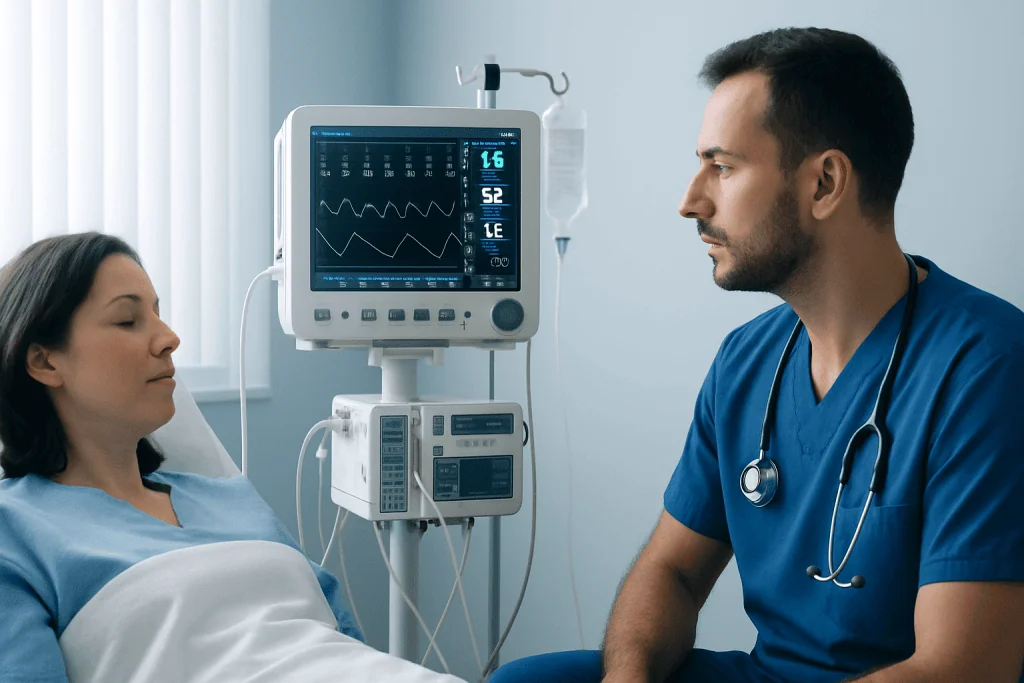
The care setting is a clinical decision, not a booking preference. Your specialist weighs your diagnosis, the planned treatment, your age, medical history, current medications, the type of anaesthesia needed, your mobility, the realistic risk of complications, and whether you have reliable support after leaving the hospital. A procedure that is routinely done as an outpatient for one person may need admission for another.
For international patients, the assessment goes further. Your team may ask how long your flight home is, whether you have heart or lung conditions, whether you take blood thinners, what previous surgery or anaesthesia you have had, and how easily you can attend follow-up visits before departure. Recovering in a hotel room in a foreign city is not the same as recovering at home with family nearby, and honest doctors factor that in.
At Acibadem, care plans are coordinated across medicine, nursing, anaesthesia, imaging, laboratory, rehabilitation and international patient services where needed. If your condition involves more than one specialty, see how multidisciplinary care is coordinatedthe setting decision often comes out of that joint discussion rather than a single opinion.
One honest limit: a firm decision usually requires in-person assessment. A recommendation based on records sent from abroad is a well-informed estimate, not a promise. Plan with that flexibility in mind.
When Inpatient Care Is Usually Recommended

Admission is typically recommended when treatment involves general anaesthesia, a larger operation, a meaningful risk of bleeding or infection, intensive pain management, or intravenous medication that cannot be given at a hotel. It is also appropriate when your team wants to observe your heart rhythm, breathing, wound healing, fluid balance, or your ability to walk safely before letting you go.
A hospital stay can matter for non-clinical reasons too. If you are travelling alone, managing several health conditions at once, or need input from more than one specialty during recovery, admission gives the team time to watch how you respond and adjust the plan before you continue recovering outside the hospital.
Ask what your expected length of stay is, then treat it as an estimate. A doctor may keep you an extra night if recovery is slower than hoped, if a test result needs review, or simply because discharge would be premature. That is a precaution, not a setback. For major operations, it is also worth asking in advance what safety checks support surgery and inpatient care at Acibadem, including what happens if you need closer monitoring than a standard ward provides.
When Outpatient Care Is Usually Suitable
Outpatient care suits many consultations, second opinions, blood tests, imaging, endoscopic evaluations, minor procedures, selected non-surgical treatments and follow-up checks. For international patients it can be efficient, because several appointments can sometimes be grouped into a short window rather than spread across weeks.
But same-day care carries its own rules. You may need to fast beforehand, avoid driving afterwards, rest at your accommodation, and return for a control visit before flying. If sedation or anaesthesia is used, confirm in advance whether a companion must escort you back, many units will not discharge a sedated patient alone.
Before you accept an outpatient plan, get two things in writing: which warning signs need urgent attention, and where you should go after hours. If you develop severe symptoms after a procedure, such as heavy bleeding, chest pain, difficulty breathing, sudden weakness or confusion, call your local emergency number or go to the nearest emergency department now. Do not wait for a callback from anyone, including your coordinator. In Turkey, the emergency number is 112.
For non-urgent questions, appointment times, interpreter arrangements, directions, your coordinator remains the right contact. Keep the two channels separate in your mind before you need either. It also helps to know in advance what happens if an outpatient visit turns into an unplanned overnight stay, so a change of plan does not catch you without a spare night’s accommodation or a changeable ticket.
Is One Setting Better Than the Other?
Neither setting is better in the abstract. Outpatient care means less disruption, no hospital nights and often a shorter total trip, when it is clinically appropriate. Inpatient care means observation, immediate access to your team, and structured pain and mobility support, when the treatment warrants it. The wrong choice in either direction creates problems: an unnecessary admission wastes your time, while an under-supervised same-day discharge can turn a manageable complication into an emergency in a hotel room.
So the honest answer to “is outpatient better than inpatient?” is: the better option is the one your specialist recommends for your specific procedure and your specific health. If you have a strong preference, say so: a good team will explain whether it can be accommodated safely, and why or why not.
What the Setting Changes About Your Quote
Competing pages will quote you day rates. Treat any figure published without an assessment with caution, because the setting is one of the main things a real quote depends on. An inpatient plan is priced around the number of nights, the room type, anaesthesia, theatre time, monitoring and medication given in hospital. An outpatient plan is priced around the consultation, tests and the procedure itself, with recovery costs shifting to your own accommodation.
When you receive a quote, ask three structural questions: what exactly is included, what would trigger a change (for example, an extra night or an added test), and how a change would be communicated and priced. A quote that separates confirmed items from estimates is more useful than a single rounded number, however attractive that number looks.
Planning Your Days in Turkey Around Your Care Type
The hospital portion is only one slice of your trip. Even a fully outpatient plan may need several days in Turkey: consultation, pre-treatment tests, the procedure, and at least one follow-up check. An inpatient plan adds the stay itself plus a hotel-based recovery period before a doctor clears you to fly. When you are choosing between inpatient and outpatient care in Turkey, you are really choosing between two different trip shapes, not just two kinds of appointment.
Ask your coordinator for a realistic timeline covering arrival, initial assessment, possible additional tests, admission or procedure day, discharge, follow-up and travel clearance. Then build slack into it. Booking a return flight tight against an expected discharge date is the single most common planning mistake international patients make, and it is entirely avoidable with a changeable ticket.
If your treatment naturally splits into stages, assessment on one visit, treatment on another, compare the options in our guide to one-trip and two-trip treatment plans in Turkey. International patient services can assist with airport transfers, hotel suggestions, interpreter scheduling and communication between departments; this help matters most when your plan involves several appointments across different days or when a companion needs practical guidance during your stay.
Can Foreigners Be Treated in Turkish Hospitals?
Yes. Foreign nationals can be treated in Turkey as private, self-paying or insured patients, and hospitals that receive international patients, Acibadem among them, run dedicated departments for exactly this: records review before travel, interpreter arrangements, scheduling and discharge documentation. You will need a valid passport, any visa your nationality requires, and ideally travel insurance; check whether your policy covers planned treatment abroad or only emergencies, because many cover only the latter.
Turkey’s healthcare system includes a large private hospital sector that treats significant numbers of international patients each year. As anywhere, quality varies between institutions, so judge the specific hospital and team handling your case: ask about their experience with your condition, how care is documented in a language you understand, and how follow-up works after you fly home. Generic country-level reputation, good or bad, tells you little about your own pathway.
Questions to Ask Before You Confirm Your Plan
Before you travel, request a plan, written or clearly explained, that separates confirmed details from estimates. You should know whether the recommendation is inpatient or outpatient, what could change it, and what follow-up is expected before you leave Turkey.
- Will I need anaesthesia or sedation, and of what type?
- How long will I be observed after treatment, and against what discharge criteria?
- Can I recover safely at a hotel, and what should the hotel have (lift, step-free access)?
- Do I need a companion, and at which stages?
- When am I likely to be cleared to fly, and who makes that call?
- Will my medical reports be issued in English or another language I understand?
- Which symptoms are routine, which need a call to the team, and which mean going straight to emergency care?
Also ask which documents to bring: recent test results, imaging files, prescription lists, allergy information, previous surgery and anaesthesia reports, and a summary from your doctor at home. Good records help the team in Turkey assess you accurately and reduce unnecessary repeat testing, though some tests may still be repeated for safety, and that is normal, not a sales tactic. Before departure, make sure you understand your discharge instructions in full; our guide on managing wound care, dressings and red flags after discharge in Turkey covers what those instructions should contain.
Step by step
- Share your medical records early. Send your diagnosis, recent tests, imaging, medication list, allergies and treatment history before travel. This lets the hospital team indicate whether inpatient or outpatient care is likely, while being clear that the final decision may depend on in-person assessment.
- Ask for a realistic care timeline. Request an outline covering consultations, pre-treatment tests, admission or procedure day, expected observation, discharge and follow-up. Keep flights and hotel bookings flexible in case your doctors recommend more time.
- Clarify companion needs. Some outpatient procedures require an escort afterwards, especially with sedation. For inpatient care, confirm visiting and overnight-companion policies in advance rather than assuming.
- Plan accommodation around recovery. Choose somewhere practical for rest and hospital transport. If mobility will be limited, ask about lifts, step-free access, bathroom safety and distance from the hospital.
- Confirm interpreter and communication support. Ask whether interpreters can be arranged for consultations, consent discussions, discharge instructions and follow-up. Know who to contact for scheduling, and know separately that urgent symptoms go to emergency services, not a coordinator.
- Prepare for discharge before treatment begins. Ask what discharge criteria must be met and what supplies or prescriptions you may need afterwards. Understanding this early makes the move from hospital to hotel smoother.
- Get written follow-up instructions. Before leaving Turkey, collect your medical reports, medication instructions, wound care guidance if relevant, and follow-up recommendations your doctor at home can act on.
Your checklist
- Recent medical reports, test results and imaging files
- Current medication list with doses and timing
- Allergy information and previous anaesthesia history
- Passport, visa documents if required, and travel insurance details
- Comfortable clothing suitable for hospital visits or recovery
- A flexible return ticket or changeable travel plan wherever possible
- Contact details for your hospital coordinator and the local emergency number (112 in Turkey)
- Accommodation address shared with your care team or companion
- A companion plan if sedation, surgery or limited mobility is expected
Key takeaways
- Inpatient care means formal admission with at least one overnight stay; outpatient care means returning to your accommodation the same day.
- The safest setting depends on the treatment, anaesthesia, your medical history, complication risk and your support after discharge: your specialist decides, not the booking calendar.
- Outpatient treatment can still involve fasting, sedation, observation, a required companion and follow-up before you are cleared to fly.
- Plan time in Turkey beyond the procedure itself, and keep flights changeable, because plans can shift for safety reasons after in-person assessment.
- Urgent symptoms are always an emergency-services matter first; coordinators handle logistics, interpreters, transfers and scheduling.
Frequently asked questions
Is outpatient better than inpatient?
Neither is better in itself. Outpatient care means less disruption and no hospital nights when it is clinically appropriate; inpatient care means observation and immediate access to your team when the treatment warrants it. The right setting is the one your specialist recommends for your procedure, your health and your support situation, not the one that shortens the trip.
Can foreigners go to hospital in Turkey?
Yes. Foreign nationals can receive both planned and emergency treatment in Turkey. For planned care, hospitals that receive international patients provide records review before travel, interpreter support and documentation for your doctors at home. Bring your passport, any required visa, and check whether your travel insurance covers planned treatment or only emergencies.
Which hospital in Turkey is considered the best?
There is no single “best” hospital: the honest answer depends on your condition. Judge specific institutions on their experience with your diagnosis, how clearly they communicate in your language, how they document care, and how follow-up works after you leave. A hospital that excels in one specialty is not automatically the right choice for another.
Can I choose outpatient care if I do not want to stay in hospital?
You can state your preference, but the final recommendation should rest on safety. If your treatment needs close monitoring, structured pain control or observation after anaesthesia, admission may be advised even if you feel well. It is better to plan flexibly than to negotiate away monitoring you may need.
How long should I stay in Turkey after inpatient care?
It depends on your procedure, recovery progress and your doctor’s assessment. Discharge from hospital usually comes before you are fit to fly, so plan for hotel-based recovery and at least one follow-up visit. Avoid booking a return flight tight against your expected discharge date.
What if my outpatient plan changes to inpatient care after assessment?
This can happen when new test results, examination findings, an anaesthesia review or a slower-than-expected recovery make observation the safer choice. Your team should explain why the plan changed and what it means for your timeline. Changeable flights and flexible hotel bookings turn this from a crisis into an inconvenience.
Can I travel alone for inpatient or outpatient care?
Some patients do, but it is not always ideal. If you will have sedation, surgery, limited mobility or a higher recovery risk, a companion may be strongly recommended, or required for safe discharge. If no companion is available, tell your coordinator early so practical options can be discussed before you travel.
What should I do if I feel unwell after leaving the hospital?
For severe symptoms, heavy bleeding, chest pain, difficulty breathing, sudden weakness or confusion, call your local emergency number or go to the nearest emergency department now; in Turkey the number is 112. For milder concerns, use the clinical contact route your team gave you at discharge. Coordinators handle logistics, not medical emergencies.
Add us as a Preferred Source to see more of our trusted health content across Google Search, AI Overviews and Discover.

Update history
- PublishedJune 8, 2026
- Medical review approvedSeptember 13, 2026
- Last content updateSeptember 12, 2026
References3
More Patient Guides

Choosing Between Inpatient and Day-Case Treatment in Turkey
Inpatient and day-case treatment in Turkey differ mainly in overnight monitoring, recovery needs and travel planning. Learn how to choose safely.

How to Compare Hospitals in Turkey for Complex Treatment
Compare hospitals in Turkey for complex treatment by checking accreditation, specialist teams, ICU support, coordination, and follow-up.

At Acibadem, How We Explain Surgical Risks and Safety Checks Before You Travel
Surgical risks and safety checks before travel means understanding your personal risk, required tests, and travel timing before coming to Turkey.

At Acibadem, What to Check Before Comparing Treatment in Turkey With Care at Home
Comparing treatment in Turkey with care at home starts with safety, records, follow-up, travel timing and total support in Istanbul.