

CT Scan in Turkey: Appointment Day Guide for Patients

A CT scan appointment in Turkey usually follows a set order: registration and identity checks, safety screening, contrast preparation if needed, the scan itself, and then arrangements for your report. The imaging takes minutes; the full visit often takes one to three hours. Bring your passport, previous scans, and a medication list, and confirm before leaving how and when your results will reach you.
The scan itself takes minutes. The rest of the appointment, registration, safety questions, contrast preparation, waiting for the images to be checked, is where most of your time goes. If you are planning a CT scan in Turkey as an international patient, knowing that order in advance removes most of the uncertainty. This guide walks you through the day from the moment you leave your hotel to the moment you know when your report will arrive.
At a glance
- Typical visit length: Often 1–3 hours in total; the imaging itself is usually a matter of minutes
- Bring with you: Passport, appointment details, previous scans and reports, a medication list, and any referral notes
- Contrast may be needed: Some CT scans use IV or oral contrast; allergy questions and kidney function checks may apply
- Language support: International patient teams can arrange interpreters and help with directions, scheduling, and result coordination
- Cost: Depends on the body region, contrast use, and reporting arrangements, hospitals provide written quotes once the scan type is known
- After the scan: Most patients return to normal activities the same day unless the care team advises otherwise
What a CT scan appointment in Turkey actually involves
A CT scan, computed tomography, uses X-rays taken from many angles to build detailed cross-sectional images of the body. It is one of the most common imaging tests in modern medicine, used to look at bones, organs, blood vessels, and soft tissue. In Turkish, the test is called bilgisayarlı tomografi, often shortened to BT; in everyday speech and on hospital signage you will usually see or hear simply tomografi. Knowing that one word is genuinely useful when you are navigating a hospital corridor.
Booking a CT scan in Turkey works much the same way as anywhere else: a doctor requests the scan, the radiology department schedules it, and the appointment day includes several steps beyond the scanner itself. Identity checks, a review of your medical history, safety screening for contrast, the imaging, and a plan for delivering your report all belong to the same visit. Understanding that the scan is the shortest part of the day is the single most useful adjustment to your expectations.
Most CT appointments are outpatient visits. You arrive, complete the scan, and leave the same day. How long the visit takes depends on the type of CT requested, whether contrast is needed, how busy the department is, and whether your referring doctor wants the images reviewed urgently. If your scan is part of a larger treatment plan, the timing of the report can affect when your next consultation happens, so it is worth asking about the reporting timeline while you are still in the department. If your treatment plan also includes MRI, the logistics are similar but not identical: our guide to an MRI scan in Turkey explains the differences that matter on the day.
Before you leave for the hospital
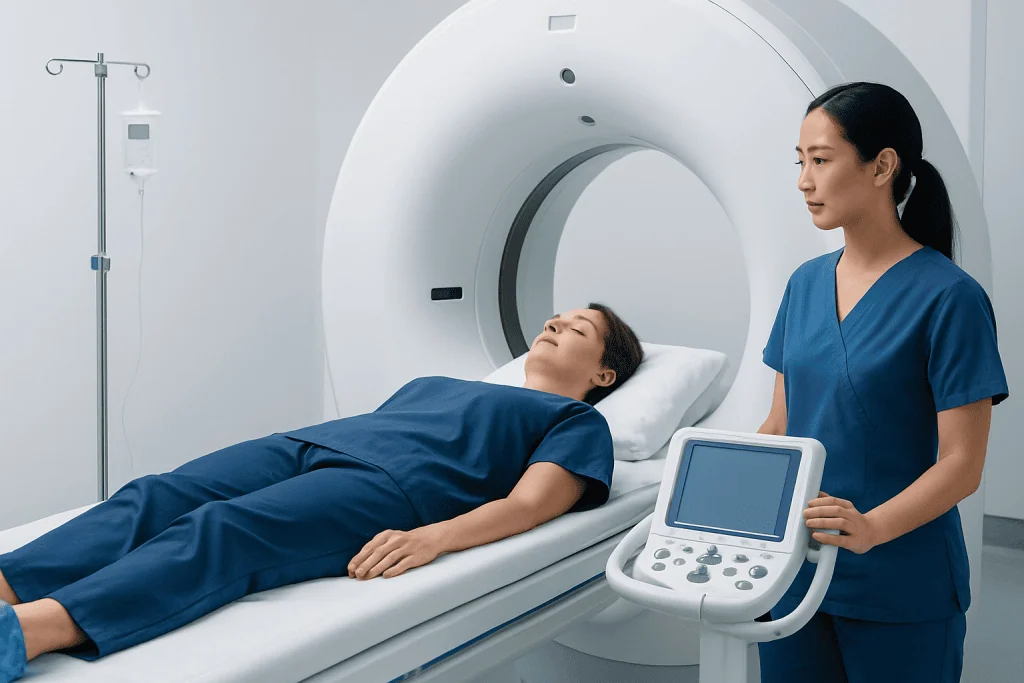
On the morning of your appointment, reread the instructions that came with your booking. Preparation varies by scan type. Some CT scans need no preparation at all. Others ask you to fast for a set number of hours, drink water beforehand, arrive early for oral contrast, or bring recent blood test results, usually kidney function tests if IV contrast is planned. If your paperwork is silent on any of these points, resolve the question before you travel to the hospital rather than on arrival. There is a broader overview of preparation for imaging and lab work in our guide on how to prepare for blood tests, scans, and pre-op checks.
Dress simply. Metal near the scanned area, large jewellery, belts, hairpins, underwired garments, clothing with metal fasteners, can interfere with the images, and you may be asked to remove items or change into a gown. Arriving in comfortable clothing with minimal metal shortens this step.
Put everything you need in one folder or small bag:
- Your passport or official identification
- Appointment confirmation and the hospital’s contact details
- The referral letter or doctor’s request, if you have one
- Previous CT, MRI, ultrasound, or X-ray images and their written reports
- A complete medication list, including blood thinners, diabetes medicines, and supplements
- Allergy information, particularly any previous reaction to contrast or iodine
- Recent kidney function results, if you were asked to bring them
Previous imaging deserves special emphasis. Radiologists often need to judge whether a finding is new, stable, or changing, and that judgement is only possible with older images to compare against. Bringing your prior scans on disc or as digital files can spare you a repeated examination: a topic covered in more detail in our guide on why tests and scans are sometimes repeated in Turkey.
Arrival, registration, and international patient support
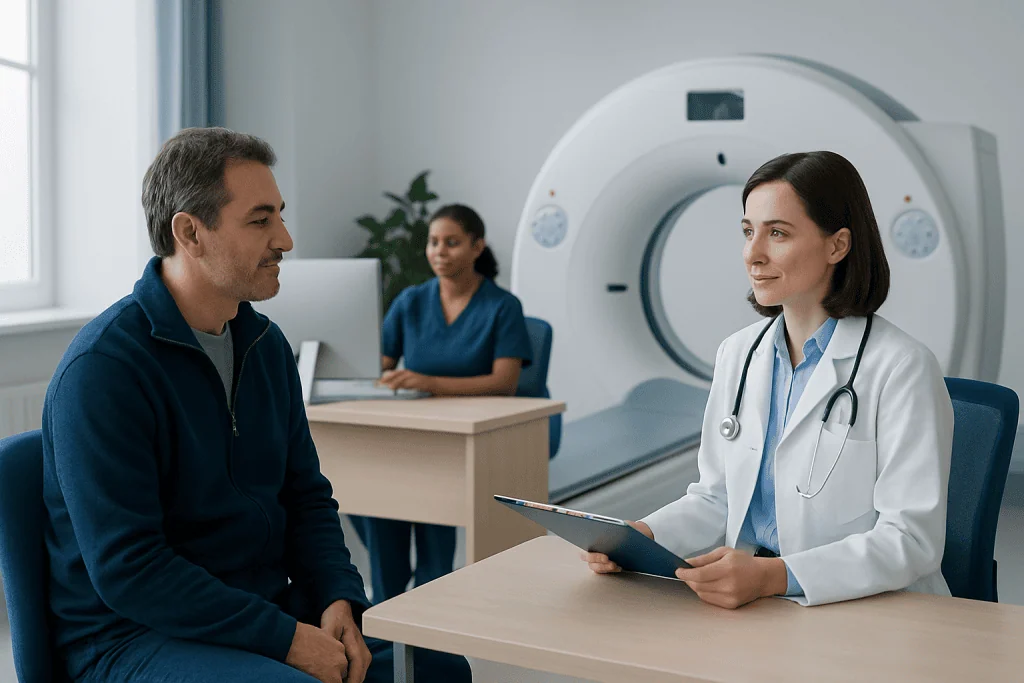
Arrive earlier than your scheduled scan time, especially on a first visit. Registration, payment or insurance confirmation, interpreter arrangements, and simply finding the radiology department all take longer in an unfamiliar building. If you are travelling within Istanbul, treat traffic as unpredictable and leave a wide margin. Arriving unhurried also means the safety screening happens calmly rather than under time pressure.
Foreign patients are routinely treated in Turkish hospitals, and private hospitals in the major cities are well used to international visitors. You do not need Turkish residency or a Turkish health number for a self-paid outpatient scan: your passport serves as identification. At Acibadem International hospitals, international patient teams can confirm your appointment, guide you to the correct department, arrange translation, and coordinate with a companion travelling with you. Wheelchair assistance and other mobility support are easier to provide when requested in advance. The paperwork side of arrival, what documents hospitals expect and why, is covered in our guide to hospital admission documents in Turkey.
During registration, staff verify your identity and appointment details. You may be asked to sign consent forms or confirm that you understand the test and any contrast-related instructions. Read what you sign; ask for translation of anything unclear. This is also the natural moment for practical questions: where your companion can wait, whether you can eat afterwards, and how your results will be delivered.
Safety questions and contrast preparation
Before the scan, the radiology team runs through a set of safety questions. Expect to be asked whether you are or might be pregnant, and whether you have kidney disease, diabetes, asthma, thyroid conditions, significant allergies, or a previous reaction to contrast material. None of these questions is unusual, and none automatically prevents a scan: they help the team choose the safest approach for you specifically. Answer them fully, even if a detail seems minor.
Some CT scans are performed without contrast. Others use contrast material, usually injected through an IV line, sometimes swallowed as a drink, occasionally both, to make blood vessels, organs, or particular tissues easier to assess. Whether contrast is needed depends on the body region and the clinical question your doctor wants answered, and the team will explain what applies to your scan.
If IV contrast is used, a brief warm sensation, a metallic taste, or a momentary feeling of needing to urinate are all common and usually pass quickly. The team monitors you during and after the injection; tell them straight away if anything feels wrong, such as itching, swelling, difficulty breathing, or dizziness.
If you take metformin or other diabetes medications, or you have reduced kidney function, the radiology team may have specific instructions connected to contrast use. Follow what your treating doctor and the radiology team tell you. Do not stop, start, or adjust any medication on your own, decisions about medicines belong to the clinicians who know your history.
What happens during the scan
A radiology technologist takes you into the scan room and positions you on the CT table, usually lying on your back. The table moves slowly through a large ring-shaped scanner. Unlike an MRI tunnel, the CT ring is short and open at both ends, which most people, including those uneasy in enclosed spaces, find easier to tolerate. The machine makes whirring sounds as it works.
You may be asked to lie still, hold your breath for a few seconds at a time, or keep a particular position. These instructions reduce motion blur and improve image quality, and following them can spare you a repeated sequence. If a position is uncomfortable, say so before the scan begins; small adjustments are often possible. If interpreter support was arranged, the key breathing instructions can be explained before you enter the room so nothing gets lost mid-scan.
The technologist operates the scanner from an adjacent control area and can see and speak with you throughout. Your only job is to follow simple instructions and to speak up if you feel unwell or anxious.
CT uses X-rays, so radiation exposure is part of the test. Doses in medical imaging are managed carefully, and doctors request CT when the diagnostic information is expected to justify the exposure. If you have concerns, about pregnancy, repeated scans, or imaging for a child, raise them with the referring doctor or the radiology team. Asking why the scan is needed and whether alternatives exist is a reasonable question, and a good department will answer it plainly.
After the scan and getting your results
Once the imaging is complete, you may wait briefly while the team confirms the images are technically adequate. If contrast was used, a short observation period is common, particularly if you have a history of allergies. Most patients leave the department once the team confirms no additional images or monitoring are needed. If you received IV contrast, you may be encouraged to drink fluids afterwards, unless you have been told to restrict fluids for a medical reason. Normal meals and activities usually resume the same day unless your care team says otherwise.
Your images go to a radiologist, who prepares a written report for your referring physician. This is why results are rarely instant: reporting time depends on urgency, complexity, and the department’s workflow. Before you leave, get three things clear: when the report is expected, how you will receive it (patient portal, printed copy, disc, or digital file), and who will explain the findings to you. A radiology report is written for doctors, and it is your treating physician, not the report alone, who should interpret what it means for your care.
For international patients, result coordination matters more than usual. If your scan feeds into treatment in Turkey, the report’s timing may shape your next appointment; if you are flying home soon, you will want copies of both the images and the report before you leave the country, plus clarity on whether a translated report is available. Keeping your own complete set of records is the simplest insurance against files going missing between systems. If several appointments hinge on the report, our guide to managing time between appointments in Turkey can help you plan the gaps.
What a CT scan costs, and why no honest answer is a single number
Search results are full of headline prices for scans in Turkey, and they are largely unhelpful, because the cost of a CT scan is not one fixed figure. What you actually pay depends on several variables:
- The body region and number of regions scanned. A single-region scan and a multi-region or whole-body protocol are different examinations with different pricing.
- Whether contrast is used. Contrast material, the IV line, and any pre-contrast blood tests add to the total.
- Reporting arrangements. Standard reporting, urgent reporting, second reads, and translated reports can each affect the quote.
- Whether the scan stands alone or sits inside a treatment plan. Imaging bundled into a wider diagnostic or surgical pathway is priced differently from a standalone appointment.
- Payment route. Self-payers, travel insurers, and international health insurers each follow different billing processes, and insurers may need pre-authorisation.
The practical approach is to ask the hospital for a written quote that names the exact scan protocol, states whether contrast and reporting are included, and specifies what would trigger additional charges. A quote that itemises these points is worth far more than any headline figure. For the wider picture of what medical travel actually costs beyond the treatment itself, see our guide to hidden costs in a medical travel budget for Turkey.
Practical comfort tips for international patients
A CT appointment is usually straightforward, but travel fatigue, an unfamiliar building, and medical uncertainty can make an ordinary day feel heavier than it is. Build slack into your schedule. Keep your phone charged and carry the hospital’s contact details in writing. If fasting was required, pack water and a light snack for after the scan, to be eaten once the team confirms it is fine.
If medical settings make you anxious, say so early, to the coordinator, to the technologist, to anyone in the chain. Having each stage explained before it happens, keeping a companion nearby until the scan-room door, or having an interpreter present for the key instructions all make a measurable difference to how the day feels.
Finally, connect the scan to what comes next. If the CT is part of a wider treatment plan, ask how the result feeds into your next consultation, whether further tests are likely, and whether your travel schedule should stay flexible for same-day or next-day follow-up. Plans built around a pending report should bend, not break.
Step by step
- Confirm your appointment and preparation instructions. Check the date, time, hospital location, and whether you need to fast, hydrate, or arrive early. Resolve any uncertainty about contrast, medications, or blood tests before you set out for the hospital.
- Gather your documents and previous imaging. Passport, referral notes, prior reports, and earlier images all travel with you. Comparison images can spare you repeated scans and help radiologists judge whether a finding is new or stable.
- Arrive early for registration. Allow time for hospital entry, registration, payment or insurance checks, and finding the imaging department. In Istanbul, assume traffic will be worse than forecast.
- Complete the safety screening honestly. Pregnancy possibility, allergies, kidney problems, diabetes, thyroid disease, and prior contrast reactions are all routine questions. Accurate answers let the team tailor the scan safely.
- Follow contrast instructions if they apply. The team may place an IV line or give you a contrast drink. Report any unusual sensation during or after administration immediately.
- Stay still and follow the breathing cues. Brief breath-holds and stillness produce clearer images and reduce the chance that part of the scan must be repeated.
- Pin down the results plan before you leave. Confirm when the report is due, in what format you will receive the images, whether a translated report is available, and who will discuss the findings with you.
Your checklist
- Passport or official identification
- Appointment confirmation and hospital contact details
- Referral letter or doctor’s request, if available
- Previous imaging reports and image files or discs
- Medication list and allergy information
- Recent kidney function tests, if requested
- Comfortable clothing with minimal metal
- Phone charger and a local contact number
- Water and a snack for after the scan, if fasting was required
- Interpreter request or companion details, if needed
Key takeaways
- A CT appointment includes registration, safety screening, imaging, and result coordination: the scanner itself is the shortest part.
- Previous scans and reports matter: they allow comparison and can prevent repeated imaging.
- Contrast scans involve extra checks on allergies, kidney function, and certain medications; answer safety questions fully.
- Cost has no single honest number: it depends on the scan protocol, contrast, reporting, and payment route, so ask for an itemised written quote.
- Before leaving the department, confirm when your report will be ready, how you will receive your images, and who will explain the findings.
Frequently asked questions
How much is a CT scan in Turkey?
There is no single figure, and any page quoting one is simplifying. The price depends on the body region and number of regions scanned, whether contrast is used, the reporting arrangements, and whether the scan stands alone or sits within a treatment plan. Hospitals provide written quotes once the exact scan protocol is known; ask for one that itemises contrast, reporting, and any charges that could be added on the day.
Can foreigners go to hospital in Turkey?
Yes. Foreign patients are routinely treated in Turkish hospitals, and private hospitals in major cities are experienced with international visitors. For an outpatient scan you do not need Turkish residency; your passport serves as identification. Payment is usually by self-pay or through an insurer, and insurers may require pre-authorisation, so it is worth checking your policy before travelling.
What is a CT scan called in Turkish?
The formal term is bilgisayarlı tomografi, abbreviated BT. In everyday use and on hospital signage you will most often see or hear simply tomografi. Knowing that word helps with wayfinding, though international patient teams and interpreters handle the detailed communication.
How long does a CT scan appointment in Turkey usually take?
The imaging itself typically takes only minutes, but the full visit often runs one to three hours once registration, safety screening, contrast preparation, and image checks are included. If you have another consultation the same day, keep your schedule flexible.
Will I need contrast for my CT scan?
It depends on the body area being examined and the clinical question your doctor wants answered. Some scans are done without contrast; others need IV contrast, oral contrast, or both for clearer detail. The radiology team reviews your safety information, allergies, kidney function, relevant medications, before giving contrast.
Can I eat before my CT scan?
Some CT scans allow normal eating; others require fasting, especially when contrast is planned. Follow the instructions issued with your appointment, and if none were given, check with the imaging department before the appointment day rather than guessing.
When will I receive my CT results?
A radiologist has to review the images and write a report, so results are rarely immediate. Timing depends on urgency, complexity, and departmental workflow. Before leaving, ask when the report is expected, whether images come digitally, printed, or on disc, and whether a translated report is available if you need one for a doctor at home.
Can I travel after a CT scan?
Most patients resume normal activities after a CT scan, including local travel, unless the care team advises otherwise. If you received contrast, feel unwell afterwards, or the scan is part of an urgent evaluation, ask your doctor before booking a flight or making longer travel plans.
Add us as a Preferred Source to see more of our trusted health content across Google Search, AI Overviews and Discover.

Update history
- PublishedJune 16, 2026
- Medical review approvedSeptember 13, 2026
- Last content updateSeptember 12, 2026
References2
- CT scan: NHS nhs.uk
- CT Scans: MedlinePlus medlineplus.gov
More Patient Guides
Sleep Apnea Testing in Turkey: What Happens During Your Evaluation
Sleep apnea testing in Turkey may include a consultation, overnight sleep study or home test, and a clear review of your results…

How to Organize Your Test Results Before Traveling to Turkey
Organize your test results before traveling to Turkey by sorting records, images, medicines and timelines so your Istanbul care team can review…

When Extra Tests Are Needed Before Treatment in Turkey
Extra tests before treatment in Turkey may be needed to confirm diagnosis, timing, and safety. Here is what you can expect in…

At Acibadem, How to Prepare for Blood Tests, Scans, and Pre-Op Checks
Blood tests, scans, and pre-op checks at Acibadem in Turkey help confirm you are ready for treatment and avoid delays on the…