

MRI Scan in Turkey: What International Patients Can Expect
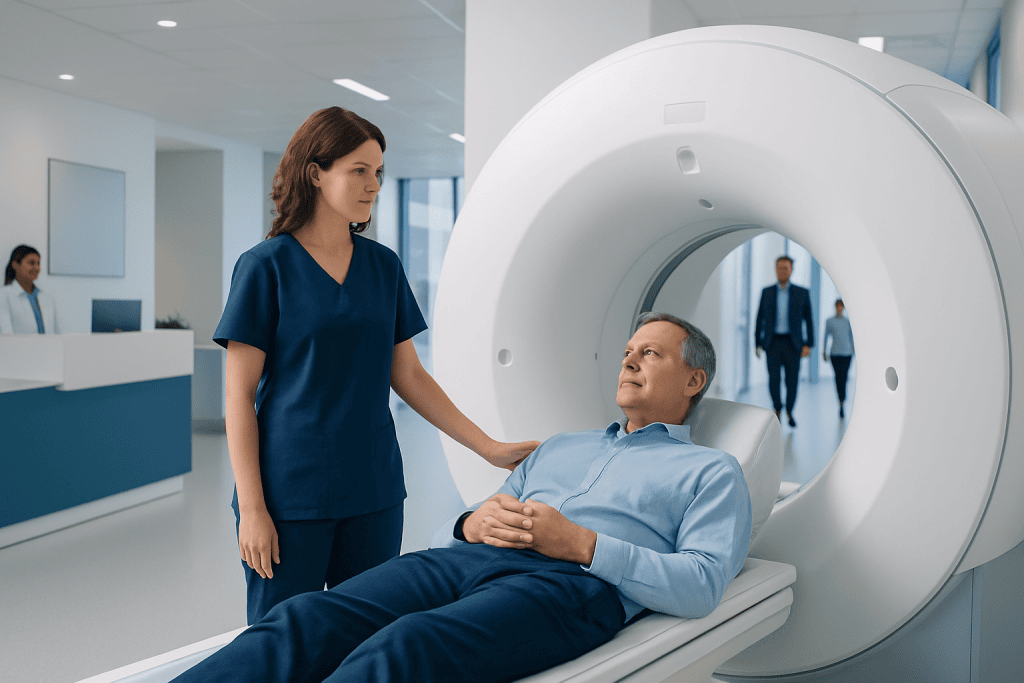
An MRI scan in Turkey follows a set path: your records are reviewed, the correct protocol is chosen, you complete magnet safety screening, the scan is performed, and a radiologist writes a report. The scan itself is often short; allow extra time for registration, preparation and reporting, and plan in advance how the report and image files will travel home with you.
An MRI appointment abroad raises practical questions: how long will it really take, will the report arrive in a language your doctor can read, and will you leave with the actual images rather than a summary? An MRI scan in Turkey follows a structured path, medical document review, appointment coordination, magnet safety screening, imaging, and a written radiology report. This guide walks through each step, explains what shapes the quote you receive, and shows how to make sure the results are usable when you get home.
At a glance
- Best for: diagnostic imaging, second-opinion imaging, follow-up scans and pre-treatment assessment
- Typical timing: the scan itself often takes 15 to 60 minutes depending on the protocol; allow extra time for registration, safety checks, preparation and reporting
- Key documents: referral or reason for the scan, previous imaging with written reports, medication list, implant cards, passport
- Cost note: quotes are prepared individually and depend on the regions scanned, contrast, sedation and reporting needs: there is no single list price that fits every case
- Language support: interpreter coordination can be arranged for international patients when requested in advance
- Travel note: most patients return to normal activities straight after MRI, unless sedation or specific medical instructions apply
What an MRI scan in Turkey involves
MRI uses a strong magnetic field and radio waves to build detailed images of the brain, spine, joints, organs, soft tissues and blood vessels. It does not use ionising radiation, which is one reason doctors often prefer it for soft-tissue questions. The trade-off is the magnet itself: every MRI appointment includes careful safety screening, because certain implants, devices and metal fragments need checking before you can enter the scanner room. If your doctor is weighing MRI against other imaging, it may help to read how a CT scan appointment in Turkey differs: the two tests answer different questions and are prepared for differently.
For international patients, an MRI scan in Turkey is usually more than the appointment itself. You may need help transferring medical records, confirming exactly which body region will be scanned, understanding whether contrast is planned, arranging interpretation, and receiving the report and image files in a format your doctor at home can open. Getting these details settled before you fly is what separates a smooth visit from a frustrating one.
At Acibadem, MRI appointments for international patients are coordinated through international patient services together with radiology and, where relevant, the specialist department involved in your care. This matters most when the scan is one part of a wider plan, oncology, neurology, orthopaedics, cardiology or a second-opinion review. You can read more about how care is organised in the guide to what to expect across the Acibadem network.
Before you travel: documents and medical information to prepare
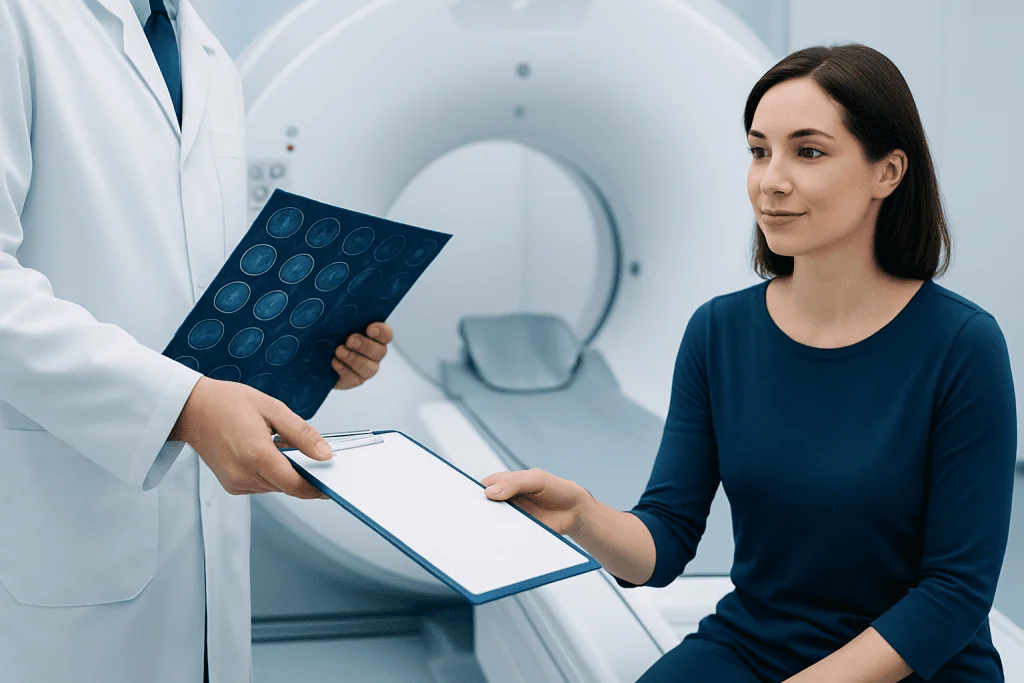
Before an appointment is confirmed, the coordination team usually reviews the reason for the MRI, your doctor’s request, recent test results and any previous imaging. If you have had an X-ray, CT, ultrasound, PET-CT or an earlier MRI, gather the images as digital files as well as the written reports. Radiologists compare old and new images side by side, and a finding that looks alarming in isolation may be reassuringly stable when the prior scan sits next to it. The report alone is not enough for this: the image files matter.
Prepare a clear list of current medications, allergies, any kidney disease history, pregnancy status if relevant, and every implant or device in your body. Examples include pacemakers, cochlear implants, aneurysm clips, neurostimulators, metal fragments, orthopaedic hardware, ports, stents and implanted pumps. Some devices are MRI-compatible only under specific conditions: a particular scanner field strength, a device setting, or a waiting period after implantation, so this checking happens well before the appointment, not at the scanner door. Implant cards with manufacturer and model information are the single most useful document you can bring.
If the scan is meant to settle a specific diagnosis or treatment decision, ask your home doctor exactly what they need from it: which body region, whether contrast is expected, whether comparison with prior imaging is essential, and in what format they want the images. Many patients find that an online pre-travel doctor review resolves these questions before flights are booked, which reduces the risk of arriving for the wrong protocol.
Scheduling your MRI and planning your day

Once your request has been reviewed, the scheduling team matches the MRI protocol to the medical question. Some protocols are routine and short; others need longer slots, contrast planning, specialist radiology sequences or a consultation arranged on the same day. If your time in Turkey is limited, share your arrival and departure dates early: the order of appointments can often be arranged around them, but only if the team knows.
Plan to arrive before your scan time, particularly on a first visit. Registration, consent, safety screening, changing and, if contrast is planned, placing an IV line all add time before you reach the scanner. If you need an interpreter, mobility assistance or help moving between departments, allow more margin so nothing feels rushed. In Istanbul, traffic is genuinely unpredictable; a generous buffer is not caution, it is realism. If this is your first trip, the guide to arriving in Turkey as a patient covers the practical side of the journey itself.
International patient coordinators can also help with appointment reminders, hospital directions, hotel coordination and transport guidance. None of this is glamorous, but on scan day it is exactly what keeps the schedule intact.
What happens on the day of the scan
On arrival you complete registration and the MRI safety questionnaire. Expect questions about metal objects, implants, prior surgery, allergies, kidney function, the possibility of pregnancy, and whether you have had contrast before. These questions repeat what you may already have submitted: that repetition is deliberate, and it is how imaging departments keep the magnet room safe.
You will be asked to remove anything the magnet could affect or that could distort the images: jewellery, watches, hearing aids, removable dental pieces, hairpins, bank cards, phones and clothing with metal fasteners. You may change into a gown. For some scans, a coil or support frame is positioned around the body part being imaged; it looks bulky but exists purely to sharpen the pictures.
During the scan you lie on a table that moves into the scanner. The machine makes loud tapping and knocking sounds, so ear protection is standard. You will be asked to stay as still as possible, and for some chest or abdominal scans to hold your breath briefly. You are never cut off: an intercom and a call device keep you in contact with the technologist throughout, and the scan can be paused if you need it to be. Most single-region scans take somewhere between 15 and 45 minutes on the table; multi-region or contrast studies take longer.
Contrast, claustrophobia and special situations
Some MRI scans use a contrast agent, given through an IV line, to highlight blood vessels, inflammation, tumours or particular tissue patterns. When contrast is planned, the team may check kidney function beforehand and will ask about previous reactions. Not every MRI needs contrast: the decision follows from the medical question and the radiology protocol, not from a default setting. It is reasonable to ask why contrast is or is not being used in your case.
If enclosed spaces make you anxious, say so before the appointment rather than on the table. Practical measures help many people: a clear explanation of each stage, music where available, an eye covering, a companion nearby when permitted, or simply a longer, unhurried slot. In selected cases sedation may be considered, but it changes the day: it requires additional medical review, consent, fasting instructions and supervision afterwards, and it usually rules out driving or travelling alone straight after the scan.
Children, patients in significant pain, people who cannot lie flat and patients with implanted devices all need specific planning, and occasionally a protocol changes after the radiologist reviews your details: a different sequence, an added region, or a contrast decision revised on the day. This is normal, not a sign that something has gone wrong; the guide on unexpected test or treatment changes explains how to stay prepared when plans shift.
Scanner types: closed, open and whole-body MRI
Field strength: what 1.5T and 3T actually mean
MRI scanners are described by magnetic field strength, measured in Tesla. Higher-field scanners can produce more detailed images for certain applications, particularly small structures in the brain, joints and blood vessels. That does not make a higher number automatically better for you: the right scanner depends on the clinical question, and some implants are approved only for specific field strengths. If your home doctor has requested a particular field strength, put that in writing early; if not, the radiology team chooses the scanner that fits the protocol. Either way, you can ask which scanner will be used: it is a fair question and imaging departments expect it.
Open and wide-bore designs
Open and wide-bore scanners exist mainly for comfort: they suit larger patients and those who struggle with the enclosed feeling of a conventional scanner. The trade-off can be image characteristics that differ from a standard closed scanner, which matters for some studies and not for others. Availability varies between sites, so if an open design is important to you, raise it during scheduling rather than assuming it will be there on the day.
Whole-body MRI versus a targeted scan
Whole-body MRI screens many regions in one session, and it appears heavily in advertising aimed at medical travellers. Be clear-eyed about what it is: a broad survey that trades depth for coverage. A targeted MRI of one region, chosen to answer a defined clinical question, generally examines that region in far more detail. Whole-body scans can also surface incidental findings, things that look uncertain, turn out to be harmless, but require further tests to prove it. Whether a whole-body study or a targeted one serves you better is a medical decision that follows from your history, not a menu choice. If a whole-body scan has been recommended to you, it is worth asking what question it is meant to answer.
How the cost of an MRI scan in Turkey is worked out
This guide does not quote figures, because no honest single figure exists: the price of an MRI scan in Turkey is built from the specifics of your case. What a quote depends on is consistent, though: the number of body regions scanned, whether contrast is used, the length and complexity of the protocol, whether sedation or anaesthesia support is needed, how quickly the report is required, whether the report is prepared in English or another language, and whether the scan is bundled with a specialist consultation or a wider check-up.
The practical route is straightforward. After your records are reviewed, you receive a quote for your specific protocol. Ask for it itemised, and ask exactly what it includes: the radiologist’s written report, the image files themselves, contrast material, translation, and any repeat sequences if image quality demands them. A headline price that excludes the report or the images is not comparable with one that includes both. This applies across countries too, comparing destinations by advertised starting prices tells you little, because inclusions, protocol length and reporting standards differ far more than the headline numbers suggest.
Reports, images and follow-up after your MRI
After the scan, a radiologist reviews the images and prepares a written report. Timing varies with the complexity of the study, whether prior imaging must be compared, and whether a specialist consultation is planned around the result. If you have a flight to catch, make the deadline known in advance so expectations are set honestly, some reports simply take longer than others, and knowing that early is better than discovering it at check-out.
Ask specifically how you will receive both the written report and the image files. Your doctor at home usually needs the images in standard DICOM format, not just the report; depending on hospital policy, files may be provided on disc, USB or through a secure digital system. Keep copies with your travel documents, and keep a digital backup separately from the physical media.
If the MRI is part of treatment at Acibadem, the relevant specialist reviews the findings with you and explains the next steps in context. If you are returning home, clarify before you leave what routine follow-up is recommended, whether repeat imaging is expected and on what interval, and how results will be shared with your home physician. The guide to remote follow-up after treatment in Turkey explains how that continuity typically works once you have flown home.
Practical tips for a smoother visit
Wear comfortable clothing without metal where possible and bring a small bag for personal items; leave unnecessary valuables at your hotel. If you take regular medication, do not change anything on your own: your treating doctor decides whether any adjustment is needed around the scan, and for most standard MRI appointments nothing changes at all.
- Bring your passport or ID, appointment confirmation, previous imaging and implant documentation.
- Arrive early and build in a buffer for Istanbul traffic.
- Tell the team if you are anxious, in pain or unable to lie still, before the appointment, not during it.
- Confirm whether you may eat and drink beforehand, especially if contrast or sedation is planned.
- Ask when and how you will receive the report and the image files, and keep both digital and printed copies.
- If your documents are in another language, ask before arrival whether translation is needed.
Step by step
- Prepare your medical request. Gather your referral, the reason for the scan and the body area involved. If the correct MRI type is unclear, a physician review before scheduling settles it.
- Gather prior imaging and reports. Image files plus written reports, whenever possible. Comparison is how radiologists tell a new finding from a stable one.
- Complete MRI safety screening. Provide implant details, surgical history, metal fragments, allergies, kidney disease history and pregnancy status if relevant. The magnet makes this step non-negotiable.
- Confirm logistics before arrival. Hospital location, appointment time, interpreter arrangements, and whether fasting or blood tests apply. Share flight dates early if your stay is short.
- Attend the appointment. Arrive early, remove metal items and follow the technologist’s instructions. Staying still is what keeps the images sharp.
- Collect the report and image files. Confirm when the report will be ready, in which language, and how the DICOM files will be provided. Keep copies for future consultations.
- Review next steps. If a consultation is booked, the specialist explains the findings in context. If you are heading home, clarify recommended follow-up and how results will reach your own doctor.
Your checklist
- Passport or official ID
- Appointment confirmation and hospital contact details
- Doctor referral or documented reason for the MRI
- Previous imaging files and written reports
- Medication list, allergy information and relevant blood test results
- Implant cards or device manufacturer and model details, if applicable
- Comfortable clothing without metal fasteners
- Interpreter request confirmed, if needed
- Travel buffer for Istanbul traffic and hospital registration
- Agreed plan for receiving the report and the image files
Key takeaways
- The MRI pathway moves through record review, safety screening, scheduling, imaging and radiology reporting: the scan is often the shortest part of the day.
- Prior scans, written reports and implant documentation let the team plan safely and compare findings accurately; bring the image files, not just the paperwork.
- Not every MRI needs contrast, and a whole-body scan is not automatically better than a targeted one, both are medical decisions, not menu items.
- Quotes are built from your specific protocol; ask for an itemised quote and confirm what it includes before comparing anything.
- Secure both the written report and the DICOM image files before you leave, in a format your home doctor can use.
Frequently asked questions
How much does an MRI scan cost in Turkey?
There is no single price, because the quote is built from your case: the number of regions scanned, whether contrast is used, protocol length, sedation, report language and how quickly reporting is needed. After your records are reviewed, you receive a quote for your specific protocol. Ask for it itemised and confirm whether the report, the image files and contrast are included.
Is Turkey the cheapest country for an MRI?
Headline price comparisons between countries are rarely meaningful, because inclusions differ: one advertised price may cover only scanner time, while another includes contrast, a full radiology report and the image files. Judge the whole package, protocol suitability, reporting standard, report language and whether you leave with usable images, rather than the lowest advertised number.
Is it safe to go to Turkey for medical procedures?
MRI itself uses no ionising radiation, and its main safety requirement, thorough magnet screening, is a standard process in well-run imaging departments everywhere. The safety of any medical trip depends less on the country than on the institution: how carefully your records are reviewed beforehand, how screening and consent are handled, and how clearly follow-up is arranged. Those are reasonable things to ask any provider about before travelling.
How long does an MRI appointment take?
Time on the scanner table is often between 15 and 60 minutes depending on the protocol, but your total visit includes registration, safety screening, changing and possible contrast preparation. Multi-region or contrast studies take longer. Keep your schedule flexible on scan day rather than booking tight connections around it.
Is MRI safe if I have metal in my body?
It depends on the implant. Some devices are fully compatible, some are conditional, safe only at certain field strengths or settings, and some are not compatible at all. Provide implant cards, surgical details and device model information before the appointment so the MRI team can verify compatibility as part of safety screening.
Do I need contrast for my MRI?
Not every MRI requires contrast. The decision depends on the body area, the suspected condition and the question your doctor wants answered. If contrast is planned, expect questions about allergies, kidney function and previous contrast experiences, and possibly a blood test beforehand.
Will I receive my MRI report in English, and can I fly home afterwards?
Ask about report language options before the scan, requesting English documentation in advance is far easier than translating afterwards, and always ask for the image files as well as the report. Most patients can travel after a standard MRI, including scans with contrast, unless their doctor advises otherwise; sedation is the main exception and changes same-day travel plans.
Do I need a whole-body MRI?
Not necessarily. Whole-body MRI surveys many regions with less detail per region, while a targeted scan examines one area thoroughly to answer a defined question. Whole-body studies can also produce incidental findings that need further tests to clarify. Which approach fits you is a medical decision based on your history, and its price follows the same logic as any MRI quote: regions, protocol length and reporting.
Add us as a Preferred Source to see more of our trusted health content across Google Search, AI Overviews and Discover.

Update history
- PublishedJune 16, 2026
- Medical review approvedAugust 30, 2026
- Last content updateAugust 30, 2026
References2
- MRI scan: NHS nhs.uk
- MRI Scans: MedlinePlus medlineplus.gov
More Patient Guides
Sleep Apnea Testing in Turkey: What Happens During Your Evaluation
Sleep apnea testing in Turkey may include a consultation, overnight sleep study or home test, and a clear review of your results…

How to Organize Your Test Results Before Traveling to Turkey
Organize your test results before traveling to Turkey by sorting records, images, medicines and timelines so your Istanbul care team can review…

When Extra Tests Are Needed Before Treatment in Turkey
Extra tests before treatment in Turkey may be needed to confirm diagnosis, timing, and safety. Here is what you can expect in…

At Acibadem, How to Prepare for Blood Tests, Scans, and Pre-Op Checks
Blood tests, scans, and pre-op checks at Acibadem in Turkey help confirm you are ready for treatment and avoid delays on the…