

Online Pre-Travel Doctor Review: What Patients Can Expect

An online pre-travel doctor review lets specialists examine your medical records before you book flights to Turkey. You send recent reports, imaging and a medication list; the team routes your file to the right specialty and returns a preliminary direction. It is a planning tool, not a diagnosis, final decisions usually require in-person examination and updated tests after you arrive.
You are weighing up treatment abroad, but you do not want to book flights and take unpaid leave before you know whether your case can actually be handled. That is what an online pre-travel doctor review exists for. You share your records. The right specialists look at them. Then you decide whether travelling makes sense, before you have spent anything on the journey.
This guide explains what to prepare, how the review works at Acibadem International, what a doctor can honestly say without examining you, and how to turn the response into a realistic travel plan. It also explains what this review is not, including how it differs from the vaccine-focused travel clinic consultation you may have seen while searching.
At a glance
- Best for: Patients considering diagnosis, treatment, surgery, a second opinion, or follow-up planning in Turkey
- What you share: Recent reports, imaging files, laboratory results, a medication list, diagnosis notes, and your main questions
- What you receive: A preliminary medical direction, the recommended specialty, likely next steps, and travel planning guidance
- Important limit: Final decisions usually require in-person examination and may change after new tests
- Not for emergencies: If symptoms are worsening quickly, call your local emergency number or go to the nearest emergency department now
- Support available: International patient coordination, interpreters, appointment planning, and travel logistics guidance
What an online pre-travel doctor review is
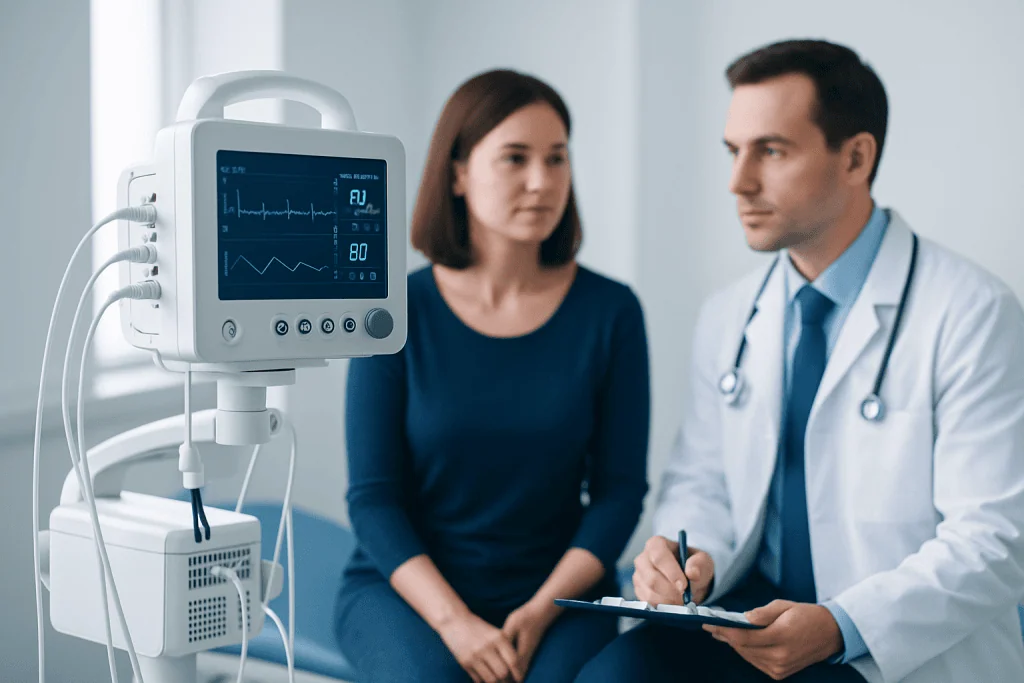
An online pre-travel doctor review is a remote assessment of your medical documents, done before you commit to travelling for care. You send your reports and describe your main concern; an international patient coordinator checks the file for completeness and directs it to the appropriate department or, where several specialties overlap, to a multidisciplinary team. The reviewing doctors then respond with a preliminary opinion on where your case belongs and what should happen next.
Be clear about what this is not. It is not a diagnosis, and it is not a confirmed treatment plan. Doctors reviewing records remotely can usually say whether your file is sufficient, which specialist should see you, what additional tests may be needed, and whether travelling for evaluation appears reasonable. What they cannot do is replace a physical examination. The final plan is normally confirmed only after you arrive, meet the care team, and complete any necessary assessments. If you want a detailed walkthrough of how our reviewing doctors actually read your file, see what to expect from our pre-travel medical record review.
At Acibadem International, the online pre-travel doctor review is built around one principle: you should be able to make an informed decision before booking flights, not after. That means clear communication about what is known, what is uncertain, and what must wait until you are in front of a doctor.
How this differs from a travel-medicine consultation
When people search for a pre-travel consultation, they often mean something different: a travel-medicine appointment focused on vaccinations, malaria prevention and destination-specific health risks. That kind of consultation typically covers your itinerary, planned activities, medical history, and whether vaccines such as yellow fever are recommended or required for entry to specific countries. A proper yellow fever risk assessment, for example, weighs your destinations against known transmission areas, checks your age and immune status for contraindications, and confirms timing, because the vaccine needs to be given in advance of travel and some countries require an official certificate. The CDC Yellow Book and national health services describe this process in detail.
An online pre-travel doctor review for treatment abroad is a different service. It is about your existing medical condition and whether a hospital in Turkey is the right place to manage it, not about immunisations for tourism. Acibadem International does not administer travel vaccines remotely, and no legitimate online service can: vaccines must be given in person at an authorised centre in your own country. If you need a yellow fever vaccine or a full travel-health consultation, use your national health authority’s registry of approved travel clinics, in the United States that is the CDC’s directory of authorised yellow fever vaccination centres; in the UK, the NHS travel vaccination pages.
A practical test of whether any online medical review is legitimate: it should tell you plainly what cannot be decided remotely, it should never promise outcomes, and it should never discourage you from local care. If a service offers certainty without seeing you, treat that as a warning sign rather than a convenience.
When it is helpful to request a review
One safety point comes first, and it is not negotiable. An online review takes days, not minutes. If you have chest pain, sudden weakness or numbness, severe breathlessness, heavy bleeding, confusion, a high fever that is not settling, or any symptom that is getting worse by the hour or by the day, call your local emergency number or go to the nearest emergency department now. Waiting for a remote opinion is not a safe way to handle a deteriorating condition, and no online review, ours included, is a substitute for that.
For non-urgent situations, a review is worth requesting when you have been advised to consider treatment, surgery, advanced imaging, or a complex consultation abroad, or when you already have a diagnosis and want a second opinion before committing to a plan at home. It also helps when you are simply unsure which department should evaluate you: a common situation when symptoms cross specialty boundaries.
The review is most valuable when your care may involve more than one specialty: surgery combined with oncology, cardiology alongside neurology, or rehabilitation planning after a major procedure. Reviewing the file early lets the hospital line up the right people before you arrive, which reduces avoidable delays and repeated tests. It is also useful for patients travelling with a diagnosis that still needs confirmation, for example, those coming to Turkey for biopsy review, where treatment cannot be confirmed until pathology has been re-examined.
Finally, mention any practical needs early: mobility limitations, chronic conditions, recent surgery, implanted devices, or medications that need attention during travel. If you use a wheelchair or need help moving through airports and hospital corridors, our guide to mobility assistance for patients travelling to Turkey explains what can be arranged.
What documents you should prepare

The review is only as good as the file it is based on. Send the most recent documents first, ideally anything from the last three to six months if your condition has changed. If your history is long, a short summary in your own words, with approximate dates, helps the doctor follow the timeline far more than a stack of unsorted PDFs.
Useful documents typically include diagnosis reports, discharge summaries, operation notes, pathology results, laboratory results, and imaging, both the written radiology reports and the original image files (MRI, CT, PET-CT, ultrasound, X-ray), usually on disc or as DICOM files. If you have a chronic condition, include your current medication list with doses, known allergies, implanted devices, previous treatments, and major past operations. Do not stop, start or change any medication in preparation for the review; that is a decision for your treating doctor only.
- State your goal in one line: second opinion, treatment planning, surgery evaluation, or follow-up after previous care.
- Label each report with its date and the hospital or clinic that issued it.
- Send original files where possible, not screenshots or cropped photos, which can hide critical detail.
- If documents are not in English or Turkish, ask your coordinator which ones need translating and which can be reviewed as they are.
Your file does not need to be perfect. A coordinator will tell you what is missing and how to obtain it. The aim is to give the doctor enough to assess your situation safely, not to make you responsible for medical interpretation.
How the review process usually works
After you contact Acibadem International, a coordinator asks for the basics: your age, country, diagnosis or main concern, preferred language, and what records you hold. Your documents are checked for readability and completeness, blurry photos and missing pages are caught at this stage, not after a doctor has started reading, and then routed to the relevant department.
The reviewing doctor or team studies the file and may come back with clarification questions. Depending on the case, the response can include a preliminary opinion, the recommended specialty, the tests or consultations likely needed after arrival, a note on any missing records, and an outline of how a hospital visit could be structured. Where several specialties are involved, the team may propose a coordinated appointment pathway so you are not bounced between departments once you arrive.
Timelines vary. Straightforward files move faster; complex cases may need more than one specialist’s input, and that takes longer. You can speed things up by sending everything in one organised batch, answering questions promptly, and telling the coordinator your preferred travel window early. This is also the right moment to raise interpreter needs and companion plans.
What the doctor can and cannot decide remotely
A remote review gives direction, not certainty. Doctors can usually comment on your records, name the appropriate department, suggest likely next steps, and explain what evaluations will be necessary on arrival. Sometimes the most useful outcome is a negative one: your documents are insufficient, and new tests are needed before any meaningful opinion is possible. That answer saves you a wasted trip.
What cannot be finalised remotely matters just as much. A doctor generally cannot confirm surgery, fix a definitive treatment plan, assess your fitness for anaesthesia, or make a firm diagnosis without examining you and reviewing updated results. Even a likely plan can change after physical assessment, fresh imaging, laboratory work, or multidisciplinary discussion. Plans changing after arrival is normal, not a failure: our guide on unexpected test or treatment changes in Turkey explains how to prepare for it.
Treat this honesty as a feature. A careful doctor refuses to manufacture certainty from an incomplete file. An online pre-travel doctor review done properly gives you a safer starting point and realistic expectations, not a script that pretends the in-person evaluation is a formality.
Planning travel after the review
Once you have preliminary feedback, the practical planning starts. Your coordinator can explain which appointments come first, whether tests should sit early in the trip, and how many days to reserve around your consultations. The length of stay depends on your condition and can change after evaluation, so build slack into your itinerary rather than booking the tightest possible return flight.
Before booking anything, ask: should you arrive on a weekday? Might fasting tests be scheduled? Should a companion travel with you? If you use a wheelchair, oxygen, a CPAP machine, or medications with storage requirements, raise it now so airport, hotel and hospital arrangements can be considered. Patients coming for possible surgery should also ask how long they may need to stay in Turkey before flying home.
Two things patients often overlook at this stage. First, insurance: standard travel policies frequently exclude planned treatment abroad, so read the exclusions before you rely on one: our guide to travel insurance for treatment in Turkey covers what to check. Second, general preparation: the pre-travel health checklist for international patients pulls the practical items into one place. Acibadem International can support appointment coordination, interpreter arrangements, hospital navigation and accommodation guidance, so that when you land you know where to go, who meets you, and how to reach your coordinator if plans change.
Step by step
- Share your main concern. Start with a clear, one-paragraph explanation of why you want a review: second opinion, treatment options, surgery evaluation, diagnostic clarification, or follow-up planning. Specific goals get specific answers.
- Send your medical records. Provide recent reports, imaging files, laboratory results, discharge notes, pathology findings, and your medication list. If you are unsure what matters, send what you have and ask the coordinator to name the gaps.
- Confirm language and contact preferences. State your preferred language, time zone, and best contact channel. Interpreter support can be planned early, and clear communication now prevents delays later.
- Wait for specialist routing. Your file is checked for completeness and directed to the relevant department or multidisciplinary team. Complex cases take longer because several specialists may need to weigh in.
- Review the preliminary response. Note what is confirmed, what is uncertain, and what depends on tests after arrival. This response is a planning tool, not a final treatment decision.
- Ask practical follow-up questions. Before booking travel, ask about appointment sequence, expected tests, likely length of stay, companion needs, and whether to bring original imaging discs and enough medication supplies. Logistics questions belong here, not at the airport.
- Plan your visit with support. Once you decide to proceed, your coordinator helps with scheduling, interpreter planning and arrival details. Keep your records accessible during travel, digital and printed copies both.
Your checklist
- A short written summary of your condition, symptoms and key dates
- Recent medical reports, discharge summaries and consultation notes
- Imaging reports and original imaging files for MRI, CT, PET-CT, X-ray or ultrasound
- Pathology, biopsy, genetic or laboratory results if relevant
- Current medication list with doses, allergies and supplements
- Details of previous surgeries, treatments or hospital admissions
- Passport name and contact details matching your travel documents
- Your main questions for the doctor, ranked by importance
- Information about mobility needs, implanted devices or travel restrictions
Key takeaways
- An online pre-travel doctor review matches your case with the right specialty before you spend money on travel.
- Complete, recent, well-organised records make the review more useful and reduce avoidable delays.
- Remote feedback is preliminary; diagnosis and final treatment decisions usually require in-person evaluation and may change after new tests.
- This review is not a travel-medicine or vaccination consultation; vaccines such as yellow fever must be given in person at an authorised centre in your own country.
- Acibadem International can coordinate appointments, interpreters and practical travel planning once you decide to proceed.
- For any symptom that is worsening quickly, call your local emergency number or go to the nearest emergency department now, do not wait for a remote review.
Frequently asked questions
Is an online pre-travel doctor review the same as a diagnosis?
No. It is a preliminary review based on the records you send, used to guide planning. A diagnosis or treatment plan usually requires an in-person examination, updated tests, and direct discussion with the medical team after you arrive.
How do I know whether an online travel clinic or review service is legitimate?
Look for services that state their limits plainly: what cannot be decided remotely, that in-person evaluation may change the plan, and that emergencies belong with local emergency services. Any online service that promises certain outcomes, guarantees a treatment without seeing you, or claims to administer vaccines remotely should be treated with caution.
What should be included in a yellow fever risk assessment during a pre-travel health consultation?
A travel-medicine clinician typically reviews your full itinerary against known yellow fever transmission areas, checks entry requirements for certificates, and assesses contraindications such as age and immune status before recommending the vaccine and its timing. This is a separate service from a treatment-abroad record review; use your national health authority’s registry to find an authorised travel clinic near you.
How long does the review take?
It depends on the complexity of your case, the completeness of your documents, and whether more than one specialist needs to see the file. Sending organised, recent records in one batch and replying quickly to clarification questions keeps the process moving.
Can I book flights before receiving the review?
It is usually better to wait, especially for complex conditions or possible surgery. The response may change which department you need, how soon you should come, and how long you should plan to stay.
What if my medical documents are not in English or Turkish?
Tell your coordinator which language they are in. The team can advise whether translation is needed for a safe review and which documents should be translated first, so you do not pay to translate reports that are not essential.
Will the doctor tell me the exact treatment before I travel?
Sometimes the doctor can outline likely options, but exact decisions are usually confirmed only after arrival. Physical examination, new imaging, laboratory tests, anaesthesia assessment or multidisciplinary review can all change the plan, and an honest review will say so.
Should I send imaging files or only the written report?
Both, if possible. Written reports are useful, but doctors often need the original image files to assess your case accurately, particularly for surgical, oncology, neurological, orthopaedic or cardiovascular evaluations. Ask your local imaging centre for a disc or digital DICOM export.
Add us as a Preferred Source to see more of our trusted health content across Google Search, AI Overviews and Discover.

Update history
- PublishedJune 8, 2026
- Medical review approvedSeptember 13, 2026
- Last content updateSeptember 12, 2026
References3
- CDC Yellow Book: The Pretravel Consultation wwwnc.cdc.gov
- CDC Travelers' Health wwwnc.cdc.gov
- WHO Fact Sheet: Yellow Fever who.int
More Patient Guides

Choosing Between Inpatient and Day-Case Treatment in Turkey
Inpatient and day-case treatment in Turkey differ mainly in overnight monitoring, recovery needs and travel planning. Learn how to choose safely.

How to Compare Hospitals in Turkey for Complex Treatment
Compare hospitals in Turkey for complex treatment by checking accreditation, specialist teams, ICU support, coordination, and follow-up.

At Acibadem, How We Explain Surgical Risks and Safety Checks Before You Travel
Surgical risks and safety checks before travel means understanding your personal risk, required tests, and travel timing before coming to Turkey.

At Acibadem, What to Check Before Comparing Treatment in Turkey With Care at Home
Comparing treatment in Turkey with care at home starts with safety, records, follow-up, travel timing and total support in Istanbul.