

Mobility Assistance for Patients Traveling to Turkey

Request mobility assistance before you book anything. Airlines arrange airport wheelchair support and usually need at least 48 hours' notice; your hospital coordinator helps with transfers, interpreters and hospital navigation. Describe what you can actually do, walking distance, stairs, transfers, rather than a diagnosis, confirm hotel access details in writing before paying, and keep your medical summary and medication list in your cabin bag.
Will someone meet you at the aircraft door? Will your wheelchair fit in the transfer car? Will the hotel bathroom actually work for you? These are the questions that keep people awake before a medical trip, and every one of them is easier to answer three weeks in advance than on arrival day, standing in a busy terminal.
If you travel with reduced mobility, a wheelchair, a walking aid or a need for hands-on support, this guide walks you through the practical side of a medical journey to Turkey: who arranges what, when to ask, and which details make the difference between a calm trip and a stressful one. It covers airport assistance, transfers, hospital access, accommodation, equipment, companions and the honest limits of what can be arranged.
At a glance
- When to request support: Before booking flights and accommodation, airlines usually need at least 48 hours’ notice, and earlier is better
- Who arranges what: The airline handles in-airport wheelchair assistance; your Acibadem International coordinator helps with transfers, hospital navigation and interpreters
- What to describe: Your practical abilities, walking distance, stairs, transfers, equipment, not just a diagnosis
- Key documents: Medical summary, medication list with generic names, equipment and battery details, travel insurance papers
- Helpful for: Wheelchair users, older patients, post-surgery travellers and anyone with limited walking tolerance
How Mobility Assistance for Patients Traveling to Turkey Actually Works
The first thing to understand is that no single organisation provides everything. Mobility assistance for patients traveling to Turkey is a chain of separate services: the airline manages assistance inside airports, a transfer provider handles the road journey, the hospital supports you inside its buildings, and your hotel is responsible for its own access. The chain works well when every link is told what you need in advance. It breaks when one link is left to guess.
Start with a plain, functional description of your needs. A diagnosis alone tells a coordinator very little. “I use a manual wheelchair, I can transfer to a car seat with help, I can stand for about a minute at passport control, I cannot manage stairs” tells them almost everything. Say whether you use a manual wheelchair, a power wheelchair, a walker, crutches or a cane, whether your limitation is temporary after surgery or long-term, and whether you need stretcher-level transport. Small details, one step at a hotel entrance, a bathroom door a few centimetres too narrow, cause most arrival-day problems, and all of them are avoidable with early questions.
Before booking anything, ask your treating doctor at home whether you are fit to fly and whether the journey needs any precautions. Request a medical summary and medication list in English if possible. Then contact your Acibadem International patient coordinator and share your description before flights are purchased, so arrival times, appointments and accommodation can be planned around what you can realistically manage rather than squeezed around a ticket that is already paid for.
Decide early who is coming with you. A companion can handle luggage, medication timing, personal care, communication and reassurance. If you are travelling alone, say so: the team can explain what support exists at each stage and where a private caregiver may need to be arranged separately. Our guide to planning a safe solo patient journey covers that situation in detail.
Airport and Airline Mobility Assistance
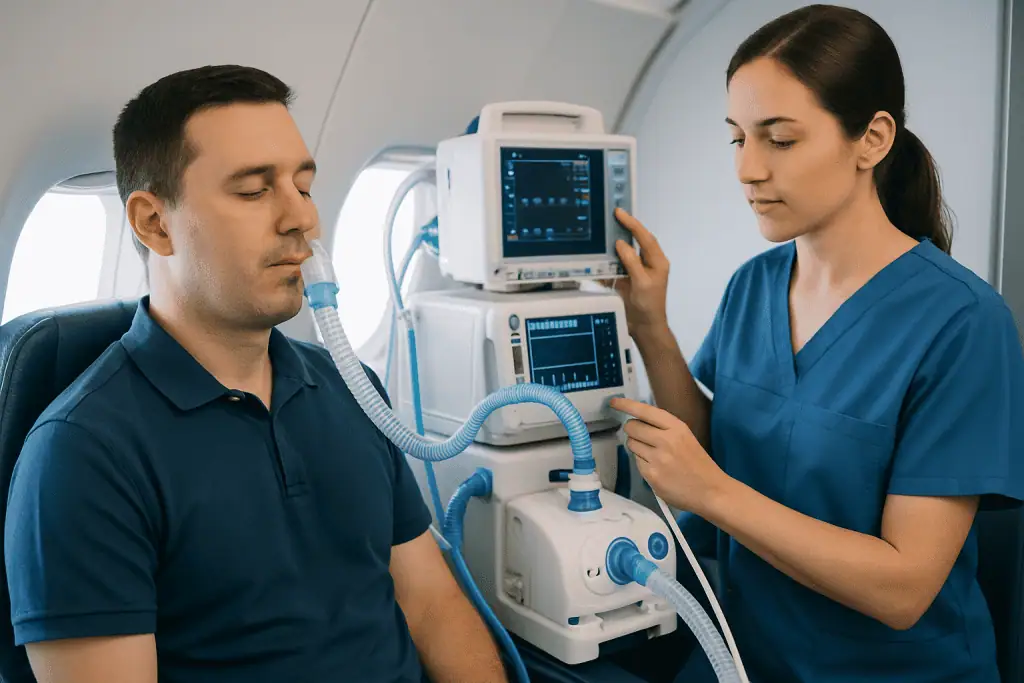
Wheelchair and mobility assistance inside airports is arranged through your airline, not through the hospital. Request it when you book the ticket, then reconfirm 48 to 72 hours before departure. Airlines work with standard categories, so use clear terms: assistance from check-in to the aircraft door, assistance during transit, or assistance from your aircraft seat all the way to arrivals if you cannot walk long distances. Turkey’s major international airports run large assistance operations daily, and the service is routine, but only for passengers who requested it. Our separate guide on how to arrange airport wheelchair assistance in Turkey explains the booking codes and meeting points step by step.
What qualifies for special assistance at the airport?
The threshold is lower than many people assume. You do not need to be a full-time wheelchair user. Special assistance is intended for anyone who cannot manage the airport journey unaided: that includes people who cannot walk long terminal distances, cannot stand in queues, cannot manage stairs to and from the aircraft, or need help stowing cabin baggage. Recent surgery, joint problems, heart or lung conditions, severe fatigue and older age all commonly qualify. You will not usually be asked to prove anything; you simply request the level of help you need. If your ability sits somewhere in the middle, describe it honestly, being pushed through a large terminal when you could have walked is a minor inconvenience, but walking a kilometre you could not manage is not.
Travelling with your own wheelchair or mobility device
If you use your own wheelchair, ask the airline how it will be carried, whether your battery type is accepted, and what technical details they need for powered devices, battery chemistry, watt-hours and whether the battery can be disconnected. Keep removable parts such as cushions, joystick controls, footrests and chargers with you in the cabin where possible; these are the pieces most often lost or damaged in the hold. Label the equipment with your name, phone number and your destination address in Turkey. If anything is damaged in transit, report it to the airline before you leave the airport and get written documentation. We cover this in depth in arriving in Turkey with mobility equipment.
On travel day, allow generous extra time for check-in, security, boarding and baggage collection. Pack medication, medical devices and supplies in your cabin bag with prescriptions or a doctor’s letter where appropriate. Your Acibadem International coordinator can help align airport timing with your onward transfer, but remember the division of responsibility: inside the airport, the airline and airport assistance provider run the service.
Accessible Transfers in Turkey

After a long flight, the road journey to your hotel or hospital should be the easy part. It will be, if the vehicle matches your needs. Before arrival, explain whether you can sit in a standard car, need help transferring from wheelchair to seat, need space for a folded manual chair, or need a vehicle that can carry you seated in your wheelchair. For power wheelchairs, share dimensions and weight: a device that will not fit through a vehicle door or exceeds a lift’s capacity is a problem no one can solve at the kerb.
Acibadem International patient services can help coordinate suitable transfer options as part of your travel planning, including airport pickup and hospital drop-off points, and whether your companion travels in the same vehicle. Be direct about this: vehicle types and availability vary, so a request made weeks ahead is far easier to meet than one made on landing. This is one of the areas where good mobility assistance for patients traveling to Turkey depends almost entirely on what you communicated in advance.
Build slack into the schedule. Traffic in Istanbul and other major cities varies sharply by time of day, and assistance through a large airport takes longer than walking through it. Leave a real buffer between landing, check-in and your first appointment. If sitting for long periods is painful or you tire quickly, ask whether the first hospital visit can be planned with rest time in mind. For a fuller picture of the whole arrival day, see flying to Turkey with limited mobility: airport, transfer and hotel planning tips.
Moving Around the Hospital Comfortably
Hospitals feel large when walking is hard, especially on a first visit in an unfamiliar country. Acibadem hospitals routinely support international patients who need wheelchair access, interpreter assistance and help finding the right department. Your international patient team can tell you which entrance to use, where to check in, where your coordinator will meet you, and how you will move between consultations, imaging, laboratory areas and inpatient units. Ask for this map of the day in advance: it removes most of the anxiety.
Tell the team plainly if queues, corridors or long waits are difficult for you. Appointments sometimes involve waiting; staff can plan around your limits far better when they know them. If you need a wheelchair on site, help with internal navigation, or simply a quieter place to sit between appointments, ask early rather than pushing on until you are exhausted. There is no advantage in arriving at a consultation depleted.
Interpreters do more than translate the consultation. They tell you where to go next, which documents are needed, and when to return: the practical glue of a hospital day. If your companion does not speak Turkish or English confidently, request interpreter support in your preferred language in advance. What happens after treatment, when your mobility may be temporarily worse than when you arrived, is covered in traveling to Turkey for treatment with limited mobility after arrival.
Choosing Accessible Accommodation, and What Turkey Is Really Like
Your hotel affects your recovery and your energy more than almost any other choice. The word “accessible” on a booking site is not evidence. Ask specific questions before paying: Is the entrance step-free? Is the lift large enough for your wheelchair? Does the bathroom have a walk-in shower, grab bars or a shower chair? How wide is the bathroom door? Is the room near the lift? Can a companion bed be added? Request photos or written confirmation. Standards vary widely between properties, and a hotel’s idea of accessible may not match yours.
Think about the route, not just the address. A hotel that looks close to the hospital on a map may sit up a steep street with uneven pavement. If you have several appointments, staying genuinely close to the hospital, or relying on organised transfers rather than walking, usually makes the week easier. Acibadem International can point you to accommodation commonly used by international patients near its hospitals, but confirm your personal access requirements directly with the property before payment.
Is Turkey disabled friendly?
Honestly: it is mixed, and it helps to know that before you land. Modern infrastructure, major airports, large hospitals, newer hotels and shopping centres, is generally well equipped with lifts, ramps and accessible toilets. Historic districts are a different matter: cobblestones, steep hills, high kerbs and steps into older buildings are common in the areas tourists most want to see. Public transport accessibility varies by city and by line. For a medical trip, this matters less than it would for a holiday, because your journey runs mostly between airport, hotel and hospital, all environments that can be planned. If you hope to do some sightseeing while you are here, plan those outings with the same specificity as the rest of the trip, and expect some places to be off limits or hard work.
Equipment, Medication and Daily Comfort
Bring the aids that make you safest and most independent, unless your care team advises otherwise: cane, walker, wheelchair cushion, transfer belt, braces, any compression garments your doctor has recommended, non-slip footwear, chargers and spare batteries. Turkey uses 230V power with European-style two-pin plugs, so bring the correct adapter for powered devices. If you use a CPAP machine, tell your airline and your coordinator in advance, powered medical devices need their own paperwork and planning.
Pack medications in their original packaging with a list showing generic names, doses and timing, and keep essential medicines in your cabin bag, never in checked luggage. If you take blood thinners, insulin, strong pain medication or any controlled medicine, ask your treating doctor whether you need a letter for travel and how to handle dose timing across time zones, do not adjust anything yourself.
Plan for comfort as deliberately as for equipment. Long travel days are draining: hydration, snacks if your treatment plan permits them, loose clothing and scheduled rest breaks all matter. If you are prone to falls, dizziness or sudden fatigue, tell your companion and the hospital team so unnecessary walking and standing can be designed out of your day. One safety note applies to every long-haul patient: if you develop sudden breathlessness, chest pain, or a painful, swollen leg during or after your journey, call your local emergency number or go to the nearest emergency department now.
Companion, Caregiver and Communication Support
A companion earns their seat many times over if you need help with transfers, personal care, medication reminders, luggage or simply a second pair of ears in appointments. Brief them properly: they should know your medication routine, your mobility limits, your allergies, your emergency contacts and where your documents are kept, in both printed and digital copies.
Be honest about personal care before you travel. Hospital staff support your medical care; help with bathing, dressing, toileting, transfers or overnight supervision outside hospital settings normally falls to a companion or a privately arranged caregiver. Clarifying this weeks ahead prevents a genuinely difficult situation on the ground. If nobody can travel with you, raise it with your coordinator early rather than hoping it will work out.
Finally, know your communication chain. Before you fly, confirm whom to contact if your flight is delayed, your equipment is damaged, a transfer vehicle is unsuitable, or you feel unwell on arrival. Your Acibadem International coordinator is the central point for hospital-related coordination; genuine medical emergencies always go through local emergency services, not a coordinator’s phone.
Costs, Insurance and Whether the Trip Makes Sense
Two questions come up constantly, so here are straight answers. First: tourists and international patients do not receive free healthcare in Turkey. Turkey’s public health insurance covers its residents; visitors pay for care, whether at public or private hospitals, either directly or through insurance. Emergency departments will treat you in an emergency, but treatment is billed. This is exactly why travel insurance deserves real attention before a medical trip, check what your policy covers, what it excludes for planned treatment abroad, and what documentation it requires. Our guide to travel insurance for treatment in Turkey lists the questions to put to your insurer.
Second: is it a good idea to travel to Turkey for medical reasons? Many international patients do so every year, and for planned, non-urgent treatment the logistics described in this guide are well-trodden ground. But the honest answer depends on you: whether your doctor confirms you are fit to fly, whether your condition allows a safe journey in both directions, whether follow-up care at home is arranged, and whether you have realistic support during travel and recovery. Discuss the decision with your treating doctor at home and with the hospital’s medical team before committing. A well-planned trip is manageable; a rushed one with reduced mobility is not worth the strain.
Step by step
- Describe your mobility needs in functional terms. Tell your coordinator your walking distance, stair tolerance, transfer ability and equipment, and whether the limitation is temporary or long-term.
- Confirm you are fit to travel. Before booking, ask your treating doctor whether flying is safe for you and what precautions apply. Request a medical summary and medication list in English if possible.
- Request airline assistance early. Add wheelchair or mobility assistance to the booking and reconfirm 48–72 hours before departure. For powered wheelchairs, provide battery and device details to airline requirements.
- Plan the accessible transfer. Share your arrival time, luggage volume, wheelchair dimensions and transfer ability before you land. Build in buffer time between airport, hotel and appointments.
- Verify accommodation access before paying. Ask about step-free entry, lift size, bathroom layout, shower access and room location. Never rely on a generic “accessible” label if you have specific needs.
- Organise hospital navigation support. Confirm which entrance to use, where your coordinator will meet you, and whether an on-site wheelchair or interpreter can be arranged. Flag any difficulty with waiting, walking or long sitting.
- Prepare the return journey. Before flying home, ask your medical team about travel timing, medication, wound care if relevant, and movement precautions. Reconfirm airport assistance and transfers for departure day.
Your checklist
- Medical summary, recent reports and fit-to-fly advice if needed
- Medication list with generic names, doses and timing
- Airline wheelchair or mobility assistance confirmation
- Details of wheelchair, walker, cane, batteries, chargers and spare parts
- Accessible transfer plan from airport to hotel or hospital
- Written confirmation of accommodation access, including bathroom setup
- Travel insurance documents and emergency contact numbers
- Power adapter for Turkey and chargers for any powered device
- Comfort items: cushion, non-slip shoes, snacks and water bottle
- Copies of passport, appointment schedule and coordinator contact details
Key takeaways
- Arrange mobility assistance before booking anything, flights, transfers and accommodation all depend on advance notice.
- Describe functional abilities, not just a diagnosis; “accessible” means little without specifics.
- Airport wheelchair assistance is requested through the airline; the hospital coordinates transfers, interpreters and in-hospital support.
- Healthcare in Turkey is not free for visitors, so check your travel insurance carefully before departure.
- Turkey’s hospitals and modern infrastructure are generally accessible; historic streets often are not, plan any sightseeing accordingly.
- A companion or caregiver matters most for personal care and transfers outside the hospital; arrange this honestly and early.
Frequently asked questions
What qualifies for special assistance at the airport?
Anyone who cannot manage the airport journey unaided qualifies: you do not need to be a full-time wheelchair user. Difficulty walking long distances, standing in queues, managing aircraft stairs, recent surgery, heart or lung conditions, severe fatigue and older age are all accepted reasons. Request the service through your airline when booking; you will not normally be asked for proof.
Is Turkey disabled friendly?
It varies. Major airports, large hospitals and newer hotels are generally well equipped with lifts, ramps and accessible facilities. Older districts often involve cobblestones, hills, steps and high kerbs, and public transport accessibility differs by city. A medical trip between airport, hotel and hospital can be planned smoothly; sightseeing in historic areas needs extra research and realistic expectations.
Do tourists get free healthcare in Turkey?
No. Turkey’s public health insurance covers residents, not visitors. Tourists and international patients pay for care directly or through insurance, and while emergency departments will treat genuine emergencies, the treatment is billed. Check your travel insurance carefully before a medical trip, including what it covers and excludes for planned treatment abroad.
Is it a good idea to travel to Turkey for medical reasons?
Many international patients travel to Turkey for planned treatment, and the logistics are well established. Whether it suits you depends on your fitness to fly, your condition, your follow-up arrangements at home and the support you have during travel and recovery. Discuss the decision with your treating doctor at home and the hospital’s medical team before committing.
Can I travel to Turkey with my own wheelchair?
Yes, many patients travel with their own manual or powered wheelchair. Inform your airline in advance and provide any battery or device details they request. Keep removable parts, cushions and controls with you in the cabin where possible, and label the equipment with your name, phone number and destination address in Turkey.
What should I do if my mobility equipment is damaged during travel?
Report the damage to the airline before leaving the airport and request written documentation. Take photos and keep receipts for any urgent repairs or replacements. Also tell your patient coordinator if the damage affects your ability to move safely or attend appointments, so alternatives can be arranged.
How do I know if a hotel room is truly accessible?
Ask specific questions before paying: step-free entrance, lift dimensions, bathroom door width, walk-in shower or grab bars, and room location relative to the lift. Request photos or written confirmation. Accessibility standards vary between properties, and a general “accessible room” label is not a guarantee that the room works for your equipment or transfers.
Should I bring a companion if I have reduced mobility?
A companion is strongly recommended if you need help with transfers, personal care, medication reminders, luggage or communication. Hospital teams support your medical care, but daily assistance outside the hospital usually requires a companion or a separately arranged caregiver. If you plan to travel alone, discuss this with your coordinator well before booking.
Add us as a Preferred Source to see more of our trusted health content across Google Search, AI Overviews and Discover.

Update history
- PublishedJune 8, 2026
- Medical review approvedSeptember 13, 2026
- Last content updateSeptember 12, 2026
References1
More Patient Guides

Airport Wheelchair Assistance: How to Book It for a Medical Trip
Airport wheelchair assistance is free, it exists at every commercial airport, and airlines are legally required to provide it, yet half…

Travelling With a Stoma: Flights, Supplies and Airport Screening
Traveling to Turkey with a stoma is manageable with the right supplies, airport screening plan, and recovery support in Istanbul or Turkey.
Mobility Aids in Turkey: Renting a Wheelchair, Walker, or Crutches
Mobility aids in Turkey can be rented through medical suppliers, pharmacies, and hospital-linked services in Istanbul and other cities.

Traveling to Turkey with Food Allergies or Special Diet Needs
Traveling to Turkey with food allergies or special diet needs is manageable with planning, translated allergy cards, and hotel and hospital support…