

Flying After Knee or Hip Replacement Surgery

There is no fixed calendar date for flying after knee or hip replacement surgery. Your surgeon clears you to travel once your wound, mobility, pain control and blood-clot risk have been assessed against the length and demands of your specific journey. Short flights are often considered earlier than long-haul routes, and many surgeons prefer more recovery time before an intercontinental trip. Individual clearance always decides.
One of the first questions international patients ask after joint replacement is when they can book the flight home. The honest answer: no calendar date decides it. Flying after knee or hip replacement surgery becomes appropriate when your surgeon confirms that your wound, mobility, pain control and blood-clot risk suit the journey you are planning, and a two-hour hop and a twelve-hour long-haul are not the same journey.
This guide explains what surgeons actually assess before clearing you to fly, why the timing differs from person to person, and how to plan the practical side, airport assistance, seating, documents and your recovery stay in Turkey, so the journey works around your recovery rather than against it.
At a glance
- The decision: Your treating surgeon clears you to fly. Timing depends on your operation, your recovery and the length of the flight, not on a universal rule.
- The main clinical concern: Surgery and long periods of sitting both raise the risk of venous thromboembolism (VTE), which includes deep-vein thrombosis and pulmonary embolism.
- Short vs long-haul: Short essential flights are sometimes considered in the early weeks; long-haul travel usually needs more recovery time and a specific prevention plan.
- Before you fly: Wound review, a confirmed clot-prevention plan, airline assistance bookings and fit-to-fly documentation where the airline requires it.
- On the journey: Regular movement when safe, hydration, sensible seating and no heavy lifting.
- Travel from Turkey: Build your recovery stay around post-operative checks and surgeon-led clearance, not around the earliest possible ticket.
Can you fly after knee or hip replacement surgery?
Yes, most people who recover without complications fly home, and many fly long-haul. The question is not whether but when, and that is an individual clinical judgement rather than a number of days you can look up. Flying after knee or hip replacement surgery is assessed on your wound healing, swelling, pain control, how safely you can walk and transfer, your general health, and your personal risk of blood clots. Two patients who had the same operation on the same day can reasonably be given different travel advice.
The flight itself is only part of the picture. Air travel means long periods of sitting still, but it also means airport distances, queues, security, boarding bridges or buses, luggage, and limited access to medical care while you are in transit. A journey with a tight connection through a large hub is more demanding than a direct flight of the same total length. Your surgeon weighs the whole itinerary, not just the hours in the air.
If you had your operation with Acibadem, your international patient coordinator can help you understand the travel plan your surgeon sets, arrange interpreter support and assist with practical matters such as transfer planning. The clinical decision about when you are fit to fly, however, always rests with your treating surgeon. For a broader view of how travel timing differs across operations, see our guide to flying after surgery, procedure by procedure.
A practical timeline for flying after joint replacement
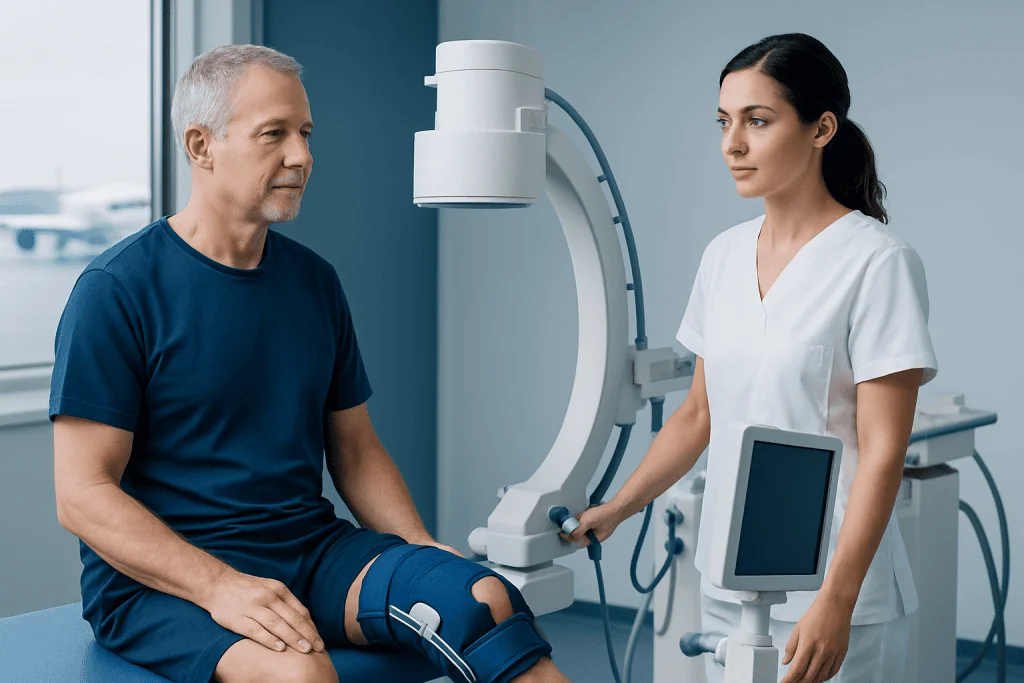
It is worth being direct about the evidence: there is no international consensus on a single safe flying date after hip or knee replacement, and published guidance varies. What surgeons broadly agree on is the shape of the decision. The earlier you fly, the more your clot risk, wound status and mobility matter; the longer the flight, the more cautious the advice tends to be. Use the timeline below to plan, and let your surgeon set the actual date.
| Recovery period | What usually matters for travel planning |
|---|---|
| Days 0–3 | Early recovery: pain control, wound care, first supervised walking, and prevention of immediate post-operative complications. Flying is generally not a realistic option in this window. |
| Days 4–7 | Swelling and reduced mobility usually still dominate. Airports are physically demanding at this stage, and international travel is commonly unsuitable unless there is a specific medical plan for it. |
| Week 2 | Many teams review the incision, walking progress and medicines around this point. Some patients are considered for short, essential flights, always with clot prevention in place and individual clearance. |
| Weeks 3–6 | Walking distance and confidence typically improve. Long-haul journeys may still call for careful assessment, a confirmed anticoagulation or prevention plan, and booked airport assistance. |
| After 6 weeks | Travel becomes easier for many patients with uncomplicated recoveries, and this is the window many surgeons prefer for long-haul flights. Clearance, seating and mobility planning still apply. |
Two more variables shape the timeline. First, your own risk profile: previous clots, heart or lung disease, obesity, smoking, limited mobility or a complicated recovery can all push the date later. Second, the airline: policies differ, and carriers can ask for medical clearance forms after recent surgery, particularly if you need oxygen, a wheelchair or special seating. Contact the airline as soon as your operation date is known, and do not assume a fit-to-fly letter automatically secures a particular service on board.
Why is flying not recommended soon after surgery?
Three things about air travel work against a body that is recovering from a major joint operation.
- Immobility. Surgery itself increases the tendency of blood to clot, and so does sitting still for hours. Put the two together in the early weeks and the combined risk of deep-vein thrombosis is higher than either alone. This is the central reason surgeons are cautious about early long-haul flights.
- The cabin environment. Cabin air is dry and cabin pressure is lower than at ground level. Dehydration thickens the blood slightly, and mild swelling of the legs and feet is common even in healthy travellers. Neither helps a leg that is already swollen from surgery.
- Distance from your team. In the first days after a joint replacement, problems such as wound issues or medication side effects are easiest to manage close to the team that operated. At 11,000 metres, or in a transit terminal, options are limited.
None of this makes flying dangerous forever. It explains why the early period carries the caution, and why the advice relaxes as your mobility returns, your wound closes and your clot-prevention plan runs its course.
Why blood-clot prevention is central to flight planning

Venous thromboembolism covers two related problems: deep-vein thrombosis, where a clot forms in a deep leg vein, and pulmonary embolism, where part of a clot travels to the lungs. Hip and knee replacement are among the operations where prevention is planned most carefully, precisely because the surgery involves the leg and the early weeks involve less movement than usual. A deep-vein thrombosis typically shows itself as new swelling, pain or warmth in one leg; a pulmonary embolism can cause chest pain, breathlessness or a racing heart. Understanding this is what makes the rest of the travel advice make sense: it is why flying after knee or hip replacement surgery is planned around movement, hydration and medication rather than around the ticket date.
Your surgeon will usually have prescribed a period of anticoagulant (blood-thinning) medicine, a mobilisation plan, and sometimes compression measures. Take prescribed medication exactly as directed, and never adjust the dose, extend the course or stop early to fit around a flight, any change belongs to your treating doctor. If time zones make dose timing unclear, raise it before you travel rather than improvising at the gate.
Compression stockings deserve a specific word. They can be helpful for some travellers, but they are not suitable for everyone after leg surgery, and a poorly fitted stocking can do more harm than good. Use them only if your team recommends a specific type and fit: our guide to compression socks for flying after surgery explains how they work and why the fit matters.
Preparing for the airport and the flight
Book wheelchair or electric-cart assistance with the airline and airport well in advance, for every segment of the journey including connections and arrival. Even if you walk short distances comfortably with a cane, crutches or a walker, terminals involve long corridors, stairs, buses and gate changes you cannot predict. Assistance costs nothing to request and removes the single biggest physical demand of the day.
Think about seating before you check in. An aisle seat makes it easier to stand and move when the seatbelt sign is off; extra-legroom seating can make positioning a stiff or swollen knee more comfortable. Avoid lifting bags into overhead lockers, ask a companion, airport staff or cabin crew to help within their procedures, and keep your own hand luggage light.
Security is a common worry and rarely a real problem. A hip or knee implant can trigger a metal detector; body scanners handle implants routinely. Tell security staff about the implant before screening and allow a little extra time. You do not usually need special paperwork for the implant itself, though carrying your discharge summary covers most questions.
In your hand luggage, keep: your discharge summary and operation details, a current medication list, enough medication for the whole journey plus a margin for delays (in original labelled packaging where possible), your surgeon’s contact details, travel insurance documents and any fit-to-fly letter the airline requested. Essential medicines never go in checked baggage.
- Drink water regularly unless you have been given fluid restrictions.
- Do the ankle and foot exercises your physiotherapist showed you while seated, and walk briefly when it is safe to do so.
- Keep your walking aid with you as far as the aircraft door, and confirm exactly where and when it will be returned on arrival.
- Build in extra time for security, boarding and connections, rushing is the enemy of a new joint.
Sitting positions, aircraft seats and the recliner question
A question many knee replacement patients ask is why they are told to avoid recliners at home. The concern is position, not the chair itself. After a knee replacement, regaining full straightening (extension) of the knee is one of the main goals of rehabilitation. Long, comfortable hours in a recliner tend to hold the knee slightly bent, which can encourage stiffness and make full extension harder to achieve. Low, soft chairs also make standing up more effortful, which matters when your leg is still weak. Most teams prefer a firm chair at a sensible height, with periods of straight-leg positioning as your physiotherapist advises.
The same logic applies at 38,000 feet. An aircraft seat holds your knee bent for hours, which is exactly the position rehabilitation is working against. You cannot change the seat, but you can change what you do in it: straighten the leg into the aisle briefly when it is safe, do your seated exercises regularly, and stand and walk when the seatbelt sign allows. Small, frequent movement beats one long walk.
Planning your recovery stay in Turkey
If you are travelling to Turkey for a hip or knee replacement, resist booking the return leg around the earliest conceivable date. Your stay needs to accommodate post-operative checks, wound review, medication adjustment and physiotherapy guidance, and enough days to become genuinely confident with transfers, stairs and walking before you take all of that to an airport. A flexible or changeable return ticket removes the pressure if your surgeon recommends waiting a little longer. Our guide to the knee replacement recovery timeline in Turkey covers what those first weeks typically look like, and if your procedure was planned with robotic assistance, the robotic-assisted knee replacement page explains the approach.
Acibadem’s international patient teams can coordinate the practical side of a recovery stay: interpretation, accommodation logistics, local transfers and communication of your discharge plan. These arrangements support the journey; they do not replace the medical review that decides when the journey happens.
Before you leave Istanbul or another Turkish city, make sure the paper trail travels with you. Ask for copies of your operative and discharge documents, relevant imaging or test results, clear medication instructions and the team’s contact details. Identify a clinician or physiotherapist at home for routine follow-up before you depart, not after. It is also worth knowing which post-operative issues your team wants to hear about before departure: our guide to warning signs to report before flying home covers this in detail.
What can delay travel clearance
Surgeons postpone clearance for good reasons, and knowing them helps you plan realistically. Common reasons a team delays a flight include fever, drainage or increasing redness at the wound, worsening swelling, pain that is not yet controlled, a fall, new difficulty walking, or side effects from medication that need adjusting. None of these necessarily changes the long-term outlook; they change the sensible date of departure.
Your history matters too. Previous deep-vein thrombosis or pulmonary embolism, bleeding disorders, atrial fibrillation, significant heart or lung disease, sleep apnoea, recent infection, cancer treatment or pregnancy can all affect how a team plans clot prevention and fitness to fly. Make sure your surgeon knows the full picture before the travel plan is set, so the prevention plan is built around you rather than around an average patient.
Once home, continue the rehabilitation, wound care and medication plan you were given. Travelling is tiring, and a temporary increase in stiffness or swelling after a long day of transit is common. Give yourself rest, elevate the leg if advised, and return to your regular exercise routine rather than treating the arrival day as the end of recovery.
Step by step
- Discuss travel before surgery. Tell your surgeon and coordinator when you hope to fly, how long the journey is and whether there are connections. Travel plans considered before the operation are easier to accommodate than plans announced at discharge.
- Keep the return flexible. Avoid non-refundable bookings for the earliest possible date. Your recovery determines departure timing, not the ticket.
- Attend every post-operative review. Use them to discuss pain, mobility, swelling, the incision and your medicines, and ask directly whether you are fit for the specific flight you have in mind.
- Confirm your clot-prevention plan. Review anticoagulant timing across time zones, mobility advice and any compression recommendation with your surgeon before you pack.
- Book airport assistance for every segment. Departure, connections and arrival, and confirm how your walking aid travels and when it comes back to you.
- Pack medical essentials in hand luggage. Medicines, prescriptions, discharge papers, a medication list and clinician contacts stay with you, with spare supplies for delays.
- Travel with a support plan. A companion who can manage luggage and navigation, plus accessible transfers at both ends, means you never stand longer or lift more than you should.
Your checklist
- Surgeon confirmation that you are fit for your specific flight
- A clear, written plan for prescribed anticoagulant or clot-prevention treatment
- Wheelchair or mobility assistance booked for each flight segment
- Fit-to-fly letter or airline medical form, if the airline requests one
- Discharge summary, operation details and medication list in hand luggage
- Enough labelled medication for the journey plus delays
- Aisle or suitable seat requested; accessible transfers arranged
- A companion or reliable assistance plan for luggage and connections
- Follow-up contact details for your team in Turkey and a clinician at home
Key takeaways
- There is no single safe flying date after hip or knee replacement; your surgeon’s clearance for your specific journey is what counts.
- Surgery and hours of sitting both raise clot risk, which is why prevention, medication, movement, hydration and sometimes compression, sits at the centre of flight planning.
- Short essential flights are sometimes considered earlier; long-haul routes usually justify more recovery time.
- Allow your stay in Turkey to cover post-operative checks, wound review and confident mobility before departure, and keep the return ticket flexible.
- Airport assistance, sensible seating, hand-luggage medical documents and light lifting make the journey itself far more manageable.
Frequently asked questions
How long after hip replacement surgery can a person fly?
There is no universally agreed date, and published guidance varies. In practice, short essential flights are sometimes considered within the first weeks for patients recovering well, while many surgeons prefer more recovery time, often around the six-week mark, before long-haul travel. Your own surgeon sets the date after reviewing your wound, mobility, medicines and clot risk.
How long after knee replacement surgery can a person fly?
The same principle applies as for hips: no fixed date, and the flight length matters. Knee replacement adds a practical layer, because swelling, bending and walking ability affect how well you manage airports and hours in a seat. Your team assesses how safely you can transfer, walk with your aid and sit for the full journey before clearing a specific flight.
Why is flying not recommended after surgery?
Three reasons dominate: surgery and prolonged sitting each increase clot risk, and combined they raise it further; dry cabin air and lower cabin pressure encourage dehydration and leg swelling; and problems in the early days are easiest to manage near the team that operated. The caution eases as healing progresses and your prevention plan runs its course.
Why no recliner after knee replacement?
The issue is position, not furniture. Recliners tend to hold the knee slightly bent for long periods, which works against regaining full straightening: a central goal of knee rehabilitation. Low, soft chairs also make standing up harder. Most teams recommend a firm chair at a good height, with straight-leg positioning as your physiotherapist directs. The same thinking applies to hours in an aircraft seat: move and straighten the leg regularly.
Do I need a fit-to-fly letter after joint replacement?
Some airlines ask for medical information or a clearance form, particularly soon after surgery or when assistance, oxygen or special seating is needed. Ask your airline what it requires before you travel and give your surgical team time to prepare the paperwork. A letter documents fitness; it does not replace the airline’s own approval process or your surgeon’s advice.
Can I take blood-thinning medication on a flight?
If anticoagulant medicine has been prescribed, it usually continues exactly as directed during travel. Keep it in your hand luggage with the prescription or medication list, and ask your team before departure how to handle dose timing across time zones. Any change to dose or duration is a decision for your treating doctor, never something to adjust around a flight.
Should I wear compression stockings on the plane?
They help some travellers, but they are not right for everyone after leg surgery, and fit matters as much as the decision to wear them. Ask your surgeon whether stockings suit you, which type and compression grade to use and for how long. A stocking that causes pain, numbness or colour changes in the foot is the wrong stocking.
Can Acibadem International help arrange my journey home?
International patient teams can coordinate practical matters: interpreter support, transfer planning, accommodation logistics and communication of your discharge plan. Your surgical and rehabilitation teams explain the follow-up recommendations for your recovery. The clinical decision about when you are fit to fly, and with which precautions, remains a personalised judgement made by your treating clinicians.
Add us as a Preferred Source to see more of our trusted health content across Google Search, AI Overviews and Discover.

Update history
- PublishedAugust 16, 2026
- Medical review approvedSeptember 2, 2026
- Last content updateSeptember 2, 2026
References2
- Hip replacement: NHS nhs.uk
- Knee replacement: NHS nhs.uk
More Patient Guides

Septoplasty Recovery: Week by Week
Learn what to expect after deviated septum surgery: a week-by-week septoplasty recovery timeline, when it is usually safe to fly home, and…

Gallbladder Surgery Recovery: Week by Week
Learn what to expect after gallbladder surgery: a week-by-week recovery timeline, pain, diet, wound care, when it is safe to fly home…
Robotic Hysterectomy Recovery: Week by Week
Recovery from robotic hysterectomy week by week: pain, lifting, wounds, driving, flying home safely, warning signs and questions to ask before you…

Breast Reconstruction Recovery: Week by Week
DIEP flap recovery week by week: hospital stay, drains, pain, walking, showering, driving, when it is usually safe to fly home, and…