

Compression Socks for Flying After Surgery: Why Surgeons Recommend Them

Travel pressure socks apply graduated compression, firmest at the ankle, lighter up the calf, to support venous blood flow while you sit still on a flight. After surgery they can help limit leg swelling, but they are one part of a travel plan your surgeon sets. Pressure level, fit, wear time and whether you need them at all depend on your operation, mobility and clot risk.
You have had your operation, the flight home is booked, and someone, a nurse, a friend, a forum, has told you to buy travel pressure socks. It is sensible advice for many patients, but not for all of them, and the details matter more than the purchase. This guide explains what compression socks actually do on a flight after surgery, who benefits, who should avoid them, and which decisions belong to your surgeon rather than to you.
Compression socks can support circulation and limit lower-leg swelling during air travel. They are not a substitute for your surgeon’s travel plan, and they do not make an early flight safe on their own. Whether you need them, how firm they should be and how long you wear them depend on your procedure, your mobility, your clot-risk history and how your recovery is going. Treat everything below as background for that conversation, not as a replacement for it.
At a glance
- Main purpose: Graduated pressure supports venous blood flow and limits travel-related leg swelling during long periods of sitting
- Best timing: Usually put on before the journey begins and worn until you are moving normally again, if your surgeon approves
- Key decision: Your surgeon confirms the type, pressure class, length and duration; a sock is not a self-prescribed item after surgery
- During a flight: Socks work alongside walking breaks, seated ankle exercises and hydration, not instead of them
- Not for everyone: Arterial circulation problems, certain wounds, reduced foot sensation and some heart conditions change or rule out compression
- Warning signs: New one-sided leg swelling, chest pain or sudden breathlessness are treated as medical emergencies wherever they occur
Why surgeons recommend travel pressure socks after surgery
Long periods of sitting slow the blood flow in your leg veins. That happens to every passenger, but surgery adds several factors of its own: the operation itself can make blood more prone to clotting for a period afterwards, you may be walking less than usual, and pain or dressings can keep you still in your seat. Dehydration on a long flight adds another layer. Each factor on its own is modest; stacked together, they raise the risk of leg swelling and, for some patients, deep vein thrombosis (DVT).
Travel pressure socks address one part of that picture. Graduated compression applies the firmest pressure at the ankle and progressively less up the calf, which supports the natural upward return of venous blood while the calf muscles are inactive. This is why the graduation matters: a sock that is uniformly tight, or tightest at the top, does not do the same job and can be counterproductive.
It is worth being clear about what the socks do not do. They do not thin your blood, they do not replace movement, and they do not remove the clot risk created by recent surgery. Surgeons who recommend compression socks for flying after surgery almost always recommend them as one layer in a wider plan: a travel date that suits your recovery, walking at intervals, ankle exercises in your seat, adequate fluids and, for some higher-risk patients, prescribed anticoagulant medication. The guide on lowering DVT risk on long flights covers those other layers in detail.
If you are flying home after treatment in Turkey, ask your surgical team for written travel and aftercare instructions before discharge, including whether compression is part of your plan. Practical arrangements, seats, transfers, timing, can be organised around that plan, but clinical decisions about travel and compression stay with the treating team.
Do travel pressure socks actually work?
This is the question most people are really asking, so it deserves a straight answer. Research on healthy long-haul travellers suggests that graduated compression reduces leg swelling and is associated with fewer clots forming silently in the legs during flights, compared with flying bare-legged. That evidence is reassuring, but it comes with two honest caveats for a postoperative traveller.
First, most travel-sock research involves ordinary passengers, not people flying days or weeks after an operation. Your risk profile after surgery is different, which is exactly why the decision is individual rather than something you can settle by reading product reviews. Second, the benefit depends on getting the details right: the correct pressure class, the correct size, the sock worn smooth and unrolled for the whole period of sitting. A poorly fitted sock can dig in, bunch behind the knee or act like a tourniquet at the top band, worse than wearing nothing.
So yes, pressure socks genuinely do something useful on an aircraft. The cabin itself changes little about how they work; the relevant factor is hours of immobility, which is why the same logic applies to long car, coach and train journeys. What the evidence does not support is treating them as a licence to fly earlier than your surgeon advises.
A practical timeline for wearing flight socks after surgery
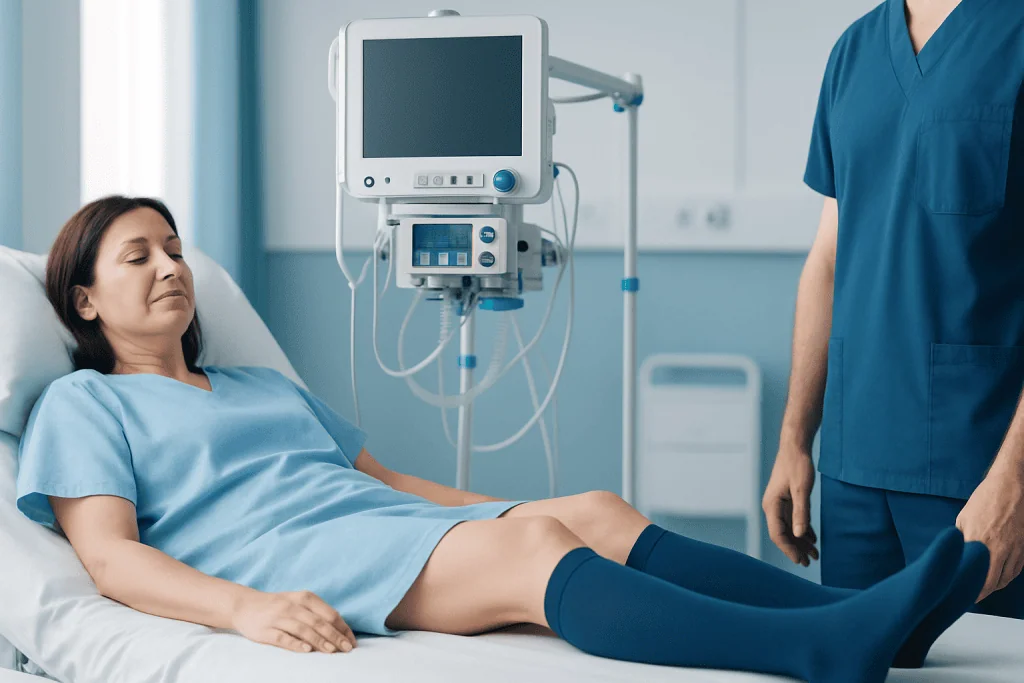
No single schedule fits every operation. A minor day-case procedure with normal mobility is a different situation from abdominal, orthopaedic, vascular, cancer or reconstructive surgery, and the safe interval before flying varies procedure by procedure: the guide on how soon flying is safe after surgery walks through those differences. The table below is a framework for the conversation with your surgeon, not permission to fly or to start compression independently.
| Recovery period | What to discuss with your surgeon | Compression-sock focus |
|---|---|---|
| Before surgery | Your clot-risk factors, expected mobility afterwards, planned return flight and any existing leg or circulation condition. | Ask whether you will need graduated socks or prescribed stockings, and get measured while you can do it comfortably. |
| Days 0–3 | Whether travel is appropriate at all in this window, wound care, pain control and safe walking distances. | Do not assume flight socks are suitable this early; follow the postoperative plan exactly. |
| Days 4–7 | How well you are walking, how much swelling you have, and whether the planned journey should be postponed. | If approved, wear the socks precisely as instructed and check your skin at every removal. |
| Weeks 2–4 | Whether your recovery and any procedure-specific restrictions allow flying yet. | Some patients use compression for the journey only; others need a longer daily plan. |
| After week 4 | Whether ongoing swelling, reduced mobility or continuing clot-prevention treatment changes your needs. | Continue only for the duration your surgical team recommends, then stop as instructed. |
Expect a longer or more cautious plan if you have had a previous clot, are much less mobile than usual, live with obesity, smoke, take oestrogen-containing medication, are pregnant or recently gave birth, have active cancer, or carry other clotting risks. Older patients often sit further along the risk spectrum too. A generic online timeline should never override individual postoperative advice.
Do I really need compression socks on a plane?

Not every traveller does. For a short flight, a fully mobile passenger with no risk factors gains little. The case for compression socks for flying strengthens as three things stack up: the length of the journey, how recently you had surgery, and your personal clot-risk history. For a postoperative patient on a long-haul or multi-leg itinerary, most surgeons will want compression as part of the plan, and for some higher-risk patients, a sock alone is not considered enough, and prescribed anticoagulation or a later travel date comes into the discussion instead.
Ask your surgeon three specific questions before you book: whether your itinerary counts as long-haul in clot-risk terms (total sitting time across connections, not just the longest flight); when you can safely fly after your particular operation; and whether ordinary travel socks are adequate or you need a prescribed medical garment. The distinction matters: a separate guide explains when patients need medical compression stockings rather than travel socks.
Once you are cleared to fly, the sock is still only one measure. Choose an aisle seat where possible, walk when the seatbelt sign allows, flex and circle your ankles while seated, avoid tight waistbands and leg clothing, and drink water regularly. Keep alcohol modest or skip it: it dehydrates you and can interact with postoperative medication.
Choosing socks: pressure class, length and fit
Searches for the best compression socks for travel usually return brand lists. After surgery, the honest answer is that the best sock is the one that matches your prescription in three respects, whatever the label says.
- Pressure class. Compression is graded in millimetres of mercury (mmHg). Lighter classes are typical for general flight use; firmer medical classes are prescribed for specific conditions. Which class you need after surgery is your surgeon’s call, firmer is not automatically better, and can be harmful for some patients.
- Length. Knee-length is standard for flight use and easiest to wear correctly. Thigh-length elastic stockings for flying are sometimes prescribed after particular operations; use the length your team specifies rather than upgrading on your own initiative.
- Fit. Sizing is based on measurements, usually ankle and calf circumference, sometimes calf length, taken when swelling is lowest, typically first thing in the morning. A sock sized off shoe size alone is a guess. If your postoperative legs are more swollen than usual, your pre-surgery measurements may no longer apply, which is another reason to involve your team.
Fabric and features (open toe, zip aids, moisture-wicking yarn) are comfort choices; graduation, class and fit are the clinical ones. If you already wear a surgical garment on your torso or limbs, check how flight socks fit into that overall plan: the guide to compression stockings and garments after surgery in Turkey explains how the pieces work together.
Who should not wear flight socks?
Compression is not universally safe, and this is where self-prescribing goes wrong most often. Conditions that change or rule out compression include peripheral arterial disease or otherwise poor arterial circulation, severe neuropathy or reduced sensation in the feet, significant leg swelling from heart failure, active skin infection on the leg, untreated leg ulcers, a poorly healing wound under the garment area, and allergy to the sock material. In arterial disease especially, external pressure can restrict blood supply the leg is already struggling to receive.
Other situations call for individual assessment rather than an off-the-shelf sock: diabetes with circulation or nerve complications, severe varicose vein disease, a history of blood clots, unexplained leg pain, or a recent change in skin colour or temperature. A patient with an already-diagnosed DVT is in a different category altogether, where both compression and fitness to fly are decisions for the treating clinician, not for a packing list.
While wearing the socks, certain changes mean the garment should come off and be reassessed before further use: numbness, tingling, increasing pain, cold or pale toes, blue discolouration, deep indentation marks that do not settle, blistering or broken skin. A correctly fitted flight sock feels firm and supportive. It should never feel painful, and your toes should stay warm and their normal colour.
How long should you wear compression socks for a flight?
If your surgeon approves flight pressure socks, the usual instruction is to put them on before the period of prolonged sitting begins, often before leaving for the airport, and keep them on until you are moving normally again. Depending on your individual plan, that can include airport waiting time, the flight itself, transfers between terminals, and a short period after arrival.
There is no universal number of hours. A three-hour direct flight and a multi-leg intercontinental journey create very different stretches of immobility, and your procedure and clot risk matter as much as the flight time. What you want from your surgeon is a clear start point and stop point in writing, particularly if you have swelling, dressings, fresh incisions or a prescribed anticoagulant running alongside.
For the return journey from Istanbul or another Turkish city, build slack into the itinerary rather than efficiency. Wheelchair or buggy assistance where recommended, a hotel night near the airport for early departures, and a flexible ticket all reduce the pressure to rush while you are recovering. The guide on planning your return flight after surgery in Turkey covers seat choice, connections and timing in detail.
How many hours a day after surgery?
Daily wear time depends entirely on why the socks were prescribed. Some patients wear compression only for journeys; some wear it through daytime hours as part of postoperative swelling control; some follow a procedure-specific schedule set by their surgical team. Overnight wear is sometimes instructed and sometimes explicitly avoided, do not assume either way, because postoperative plans genuinely differ.
Follow the written schedule from your team, including its guidance on bathing, dressing changes and sleep. If you have been told to wear compression during the day, putting the socks on in the morning, before gravity has done its work on your ankles, is usually easiest, then removing them at the instructed time and inspecting your skin.
Resist the logic that more compression must be better. Extending wear time beyond your instructions adds skin risk without adding benefit. Worsening swelling, persistent pressure marks, changes around an incision, or growing difficulty getting the garment on and off are all things your team will want to know about at follow-up, because they can signal a wrong size, a wrong pressure class, or a separate cause of swelling that needs its own assessment.
Using compression socks safely when you travel
Technique is unglamorous but decisive. Put the socks on with your legs at their least swollen, smoothing the fabric from the toes upward so the heel pocket sits on your heel and there are no wrinkles, especially behind the knee. Never fold, roll or turn down the top band: a rolled band concentrates pressure in a ring, which defeats the graduation entirely.
Check your feet and legs before putting the socks on and again after removing them, paying attention to skin near dressings, bony points and anywhere sensation is reduced. Pack a spare pair in hand luggage for a long journey, alongside your discharge letter, medication list and follow-up contacts: the broader packing logic is covered in the guide on what to bring and buy for recovery compression.
Finally, know the signs that matter, so nothing gets dismissed as ordinary travel stiffness. New swelling, pain, warmth or redness in one leg can indicate a clot; sudden breathlessness, chest pain, coughing blood, faintness or a racing heartbeat can indicate a clot that has travelled to the lungs. Clinicians treat these as emergencies wherever they occur, in an airport, on board, or after you land, and cabin crew are trained to arrange medical support in flight. Knowing this in advance is part of travelling prepared, not a reason to travel anxious.
Step by step
- Confirm that you are fit to travel. Before taking a return flight, ask your surgeon when flying is safe after your specific operation, taking into account flight length, connections, mobility, current symptoms and any clotting history.
- Ask for a written compression plan. Confirm whether you need socks or stockings, the pressure class and length, and exactly when to put them on and take them off. Ask whether medication or other clot-prevention measures sit alongside them.
- Get the fit checked. Use the size your team or a qualified fitter determines from leg measurements. The socks should lie smooth without rolling, bunching, pain, numbness or colour change in your toes.
- Plan a lower-stress airport journey. Allow extra time for check-in, security and boarding, and arrange airport assistance in advance if walking long distances is difficult.
- Keep moving during travel. Walk when permitted, and do ankle pumps, circles and calf contractions while seated. Avoid sitting with your legs tightly crossed for long stretches.
- Follow your medication instructions exactly. Take anticoagulants and other prescribed medicines as directed, and do not add aspirin, blood thinners or supplements for the flight unless your doctor has specifically prescribed them.
- Inspect your legs after arrival. Remove or continue the socks as instructed, check your skin, and note any new swelling or discomfort so it can be assessed rather than ignored.
Your checklist
- Written travel advice or clearance from your surgeon
- Correctly sized compression socks, if recommended, plus a spare pair
- Medication list and enough prescribed medication for the whole journey
- Discharge summary and procedure details in hand luggage
- Emergency contact details and follow-up plan
- Loose, comfortable clothing and easy-to-remove footwear
- Water bottle to fill after security, where permitted
- Airport mobility assistance booked if needed
- Aisle seat requested and time allowed for walking breaks
Key takeaways
- Graduated travel pressure socks support venous blood flow and limit swelling during long periods of sitting, and research in ordinary travellers supports their use on long flights.
- After surgery, they are a prescribed part of a wider plan: the pressure class, length and wear schedule come from your surgical team, not from the packaging.
- They do not replace movement, hydration, medication or a sensible travel date, and they never make an early flight safe on their own.
- Arterial disease, reduced foot sensation, certain wounds and heart-related swelling change or rule out compression; these situations need clinical assessment first.
- Fit is everything: measured sizing, smooth fabric, no rolled top band, and removal for reassessment if toes become numb, painful, cold or discoloured.
Frequently asked questions
Do compression socks actually help during travel?
Evidence from long-haul travellers suggests that properly fitted graduated compression reduces leg swelling and is associated with fewer silent clots forming in the legs during flights. The benefit depends on correct graduation, size and wear time. After surgery, your risk profile is different from an ordinary traveller’s, so the decision about whether and how to use them sits with your surgical team.
Do pressure socks work on an aeroplane specifically?
The relevant factor is hours of immobility rather than anything unique to the cabin, so the socks work the same way on a plane as on a long car or train journey. Flights simply combine long sitting with dehydration and cramped seating, which is why they are the setting where compression is most often recommended.
What are the best compression socks to wear for travel?
The best sock is the one that matches your clinical needs: genuinely graduated compression, the pressure class and length your surgeon recommends, and a size taken from your actual leg measurements. Brand, colour and fabric are comfort preferences. After surgery, resist choosing by review score alone: a well-reviewed sock in the wrong size or class can do more harm than good.
Can I fly soon after surgery if I wear compression socks?
Socks do not automatically make early flying safe. Fitness to fly depends on your operation, anaesthetic recovery, wound status, mobility, bleeding and clot risk, and any procedure-specific restrictions. Your surgeon should clear the travel date and confirm whether compression forms part of your plan.
Are flight socks the same as medical compression stockings?
Not always. Travel socks are generally lighter, off-the-shelf garments for flight use, while medical stockings are prescribed at a specific pressure class and length for a particular condition or postoperative need. Use the type your surgical team recommends rather than judging by packaging claims.
Should I wear compression socks overnight after surgery?
Only if your surgeon has specifically instructed it. Many postoperative plans have compression removed at night, but schedules vary with the procedure, the degree of swelling and the clot-prevention strategy. If this was not covered before discharge, it is worth having it written into your aftercare instructions.
Do I need blood thinners as well as compression socks for a flight?
Some higher-risk patients are prescribed anticoagulant medication around travel, but that decision belongs to the clinician managing your recovery, because the benefit has to be weighed against bleeding risk after surgery. Do not add aspirin or leftover blood thinners for a flight on your own initiative.
Add us as a Preferred Source to see more of our trusted health content across Google Search, AI Overviews and Discover.

Update history
- PublishedAugust 19, 2026
- Medical review approvedSeptember 13, 2026
- Last content updateSeptember 13, 2026
References3
- NHS: Deep vein thrombosis (DVT) nhs.uk
- CDC Travelers' Health: Deep Vein Thrombosis and Pulmonary Embolism wwwnc.cdc.gov
- MedlinePlus: Compression stockings medlineplus.gov
More Patient Guides

Septoplasty Recovery: Week by Week
Learn what to expect after deviated septum surgery: a week-by-week septoplasty recovery timeline, when it is usually safe to fly home, and…

Gallbladder Surgery Recovery: Week by Week
Learn what to expect after gallbladder surgery: a week-by-week recovery timeline, pain, diet, wound care, when it is safe to fly home…
Robotic Hysterectomy Recovery: Week by Week
Recovery from robotic hysterectomy week by week: pain, lifting, wounds, driving, flying home safely, warning signs and questions to ask before you…

Breast Reconstruction Recovery: Week by Week
DIEP flap recovery week by week: hospital stay, drains, pain, walking, showering, driving, when it is usually safe to fly home, and…