

Hospital Bed Controls and Safe Positioning After Surgery in Turkey

After surgery, use only the bed controls your nurse has shown you, make small adjustments, and pause to see how you feel. Most patients rest with the head of the bed slightly raised, but the right position depends on your operation. Press the call bell before sitting up fully, standing or walking for the first time, anaesthesia and pain medicines can affect your balance more than you expect.
You wake up after surgery, you need to sit up a little, and there is a panel of buttons on the bed rail that you have never seen before. Which one is safe to press? Should you wait for someone? Most patients ask themselves exactly this in the first hours.
This guide explains hospital bed controls and safe positioning after surgery in Turkey: what the buttons do, which positions are commonly used, how to move without straining your wound, and when to call for help. It is general information for your hospital stay: your own nurse’s instructions always take priority, because they know your operation and your current condition.
At a glance
- Best first step: Ask your nurse to demonstrate the bed controls before you use any of them alone. Some buttons are deliberately locked.
- Key safety habit: Press the call bell before getting out of bed, especially in the first day after anaesthesia or after any pain medication.
- Most common resting position: Head of the bed slightly raised, unless your surgical team has set specific limits for your procedure.
- Movement rule: Small adjustments, then pause. Avoid twisting, reaching far across the bed, or pulling yourself up with one arm.
- Language support: Interpreter assistance is available so bedside instructions are clear, not guessed.
- Family role: Your companion can remind you to call staff and pass you items, but should not lift or move you without nursing guidance.
Why your hospital bed matters after surgery
Your hospital bed is more than a place to rest. In the first days after an operation it is a working piece of equipment: it helps you sit up to breathe and eat, protects your incision from strain, lets nurses examine you without awkward lifting, and gives you a stable base for your first steps. Understanding hospital bed controls and safe positioning after surgery in Turkey, or anywhere else, is one of the simplest ways to make your recovery smoother and reduce the risk of a fall or a pulled line.
It is normal to feel unsure about which buttons to press, especially in an unfamiliar hospital and while anaesthesia is still wearing off. At Acibadem hospitals, your nurse can walk you through the control panel and explain which positions suit your procedure. If anything is unclear, asking twice is always appropriate; repetition is normal when you are tired and medicated.
In the first hours and days after surgery, your balance, strength and reaction time may be different from usual. Pain medicines, IV lines, drains, catheters, monitors and compression devices can all make simple movements more complicated than they look. For this reason, safe bed use is a shared process between you, your nurse and, when present, your companion, not something you work out alone by trial and error.
Understanding common hospital bed controls
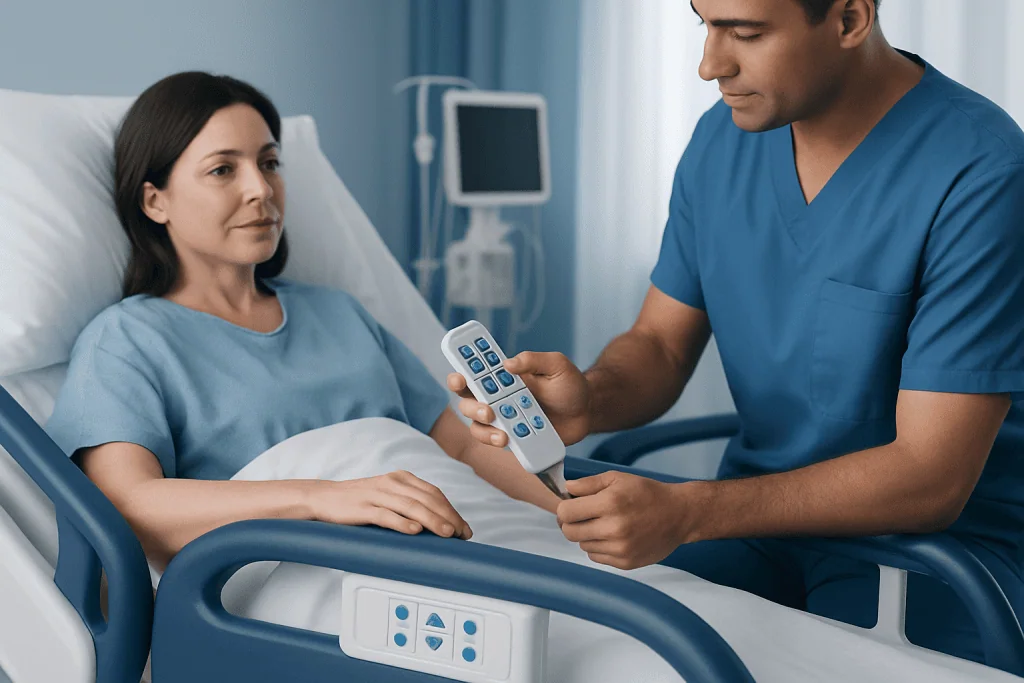
Most modern hospital beds have controls on the side rail, on a handheld remote, or both. The symbols vary between manufacturers, but the functions are broadly the same. The controls a patient typically uses are:
- Head-up / head-down. Raises or lowers the backrest so you can sit more upright for breathing, drinking, eating or talking, then recline again to rest.
- Knee or leg section. Raises a gentle bend under the knees. This can reduce sliding down the bed and ease tension in the lower back, but after some operations it should only be used as your nurse directs.
- Bed height. Moves the whole bed up or down. The safest height for resting is usually low; the safest height for standing is one where your feet reach the floor with your knees at a comfortable angle. These are not the same, which is why staff often adjust height for you.
- Call bell. Sometimes built into the same remote, sometimes a separate cord or button. This is the control that matters most, make sure you can always reach it.
Controls that belong to staff
You may also see buttons for whole-bed tilt (head-down or feet-down tilt), chair position, alarm settings, brake indicators or a full flat-lowering function. These are intended for clinical use, for example, staff may tilt or flatten the bed during examinations or procedures. Some panels have a lock function, so do not worry if a button does not respond; it may be intentionally disabled for your safety. If you are unsure what a symbol means, press the call bell rather than experimenting.
- Make small adjustments and wait a few seconds to see how your body responds before adjusting further.
- Keep the call bell, water, tissues, glasses and phone within easy reach, reaching and leaning cause more accidents than the buttons themselves.
- Tell your nurse if the remote falls, becomes tangled in tubing, or is hard to reach.
- Ask for an interpreter if the instructions are not fully clear in the language being used.
How should a hospital bed be positioned? Common positions explained
Nurses use a small set of standard bed positions, and knowing their names makes bedside conversations easier:
- Supine (flat on the back). Used for some examinations and for rest after certain procedures. Not everyone tolerates it comfortably straight after surgery, especially if breathing feels heavy.
- Semi-Fowler’s (head raised to a gentle incline). A very common post-operative resting position. It can make breathing easier, reduce reflux and let you see the room without straining your neck.
- Fowler’s (head raised closer to sitting). Often used for meals, drinks and coughing or breathing exercises, when your team has approved sitting up.
- Lateral (lying on your side). Used for pressure relief and comfort, usually with pillows behind the back and between the knees. After some operations only one side is permitted, or side-lying is restricted altogether.
- Head-down or feet-down tilt. Clinical positions used by staff in specific situations. These are not positions you select yourself.
Which of these applies to you depends on your operation. Abdominal and bariatric procedures often favour a slightly raised head with gently bent knees to reduce pull on the abdominal wall. Chest and cardiac procedures usually involve specific instructions about how to sit up without straining the breastbone. Spinal, orthopaedic, ophthalmic and plastic surgery procedures can each carry their own positioning rules, some strict, some flexible. This is exactly why the guidance in this article stays general: the correct position is the one your surgical team specifies for your case.
Safe positions for comfort and recovery

Your safest position depends on your operation, anaesthesia, pain level and any devices attached to you. In many cases, slightly raising the head of the bed makes breathing easier and feels more natural while you are awake. Some procedures, however, set limits on sitting angle, bending, twisting or leg position, follow your team’s instructions even when a different position feels tempting.
When you do move, move deliberately. Avoid sudden twisting, reaching far across the bed, or hauling yourself up with one arm. If you have slid down and need to move higher in the bed, ask for help rather than pushing hard with your heels and elbows; nurses have techniques and equipment, such as slide sheets, that reposition you with far less strain on your wound and their backs.
Pillows are genuinely useful when placed well. Depending on your surgery, they may support your back in side-lying, sit between your knees to keep hips aligned, lift a swollen limb, or brace your abdomen when you cough. Do not stack pillows in a way that bends your body sharply, and never let a pillow press on an incision, drain, catheter or IV line. Ask your nurse to show you the arrangement that fits your procedure: it takes a minute and saves hours of discomfort.
If you notice new pain, dizziness, breathlessness, numbness, or pulling at a wound or tube after changing position, stop where you are and call the nurse. These sensations do not always mean something is wrong, but they should be checked before you keep moving.
Positioning when you spend long periods in bed
Some patients are up and walking within hours; others spend a day or more mostly in bed. If that is you, position changes become part of your care, not just comfort. Lying in one position for long stretches puts sustained pressure on the skin over bony points, heels, hips, tailbone, shoulder blades, the back of the head, and sustained pressure is what leads to pressure sores.
The general principles nurses follow for patients who cannot move freely are simple: change position regularly rather than staying still for many hours, use a gentle side tilt supported by pillows rather than lying hard on the point of the hip, keep heels slightly lifted off the mattress where advised, and keep the head of the bed at a moderate rather than steep angle for long periods, because a steep angle increases sliding and friction on the lower back. Many hospital mattresses are pressure-relieving by design, but repositioning still matters.
You do not need to manage this yourself. Nursing staff plan turning and repositioning for patients who need it, and they will show you which changes you may make on your own. What you can do is speak up: tell your nurse if any area of skin feels sore, numb or hot, if you have been in one position longer than feels comfortable, or if a device such as an oxygen line or compression sleeve is pressing into your skin.
Using the call bell before you move
The call bell is the most important control at your bedside. Use it before getting out of bed, walking to the bathroom, adjusting any equipment, or moving when you feel weak, sleepy or uncertain. Nurses genuinely prefer an early call to responding after a fall or a pulled IV line, asking is not a bother, it is part of the system working as intended.
A common trap: you feel completely fine lying down, then dizzy the moment you sit or stand. This can happen because of anaesthesia, pain medicine, fasting before surgery, blood pressure changes on standing, or simply having been horizontal for a while. The safe sequence is staged: sit up in bed first, then sit on the edge with your feet on the floor and pause, then stand with someone beside you. A nurse or care assistant will guide you through this the first time and tell you when you can do it independently.
If a companion is staying with you, it may be tempting to ask them to lift you or walk you to the bathroom. Companions are excellent at emotional support, passing items and pressing the call bell, but they should not move you physically unless a nurse has shown them exactly how to help. This protects both of you. If you have travelled without a companion, the nursing team simply takes on more of this role; our guide on travelling to Turkey for surgery alone covers how to plan for that.
Preventing falls and bedside accidents
Falls are among the most preventable problems during a hospital stay, and they are not limited to frail patients. Fit, independent people fall after surgery because their body is still processing anaesthesia, medication and the operation itself. The safest mindset is to treat every first movement as assisted until your care team confirms otherwise.
Practical habits that help:
- Keep the bed low when resting, unless staff have raised it for care.
- Keep the path to the bathroom clear of bags, cables and charging leads.
- Wear slippers with non-slip soles, and make sure gowns or robes are not dragging on the floor.
- Put on glasses or hearing aids before standing, so you can orient yourself properly.
- Do not step over tubes, cables or compression devices, ask staff to reroute them.
- Never lean on a wheeled bedside table unless staff confirm it is locked.
- Sit at the edge of the bed before standing, and pause there.
- Tell your nurse if you feel confused, sleepy, nauseated or unsteady at any point.
Side rails deserve a specific mention. They can support safe turning and reduce the chance of rolling toward the edge, and staff decide when they should be up based on your condition. They are never meant to be climbed over, climbing a rail turns a small risk into a large one. If a rail is up and you need to get out of bed, press the call bell and wait for it to be lowered safely.
Communication support for international patients
When you are recovering in another country, small practical details can feel more stressful than the operation itself. You may understand the overall treatment plan yet still feel unsure about bedside instructions, button symbols, visiting routines or bathroom assistance. Clear communication at the bedside is part of safe care, not an extra, and understanding hospital bed controls and safe positioning after surgery in Turkey is much easier when instructions arrive in a language you fully understand.
Acibadem supports international patients with coordination services and interpreter assistance during the hospital stay. If a nursing instruction, mobility rule, medication timing or discharge preparation is unclear, ask for language support rather than guessing. It also helps to agree simple shared phrases with your nurse and companion, “call before standing”, “wait before walking”, and to ask staff to point out the call bell and your recommended resting position more than once. Nobody expects you to memorise everything on the first pass after anaesthesia.
What to expect as you become more mobile
Your bed positions and movement plan will change as you recover. Early on, you may need help with every adjustment. Later, your team may encourage you to sit up for meals, dangle your legs at the bedside, stand with assistance, and take short supervised walks, early, guided movement is a normal part of modern post-operative care for many procedures, because it supports breathing and circulation.
Do not measure yourself against the patient in the next room. Different operations, pain levels, medical histories and travel distances all affect how quickly someone feels steady. Your team guides you based on your own recovery, not a general timetable.
Before discharge, ask which sleeping and resting positions are recommended at your hotel or home, because hotel beds do not adjust the way hospital beds do. You may want extra pillows, a plan for getting in and out of bed, and a clear night-time route to the bathroom. It is also worth asking practical questions about the days that followshowering safely after surgery, which symptoms your team wants reported, and when it is reasonable to fly homewhile your care team is still in front of you.
Step by step
- Ask for a bedside demonstration. Once you are alert after surgery, ask your nurse to show you each button you are allowed to use, and confirm which controls are staff-only.
- Keep essential items within reach. Place the call bell, water, tissues, phone and glasses where you can reach them without stretching. If something falls, call for help rather than leaning over the rail.
- Adjust your position slowly. Use small changes rather than going from flat to upright in one move. Pause after each adjustment and notice any dizziness, pain, nausea, pulling or breathlessness.
- Call before standing. Even if you feel strong, call the nurse before your first attempts to sit on the edge, stand or walk. Staff will check lines, drains, footwear and your balance first.
- Use pillows with guidance. Ask where pillows belong for your surgery type. Good support reduces strain; poor placement can press on sensitive areas.
- Change position regularly if you are mostly in bed. Follow the repositioning plan your nurses set, and report any sore or numb areas of skin early.
- Involve your companion safely. They can remind you to use the call bell and help communicate, but should not lift, pull or walk you without nursing guidance.
- Review your hotel or home setup before discharge. Ask how to sleep, sit up and get out of an ordinary bed after you leave, especially if you will spend recovery nights in a hotel before travelling.
Your checklist
- I know where the call bell is and can reach it easily.
- A nurse has shown me which bed controls I may use.
- I understand whether I may raise the head, legs or bed height myself.
- I know my recommended resting position and any positions to avoid.
- My slippers or walking shoes have non-slip soles.
- My phone, glasses, water and personal items are within easy reach.
- I will call staff before getting out of bed or going to the bathroom.
- My companion knows not to lift or move me without nursing guidance.
- I know which sensations to report after changing position.
- I have asked for interpreter support wherever an instruction was unclear.
- I have asked about sleeping positions and bed setup after discharge.
Key takeaways
- Hospital bed controls improve comfort and independence, but use only the ones your nurse has demonstrated, some are locked or staff-only by design.
- Most patients rest with the head slightly raised, yet the right position always depends on the specific operation; follow your team’s limits.
- Safe positioning means small deliberate movements, no twisting or far reaching, and pillow support placed with guidance.
- If you spend long periods in bed, regular position changes protect your skin, report sore or numb areas early.
- Call for assistance before standing, walking or using the bathroom, especially soon after anaesthesia or pain medication.
- Companions help with reminders and communication; staff guide physical movement. Interpreter support keeps bedside instructions clear during your stay in Turkey.
Frequently asked questions
How should a hospital bed be positioned after surgery?
There is no single correct angle. Many patients rest comfortably in a semi-Fowler’s position, head of the bed gently raised, which can ease breathing. Some operations set specific limits on sitting angle, side-lying or leg position, so the bed is positioned according to your surgical team’s instructions rather than a general rule.
What are the main controls on a hospital bed?
Patient-facing controls usually raise or lower the backrest, adjust the knee or leg section, change the overall bed height, and call the nursing team. Additional functions, whole-bed tilt, chair position, alarms and full lowering, are intended for staff and may be locked on your panel.
Can I use the bed controls by myself after surgery?
Often yes, for the basics such as raising the head of the bed, once your nurse has shown you how. Certain controls may be disabled or reserved for staff. Ask first, especially on the day of surgery when anaesthesia and pain medicine can affect your judgement and balance.
What is the proper positioning for patients who stay in bed for long periods?
The key principles are regular position changes, gentle side tilts supported by pillows rather than lying hard on bony points, heels kept off the mattress where advised, and a moderate rather than steep backrest angle for long stretches. Nurses plan repositioning for patients who cannot move freely, so you are not managing this alone.
Why should I call the nurse before getting out of bed?
You can feel fine lying down and still become dizzy when you sit or stand, because of anaesthesia, medication, fasting or blood pressure changes. You may also have IV lines, drains or compression devices attached. Calling first lets staff check everything and guide you through sitting, standing and walking in safe stages.
Can my family member help me move in bed?
Your companion can call staff, pass you items and remind you of safety instructions. They should not lift, pull or reposition you unless a nurse has shown them exactly how to help. This protects your wound and lines, and protects your companion from injury too.
Should the side rails always be up?
Not always. Staff decide based on your mobility, condition and safety needs. Rails can support turning and reduce the chance of rolling toward the edge, but they must never be climbed over. If a rail is up and you need to get out of bed, press the call bell and wait for help.
How can I prepare for sleeping in a hotel after discharge in Turkey?
Before leaving the hospital, ask which positions and movements are safe for you in an ordinary bed. You may want extra pillows arranged the way your nurse showed you, help nearby for getting in and out during the first nights, and a clear, lit path to the bathroom. Interpreter and coordination support can help you get these practical answers before you go.
Add us as a Preferred Source to see more of our trusted health content across Google Search, AI Overviews and Discover.

Update history
- PublishedJune 22, 2026
- Medical review approvedSeptember 13, 2026
- Last content updateSeptember 12, 2026
References2
- Pressure ulcers (pressure sores): NHS nhs.uk
- Pressure Sores: MedlinePlus medlineplus.gov
More Patient Guides

When a Hospital Stay in Turkey Becomes Longer Than Planned: What to Arrange
If your hospital stay in Turkey is longer than planned, arrange medical updates, accommodation, travel changes, insurance and support for your companion.

Waiting for Test Results in Turkey: How to Use Time Between Appointments
Waiting for test results in Turkey is easier with a clear plan for appointments, rest, records, questions and support in Istanbul.

Unexpected ICU Stay in Turkey: What Patients and Families Should Expect
Unexpected ICU stay in Turkey: learn what patients and families can expect, from communication and visiting to care updates and travel support.

How to Manage Special Diets During Medical Travel in Turkey
Special diets during medical travel in Turkey are easier to manage when you share your needs early, confirm meals and carry safe…