

Interpreter and Patient Coordinator Support in Turkey

Interpreter and patient coordinator support in Turkey is a non-clinical service for international patients. An interpreter bridges the language gap during consultations, consent discussions and discharge. A coordinator organises the practical side: records, appointments, transfers and follow-up communication. Support usually begins before travel and can continue after you return home, but it never replaces the medical judgement of your treating physicians.
Two questions worry international patients more than almost anything else: will I understand my doctor, and who will tell me where to go next in a hospital far from home? Interpreter and patient coordinator support in Turkey exists to answer both.
This guide explains how that support works, from your first enquiry to remote follow-up after you return home. You will learn what an interpreter actually does, what a coordinator handles, where the limits of each role sit, and how to prepare so the support works as well as it can. It is informational: it describes how the system works, not what any individual case requires.
At a glance
- Service type: Non-clinical patient support, not a medical procedure
- Purpose: Clear communication with your care team plus practical coordination of records, appointments and travel logistics
- Anaesthesia: Not applicable
- Hospital stay: Determined by your medical treatment, not by the support service
- Recovery: Not applicable to the service itself; depends entirely on your treatment plan
- Timeline: Support typically starts before travel and can continue through discharge and remote follow-up
- Who provides it: International Patient Services, working across specialties and departments
- What it includes: Interpreter assistance, a coordinator as a single contact point, appointment scheduling, transfer guidance and document flow
- What it does not do: Make medical decisions, replace physician evaluation, or change clinical outcomes on its own
What is interpreter and patient coordinator support?
It is two roles working together. An interpreter converts what your doctors, nurses and you say to each other, accurately and in both directions, during the conversations that matter: consultations, consent discussions, pre-operative briefings, ward rounds and discharge. A patient coordinator handles organisation: collecting your records before travel, scheduling appointments, keeping departments in step with each other, guiding you through the building, and staying in contact after you leave.
Neither role is clinical. The interpreter does not add or soften medical information; the coordinator does not make treatment decisions. Both exist so that the people who do make those decisions, your physicians, receive accurate information from you, and so that you understand exactly what they say back.
For international patients, this matters more than it may sound. Medical travel is not one appointment; it is a chain of steps in an unfamiliar system, in a language you may not speak. Interpreter and patient coordinator support in Turkey turns that chain into a managed sequence with a named contact. If you want a fuller picture of what the coordinator role covers day to day, see how an international patient coordinator helps you.
When is it recommended?
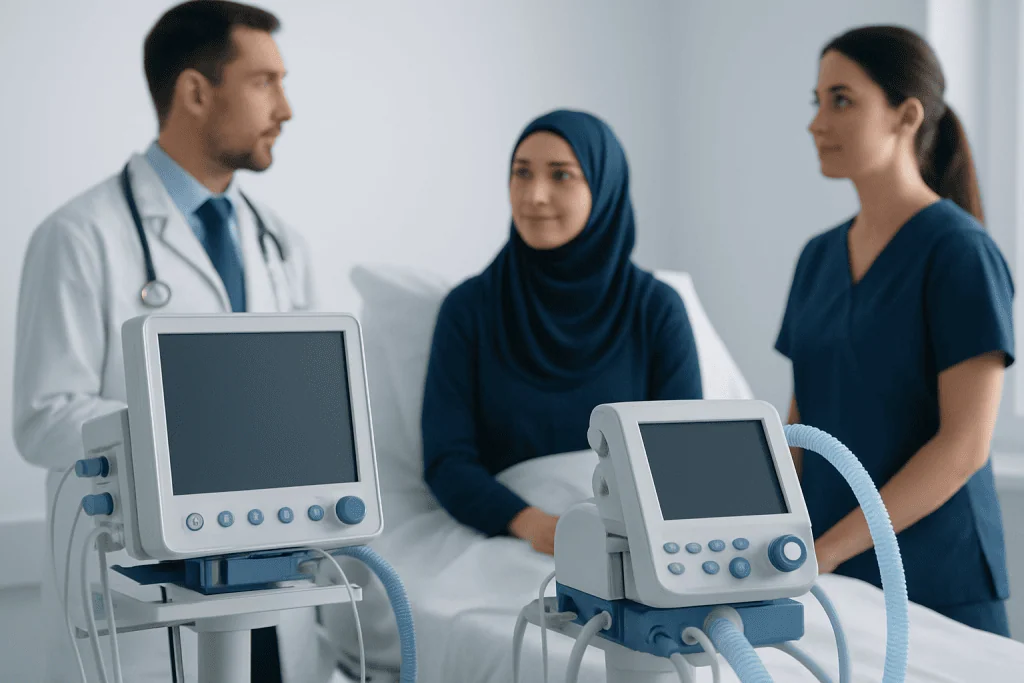
Whenever you are travelling to Turkey for medical care and are not fully comfortable in Turkish. That includes patients who speak good English. Hospital conversations use precise terminology, dosage schedules, consent points, activity restrictions, where a small misunderstanding carries real weight. Many patients who manage fine in everyday English still prefer professional interpretation for consent and discharge discussions.
The case for coordinator support grows with complexity. A single outpatient consultation needs light coordination. A plan involving several specialists, imaging, laboratory work, surgery and inpatient recovery involves many time-sensitive moving parts, and a coordinator keeps them sequenced so you know where to be, what to bring and what happens next.
Support also matters when a companion is helping with your care but does not speak the local language. Discharge instructions, medication routines and mobility guidance are often carried out by the companion as much as the patient, so their understanding counts too. The practicalities of that are covered in companion access to hospital interpreters in Turkey.
Finally, patients with complex histories or records from another country benefit from early coordination. When documents arrive and are reviewed before travel, the hospital team can prepare, and arrival day is spent on assessment rather than paperwork.
Who is a good candidate?

Anyone planning treatment in Turkey who wants help with communication and organisation. The service is not tied to one specialty: patients coming for surgery, diagnostics, oncology, fertility care, orthopaedics, cardiology or a general check-up all use the same underlying support structure, adjusted to the complexity of their plan.
It fits particularly well if this is your first medical trip abroad, if you feel anxious about navigating a foreign healthcare system, or if you simply prefer one contact point rather than many. It also suits tight schedules: when your travel window is short, coordinated records, test planning and internal communication reduce the chance of avoidable delays.
Patients travelling without a companion often lean on this support most heavily, since the coordinator becomes the practical safety net a family member would otherwise provide: the options are set out in travelling alone to Turkey for treatment. Accessibility needs, elderly patients and family coordination are all workable, and they are easiest to arrange when they are known during the planning stage rather than on arrival.
One honest limit: language coverage varies. Widely spoken languages are usually straightforward to arrange; rarer languages may need advance notice, and availability can differ by hospital and by hour of the day. Planning ahead is what makes the difference.
Can foreigners use hospitals in Turkey?
Yes. Foreign nationals can be treated in Turkish hospitals, and private hospital groups in particular have built dedicated international patient departments to serve them. Turkey is a well-established medical travel destination, and the infrastructure around it, multilingual staff, coordinators, transfer arrangements, document handling, reflects years of receiving patients from abroad.
The Turkish healthcare system has both public and private tiers. Public hospitals primarily serve residents through the national insurance system. Private hospitals serve residents and international patients alike, and this is where most medical travellers are treated, because the international support layer, interpreters, coordinators, English-language documentation, is built into the private system’s workflow.
Practically, this means you do not need residency, Turkish insurance or local language skills to be treated. You need valid travel documents, your medical records, and, for anything beyond a simple consultation, a plan agreed with the hospital before you fly. Visa requirements depend on your nationality; your own government’s travel guidance is the reliable source for those rules.
Support models
Support is shaped to your journey rather than sold as one fixed product. The common configurations:
- Interpreter-focused support: your logistics are simple, but you want accurate interpretation during consultations, tests and discharge. What this looks like inside the hospital is described in hospital interpreter services in Turkey.
- Coordinator-focused support: your plan involves many appointments or departments and you want a single administrative contact managing the sequence.
- Combined support: interpreter plus coordinator, the usual arrangement for surgery or multi-step treatment.
- Remote pre-arrival support: records are collected and reviewed before you book travel, so the pathway is clearer before you commit to dates.
- Post-discharge coordination: report sharing, follow-up scheduling and communication after you return home.
The intensity scales with the medical plan. A check-up visit needs light touch coordination; major surgery with pre-operative testing and inpatient recovery needs the full structure. In a multidisciplinary group such as Acibadem, coordination also connects departments, imaging, laboratories, more than one specialty, which matters most when a treatment plan is refined after in-person evaluation.
Online evaluation before travel
Most international patient journeys begin remotely. Medical records, imaging, laboratory reports and a summary of the situation are reviewed by the relevant department, which identifies the appropriate specialty and outlines likely next steps. Language preferences are noted at this stage so interpretation is arranged before it is needed, not after.
Be clear about what a remote review is: an initial assessment based on the information provided. It does not replace a face-to-face consultation, and it does not confirm that a specific treatment will be suitable. Final recommendations typically depend on in-person examination and often on updated tests after arrival. Plans that survive contact with an examination room are the exception, not the rule, and honest planning accounts for that.
The pre-travel phase is also where practical questions get answered: how long a stay to expect, whether a companion is advisable, which documents matter, and whether existing conditions or medications need particular attention. The completeness of your records directly determines how useful the preliminary guidance is.
Before the treatment
Before treatment begins, the coordinator handles the practical scaffolding: confirming appointment times, explaining which documents to bring, and advising when to arrive. Clinical instructions, fasting, pre-operative preparation, anything touching medication, come from your physician, and only from your physician. The coordinator relays and clarifies; the doctor decides.
Expect to prepare your passport, previous reports, imaging files or discs, laboratory results, a current medication list, and details of allergies and past surgeries. If your records are in another language, find out in advance which documents need translation or summary, translating everything is rarely necessary, translating nothing is rarely wise.
Sort accommodation, transport and companion arrangements before departure, and raise mobility limitations, dietary needs or accessibility concerns during planning. Even with strong support, keep your own written list: questions for the doctor, medications, emergency contacts, travel details. Coordinators are good; your own paperwork is still yours.
What happens during the treatment period
The interpreter’s work concentrates on the conversations where accuracy matters most: consultations, informed consent, pre-operative explanations, ward communication during a stay, and discharge instructions. A professional interpreter conveys what is said completely and neutrally, including questions the care team asks you, which are as important as the answers you receive. The step-by-step detail is in how interpreters support your care at every step.
The coordinator manages the flow of each day: where to go next, when schedules shift, how departments hand you on to each other. In a large hospital, or when a treatment pathway changes after new findings, this is the difference between a managed day and a confusing one.
One principle holds throughout: medical decisions come from your treating physician. The support team’s job is to make sure nothing is lost in translation or logistics on the way to and from those decisions. If anything is unclear, ask again, repeating a question through an interpreter costs nothing; a misunderstood instruction can cost a great deal.
Hospital stay and discharge
If your treatment involves admission, the coordinator explains the admission steps, room processes and how discharge planning works. Interpretation is most valuable during ward rounds, when nurses explain care routines, and when the team discusses medicines, wound care, mobility or follow-up tests.
Discharge deserves particular attention because a large amount of information arrives in a short window: medication schedules, dietary advice, activity restrictions, bathing guidance, warning signs to watch for, and the timing of control visits. Written instructions are worth requesting where available, and having a companion hear the key points alongside you doubles the chance nothing is missed.
Leaving the hospital is not the same as being ready to fly. Travel timing depends on your treatment and your physician’s advice, and any fit-to-fly opinion, additional reports or revised appointment plans are best settled before discharge rather than from a hotel room afterwards.
Recovery timeline
The support service itself has no recovery period: your timeline belongs entirely to your treatment. But recovery is precisely when communication support earns its keep, because it is when instructions, monitoring and follow-up planning matter most. The table shows how support typically fits around a treatment journey; it is not a medical healing schedule.
| Timeframe | How support fits in |
|---|---|
| First 24 hours | Immediate instructions about rest, medication, eating and movement are given by the care team. Interpretation ensures these arrive intact. |
| First week | Control visits, dressing checks or laboratory tests may follow. The coordinator keeps appointments sequenced and clarifies practical next steps. |
| Weeks 2–4 | If you have returned home, this period may involve remote follow-up and report sharing, depending on your case. |
| Months 1–3 | Some treatments need longer monitoring or staged care. Coordination helps with records, recommendations and future review planning. |
| Ongoing | The outcome depends on your treatment, not the support service. What support does is help you follow instructions accurately and keep expectations realistic. |
What to avoid after treatment
What to avoid physically depends on your procedure, and the only reliable source is your physician’s discharge instructions, even where they differ from general advice you have read elsewhere. Another patient’s recovery advice does not transfer to your case.
What patients can avoid regardless of procedure: guessing where language is uncertain rather than asking for clarification; skipping follow-up appointments because the trip home felt like the finish line; and leaving the hospital without knowing when the next review is scheduled or which documents to keep. Withholding information cuts the other way too: the care team can only assess what it knows about, so completeness in what you report matters as much as understanding what you are told.
Before travelling home, confirm whether you need reports, prescriptions, imaging copies or arrangements for remote follow-up. Digital and printed copies of important documents are a cheap insurance policy.
Risks and limitations
The service itself is low-risk, but it has real limits, and it is better to know them in advance. It does not replace medical evaluation. It cannot make a preliminary plan final: a review based on records alone may change after in-person examination, and travel plans sometimes need adjusting when additional tests are required or a longer stay is advised. Building slack into your schedule is more honest than assuming the first plan holds.
The main practical risks are communication gaps and incomplete records, both largely preventable with preparation. A subtler risk is over-relying on informal translation from companions or phone apps during important discussions. Medical terminology is exact; allergies, previous reactions, consent points and post-treatment restrictions do not tolerate approximation. Companions are valuable, but the trade-offs are worth understandingmedical interpreter or family member: who should help during appointments works through them.
Finally, coordination is administrative, not clinical. In urgent situations, clinical assessment always comes first; support services assist the care pathway, they never substitute for medical judgement.
Results and expectations
The result of good interpreter and patient coordinator support is not a health outcome: it is a clearer, better-organised experience: consultations you fully understood, a travel plan that matched the medical plan, and a defined contact for what comes next. For many patients, that reduces stress and makes it easier to take an active part in decisions about their own care.
What it does not do: make a treatment suitable, simple or free of complications. Recommendations may change after examination. Tests may be added. Stays may lengthen. Treat coordination as a framework that absorbs those changes, not a promise that they will not happen.
Your side of the arrangement matters too. Communication works when it is two-way, complete records, accurate history, honest reporting of changes in symptoms or plans. Interpreter and patient coordinator support in Turkey is at its best when the patient treats it as collaboration rather than a service performed on them.
International patient travel planning
Plan beyond the hospital visit. Check the expected length of stay for your treatment, whether a companion is advisable, and how soon travel home is realistic. Consider accommodation near the hospital if repeat visits are likely, mobility after treatment, and how you will manage meals, prescriptions and rest during recovery days.
International patient teams typically assist with appointment timing, transfer coordination and pre-arrival preparation; the scope depends on your case and treatment pathway. Visa and entry requirements depend on your nationality and are best checked against your own government’s official travel guidance rather than second-hand summaries.
Before flying home, confirm what you are taking with you: reports, certificates, imaging copies, pathology results where relevant, medication documentation and the arrangement for post-discharge questions. The trip is not over at the hospital door; it is over when your home-country doctor can pick up your file and understand it.
How costs and quotations work
This guide gives no figures, because honest figures cannot be given without a case. What can be explained is the structure. The cost of a treatment journey, including its support layer, depends on the type of treatment, the number of appointments and departments involved, whether inpatient care is needed, the length and intensity of coordination, and the language required.
When reviewing a quotation, the useful question is not the number but the boundary: what is inside it and what is not. Hospital-based coordination, interpretation for appointments and scheduling assistance are commonly part of the international patient pathway. Flights, visas, accommodation, companion expenses, translation of large document sets, tests added after arrival, extended stays and care unrelated to the planned treatment episode are typically outside it unless stated. A written breakdown removes the guesswork.
A quotation built on remote records is preliminary by nature. If in-person evaluation changes the diagnosis, adds imaging, involves another specialty or revises the procedure plan, the scope changes with it. Knowing in advance which factors could move the final figure is worth more than any headline number.
Why choose Acibadem
For international patients, choosing a hospital group is about more than the procedure. It is about whether the setting around the procedure, communication, coordination, continuity between departments, actually works. Acibadem operates as a multidisciplinary group, and its international patient services are built into that structure rather than bolted on: record collection before travel, interpreters for key conversations, a coordinator as a single contact, transfer guidance, and remote follow-up communication where appropriate.
That is useful, and it is also limited. Support services do not replace medical advice, and no support structure makes an unsuitable treatment suitable. The right choice always depends on your diagnosis, goals, timeline and preferences, and a proper physician evaluation remains the essential step. What a strong international patient system adds is this: when the medical answer arrives, you understand it fully, and the practical path to acting on it is already organised.
Medical review and disclaimer
This guide has been medically reviewed by the Acibadem International medical team. It provides general, practical information about interpreter and patient coordinator support for international patients travelling to Turkey.
It does not replace a consultation, examination or personalised medical advice from a qualified physician. Support arrangements, travel plans and treatment pathways vary from patient to patient, and what is appropriate for you depends on your medical history, current condition, language needs and the care you require. Final suitability, timing, tests, treatment details and discharge planning can only be confirmed by a treating team after appropriate assessment.
Step by step
- Initial contact. The international patient team learns your medical need, preferred language and travel goals.
- Record submission. Reports, imaging, medication details and relevant summaries are gathered for preliminary review.
- Preliminary medical review. The relevant department assesses the likely pathway and identifies any missing information.
- Plan and quotation scope. You receive an initial outline based on available information, with the understanding that in-person evaluation may change it.
- Travel planning. Flights, accommodation, documents and dates are organised around the expected length of stay.
- Arrival. Transfers and hospital access are guided according to your schedule.
- In-person consultation. The specialist examines you and confirms or revises the next steps.
- Pre-treatment tests. Any required testing, imaging or anaesthesia review is arranged before the procedure.
- Treatment. The planned consultation, procedure or therapy takes place, with interpretation at key communication points.
- Hospital stay. If admitted, your care team monitors recovery while the coordinator manages practical communication.
- First control visit. Recovery, results and immediate next steps are reviewed.
- Discharge and travel clearance. You receive instructions, documents and advice on when travel home is appropriate.
- Remote follow-up. After you return, communication may continue for reports, questions and longer-term review coordination.
Your checklist
- Valid passport and travel documents
- Medical history summary
- Current medication list
- Known allergies and previous reactions
- List of previous surgeries or major treatments
- Description of current symptoms or treatment goals
- Relevant laboratory test results
- Imaging and reports, including discs/files where relevant
- Pathology or biopsy reports where relevant
- Emergency contact details
- Companion details if someone will travel with you
- Preferred language for communication
Key takeaways
- An interpreter handles language at key clinical conversations; a coordinator organises records, appointments and logistics, neither makes medical decisions.
- Foreign nationals can be treated in Turkish hospitals, and private hospitals have dedicated international patient departments built for exactly this.
- Support usually starts before travel with record collection and preliminary review, and can continue remotely after you return home.
- Remote reviews and quotations are preliminary; in-person evaluation can change the plan, so build flexibility into your schedule.
- Keep your own copies of records, medication lists and contact details, good support complements preparation, it does not replace it.
Frequently asked questions
Can foreigners go to hospital in Turkey?
Yes. Foreign nationals can receive treatment in Turkish hospitals without residency or Turkish insurance. Private hospital groups in particular maintain international patient departments with interpreters and coordinators to manage the process from records review through to discharge and follow-up.
What is the healthcare system like in Turkey?
Turkey has both public and private healthcare. Public hospitals mainly serve residents through the national insurance system, while private hospitals serve residents and international patients alike. Most medical travellers use private hospitals because the international support layer, multilingual staff, coordinators, English-language documentation, is built into their workflow.
How much does it cost to see a doctor in Turkey?
It depends on the hospital, the specialty and what the visit involves: a single consultation is quoted differently from a consultation with imaging and tests. International patient departments provide written quotations based on your records; these are preliminary and can change after in-person evaluation, so ask what is included and which factors could affect the final figure.
Is Turkey known for medical tourism?
Yes. Turkey is an established medical travel destination, receiving international patients across many specialties. That history is why structured support, interpreters, patient coordinators, transfer arrangements and remote follow-up, exists as a standard part of the private hospital pathway rather than an improvised extra.
What is the difference between an interpreter and a patient coordinator?
An interpreter works on language during key communication points: consultations, consent discussions, ward communication and discharge instructions. A patient coordinator works on organisation: records, scheduling, department-to-department flow and practical planning before, during and after your stay. The roles usually work together on the same case.
Can my companion also use the interpreter?
Often yes, particularly when the companion is helping with your care and needs to understand instructions about medication, mobility, appointments and discharge. Exact arrangements vary by hospital and situation, so companion involvement is worth raising during the planning stage.
Why is professional interpretation better than a friend or a translation app?
Medical communication involves exact terminology, consent details and safety instructions that must survive translation intact. Friends and apps handle everyday conversation reasonably well but can miss nuance or mistranslate critical points, allergies, restrictions, dosing schedules, precisely where accuracy matters most. Professional interpretation reduces that risk; it does not remove the need to ask questions until you understand.
Will support continue after I go back home?
In many cases, yes. Remote follow-up can include sharing reports, answering practical questions and coordinating the next recommended review. The scope depends on your treatment plan and the hospital’s process, so confirm before discharge what the follow-up arrangement will be and who your contact is.
Add us as a Preferred Source to see more of our trusted health content across Google Search, AI Overviews and Discover.

Update history
- PublishedJune 22, 2026
- Medical review approvedAugust 31, 2026
- Last content updateAugust 31, 2026
References2
- CDC Travelers' Health: Medical Tourism wwwnc.cdc.gov
- GOV.UK: Foreign travel advice: Turkey gov.uk
More Patient Guides

HoLEP in Turkey: How It Compares With TURP and What Recovery Involves
HoLEP in Turkey treats enlarged prostate tissue with laser enucleation; learn how it compares with TURP, recovery, travel and follow-up.

Porcelain Veneers in Turkey: Who Is Suitable and How Many Visits Are Needed?
Porcelain veneers in Turkey can enhance tooth shape and colour in two visits for suitable patients after a personalised dental assessment.

How to Prepare for a Sedation Procedure in Turkey
Prepare safely for a sedation procedure in Turkey with guidance on fasting, medicines, travel, recovery and follow-up.

Treatment Delays in Turkey: What Happens If Tests or Recovery Change Your Schedule
Treatment delays in Turkey can happen if tests or recovery change your plan. Learn how to manage appointments, travel, accommodation and follow-up.