

Pain Management During Hospital Treatment in Turkey

During hospital treatment in Turkey, pain is assessed regularly, usually with a 0-to-10 scale, and managed with a plan built around your diagnosis, medical history, and other medicines. Report pain early, describe it specifically, and ask for interpreter support when you need it. Do not take your own medicines in hospital unless your treating team confirms they are safe.
Wondering how you will explain your pain to a nurse in another country, at two in the morning, when you are tired and sore? That worry is normal, and it has practical answers.
Pain control is part of feeling safe, resting properly, and recovering during a hospital stay. This guide explains how pain management during hospital treatment in Turkey actually works: how pain is assessed, what your care team can do, which medicines are involved, how interpreter support fits in, and when pain needs urgent attention. It is written for international patients, so it also covers the practical points that only matter when you are far from home, controlled medicines, discharge instructions in a language you understand, and what to do after you leave the ward.
At a glance
- Best for: International patients preparing for inpatient treatment, surgery, or a procedure in Turkey
- Main goal: Help you report pain clearly and receive timely, safe support throughout your stay
- Who to ask: Your nurse first, then your physician, the anaesthesiology or pain (algology) team, and your international patient coordinator
- Language support: Interpreter assistance can help you describe pain, understand medicines, and follow discharge instructions
- Important reminder: Do not take personal pain medicines or supplements in hospital unless your treating team confirms they are safe
- Realistic expectation: Some discomfort is normal after many treatments; the aim is pain controlled enough for breathing, sleep, movement, and recovery
How pain management during hospital treatment in Turkey works
Pain management during hospital treatment in Turkey is not a single medicine handed over on request. It is a planned part of your care. It may include regular pain assessments, scheduled or as-needed medicines, positioning, ice or heat where appropriate, gentle early movement, breathing exercises, and clear communication about what is normal for your treatment. The aim is to keep pain at a level where you can rest, breathe deeply, eat, move safely, and take part in recovery activities within the limits your doctors set.
You should not tolerate severe pain in silence. In Turkish hospitals that treat international patients, nurses typically ask about pain at regular intervals, especially after surgery or an interventional procedure. At Acibadem, your care can involve physicians, nurses, anaesthesiology specialists, rehabilitation professionals, and interpreters, so your pain is understood in context rather than treated as a number on its own. Turkey also recognises pain medicine, known locally as algology, as a distinct specialty, which means dedicated pain management (algology) teams exist within hospitals for more complex cases.
One honest point up front: complete absence of pain is not always realistic after certain treatments, and no responsible team will promise it. What they can do is explain what level of discomfort to expect, adjust your plan when it is not working, and tell you exactly which symptoms should never be waited out. That balance, expected discomfort managed actively, unexpected symptoms reported immediately, is the core of good pain care.
How to describe your pain clearly
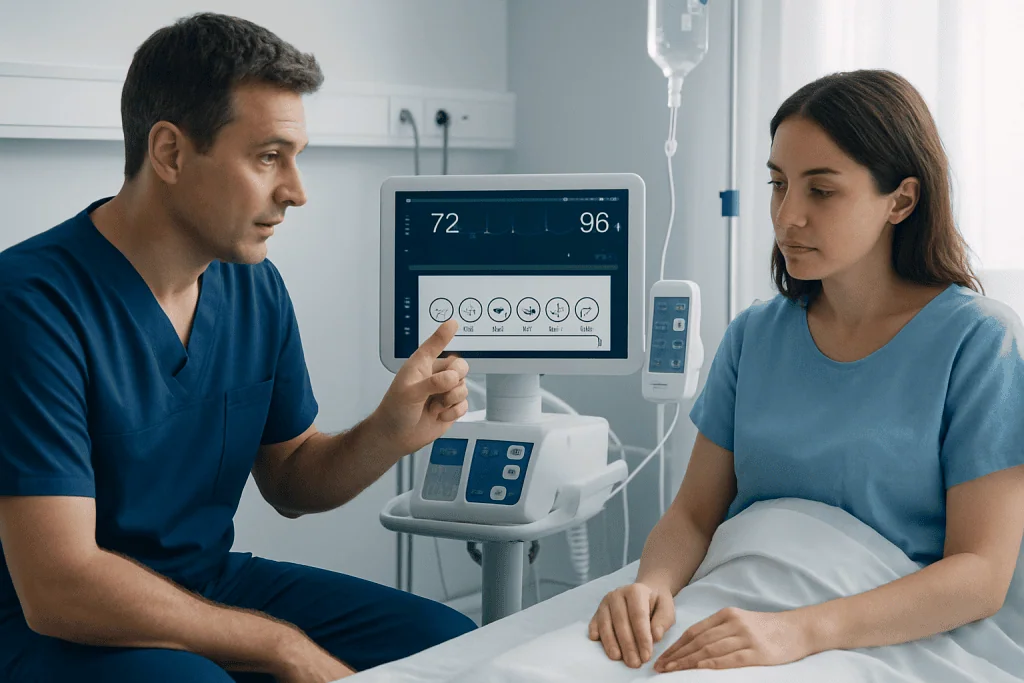
The more specific you are, the faster your team can respond. Instead of saying only that you are in pain, describe where it is, how strong it feels, what it feels like, when it started, and what makes it better or worse. If English is not your first language, or you are worried about explaining symptoms in a stressful moment, ask for an interpreter before pain becomes difficult to manage, not after.
Most hospitals use a pain scale from 0 to 10, where 0 means no pain and 10 means the worst pain you can imagine. This is not a test and there is no right answer. It simply lets the team compare your pain over time and judge whether the current plan is working. Use the same scale consistently, and give two numbers where you can: your pain at rest, and your pain when you move, cough, or breathe deeply. The gap between those two numbers often matters more than either number alone.
Simple descriptive words help too: burning, stabbing, cramping, pressure, tightness, aching, throbbing, numbness, or an electric-shock feeling. Details worth sharing include:
- Where the pain is located and whether it spreads anywhere, such as down a limb or into the chest or jaw
- Whether it is constant or comes in waves, and how long each wave lasts
- Your pain score at rest and during movement
- Any nausea, dizziness, itching, sleepiness, shortness of breath, or confusion alongside the pain
- What has helped you before, and any medicines that caused side effects or did not work
- Whether the pain feels like your usual pain or something new and different, for surgical patients this distinction is important
There is a common worry among patients about saying the wrong thing to a pain team. In practice, there is nothing you should hide. The two habits that genuinely make care harder are minimising pain to seem polite, and giving vague answers like “it hurts everywhere” when a more specific description is possible. Honest, specific reporting, including honesty about past medication use and what has not worked, leads to better decisions, not judgement.
What your hospital team may do to keep you comfortable

Your pain plan depends on your diagnosis, the treatment you are having, your age, medical history, allergies, kidney and liver function, and the other medicines you take. Some patients need scheduled pain relief for a period; others need medicine only when pain rises. Teams often use a combination approach, because different types of pain respond to different methods, and combining approaches can reduce reliance on any single medicine.
In hospital, pain relief may include tablets, injections, intravenous medicines, regional anaesthesia techniques such as nerve blocks, or medicines given at carefully monitored intervals. Non-medicine support is often part of the plan as well: adjusting your bed position, splinting a surgical area with a pillow when you cough, guided breathing, early safe mobilisation, physiotherapy, and relaxation techniques. Your nurse monitors for side effects throughout and reports concerns to the physician. If you are having an operation, it is worth reading in advance about what to expect from pain control after surgery in Turkey, because post-surgical pain follows fairly predictable patterns that are easier to handle when you know them.
Behind the scenes, hospital care is organised around structured safety processes: medication checks, allergy documentation, identity confirmation before medicines are given, and clinical monitoring after stronger analgesics. This does not mean every patient gets the same plan. It means the hospital uses systems designed to reduce risk and keep the different teams involved in your care communicating with each other.
Strong painkillers and controlled medicines in Turkey
Patients often ask what strong painkillers are available in Turkey. The honest answer is that Turkish hospitals use the full modern range of analgesia, from paracetamol-type medicines and anti-inflammatories through to opioid medicines and regional anaesthesia techniques, but stronger options are prescribed, dosed, and monitored by your treating doctor, not chosen from a menu. Opioids and certain other analgesics are controlled medicines in Turkey, dispensed under prescription with specific rules, exactly as in most countries. In hospital, this works in your favour: you receive them under supervision, with monitoring for sedation, breathing, nausea, and constipation.
Two practical points follow from this. First, do not expect to buy strong prescription painkillers freely at a pharmacy; controlled medicines require a valid prescription. Second, if you already take a controlled pain medicine at home, tell your coordinator and your treating team before you travel. They can advise on documentation and how your usual medicine fits into your hospital plan. Our guide on keeping regular medicines on schedule during medical travel covers the practicalities of carrying and timing medicines across a journey.
Chronic pain: algology clinics and longer-term options
If you live with long-term pain, back pain, nerve pain, joint pain, headache disorders, or pain after previous surgery: your situation during a hospital stay is different from a patient whose pain began with treatment. Your baseline pain and your medication tolerance both affect how new pain should be assessed, so tell your team about your chronic pain history before admission, and bring recent reports from your home pain clinic if you have them.
Patients also ask what the best pain medication for chronic pain is. There is no single best medicine, and any page that names one is oversimplifying. Chronic pain has many causes, nerve-related, inflammatory, mechanical, mixed, and each responds differently. The right approach is chosen by a doctor after assessment, and often combines medicines with physiotherapy, interventional techniques, and lifestyle measures rather than relying on one tablet. Turkey’s algology specialty exists precisely for this kind of layered assessment, and options such as interventional pain managementtargeted injections, nerve blocks, and related procedures, can be discussed where medicines alone are not enough.
When does chronic pain become too much to manage alone? A useful threshold: when pain regularly disrupts your sleep, stops you working or moving normally, no longer responds to your usual plan, or begins to affect your mood and relationships. Those are reasons to seek specialist assessment rather than to keep enduring. Separately, if chronic pain suddenly changes character or comes with new symptoms such as chest pain, breathlessness, weakness, or confusion, that is not a clinic question, call your local emergency number or go to the nearest emergency department now.
Medication safety: what to bring and what not to take
Before admission, prepare a complete list of your usual medicines, vitamins, herbal products, supplements, patches, injections, and over-the-counter painkillers. Include the dose, the timing, and the reason you take each one. Bring medicines in their original packaging where possible, but do not take them during your hospital stay until your treating team confirms when and how they should be used. This is not bureaucracy; it prevents dangerous combinations.
It matters most for blood thinners, anti-inflammatory medicines, opioid pain medicines, sedatives, sleeping tablets, antidepressants, diabetes medicines, and herbal products that can affect bleeding or anaesthesia. Even everyday medicines can be unsafe around surgery or can interact with new medicines prescribed in hospital. If you are unsure about anything on your list, ask your nurse or international patient coordinator to check with the physician. Never adjust doses yourself, every change belongs to your treating doctor.
Describe allergies and past reactions in concrete terms: whether a medicine caused a rash, swelling, breathing difficulty, fainting, severe nausea, confusion, or simply did not work well. This helps the team separate a true allergy from an expected side effect and choose safer alternatives where needed.
Working with interpreters and international patient services
Pain is hard to describe even in your own language. During a hospital stay abroad, you may be tired, anxious, or overwhelmed by unfamiliar routines, and precision suffers. Interpreter support makes a real difference, particularly when discussing medication changes, side effects, consent, discharge instructions, or new symptoms.
Acibadem supports international patients with coordination services that may include interpreter assistance, appointment planning, admission guidance, and communication between you and the hospital team. Even if a companion travels with you, use professional interpretation for medical discussions. Family members are excellent for comfort and for noticing when you are struggling; trained language support is what reduces misunderstandings about doses, timing, risks, and follow-up.
Ask your coordinator how to request language help during the day and what the arrangement is at night or in urgent situations, so you are not working it out at 2 a.m. Keep the nurse call button within reach, and learn a few essential words if you feel able: pain, nausea, dizzy, bathroom, help, breathing problem. You are not being difficult by asking for clarification. You are doing exactly what a well-prepared patient should do.
When pain needs urgent attention, in hospital and after discharge
Some discomfort is expected after treatment, but certain symptoms should be reported immediately, not at the next routine round. Press the nurse call button, or ask your companion to call for help, if pain suddenly becomes severe, changes character, spreads to the chest or jaw, comes with shortness of breath, or is accompanied by fainting, confusion, weakness, heavy bleeding, or a new severe headache.
Also report pain that prevents deep breathing, walking as instructed, urinating, sleeping, or eating. If your pain medicine wears off before the next dose is due, tell your nurse when it stops working and what your score is at that point. That pattern is exactly what the physician needs to adjust the plan safely, rather than simply adding medicine without understanding what is happening.
Side effects count as reportable too. Nausea, constipation, itching, unusual sleepiness, hallucinations, dizziness, or difficulty breathing should be raised quickly. The team may be able to change the dose, timing, medication type, or supportive treatment to improve comfort while keeping you safe.
After discharge, the same logic applies with one difference: the call button is gone. Know before you leave who to contact for questions and worsening symptoms, and read our guide on when pain, swelling, or fever should prompt an urgent call after surgery in Turkey. For sudden severe symptoms, crushing chest pain, breathing difficulty, collapse, sudden weakness, or heavy bleeding, do not wait for a callback: call your local emergency number or go to the nearest emergency department now.
Step by step
- Before you travel, share your medication history. Send your current medication list, allergies, previous anaesthesia issues, and any chronic pain history to your care coordinator before admission where possible. This gives the hospital team time to review risks and plan safer pain support.
- On admission, confirm how to ask for help. Ask where the nurse call button is, how often pain will be checked, and how to reach an interpreter, including at night. Knowing the routine reduces anxiety and helps you act early instead of waiting until pain is severe.
- Use the pain scale consistently. Report your pain from 0 to 10 at rest and during movement, using the same scale each time, so your team can see whether pain is improving, worsening, or changing after medication.
- Report side effects promptly. Pain relief should not leave you feeling unsafe or unable to take part in recovery. Mention nausea, dizziness, itching, constipation, excessive sleepiness, or breathing concerns so the plan can be adjusted.
- Do not self-medicate in hospital. Avoid taking your own tablets, supplements, or herbal products unless your physician or nurse confirms they are allowed. Unreviewed combinations can raise bleeding, sedation, stomach, kidney, liver, and interaction risks.
- Plan discharge pain control before you leave. Ask what pain level is expected at home, which medicines to take and when, when your doctor wants them reduced or stopped, and how they affect flying. Make sure the instructions are in a language you understand, and confirm who to contact after discharge.
Your checklist
- A full list of your prescription medicines, over-the-counter medicines, supplements, and herbal products, with doses and timing
- Details of allergies, side effects, and medicines that did not work well for you
- Your chronic pain history and recent pain clinic reports, if relevant
- Documentation for any controlled medicine you carry, checked with your coordinator before travel
- Contact details for your international patient coordinator
- A translated or clearly written discharge medication plan before leaving hospital
- Comfortable clothing that is easy to put on without pulling or bending
- Glasses, hearing aids, phone charger, and anything that helps you communicate clearly
- A small notebook or phone note to track pain scores, medicine times, and questions
- Your companion’s contact information, if someone is supporting you
Key takeaways
- Pain management is a planned part of safe hospital care in Turkey and should be discussed openly throughout your stay.
- Use specific descriptions and a consistent 0-to-10 pain scale, reported at rest and during movement, to help your team respond.
- Do not take personal medicines or supplements in hospital unless your treating team approves them; all dose decisions belong to your doctor.
- Strong painkillers exist in Turkey as controlled, prescription-only medicines, expect supervision, not a menu.
- Interpreter and international patient services help you communicate symptoms, side effects, and discharge instructions accurately.
- Report sudden, severe, changing, or unusual pain immediately; after discharge, know who to call and when emergency care is the right choice.
Frequently asked questions
What is the best pain medication for chronic pain?
There is no single best medicine for chronic pain, because chronic pain has many causes and each responds differently. Nerve-related pain, inflammatory pain, and mechanical pain are treated in different ways, often combining medicines with physiotherapy or interventional techniques. The right plan comes from a doctor’s assessment of your specific condition, be cautious of any source naming one universal answer.
What are some strong painkillers available in Turkey?
Turkish hospitals use the full modern range of analgesia, including opioid medicines and regional anaesthesia techniques, alongside simpler options. Stronger medicines are controlled: they require a prescription, are dosed by your treating doctor, and are monitored for side effects. You cannot buy them freely at a pharmacy, and in hospital they are given under supervision rather than on request.
What should I not say to a pain management team?
There is nothing you need to hide, honesty helps you. The habits that make care harder are minimising pain out of politeness, giving vague descriptions when specifics are possible, and leaving out your full medication history, including anything that did not work or caused side effects. Accurate, specific reporting leads to better decisions, not judgement.
When does chronic pain become too much to manage alone?
When pain regularly disrupts sleep, limits work or movement, stops responding to your usual approach, or starts affecting your mood, it is time for specialist assessment rather than endurance. If chronic pain suddenly changes character or comes with chest pain, breathlessness, weakness, or confusion, call your local emergency number or go to the nearest emergency department now.
Will I be pain-free during hospital treatment in Turkey?
Not always, especially after surgery or certain procedures, and a responsible team will not promise it. The goal is pain controlled to a manageable, safe level so you can rest, breathe deeply, move as advised, and recover. Tell your nurse if pain is stronger than expected or stops you doing your recovery activities.
Can I bring my usual pain medication from home?
Yes, bring it in original packaging and include it on your medication list, with documentation for any controlled medicine. However, do not take it during your admission unless the hospital team confirms it is safe, because some medicines interact with anaesthesia, blood thinners, antibiotics, or other hospital treatments.
Who should I speak to if my pain medicine is not working?
Start with your nurse, who can assess your pain, check your vital signs, and contact the physician if the plan needs review. If there is a language barrier, ask for interpreter support through the hospital or your international patient coordinator. Do not increase doses or take your own medicine without your doctor’s approval.
What pain instructions should I get before discharge?
You should understand which medicines to take, the dose and timing, possible side effects, whether to take them with food, and any restrictions around alcohol or driving. Ask what pain level is expected at home, which symptoms need urgent contact, and, if you are flying soon, whether any medicine or mobility limit affects travel. Ask for the plan in a language you fully understand.
Add us as a Preferred Source to see more of our trusted health content across Google Search, AI Overviews and Discover.

Update history
- PublishedJune 8, 2026
- Medical review approvedSeptember 13, 2026
- Last content updateSeptember 12, 2026
References2
- Pain Relievers: MedlinePlus medlineplus.gov
- Acute Pain vs. Chronic Pain: Cleveland Clinic my.clevelandclinic.org
More Patient Guides

When a Hospital Stay in Turkey Becomes Longer Than Planned: What to Arrange
If your hospital stay in Turkey is longer than planned, arrange medical updates, accommodation, travel changes, insurance and support for your companion.

Waiting for Test Results in Turkey: How to Use Time Between Appointments
Waiting for test results in Turkey is easier with a clear plan for appointments, rest, records, questions and support in Istanbul.

Unexpected ICU Stay in Turkey: What Patients and Families Should Expect
Unexpected ICU stay in Turkey: learn what patients and families can expect, from communication and visiting to care updates and travel support.

How to Manage Special Diets During Medical Travel in Turkey
Special diets during medical travel in Turkey are easier to manage when you share your needs early, confirm meals and carry safe…