

Preventing Blood Clots During Medical Travel to Turkey: What Patients Should Ask

Ask your care team, before you book flights, whether your medical history, your procedure and your flight times raise your clot risk. The most useful precautions — regular movement, hydration, correctly fitted compression stockings and, for some patients, prescribed medication — are individual decisions, not general rules. Request a travel-specific prevention plan and written discharge guidance that covers the journey home.
Is it safe to fly home a few days after your procedure? Does the long flight to Turkey need any special preparation? These are sensible questions, and the honest answer to both is: it depends on you. Your medical history, your treatment, your recovery and the length of your flights all shape your personal risk of blood clots.
This guide explains how that risk is assessed, which precautions are commonly discussed, and — most importantly — which questions to ask your care team at each stage. It is informational: the decisions themselves belong to you and your treating doctor.
At a glance
- Best time to ask: Before you book flights, and again before discharge
- Main concern: Deep vein thrombosis (DVT) and pulmonary embolism (PE)
- Who may need extra planning: Patients with prior clots, active cancer, limited mobility, obesity, pregnancy or recent childbirth, hormone therapy, or long total travel times
- Commonly discussed precautions: A personal risk review, hydration, regular leg movement, professionally fitted compression stockings, and medication only if prescribed
- Documents worth requesting: Written discharge instructions, a fit-to-fly letter, a medication list, and clear contact details for questions after discharge
Why preventing blood clots during medical travel to Turkey needs a plan
Preventing blood clots during medical travel to Turkey is worth thinking about early, because treatment abroad often combines several risk factors that would each be minor on their own. Long periods of sitting on the flight. Mild dehydration from cabin air and disrupted routines. The procedure itself. Reduced movement in the first days of recovery. Then another long flight home, often sooner than you would travel after treatment in your own country.
When clinicians talk about travel-related clots, they usually mean deep vein thrombosis — a clot in a deep vein, most often in the leg. A DVT becomes more serious if part of the clot travels to the lungs, which is called a pulmonary embolism. Most people who travel for treatment do not develop either. The point of planning is not to create worry; it is to remove avoidable risk and to make sure the advice you receive fits your situation rather than a generic traveller.
Two things make the difference in practice. First, raising the subject before flights are booked, because the safest travel dates depend on your procedure and cannot always be squeezed into an itinerary that was fixed first. Second, asking for advice that covers the whole journey — outbound flight, hospital stay, recovery days, and the flight home — rather than the operation alone. Once you are back in Turkey recovering after treatment, the same thinking continues; the guide on preventing blood clots during recovery in Turkey covers that stage in more detail.
Who should ask for a more detailed risk review
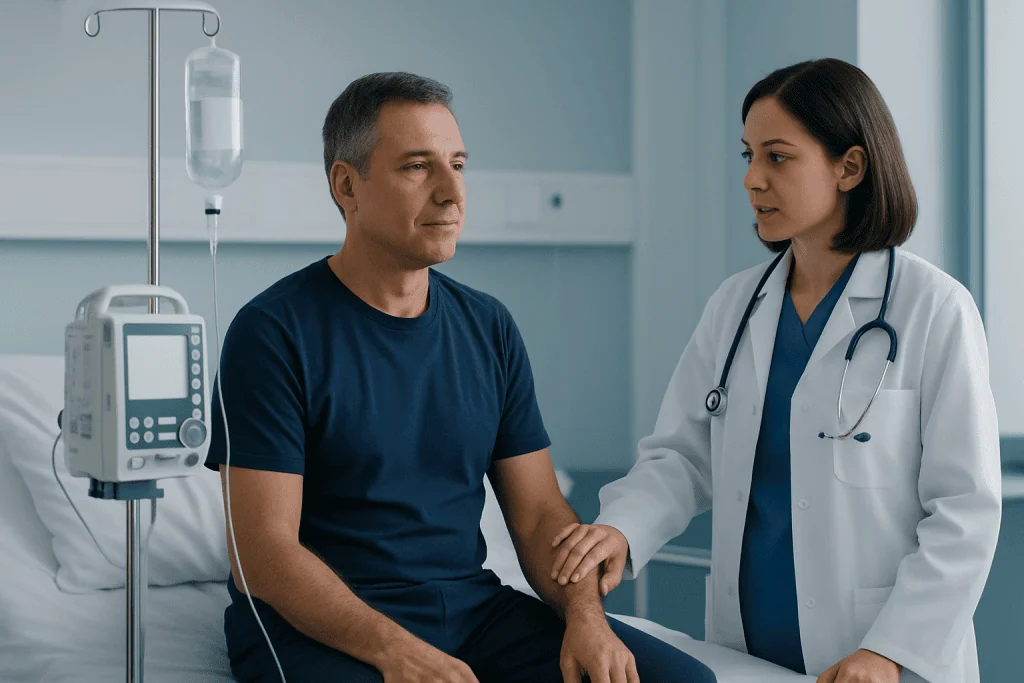
Anyone can ask about clot prevention. Some patients should ask for a more detailed review before confirming anything. That includes people with a previous DVT or pulmonary embolism, a personal or family history of clotting disorders, active cancer or recent cancer treatment, recent major surgery, obesity, smoking, pregnancy or recent childbirth, significant varicose veins, hormone therapy including some contraceptives and hormone replacement, and anyone whose mobility is already limited.
If you have had a clot recently, the question changes from prevention to timing: whether flying at all is appropriate yet is a separate clinical decision. The guide on flying to Turkey with recent blood clots explains what that assessment usually involves.
Your treatment type matters as much as your history. Longer operations, orthopaedic procedures, cancer care, any admission that keeps you in bed, and any treatment that limits walking afterwards can all raise risk. Even a procedure you would call minor can change the picture when it sits between two long-haul flights. The combination is what counts.
A direct way to open the conversation works best. Ask: “Based on my medical history, my flights and my planned treatment, am I at increased risk of a blood clot?” Then ask what specific precautions apply to you — not what is recommended in general. In a multidisciplinary hospital, the answer may involve more than one specialist when your travel plan and your treatment plan need to be weighed together.
Questions to ask before you book flights and finalise dates

Flight timing is the most practical part of preventing blood clots during medical travel to Turkey, and it is the part patients most often decide too early. Ask whether you should arrive a set number of days before treatment — to rest after the journey, rehydrate and complete pre-assessment — especially if your outbound flight is long-haul. Then ask whether your intended return date is realistic. The safest time to fly home depends on your mobility, pain control, wound care needs and overall recovery, and none of those can be judged from a calendar alone.
Routing is worth a question too. For some patients a direct flight with a shorter total travel time is better. For others, a stopover that allows a proper walk between flights helps more than it costs. There is no universal answer; your doctor can advise based on your procedure and general health rather than on convenience or price.
Useful questions at this stage include:
- How long after my treatment is it safe for me to fly, realistically rather than optimistically?
- Will I be able to walk comfortably through the airport and move during the journey?
- Should I book wheelchair assistance to avoid overexertion, while still moving at safe intervals?
- Is an overnight or very long flight a problem for someone in my situation?
- Will I need a fit-to-fly letter, a medication letter or a discharge summary for the airline?
- If my recovery is slower than expected, how flexible should my return ticket be?
That last question deserves emphasis. A changeable return ticket costs you nothing in medical terms and removes the pressure to fly before you are ready. Build the flexibility in at booking, not at the departure gate.
The prevention steps commonly discussed
Clot prevention is usually a layered combination: simple habits for everyone, and specific measures for patients whose risk justifies them. The layers are worth understanding separately, because the questions you ask about each are different.
Movement and hydration
The baseline advice is unglamorous and effective: drink fluids regularly, avoid long unbroken periods of sitting, do ankle and calf exercises, wear loose clothing, and walk when it is safe to do so. The weak point is vagueness. “Move as much as possible” means little when you are tired and sore. A better question is: “How often should I stand, walk or do leg exercises on the day of treatment, the next day, and during the return trip?” A schedule you can follow beats a principle you can ignore.
Compression stockings
Graduated compression stockings are commonly discussed, but they are not a self-service item. The wrong class of compression, the wrong size or the wrong fit can be uncomfortable and unhelpful, and for some patients stockings are not appropriate at all. If they are recommended for you, ask exactly what type, what compression class, how they should be measured and fitted, and how long each day you should wear them. The dedicated guide on medical compression stockings for travel to Turkey covers when patients may need them and how fitting works.
Medication, only when prescribed
Some patients are prescribed anticoagulant medication around the time of treatment, particularly where the procedure or the medical history raises clot risk. Others are managed with movement and hydration alone. If medication applies to you, the decision, the dose, the start date and the duration belong to your treating doctor. Your job is to understand the plan: when it starts, how long it continues, how to store and carry it while travelling, what bleeding precautions come with it, and what to do if your itinerary changes. You should also tell your doctor about every medicine and supplement you already take, so any interactions can be assessed before you travel. Keeping doses on time across time zones is its own challenge; the guide on keeping your regular medicines on schedule during medical travel explains practical ways to manage it.
Managing the airport, the flight and your hotel stay
Prevention does not start in the operating theatre and it does not end at the hospital door. Your routine in transit and at your accommodation matters just as much.
At the airport. Allow extra time so you are not rushing, but do not spend the whole wait in a seat. If your doctor has said it is safe, stand periodically, walk short distances, and do calf and ankle movements while you wait. If you have booked wheelchair assistance, that does not mean total immobility — ask in advance how to combine assistance with the movement your care team wants from you.
On the flight. Change position regularly and avoid crossing your legs for long stretches. If you can walk, short walks in the cabin at sensible intervals are useful. If you cannot walk much after treatment, ask before you fly which in-seat exercises are suitable and how often to do them — ankle circles, heel-toe raises and gentle knee lifts are the usual candidates, but confirm what fits your procedure. Drink water regularly unless you have been given fluid restrictions for another reason, and go easy on alcohol, which works against hydration.
At your hotel or recovery accommodation. Ask yourself one question every few hours: have I moved enough since I last checked? Short, regular movement is easier to sustain than one long daily walk, and it is what most prevention advice actually asks for. If someone is travelling with you, give them a role: tracking medication times, fluid intake and gentle movement in the first day or two, when you are least likely to manage it yourself. Choosing that person carefully is worth its own thought — see medical travel with a companion: who should come and why.
Warning signs, and what your discharge plan should say about them
Part of good preparation is knowing what clinicians watch for, so that the written instructions you receive at discharge make sense to you.
The typical signs of a DVT are new swelling in one leg, calf pain or tenderness, unusual warmth, or redness — usually on one side rather than both. These signs do not always mean a clot, which is exactly why clinicians assess them promptly rather than assuming either way. A pulmonary embolism presents differently: sudden shortness of breath, chest pain, coughing up blood, fainting, or an unexplained racing heartbeat. Clinicians treat that pattern as an emergency to be assessed immediately, not something to observe at home.
What this means for your planning is a set of questions to settle before discharge, while the team is in front of you:
- Which symptoms should I watch for after my particular procedure, and for how long?
- Who do I contact first if symptoms appear while I am still in Turkey — the ward, an emergency department, or a named contact?
- What is the plan if symptoms begin after I have flown home — my local doctor, the treating hospital, or local emergency services first?
- Is all of this written down in my discharge summary, in English?
A good discharge plan answers all four before you ask. If yours does not, ask until it does. Knowing how out-of-hours care works locally helps too; the guide on after-hours medical help in Turkey explains what international patients should understand about the system before they need it.
Step by step
- Share your full clot risk history early. Tell your care team about previous blood clots, family history of clotting disorders, cancer treatment, smoking, hormone use, pregnancy history, mobility problems and recent surgery — before flights are booked if possible, because the safest travel dates may depend on it.
- Ask for a travel-specific prevention plan. Request advice that covers the whole journey: before departure, during the outbound flight, during recovery in Turkey, and on the trip home. A plan built only around the procedure misses half the risk.
- Confirm whether you need stockings or medication. Do not self-prescribe compression stockings or blood thinners. Ask whether they are appropriate for you, how to use them correctly, and what side effects or warning signs come with them.
- Plan movement into every stage. Ask how often you should stand, walk or do leg exercises given your treatment and mobility, then build that schedule into airport waits, transfers, hotel days and the flight home.
- Get written discharge and fit-to-fly guidance. Before leaving hospital, ask for written instructions in English covering your medications, hydration and movement advice, the symptoms your team wants assessed, and contact details for questions.
- Settle the “who do I contact” question in advance. Make sure your discharge plan names the first point of contact for concerns in Turkey and the first point of contact once you are home, so you never have to work it out under pressure.
Your checklist
- Tell your doctor about any previous DVT, PE or clotting disorder
- Ask whether your treatment or recovery period increases clot risk
- Confirm realistic dates for your outbound and return flights before booking
- Choose a flexible return ticket in case recovery takes longer
- Ask whether compression stockings are appropriate and how they should be fitted
- Understand any prescribed medication plan, including timing across the journey
- Pack your medication list, discharge summary and contact details in hand luggage
- Arrange airport assistance if long walks will be difficult, and plan safe movement around it
- Set reminders to drink water and move regularly during travel and recovery
Key takeaways
- Clot prevention should be discussed before flights are booked, not only after treatment.
- Your personal risk depends on your history, your procedure, your mobility and your total travel time — not on any one factor alone.
- Common precautions layer up: movement and hydration for everyone; fitted compression stockings and prescribed medication only where a doctor advises them.
- Written discharge and fit-to-fly guidance in English is worth insisting on, because you will follow it far from the team that wrote it.
- Know before discharge which symptoms your team wants assessed and who your first point of contact is, both in Turkey and at home.
Frequently asked questions
Is flying to Turkey for treatment automatically dangerous for blood clots?
No. Many patients travel without any problem. Risk is individual: what matters is whether your medical history, your procedure, your mobility and your flight duration combine into a higher-risk situation that needs extra precautions. That is a judgement your treating doctor makes, not a rule of thumb.
Should I wear compression stockings on the flight?
Possibly, but ask your doctor before buying them. The right type, compression class, fit and wearing time depend on your circulation, your procedure and your overall risk profile — and for some patients stockings are not the right measure at all. Poorly fitted stockings can be worse than none.
Will I need blood-thinning medication for my trip?
Not everyone does. Some patients are prescribed anticoagulant medication because of their operation, cancer care, previous clot history or limited mobility; others are managed with movement and hydration alone. The decision, including when to start and stop, belongs to your treating doctor, who weighs clot prevention against bleeding risk for your specific case.
How soon after treatment can I fly home from Turkey?
It depends on the type of treatment, how your recovery progresses and how mobile you are. Ask your surgeon or physician for a realistic travel window before you book, then confirm it again at discharge, because recovery timelines can change. A flexible return ticket makes that second conversation much easier.
What are the typical signs of a DVT?
New swelling in one leg, calf pain or tenderness, unusual warmth or redness — usually on one side. These signs do not always mean a clot, which is why clinicians assess them promptly rather than guessing. Your discharge plan should say exactly which signs your team wants checked after your procedure and who your first point of contact is.
Which symptoms do doctors treat as an emergency?
Sudden shortness of breath, chest pain, coughing up blood, fainting, or an unexplained rapid heartbeat are the classic signs of a possible pulmonary embolism, and clinicians treat that pattern as an emergency requiring immediate assessment. This is exactly why your discharge plan should name the first point of contact for both Turkey and home before you leave hospital.
Does a layover help or hurt clot risk on a long journey?
It can go either way. A direct flight shortens total travel time, which suits some patients; a stopover that allows a proper walk between flights suits others. Your doctor can advise which pattern fits your procedure and mobility — it is worth asking before you compare routes, not after.
What should be in my discharge paperwork for the flight home?
Ask for written instructions in English covering your medications and their timing, hydration and movement advice for the journey, the symptoms your team wants assessed, and contact details for questions after discharge. If the airline requires one, ask for a fit-to-fly letter as well, and keep everything in your hand luggage rather than checked baggage.
Add us as a Preferred Source to see more of our trusted health content across Google Search, AI Overviews and Discover.

Update history
- PublishedJuly 8, 2026
- Medical review approvedSeptember 1, 2026
- Last content updateSeptember 1, 2026
References2
- Deep vein thrombosis (DVT) — NHS — nhs.uk
- Deep Vein Thrombosis — MedlinePlus — medlineplus.gov
More Patient Guides

Need a Blood Transfusion in Turkey? What International Patients Should Know
Blood transfusion in Turkey is provided after blood typing, compatibility testing and clinical review, with international patient support available in Istanbul.
8 min read
When You May Need ICU Care After Surgery in Turkey
ICU care after surgery in Turkey may be planned for close monitoring or needed if recovery requires extra support. Learn what to…
8 min read
Medical Records Privacy in Turkey: Consent, Sharing, and Patient Rights
Medical records privacy in Turkey gives you rights to informed consent, confidential care, record access and controlled sharing during treatment in Istanbul.
8 min read
When to Delay Travel for Treatment in Turkey Because of Cold, Flu, or Fever
Delay travel for treatment in Turkey if you have fever, worsening flu symptoms, or breathing difficulty; contact your care team before flying.
8 min read