

Questions to Ask Before Choosing a Hospital in Turkey for Major Surgery

Ask every hospital the same set of questions: whether it is internationally accredited, how often it performs your specific operation, whether intensive care is available on site, who coordinates your case, what a written quote includes and excludes, how long you should stay in Turkey, and how follow-up works after you fly home. Compare the answers side by side, in writing.
You have a diagnosis, a rough surgery timeline, and a shortlist of hospitals that all sound reassuring online. Websites will not settle the choice for you. The right questions will. If you are weighing up questions to ask before choosing a hospital in Turkey for major surgery, this guide gives you a structured set — covering safety, the surgical team, costs, preparation, dignity, travel and follow-up — so you can compare hospitals on substance rather than presentation.
At a glance
- Best for: International patients comparing hospitals in Turkey for major inpatient surgery
- Main decision areas: Safety systems, specialist experience, costs, preparation, logistics, follow-up
- Ask about: Accreditation, ICU access, the full care team, interpreter support, written quotes
- Preparation: Pre-operative instructions and medication decisions belong to your treating team
- Before you choose: Get a written treatment plan and a written estimate, then compare like with like
Why the right questions matter before major surgery
When you plan an operation abroad, it is natural to focus on the surgery itself. In practice, your experience depends just as much on what surrounds the operation: how clearly the team communicates before you travel, what happens if something unexpected arises, how the hospital supports you as an international patient, and what continues after you return home.
The most reliable way to compare hospitals is to put the same questions to each one and record the answers. Websites are written to persuade. Answers to specific questions are harder to polish. The questions to ask before choosing a hospital in Turkey for major surgery do two jobs at once: they show you what the hospital offers, and how it communicates when a patient wants detail rather than reassurance.
Expect specific answers, not general ones. A well-organised hospital should be able to explain its accreditation status, how often it performs your type of operation, whether intensive care is available on site, roughly how long you may need to remain in Turkey, and who will coordinate your case. At Acibadem, international patient teams help gather this information before you travel, so the planning happens with fewer surprises. Whichever hospital you speak to, the pattern of the answers matters as much as the content: clear, consistent replies before you book are a reasonable indicator of how you will be supported once you arrive.
Questions to ask about hospital quality and safety
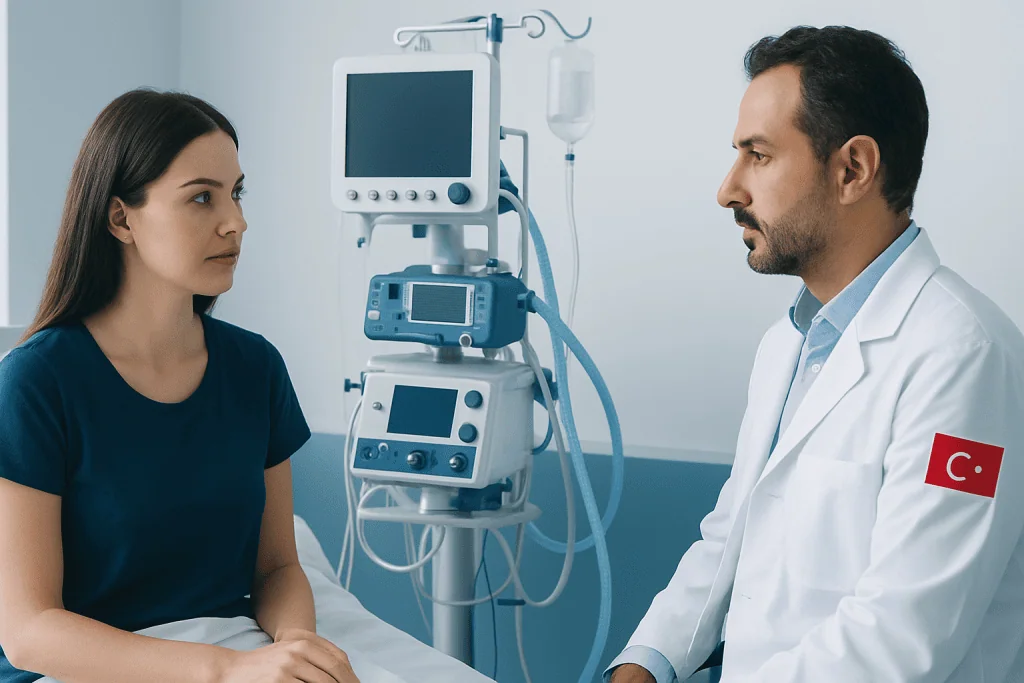
Start with the institution, not the surgeon. Ask whether the hospital is internationally accredited and how often those standards are reviewed. For many international patients, accreditation such as JCI is a useful marker because it reflects structured, audited processes around patient safety and quality — it is a starting point for your questions, not a substitute for them.
Then ask whether the hospital regularly performs the specific operation you need, and whether it is equipped for higher-risk inpatient care. For major surgery that means advanced imaging, laboratory and blood bank services on site, operating theatres set up for complex cases, and an intensive care unit if closer monitoring may be needed afterwards. Intensive care is worth exploring in its own right — our guide to questions to ask about ICU care before major surgery in Turkey covers what to check in detail.
It is also reasonable to ask how complications are handled. You do not need a technical protocol; you need to know that a multidisciplinary system exists — that anaesthetists, intensivists and relevant specialists are available around the clock, and that decisions are not left to a single doctor working alone. Whether your operation falls under general surgery, cardiovascular surgery or another department, the depth of the supporting hospital matters as much as the department itself.
- Is the hospital internationally accredited, and when was the last review?
- How often does it perform this specific operation?
- Is there 24/7 ICU, anaesthetic and emergency cover on site?
- Are imaging, laboratory and blood bank services available in the same building?
- Who takes over if my surgeon is unavailable during my stay?
Questions to ask your surgeon and care team

Major surgery is never one person’s work. Ask who will be involved from pre-operative assessment through to discharge: the surgeon, the anaesthetist, and — depending on your health — cardiology, internal medicine, nutrition, physiotherapy or intensive care. If you have other conditions, ask whether your case will be reviewed by a multidisciplinary team before a plan is confirmed.
When you speak to the surgeon, useful questions include:
- How often do you treat my specific condition, not just this general category of operation?
- What are the realistic alternatives to surgery in my case, including doing nothing for now?
- What are the main risks for someone with my health history, and how would they be managed?
- What technique do you plan to use, and why that one for me? If a minimally invasive or robotic approach is being considered, ask what it changes about the operation and the recovery — and what it does not.
- What does a typical hospital stay and early recovery look like for this operation?
- Who examines me in person before the operation is confirmed, and could the plan change after that examination?
That last question matters more than it looks. A remote opinion based on your records is a starting point; a final surgical plan should follow an in-person assessment. Be cautious of any provider that treats the plan as fixed before a doctor has examined you.
Communication is part of the clinical picture. Ask who will explain the treatment plan, whom you can reach with questions before travel, and whether an interpreter is available if English is not your preferred language. Acibadem’s international patient departments coordinate this so you know your named contact before arrival and throughout your stay.
What about “the best hospital in Turkey” for a given surgery?
Many patients search for the single best hospital in Turkey for plastic surgery, cardiac surgery or bariatric surgery. The honest answer is that no such ranking exists in a form you can rely on. “Best” depends on your operation, your health history, and the depth of the hospital behind the surgeon.
For aesthetic and reconstructive procedures in particular, the useful distinction is between a standalone clinic and a full hospital. A dedicated plastic, reconstructive and aesthetic surgery department inside a hospital sits alongside anaesthesiology, intensive care and other specialties — relevant if you have underlying conditions, if the procedure is extensive, or if several procedures are being combined. The same logic applies to bariatric and metabolic surgery, where anaesthetic risk assessment and post-operative monitoring carry real weight.
So rather than hunting for a “best” list, ask each candidate the same questions: does a specialist department exist for this work, how often is this procedure performed there, what supporting services sit around it, and what happens if the recovery does not go to plan. Those answers separate hospitals far more reliably than marketing rankings do.
Questions to ask about costs, packages and what is included
This guide will not tell you what surgery costs, because no honest general answer exists — the figure depends on the operation, your health, the length of stay and what the hospital bundles into the quote. What you can control is the quality of the quote itself.
Ask for a written estimate that lists what is included and what is billed separately. For major surgery, check whether it covers pre-operative tests, surgeon and anaesthesia fees, operating theatre use, the hospital stay, standard inpatient medications, pathology where relevant, and routine follow-up reviews before you leave Turkey.
Then ask what could change the final amount. A longer stay, additional tests, unplanned ICU time or extra specialist consultations can all affect the total. The point is not to predict every scenario; it is to see whether the hospital explains variation openly. A hospital that names the uncertainties in advance is usually a hospital that bills transparently later.
When comparing quotes, compare like with like. A lower figure is not a better figure if it excludes services you will probably need — transfers, interpreters, companion arrangements, post-operative reviews. If you are looking at bundled offers, our guide to questions to ask before choosing a treatment package in Turkey takes this apart line by line.
- What exactly does the estimate include?
- What is excluded or billed separately?
- How are extra nights, ICU time or additional tests handled?
- Is the quote valid after the in-person assessment, or could it change — and why?
Questions to ask about preparation before surgery
Preparation is where many international patients are caught out, because the days before an operation come with instructions that vary by procedure and by patient. The principle is simple: your surgical and anaesthetic team gives you written pre-operative instructions, and those instructions — not general internet advice — govern what you do.
Typical areas those instructions cover include fasting times before anaesthesia, smoking and alcohol in the period before surgery, herbal supplements, skin preparation, and which of your regular medicines to take on the day. Medication decisions in particular — including anything that affects bleeding — are made by your treating doctors based on your history; they are never something to change on your own initiative. If you take anticoagulants or antiplatelet drugs, raise it early in the planning conversation, because timing matters: our guide on blood thinners before surgery in Turkey explains which questions to put to the team and when.
Ask each hospital these preparation questions before you choose:
- When will I receive written pre-operative instructions, and in what language?
- Which pre-operative tests happen at home and which happen after I arrive?
- Is a dental check required before my operation? Some procedures — particularly cardiac and joint surgery — may call for dental clearance before major surgery, and it is far easier to arrange at home than in the week of the operation.
- How many days before surgery should I arrive, so assessments are not rushed?
- Whom do I ask if an instruction is unclear once I have my dates?
Questions to ask about dignity, privacy and consent
Patients often hesitate to ask this, so here it is plainly: yes, in a properly run operating theatre you are covered during surgery. Standard practice is sterile draping that exposes only the surgical site; the rest of your body remains covered, both for sterility and for your dignity. You are also covered during transfers to and from theatre, and only the staff involved in your care should be present.
It is entirely reasonable to ask about this before you choose. Useful questions include how the hospital handles patient privacy in theatre and on the ward, whether you can request considerations that matter to you — for example regarding staff gender where the hospital can accommodate it — and how photography or imaging of the surgical site is consented and stored, which is particularly relevant in aesthetic surgery.
Consent itself deserves the same scrutiny. Ask when you will see the consent form, whether it is available in a language you fully understand, and whether you will have time to read it and ask questions before the day of surgery — not on the trolley. A hospital confident in its process will welcome these questions. For a deeper treatment, see our safety and consent checklist for surgery in Turkey.
Questions to ask about travel, stay and practical support
Major surgery needs more planning than a short medical visit. Ask how many days before surgery you should arrive, how long the hospital stay is likely to be, and how long you should remain in Turkey after discharge before flying. These timelines drive everything else: flights, accommodation, companion arrangements, and time away from work. For some operations, flying too soon is a clinical question, not a scheduling one — so ask the surgical team directly rather than assuming.
Then ask what practical support exists for international patients: airport transfers, hotel or nearby accommodation options, interpretation during ward rounds and not only at the first consultation, mobility assistance, and transport at discharge. If you travel with a companion, ask whether they can stay with you in the room, visit freely, and — with your permission — receive updates from the team.
Hospitals that regularly treat overseas patients have structured processes for all of this. Acibadem’s international teams commonly coordinate interpreters and travel logistics across its hospitals, which makes a long treatment journey feel more manageable. Whichever hospital you consider, vague answers on logistics before you book usually mean improvised logistics after you arrive.
Questions to ask about recovery, discharge and follow-up
Do not choose a hospital for the day of surgery alone. Ask what the days after the operation look like: how pain and mobility are monitored, whether physiotherapy or rehabilitation is part of the pathway, and what milestones you typically need to meet before discharge. Knowing the recovery pathway in advance helps you prepare practically — and tells you whether the hospital has thought past the theatre doors.
Ask what written documents you will take home: a discharge summary, medication list, test results, imaging copies where relevant, and wound care instructions. These matter most if a doctor in your home country will continue your care — a good discharge pack is what makes that handover work.
Finally, ask how follow-up operates once you have left Turkey. Is there a remote review? A named contact for questions? A way to share wound photographs or updates? A well-organised hospital can describe its continuity of care for international patients in concrete terms, rather than leaving you to manage everything alone after the flight home.
How to compare hospitals with confidence
Once you have put the questions to ask before choosing a hospital in Turkey for major surgery to two or three candidates, write their answers down side by side: safety systems, experience with your operation, ICU availability, communication quality, quote transparency, travel support, follow-up. A comparison table you built yourself beats any ranking you found online, because it reflects your operation and your circumstances.
Pay attention to how each hospital answers, not only what it says. Clear, consistent, written replies are a good sign. Vague answers, missing detail in the written quote, or pressure to decide quickly are reasons to slow down. For major surgery there is almost never a genuine reason to book before you understand the plan.
If you are considering a large group such as Acibadem, ask how care is coordinated across departments and how international cases are managed end to end. For major surgery, organisation is part of safety: it reduces uncertainty before you travel, during your stay, and through recovery.
Step by step
- Define your surgery and medical needs. Gather your diagnosis, recent test results, imaging, medication list and a short medical history before contacting anyone. Complete information gets you accurate answers instead of generic ones.
- Make a shortlist of hospitals. Choose two or three that regularly treat international patients and perform your specific operation. Consider accreditation, the depth of specialist departments, and whether a dedicated international patient service exists.
- Ask every hospital the same questions. Use one checklist covering accreditation, ICU access, complication management, surgeon experience and on-site services, so the comparison is fair.
- Request a written treatment plan and estimate. Ask for the expected pathway in writing — tests, likely length of stay, early recovery — plus a quote that states inclusions and exclusions.
- Clarify preparation early. Ask when written pre-operative instructions arrive, which tests happen where, and raise regular medications with the treating team well before travel.
- Review travel and companion logistics. Confirm arrival timing, expected time in Turkey, accommodation, transfers, and companion arrangements before you commit to flights.
- Clarify follow-up before you book. Know whom to contact after discharge, what records you will take home, and whether remote follow-up is available.
- Choose the clearest hospital, not just the cheapest. For major surgery, clarity, organisation and safety systems are worth more than the lowest quote.
Your checklist
- Ask whether the hospital is internationally accredited
- Confirm it regularly performs your specific major surgery
- Check ICU, emergency, imaging and lab support on site
- Ask who examines you in person before the plan is final
- Ask who coordinates your care and communication before travel
- Request a written quote with inclusions and exclusions
- Ask when written pre-operative instructions will arrive, and in which language
- Clarify expected length of hospital stay and total time in Turkey
- Ask about interpreters, transfers and companion arrangements
- Confirm what discharge documents and follow-up you will receive
Key takeaways
- Put the same questions to every hospital and compare the answers in writing.
- For major surgery, ask about accreditation, ICU access and the full care team — not the surgeon alone.
- A written estimate should state what is included, what is excluded and what could change it.
- Preparation instructions and all medication decisions come from your treating team, not general advice.
- Dignity, consent and follow-up are fair questions to ask before you book, not after you arrive.
Frequently asked questions
What are some good questions to ask surgeons before surgery?
Ask how often the surgeon treats your specific condition, what the realistic alternatives are, what the main risks are for someone with your history, which technique is planned and why, what the hospital stay and early recovery typically involve, and who examines you in person before the plan is confirmed. Write the answers down so you can compare surgeons fairly.
Which hospital in Turkey is considered the best for plastic surgery?
There is no reliable single “best” — rankings you find online are mostly marketing. What you can assess is whether a dedicated plastic and reconstructive surgery department exists within a full hospital, how often your specific procedure is performed there, and what anaesthetic and intensive care support sits behind it. Those answers matter more than any list.
What should I avoid in the days before surgery?
It depends on your operation and your health, which is why hospitals issue written pre-operative instructions covering fasting, smoking, alcohol, supplements and skin preparation. Follow those instructions rather than general advice. Any decision about your regular medicines belongs to your treating doctors — never change them on your own.
Do they cover your privates during surgery?
Yes. Standard theatre practice uses sterile draping that exposes only the surgical site; the rest of your body stays covered for both sterility and dignity, including during transfers. Only staff involved in your care should be present, and it is entirely reasonable to ask a hospital how it handles privacy before you choose.
Should I choose a hospital based mainly on price?
No. For major surgery, the sounder choice combines clear quality standards, relevant experience, a transparent written quote and organised follow-up. A lower quote may simply exclude services you will need, so compare what each estimate actually covers rather than the headline figure.
Why does accreditation matter when comparing hospitals in Turkey?
Accreditation shows a hospital follows recognised, externally reviewed standards for patient safety and quality processes. It does not replace your own questions, but it is a sensible starting filter when you are comparing hospitals from abroad and cannot visit them first.
Should I ask about follow-up even before I travel?
Yes. Before choosing a hospital, ask what follow-up happens before you fly home, how questions are handled afterwards, and exactly which records and instructions you will take back for the doctor continuing your care. Continuity is easiest to arrange before you book, not after discharge.
Add us as a Preferred Source to see more of our trusted health content across Google Search, AI Overviews and Discover.

Update history
- PublishedAugust 1, 2026
- Medical review approvedSeptember 2, 2026
- Last content updateSeptember 2, 2026
References2
- CDC Travelers' Health — Medical Tourism — wwwnc.cdc.gov
- MedlinePlus — Surgery — medlineplus.gov
More Patient Guides

Choosing Between Inpatient and Day-Case Treatment in Turkey
Inpatient and day-case treatment in Turkey differ mainly in overnight monitoring, recovery needs and travel planning. Learn how to choose safely.
8 min read
At Acibadem, How We Manage Unexpected Changes to Your Treatment Plan
Unexpected changes to your treatment plan at Acibadem are managed through clear explanations, safety checks, and practical support in Turkey.
9 min read
Need More Than One Specialist in Turkey? How Multidisciplinary Care Is Coordinated
Multidisciplinary care in Turkey means your specialists coordinate tests, opinions and treatment plans so you can move through care with fewer delays.
9 min read
How to Compare Hospitals in Turkey for Complex Treatment
Compare hospitals in Turkey for complex treatment by checking accreditation, specialist teams, ICU support, coordination, and follow-up.
9 min read