

Radiology and Imaging Safety for International Patients

Safe imaging abroad depends on preparation. Send your previous reports and image files before you travel, tell the team about pregnancy, kidney problems, allergies, implants and past contrast reactions, and ask for interpreter support if instructions are unclear. Radiation-based scans are only used when medically justified, and MRI and contrast studies follow structured screening checks.
If you are planning treatment in Turkey, imaging is usually one of the first steps. And it raises practical questions straight away. Will the scans you had at home be accepted, or will everything need repeating? Is MRI safe with your implant? Do you need blood tests before contrast? This guide answers those questions and explains what radiology and imaging safety for international patients actually involves, from the documents you pack to the moment you collect your results.
It covers X-ray, ultrasound, CT, MRI, PET-CT, mammography and other radiology appointments. Read it before you travel; most of the safety work happens in advance.
At a glance
- Best first step: Send previous images and written reports before you travel, ideally as digital DICOM files.
- Key safety checks: Pregnancy status, kidney function, allergies, implanted devices and any previous contrast reaction.
- Common documents: Passport, referral notes, laboratory results, a full medication list and imaging CDs, USB drives or secure links.
- Support available: Interpreter coordination, appointment planning and record transfer through international patient services.
- Important reminder: Do not delay or skip urgent imaging because of travel logistics; ask the team how to proceed safely instead.
Why radiology and imaging safety matters when you travel for care
Imaging is the map your doctors use to navigate. Scans confirm or rule out a diagnosis, show how findings have changed over time, guide surgical planning, track how treatment is working and help decide whether further tests are needed. Get the imaging right and everything downstream becomes clearer. That is why radiology and imaging safety for international patients is worth taking seriously before you fly, not on the morning of the appointment.
For a patient crossing borders, safety has two layers. The first is the scan itself: correct patient identification, an appropriate protocol, radiation protection where relevant, contrast screening, infection control and clear communication between radiologists, technologists and your treating physicians. At Acibadem, imaging sits inside the hospital’s wider quality and patient safety system rather than operating as a stand-alone service; you can read more about how the radiology department is organised and how hospital safety works for international patients more broadly.
The second layer is you. Arriving with the right records, understanding instructions in a language you are comfortable in, and mentioning details you are not sure matter, all of this is part of imaging safety. A pacemaker model number or a half-remembered contrast reaction from years ago can change how the team prepares for your appointment. If in doubt, say it anyway. Nobody expects you to filter what is medically relevant; that is the team’s job.
Before you travel: organise your imaging records
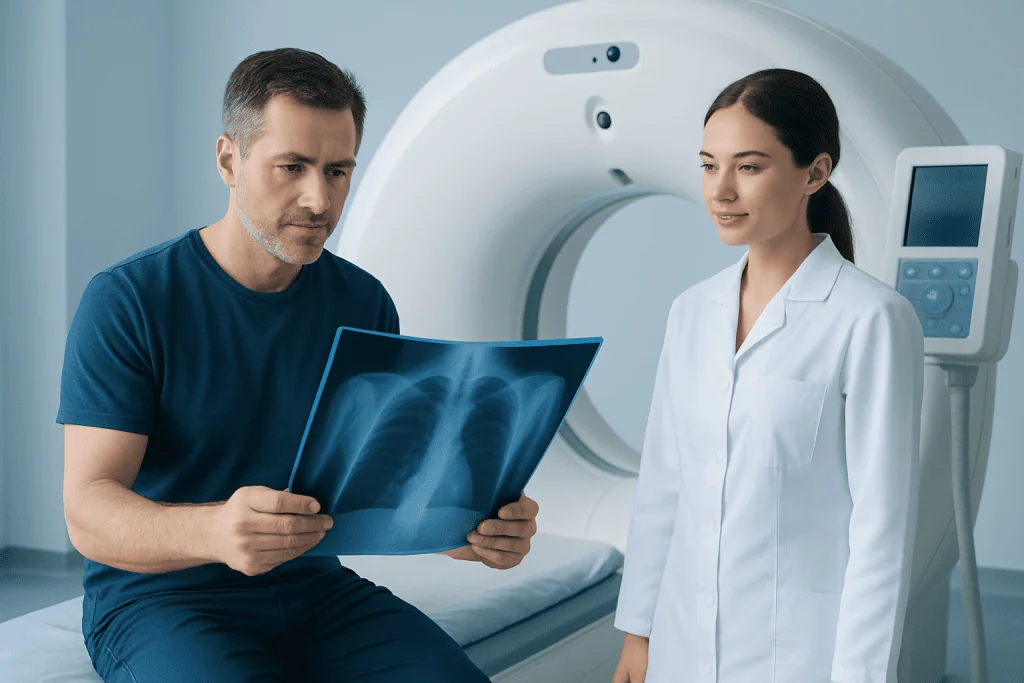
The safest imaging plan starts before your flight. If you have already had scans at home, send both the written radiology reports and the actual images. Reports summarise what a radiologist saw; the image files let specialists in Turkey look for themselves, compare directly with new findings and, in many cases, avoid repeating a scan you have already had. That matters for convenience, and for radiation-based tests it matters for safety too.
Ask your local hospital or clinic for images in DICOM format. This is the standard used by radiology departments worldwide and can be supplied on a CD, a USB drive or through a secure online link. If all you have is printed film or a phone photograph of a report, bring it, some information is better than none, but request the digital files as well if you can. A clean transfer of images before your first consultation saves time and often changes what happens at that consultation.
Then build a simple imaging folder for travel. For each previous scan, note the date, the body area, why it was done, whether contrast was used and whether you reacted to it. If your documents are not in English or Turkish, Acibadem’s international patient team can coordinate translation and interpreter support so nothing is lost between languages.
- Bring original reports plus digital image files whenever available.
- List every previous CT, MRI, PET-CT, angiography, mammography or ultrasound examination you can recall.
- Note any implanted devices, stents, surgical clips, pumps or prostheses, with model details if you have them.
- Carry recent blood tests if contrast may be used, especially kidney function results.
If imaging is part of a broader work-up before an operation, our guide to pre-op tests in Turkey explains how scans, blood work and consultations usually fit together.
Radiation protection: what to know about X-ray, CT and nuclear imaging
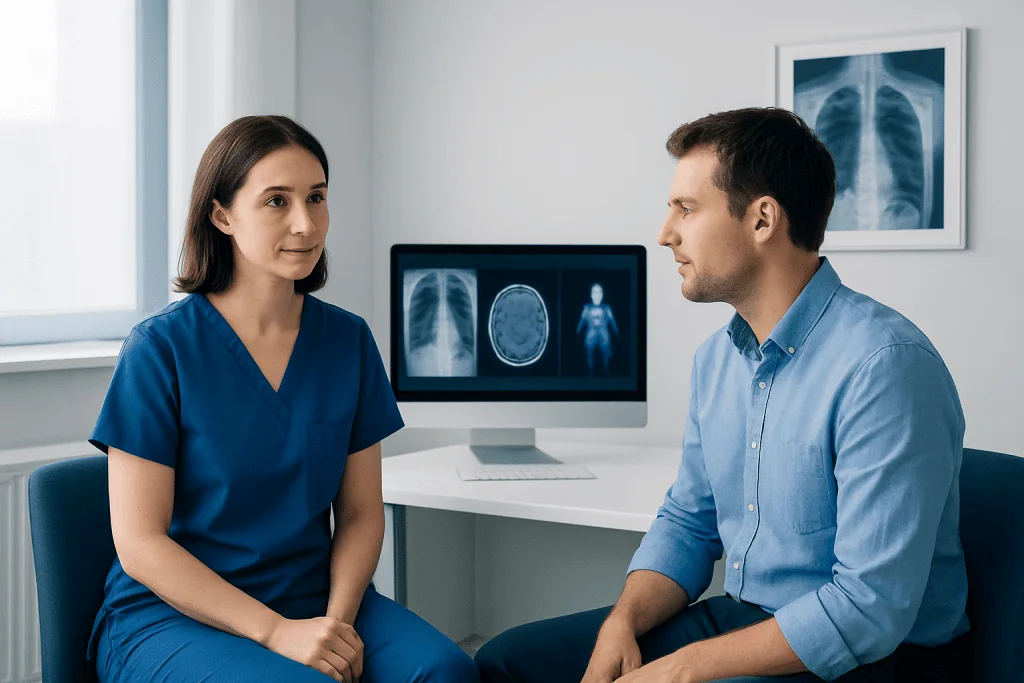
Some tests: X-ray, CT, fluoroscopy, mammography, PET-CT and certain nuclear medicine scans, use ionising radiation. Used carefully, radiation provides information that can be essential for accurate diagnosis and safe treatment planning. The goal is not to avoid every such scan. It is to make sure each one is justified by a clear clinical question, optimised so the dose is no higher than needed, and genuinely relevant to your care.
Radiology teams work to the principle of keeping exposure as low as reasonably achievable while still producing images good enough to answer the question. In practice that can mean choosing a lower-dose protocol, limiting the scanned area to the region that matters, using shielding where appropriate, or selecting a method without ionising radiation, ultrasound or MRI, when it can do the job. Your previous images help here too: a scan that already exists does not need repeating just because it was done in another country.
Pregnancy, children and repeat scans
If you are pregnant, might be pregnant or are trying to conceive, tell the team before any imaging appointment. That does not automatically rule out a scan; it means specialists will review timing, urgency and alternatives before proceeding. For children and adolescents, dose optimisation is weighted even more heavily, with protocols adjusted for age, weight and the specific clinical need. And if you have had many radiation-based scans in recent years, say so: the team can factor that into the decision about which test to use next.
MRI safety: implants, metal and preparation questions
MRI does not use ionising radiation, but it has its own strict safety rules because the scanner is a powerful magnet that is always on. Before an MRI you will be asked detailed questions about pacemakers, defibrillators, cochlear implants, aneurysm clips, neurostimulators, infusion pumps, retained metal fragments, prosthetic joints and other devices. The questions are repetitive by design. Answer them fully every time.
If you have an implanted device, bring the implant card, manufacturer information, operation note or anything that identifies the exact model. Many devices are MRI conditional, meaning the scan may be possible only under specific settings and after verification. Without accurate device information, the team may need extra time to check safety or may recommend a different test entirely. Guessing is not an option in an MRI suite, and a delay for verification is a sign the system is working.
Expect to remove jewellery, watches, bank cards, hearing aids, hairpins and clothing with metal parts before entering the scanner room. Tell the team if you have claustrophobia, difficulty lying flat, significant pain, tremor or sensitivity to noise: they can plan extra support, talk you through the timing, provide ear protection or coordinate with your physician if a different approach is needed. For a fuller walkthrough, including how anxiety and contrast are handled, see our guide to MRI in Turkey for international patients.
Contrast media: allergies, kidneys and clear communication
Some CT, MRI, angiography and ultrasound examinations use contrast agents to make blood vessels, organs or tissues easier to see. Contrast is often what turns an ambiguous image into a useful one, but it requires screening first. Expect questions about kidney disease, diabetes medications, thyroid disease, asthma, allergies, breastfeeding, pregnancy and any previous reaction to contrast.
A previous contrast reaction is one of the most important details you can share. Describe what happened, when, and what treatment you needed. Warmth, a metallic taste or brief nausea during injection is a different category from hives, swelling, breathing difficulty or a drop in blood pressure, and the team’s preparation differs accordingly. If you have old medical notes about the event, including the name of the agent used, bring them.
Kidney function may need checking with a blood test before certain contrast studies, particularly if you are older, have kidney disease or diabetes, are at risk of dehydration or take certain medications. Do not stop or change any medicine on your own before travel; share your full medication list and follow the instructions of your treating doctor and the radiology team. After contrast, you may be given simple hydration or observation guidance depending on your situation. Delayed reactions are uncommon, but if you develop swelling of the face or throat, difficulty breathing or feel faint after leaving the department, call your local emergency number or go to the nearest emergency department now.
Ultrasound and other tests without ionising radiation
Not every imaging question needs radiation. Ultrasound uses sound waves and is frequently the first choice for abdominal organs, the thyroid, blood vessels, joints and pregnancy-related imaging. It requires little preparation beyond, for some examinations, fasting or arriving with a full bladder: your appointment instructions will say which, and it is worth following them exactly, because poor preparation is the most common reason an ultrasound has to be rescheduled.
Part of imaging safety is simply choosing the right test. If your clinical question can be answered by ultrasound or MRI, a radiation-based scan may not be needed at all. This is one more reason to share your history and previous images early: the more complete the picture, the better the team can match the test to the question.
Your day in the radiology department
On the day, arrive early enough for registration, identification checks, consent forms and screening questions. International patient coordinators can tell you where to go, which documents to carry and whether an interpreter should be present. If fasting is required, follow the exact instructions you were given, fasting rules vary by test and by whether sedation or contrast is planned, so general internet advice is not a substitute.
Expect staff to confirm your name, date of birth, the body area being scanned and the reason for the test, sometimes more than once. This repetition is a deliberate safety step, not disorganisation. If the test being described does not match what you expected, stop and ask before proceeding. The same applies to paperwork: consent forms should be understood, not just signed, and you can read how they work in our guide to medical consent forms in Turkey.
Wear comfortable clothing and bring only what you need. Leave valuables with a companion where possible, especially before MRI. If you need mobility assistance, a wheelchair, help transferring onto the scanner table or extra time because of pain or disability, tell your coordinator in advance so the appointment can be planned around it rather than improvised on the day.
After your scan: results, copies and follow-up planning
After imaging, a radiologist reviews the images and prepares a report for your treating physician. Timing varies with the complexity of the case, whether comparison with previous scans is needed and how many specialists are involved, ask for a realistic estimate rather than assuming a fixed turnaround. For urgent findings, hospitals have internal processes to alert the relevant clinical team promptly.
Before you leave Turkey, confirm how you will receive both the written report and the image files. You may need digital copies for your doctors at home, for insurance claims or for future comparison. Ask for DICOM files or a secure download link, check that you can actually open them, and keep a personal imaging archive listing dates, body areas and the hospital where each test was performed.
If your care continues after you return home, request a clear follow-up plan: when imaging should be repeated, which symptoms need prompt attention and which doctor should review future results. Acibadem’s international patient services can help coordinate communication, translated documents and follow-up appointments when your treatment involves more than one specialty.
Step by step
- Send your medical records early. Share previous radiology reports, image files and referral notes before you travel. Early review helps the team decide which scans are genuinely needed and may prevent unnecessary repeat imaging.
- Prepare a safety information list. Write down allergies, previous contrast reactions, kidney problems, pregnancy status, implanted devices and all current medications. Keep the list with your passport and show it at registration and screening.
- Confirm preparation instructions. Ask whether you need to fast, drink water, arrive earlier for blood tests or follow any medication instructions from your treating doctor. Instructions differ by examination and by your history, so verify rather than assume.
- Bring implant and device documents. For MRI especially, carry implant cards, device model details and surgical notes. If you are unsure whether something contains metal or electronics, mention it during screening.
- Ask for interpreter support. If medical terms are unclear, request an interpreter through international patient services. Understanding consent, contrast questions and aftercare instructions is a safety requirement, not a courtesy.
- Check how results will be delivered. Before leaving the hospital, ask when the report will be ready and how you can access the images. Request copies in a format your home doctor can use, and test that you can open them.
- Keep imaging records for the future. Store reports and images together with dates and body areas. Future doctors rely on these comparisons to judge whether findings are stable, improving or changing.
Your checklist
- Passport or official identification
- Appointment confirmation and hospital contact details
- Previous imaging reports and DICOM image files
- Referral letter or medical summary from your doctor
- Medication list, including supplements and blood thinners
- Allergy list and details of any previous contrast reaction
- Recent kidney function blood tests, if available
- Implant cards, device information or operation notes
- Pregnancy or breastfeeding information, if relevant
- Insurance documents or payment authorisation, if required
Key takeaways
- Radiology and imaging safety for international patients starts with accurate records, honest screening answers and clear communication, most of it done before you fly.
- Radiation-based scans are used only when the expected medical benefit justifies the exposure, and previous images can prevent unnecessary repeats.
- MRI safety depends on verified information about implants, devices and metal; bring your implant card.
- Contrast studies require attention to allergies, kidney function and any previous reaction, however long ago.
- Interpreter support and international patient coordination make radiology appointments clearer and less stressful.
Frequently asked questions
Will I need to repeat scans I already had in my home country?
Not always. If your previous images are recent, of adequate quality and relevant to the current question, the team may use them for comparison or planning. Bringing the actual image files in DICOM format, not just the written report, gives specialists the best chance of avoiding unnecessary repetition.
Are CT scans safe for international patients?
CT uses ionising radiation, so it is performed only when medically justified, with protocols adjusted to the clinical question and the body area to keep exposure as low as reasonably achievable. If you are pregnant or might be, tell the team before the scan so timing and alternatives can be reviewed.
What should I do if I had an allergic reaction to contrast before?
Tell the radiology team before your appointment and describe the reaction as precisely as you can: what happened, when, and what treatment you needed. Bring any records from the event, including the contrast agent’s name if you know it. The team can then review precautions, alternatives or whether contrast is necessary at all.
Can I have an MRI if I have a pacemaker, stent or implant?
It depends on the exact device and its MRI safety conditions. Many devices are MRI conditional, meaning scanning may be possible only under verified settings. Bring your implant card, device model details and surgical records so the team can check compatibility. Do not assume MRI is safe or unsafe without that check.
Do I need blood tests before imaging with contrast?
You may need kidney function tests before certain contrast examinations, particularly if you have kidney disease, diabetes or other risk factors. If you have recent results, bring them; the radiology team will tell you whether updated tests are needed before your scan.
How can I understand instructions if I do not speak Turkish?
International patient services can coordinate interpreter support for appointments, consent discussions and preparation instructions. Ask the team to repeat or rephrase anything unclear. Accurate understanding is part of imaging safety, so never sign or proceed on a guess.
Can I get copies of my images before returning home?
Yes. Ask how to receive both the radiology report and the image files, ideally as DICOM files or a secure download link. Confirm the format, the access method and the expected timing before you leave the hospital, and check that the files open correctly.
Is ultrasound or MRI always safer than a CT scan?
Not necessarily safer for you overall: the safest test is the one that answers the clinical question reliably. Ultrasound and MRI avoid ionising radiation, and teams choose them when they can do the job, but sometimes CT or PET-CT provides information the alternatives cannot. Share your history and let the specialists match the test to the question.
Add us as a Preferred Source to see more of our trusted health content across Google Search, AI Overviews and Discover.

Update history
- PublishedJune 8, 2026
- Medical review approvedSeptember 13, 2026
- Last content updateSeptember 12, 2026
References3
- WHO: Ionizing radiation and health effects who.int
- NHS: MRI scan nhs.uk
- MedlinePlus: Imaging and radiology medlineplus.gov
More Patient Guides

When to Delay Travel for Treatment in Turkey Because of Cold, Flu, or Fever
Delay travel for treatment in Turkey if you have fever, worsening flu symptoms, or breathing difficulty; contact your care team before flying.

Traveling to Turkey for Treatment While Pregnant: Safety Questions to Ask First
Traveling to Turkey while pregnant can be safe with medical clearance, airline checks and a tailored care plan. Ask these key safety…
When to Seek Urgent Help After Leaving the Hospital in Turkey
When to seek urgent help after leaving the hospital in Turkey: act fast for breathing trouble, chest pain, heavy bleeding, high fever,…
At Acibadem, How We Handle Consent, Privacy, and Patient Decision-Making
Consent, privacy, and patient decision-making at Acibadem in Turkey are handled with clear information, confidentiality, interpreters, and respect for your choices.