

MRI in Turkey for International Patients: Claustrophobia, Contrast, and Safety Checks
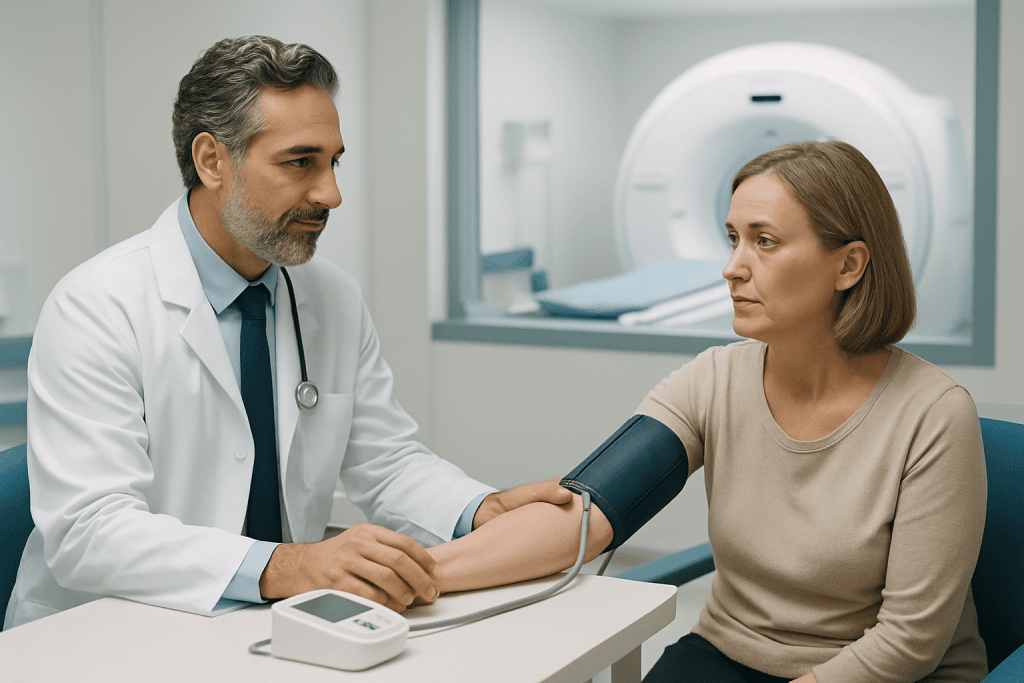
An MRI in Turkey follows the same safety logic as anywhere else: your history is reviewed first, a screening questionnaire checks for metal and implants, and contrast is only used when the clinical question requires it. For international patients, the practical work happens before travel, sharing previous scans, implant details and medication lists early prevents same-day delays and makes claustrophobia easier to manage.
Worried you will not cope inside the scanner? Unsure whether you need contrast, or whether an old implant will stop the scan going ahead? These are the questions most international patients arrive with, and every one of them is easier to sort out before you travel than on the morning of the appointment.
This guide explains how an MRI in Turkey for international patients is arranged and screened, how claustrophobia is handled in practice, when contrast may be used and what safety checks come with it, and what determines the cost of a scan, without pretending any of this can be reduced to a single number. The aim is simple: you arrive prepared, you know which questions to ask, and nothing on the day comes as a surprise.
At a glance
- Best for: International patients arranging an MRI in Turkey, alone or as part of a wider treatment visit
- Main concerns covered: Claustrophobia, contrast agents, kidney checks, metal implants, safety screening, results in English
- Before you go: Share your medical history, previous scans, medication list and implant details as early as possible
- On the day: Expect identity checks, a detailed safety questionnaire and a change into scan-safe clothing if needed
- Support available: Interpreter help, international patient coordination and scheduling across departments
- Important note: Not every MRI needs contrast, sedation or special preparation: the protocol depends on the clinical question
What to expect when you arrange an MRI in Turkey
An MRI uses a strong magnetic field and radio waves to build detailed images of structures inside the body. It does not use ionising radiation, which is one reason it is so widely requested. For most people arranging an MRI in Turkey for international patients, meaning a scan booked from abroad, often combined with a consultation, the practical questions have less to do with the machine and more to do with timing, paperwork, language support and comfort during the scan itself.
When you arrange the scan, you will usually be asked why it has been requested, which body area is being examined, whether you have had previous imaging, and for basic medical details. If your referring doctor has recommended contrast, or noted concerns such as claustrophobia, kidney problems, pregnancy or an implanted device, sharing that information at the booking stage is the single most useful thing you can do. It gives the radiology team time to check protocols, confirm implant compatibility and plan the appointment properly.
At Acibadem, international patient services help organise the imaging appointment, pass on preparation instructions and coordinate interpreter support when needed. This matters most when you are combining a scan with consultations in one visit, or arriving from abroad on a tight schedule where a delayed or repeated scan would disrupt the whole trip. The wider principles behind imaging appointments are covered in our guide to radiology and imaging safety for international patients.
One honest caveat before the detail: an MRI answers a specific clinical question. It is not a substitute for a consultation, and a scan requested without a clear question often produces findings that need further tests to interpret. If a doctor at home has requested the scan, bring that request: it shapes which sequences the radiologist runs.
Claustrophobia: what you can do before and during the scan
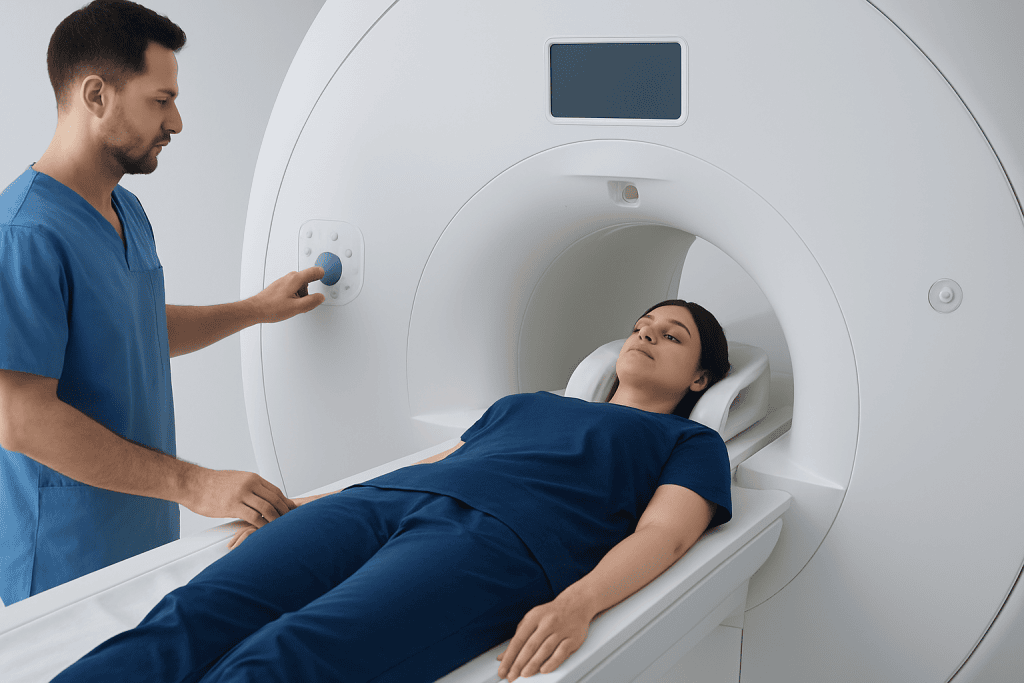
If small spaces make you anxious, say so when the appointment is being arranged rather than on the day. Claustrophobia is common, imaging teams deal with it constantly, and early notice is what allows them to help. It gives the team time to explain the process step by step, adjust the schedule so you are not rushed, and discuss what support might be appropriate in your case.
Knowing exactly what happens usually helps. You lie on a scanning table that moves into the bore of the machine. The scanner makes loud tapping, knocking and buzzing sounds while images are taken: this is normal, and you will be given ear protection. Images are taken in sequences with short gaps between them, and the technologist can usually speak to you between sequences through an intercom. You hold a call button throughout, so you are never out of contact.
Simple strategies make a real difference: slow, steady breathing; closing your eyes before the table moves into the scanner and keeping them closed; listening to the technologist’s countdowns; and remembering that each noisy sequence has a fixed length. Some scans of the knee, ankle or foot position you feet-first, with your head partly or fully outside the bore, worth asking about, because it changes how enclosed you actually feel.
If anxiety is severe, your doctor may discuss whether additional support, including medication, is appropriate. This must always be reviewed in advance, not on the day, because it can affect fasting instructions, whether you can drive or travel alone afterwards, and whether someone needs to accompany you. This guide cannot tell you whether medication is right for you: that is a decision for the clinician responsible for your care.
- Mention panic attacks or severe anxiety at the booking stage, not in the changing room
- Ask how long your specific scan is expected to take, and whether it is head-first or feet-first
- Check whether a companion can wait nearby during the scan
- Arrange return transport in advance if medication for anxiety is being considered
MRI contrast: when it may be used and what safety checks matter

Many MRI scans are performed without contrast. Others use a gadolinium-based contrast agent, given through a small cannula in the arm, to show certain tissues, blood vessels, areas of inflammation or tumours more clearly. Whether contrast is used depends on the clinical question and the radiologist’s protocol, not on preference, and not on what makes the scan more expensive or impressive. If contrast is planned for your scan, the team should explain why and review your history first.
The safety checks that matter most concern your kidneys, because gadolinium agents are cleared through them, and any history of reactions to contrast. Mention kidney disease, dialysis, an organ transplant, diabetes, severe allergies, asthma, and any previous reaction to contrast, even one that happened during a CT scan with a different type of agent. Depending on your history, the team may ask for a recent kidney function blood test before confirming contrast; if you already have recent results, bring them. You can read more about why kidney protection matters across imaging and treatment in our page on renal safety.
If you are pregnant, might be pregnant, or are breastfeeding, say so before the appointment. The radiology team will decide what information they need and whether the timing, protocol or use of contrast should change. Bring a complete medication list as well, complete information is the best protection against same-day delays. Do not stop or change any regular medicine on your own account; only the doctor treating you can advise on that.
Metal, implants and the MRI safety questionnaire
MRI safety screening is taken seriously everywhere for the same reason: the magnet is always on, and it is powerful. Before the scan you will complete a detailed questionnaire about implants, past surgery, injuries involving metal and any devices in or on your body. This is not paperwork to rush. Accurate answers are what keep the scan safe.
Tell the team about a pacemaker or defibrillator, aneurysm clips, a cochlear implant, an artificial heart valve, a neurostimulator, an insulin pump, an implanted port, joint replacements, retained metal fragments, or any history of metalwork or eye injuries involving metal. Many modern implants are MRI-conditionalsafe to scan under specific settings, rather than automatically unsafe. But “conditional” means the radiology team needs exact details: the device model, the manufacturer’s card, or the operation records. Without them, a cautious team will postpone rather than guess, and postponement is exactly what an international patient on a fixed itinerary wants to avoid.
You will also remove jewellery, watches, hearing aids, removable dental pieces, hair accessories with metal, bank cards and phones before entering the scan room. Medication patches and wearable devices such as glucose sensors should be mentioned too, because some contain metal or are affected by the magnetic field. A practical tip that saves time at check-in: photograph your implant cards and surgical reports and keep the images on your phone.
What an MRI in Turkey costs: how quotes actually work
This guide gives no prices, because a single figure for “an MRI in Turkey” would be misleading. What we can do is explain what a quote depends on, so you can compare offers intelligently.
- The body area and number of regions. A single-region scan and a multi-region or whole-body protocol are different appointments with different scanner time.
- Contrast. If contrast is used, the agent, the cannula and any pre-scan blood tests are part of the picture.
- Sedation or anaesthesia support, where clinically agreed, changes staffing, observation time and preparation.
- Reporting and translation. Ask whether the radiologist’s report, an English version and digital image files are included in what you are quoted.
- What sits around the scan: consultations, interpreter services and follow-up review may be quoted separately or bundled.
Ask for a written quote that states exactly what is included, and question anything vague. As for “the cheapest country for an MRI”, no honest guide can answer that, because prices move, exchange rates move, and the cheapest scan is worthless if the protocol does not answer your clinical question or the report cannot be used by your doctor at home. Judge the whole pathway, not the headline figure. Our guides on the hidden costs patients often miss in a medical travel budget and what to check in travel insurance for treatment in Turkey cover the financial side in more depth.
Can foreigners use hospitals in Turkey, and is any of it free?
Yes, foreigners can be treated in Turkish hospitals, and private hospitals routinely receive international patients; that is what international patient departments exist for. But tourists do not receive free healthcare in Turkey. The Turkish state health system covers people enrolled in it, and visitors are not. As a visiting patient you pay for private care directly, or through travel or health insurance if your policy covers planned or emergency treatment abroad, which is exactly why checking your policy wording before travel matters.
Practical preparation before you travel
Bring your passport or ID, a referral or doctor’s request if you have one, insurance or payment documents where relevant, and any previous imaging reports or scan discs. Reports in another language are most useful when they arrive before you do, because earlier imaging sometimes answers part of the question already, and knowing that in advance changes what is scanned. A fuller list of what to carry is in our guide to documents international patients should bring for hospital admission in Turkey.
Ask in advance whether you need to fast, arrive early or complete blood tests before the scan. Preparation varies with the body area and with whether contrast or medication support is planned; some abdominal scans require an empty stomach, most joint scans require nothing at all. Do not stop regular medicines unless the clinician responsible for your care has told you to.
If you are visiting Turkey specifically for diagnosis, leave genuine slack in your itinerary: time for the pre-scan review, the scan, and receiving the report or follow-up advice. A schedule with no margin turns a minor delay into a missed flight. If the MRI is part of a wider work-up before treatment, our guide to pre-op tests in Turkey explains how imaging fits alongside the other checks.
The day of your MRI and getting your results
On arrival, expect registration, identity confirmation and a final safety review, yes, some questions will be asked again, deliberately. You may change into a gown if your clothing contains metal fasteners or fibres unsuitable for the scanner room. The radiographer will explain how to lie, how to stay still, and when to hold your breath if the scan requires it.
During the scan, stillness is the one thing only you can contribute. Movement blurs images and forces repeat sequences, which lengthens the appointment. The noise is normal; the ear protection is not optional. If contrast is used, it is typically given partway through, and the team observes standard safety procedures throughout and afterwards.
After the scan, some patients leave immediately; others stay for a short observation period, depending on what was used during the appointment. Before you go, confirm three things: when the radiologist’s report will be ready, whether it will be provided in English, and how you will receive the images, disc, portal or download link. In a multidisciplinary setting such as Acibadem, results can often be coordinated with your next consultation so the scan feeds directly into your onward plan rather than sitting in your inbox untranslated.
Step by step
- Share your history when booking. Explain why the MRI is requested, which body part is involved, and anything that makes lying flat or staying still difficult. Mention claustrophobia, implants, prior surgery, pregnancy, kidney issues and any previous contrast reaction as early as possible.
- Gather previous reports and device information. Older MRI, CT, X-ray or ultrasound reports should travel with you, or ahead of you where possible. For any implanted device, keep the device card, model details or surgical records to hand so MRI compatibility can be confirmed before your appointment, not during it.
- Confirm preparation instructions. Ask whether you need to fast, arrive early or complete blood tests. Check whether regular medications continue as normal and whether a companion is advisable if anxiety support is being discussed.
- Get the quote in writing. Confirm what the quoted appointment includes, contrast if planned, the report, an English version, digital images, so there are no surprises at the desk.
- Plan for comfort on the day. Wear simple clothing without metal, leave valuables at your accommodation where possible, and arrive with time to spare so anxiety is not compounded by rushing.
- Complete the safety screening carefully. Answer every question honestly, even where something seems minor. Metal fragments, old operations, skin patches and wearable devices all matter in an MRI environment.
- Ask your questions before the scan starts. How long will it take? Is contrast expected? How do you communicate mid-scan? Knowing the sequence of events makes the experience far more manageable.
- Confirm how results will be delivered. Before leaving, establish when the report is expected, in what language, and in what format, and make sure the team knows your travel timeline so follow-up fits inside it.
Your checklist
- Passport or ID
- Referral note or doctor’s request, if available
- Previous imaging reports and scan files
- Medication list and allergy history
- Kidney function results if requested
- Implant or device card and surgery details, photographed on your phone
- Glasses, hearing aids and removable dental items stored safely before the scan
- Written quote confirming what the appointment includes
- Interpreter request confirmed if you need language support
- Return transport arranged if medication for anxiety may be used
Key takeaways
- An MRI in Turkey for international patients runs smoothly when history, implant details and safety information are shared early.
- Claustrophobia is common and manageable, advance notice, not last-minute disclosure, is what makes support possible.
- Not all MRI scans need contrast; where contrast is planned, kidney function and previous reactions are the checks that matter.
- MRI safety screening for metal and implants is essential, and “MRI-conditional” implants need exact device details.
- MRI cost depends on the region scanned, contrast, sedation and what the quote includes, insist on a written quote, and remember tourists are not covered by Turkey’s state health system.
- Confirm before you leave how, when and in which language your results will reach you.
Frequently asked questions
How much does an MRI cost in Turkey?
There is no single figure, and any page giving one is simplifying. The cost depends on the body area and number of regions scanned, whether contrast or sedation is involved, and what the quote includes: the radiologist’s report, an English translation and digital image files may be bundled or separate. Ask for a written quote listing exactly what is covered before you commit.
Can foreigners go to hospital in Turkey?
Yes. Foreign visitors can receive treatment in Turkish hospitals, and private hospitals routinely receive international patients through dedicated international patient departments that handle scheduling, interpreters and documentation. You will need identification and a means of payment or insurance cover.
Do tourists get free healthcare in Turkey?
No. Turkey’s state health system covers people enrolled in it, and tourists are not. As a visitor you pay for care directly or through insurance, which is why checking whether your travel or health policy covers planned and emergency treatment abroad matters before you fly.
Do all MRI scans in Turkey use contrast?
No. Many MRI scans are performed without contrast. The decision depends on the body area and the clinical question, not on preference. If contrast may be used, the team should review your kidney history and any previous reactions, and explain the reason beforehand.
What should I do if I am claustrophobic?
Raise it when the appointment is being arranged so the radiology team can plan for it. Clear step-by-step explanations, unhurried scheduling and practical adjustments often help considerably, and any additional support, including medication, must be discussed with a clinician in advance, never arranged on the day.
Can I have an MRI with a metal implant or medical device?
Often yes, but it depends on the specific implant and its MRI conditions. Many modern devices are MRI-conditional, meaning they can be scanned under defined settings. Bring the device card or surgical records, because the team needs exact model details before confirming the scan can go ahead safely.
Will I get my MRI report in English?
Ask for this when arranging the scan rather than assuming it. Centres experienced with overseas patients, including Acibadem, can usually coordinate English-language reporting and provide images digitally, but confirming the timeline before you leave avoids chasing documents from abroad.
Is MRI safe during pregnancy?
Pregnancy, even a possibility of it, should always be mentioned before the scan. The radiology and clinical teams will decide what information they need and whether the timing, protocol or use of contrast should be adjusted. That decision belongs to them, made with your full information.
Add us as a Preferred Source to see more of our trusted health content across Google Search, AI Overviews and Discover.

Update history
- PublishedJuly 8, 2026
- Medical review approvedSeptember 13, 2026
- Last content updateSeptember 12, 2026
References2
- MRI scan: NHS nhs.uk
- MRI Scans: MedlinePlus medlineplus.gov
More Patient Guides
Sleep Apnea Testing in Turkey: What Happens During Your Evaluation
Sleep apnea testing in Turkey may include a consultation, overnight sleep study or home test, and a clear review of your results…

How to Organize Your Test Results Before Traveling to Turkey
Organize your test results before traveling to Turkey by sorting records, images, medicines and timelines so your Istanbul care team can review…

When Extra Tests Are Needed Before Treatment in Turkey
Extra tests before treatment in Turkey may be needed to confirm diagnosis, timing, and safety. Here is what you can expect in…

At Acibadem, How to Prepare for Blood Tests, Scans, and Pre-Op Checks
Blood tests, scans, and pre-op checks at Acibadem in Turkey help confirm you are ready for treatment and avoid delays on the…