

Returning Home with a PICC Line or Port After Treatment in Turkey

Most patients can travel home with a PICC line or port still in place, provided the treating team confirms they are fit to fly. The essentials are written device details and care instructions, supplies and medicines in hand luggage, a dressing that stays clean, dry and undisturbed through the journey, and a local team arranged to take over flushing, dressing changes and monitoring soon after you arrive.
Leaving hospital with a line still in your arm, or a port still under your skin, changes how you think about the journey home. It should not stop you travelling, these devices are designed to stay in place between treatments, but it does add a short list of things to organise before you board. This guide walks through returning home with a PICC line or port after treatment in Turkey: what to confirm before discharge, what to carry, how to manage the airport and flight, and how to hand your care over to a team at home without a gap.
At a glance
- Best time to plan: Start 3–5 days before your flight, while your care team is still in front of you
- Main priorities: Written care instructions, a documents folder, a small supply kit, and a booked handover at home
- Travel documents: Discharge summary, device type and insertion date, medicines list, allergies, next flush or dressing date
- Who can help: Your treating team, ward nurses, and Acibadem’s international patient services
- After arrival: A local clinician takes over dressing changes, flushing and monitoring, arranged before you fly, not after
What returning home with a PICC line or port actually involves
The two devices sound similar but travel differently, so it helps to be clear about which one you have. A PICC line (peripherally inserted central catheter) is a thin tube that enters through a vein in the upper arm and ends near the heart. Part of it sits outside the body under a transparent dressing, which means it needs visible care: the dressing must stay clean, dry and intact, and the line needs flushing on a schedule to stay usable. A port (sometimes called a portacath or implanted port) sits entirely under the skin, usually on the chest. When it is not accessed with a needle, there is nothing external to protect, only a small raised area under healed skin, and its maintenance schedule is generally less frequent.
| PICC line | Implanted port | |
|---|---|---|
| Where it sits | Upper arm, with an external section under a dressing | Fully under the skin, usually on the chest |
| What travel care involves | Keeping the dressing dry and secure; avoiding pulling or heavy use of that arm | Very little, if not currently accessed; comfort around the site if it is tender |
| Typical maintenance | Regular dressing changes and flushes on a set schedule | Periodic flushing, on a longer interval set by your team |
| Who maintains it at home | Community or hospital nurses trained in line care | A clinic or nurse trained in accessing ports |
Why this matters for the journey: returning home with a PICC line or port after treatment in Turkey is mostly a planning exercise, not a medical challenge. The device does not need anything special from you at altitude. What it needs is protection from tugging, moisture and contamination, plus an unbroken chain of care: the last flush or dressing change in Turkey connecting cleanly to the first one at home.
What to sort out before you leave Turkey
The most useful work happens before discharge, while the people who placed and used your device are still available to answer questions. Before you leave the ward, you should be able to answer four things: why the line or port is staying in, who will look after it next, when the next flush or dressing change is due, and what your written instructions say to watch for. You do not need to memorise any of it: you need it on paper, in language a clinician at home can act on.
Ask your nurse to show you what your site looks like today, while it is normal. This gives you a baseline. It is much easier to notice a change later if you know what “fine” looked like at discharge. If your port is currently accessed, or you are travelling with any infusion equipment, go through the travel arrangements for that separately and in detail: this is a different situation from travelling with a de-accessed port, and your team will set the specifics.
Timing of the flight itself is a decision for your doctors, based on your overall condition rather than the device alone. The general question of when flying is sensible after treatment is covered in our guide on when it is safe to fly home after surgery in Turkey. At Acibadem, international patient services can help with the practical side of discharge: assembling your treatment summary in English, arranging interpreter support for the discharge conversation, and confirming what you should carry during travel. If your home team will need translated or consolidated records, ask before you fly: it is far easier to fix a missing document in Istanbul than from your sofa a week later.
The documents and supplies you should carry with you
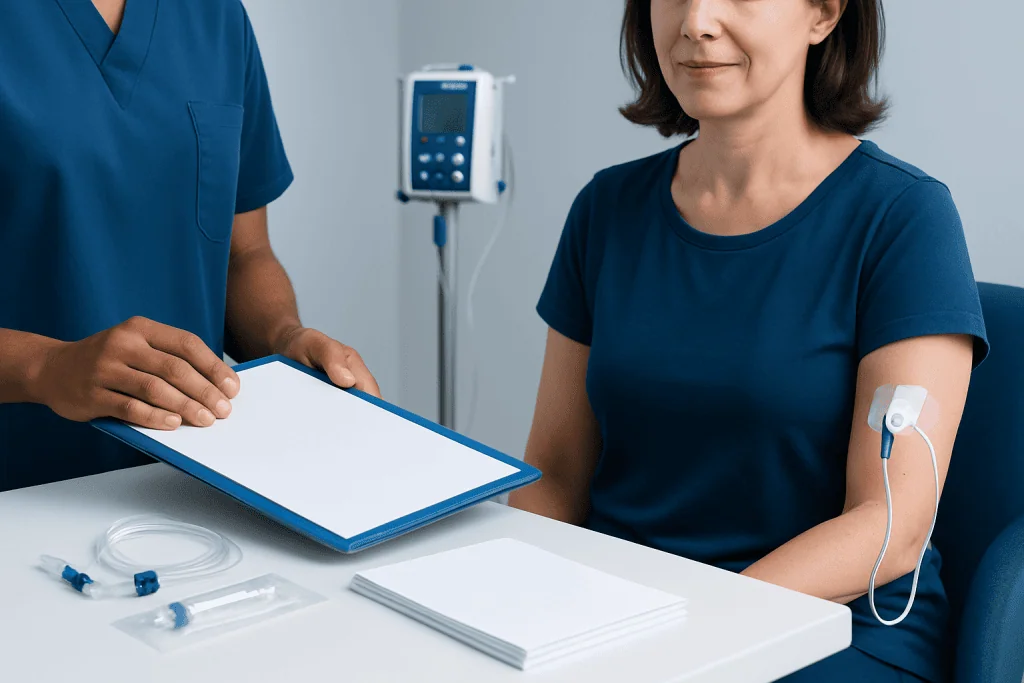
Everything medical travels in your hand luggage, in one folder, never in the hold. Checked bags get delayed and lost; your discharge summary and medicines cannot afford to. Keep digital copies on your phone and email a set to yourself and to whoever is meeting you at home, so the paperwork survives even if the folder does not.
The folder should include your discharge summary, a short letter confirming recent treatment, the exact name and type of the device, its insertion date, your current medicines, allergy information, and the date the next flush or dressing change is due. If your treatment involved blood thinners, antibiotics, nutrition support or cancer therapy, make sure that is stated plainly: these details change how a clinician at home reads everything else. If your follow-up depends on recent test results, carry a copy of those too.
Alongside the folder, pack a small supply kit for the journey, especially if it is long or includes layovers. Pack only what your discharge nurse advises: this kit is for routine care and unexpected practicalities, not for improvised procedures. Typical contents include:
- Spare dressing materials, if your team says to carry them
- Medical tape or securement items, if advised
- Alcohol hand gel for general hand hygiene while travelling
- Your prescribed medicines in original packaging
- Contact numbers for the hospital in Turkey and your provider at home
- A copy of your latest results, if follow-up depends on them
Medicines deserve their own five minutes of planning: declarations at customs, keeping them in labelled packaging, and organising the first days back. Our guide on returning home with new medicines after treatment in Turkey covers this in detail, including what to think about when your flight crosses several time zones.
Getting through the airport and the flight
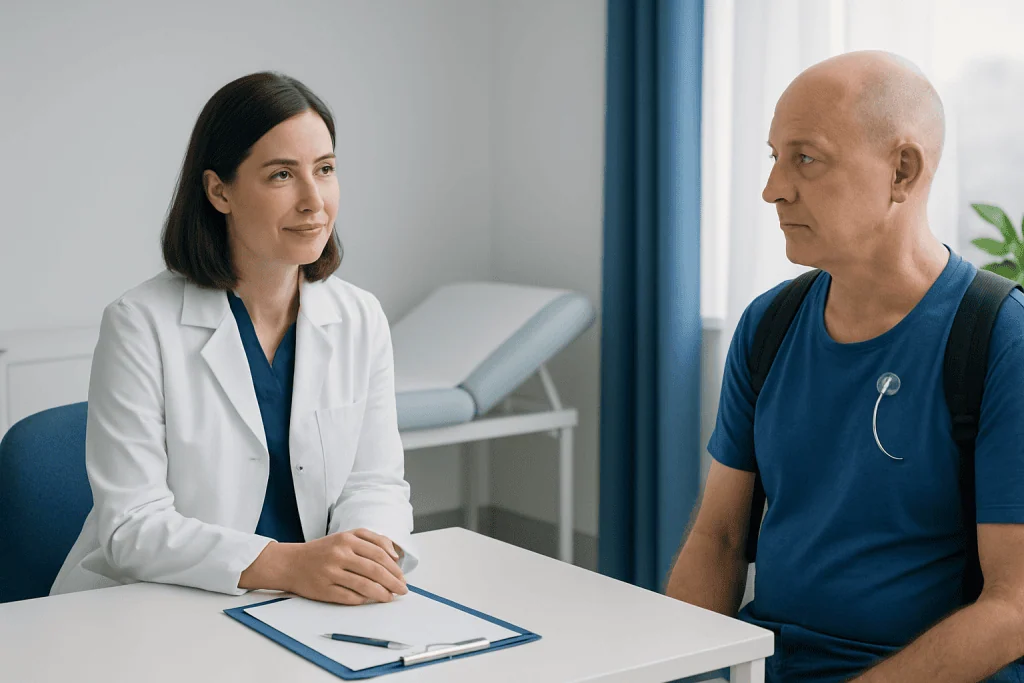
Allow more time than you think you need. After treatment, most people move slower, tire faster, and carry more than usual. Rushing through queues is exactly the situation in which a bag strap catches a dressing or an arm gets knocked. If there is any doubt about your stamina, arrange wheelchair support, help with bags or priority boarding with the airline in advance: the practical steps are set out in our guide to airport assistance when returning home after surgery. Airlines handle these requests routinely; they simply need notice.
At security, neither device usually causes drama. A port is a small implant under healed skin; it may or may not register on detection equipment, and if staff ask about it, your documents folder answers the question in seconds. A PICC dressing on the arm is visible and occasionally prompts a question at pat-down; again, the treatment letter settles it. You do not need to volunteer a medical history at the checkpoint: you need paperwork within reach and a calm sentence: “I have a medical line; here is my hospital letter.”
On board, the device itself asks nothing of you. Normal cabin conditions do not require any action on a PICC or a de-accessed port. Your job is simpler: keep the dressing dry and covered, avoid fiddling with it, keep your medical bag under the seat rather than in the overhead locker, and take medicines on schedule. Wear loose clothing so nothing rubs or compresses the site, and avoid using the PICC arm for hauling luggage, lifting and strain limits after discharge apply on travel day more than any other day. If your team has said movement is safe for you, stand, stretch and walk the aisle on a long flight; travel fatigue is real, and arriving exhausted makes every other task harder.
Monitoring the site during the trip and afterwards
Your discharge instructions will include a short list of things your team wants reviewed by a clinician if they appear, changes at the site, changes in how the line behaves, and general symptoms such as fever. This list is specific to you: it reflects your treatment, your device and your overall condition, which is why the written version from your own team matters more than any general article, this one included. Before you leave, read it with your nurse and make sure your travel companion has read it too. Two people who know what the instructions say are better than one tired traveller trying to remember.
Checking the site is a matter of looking, not touching. When you can do so hygienically, not in a cramped aircraft toilet if it can wait, glance at the dressing: is it still sealed, dry and flat? A dressing that has lifted or become wet is no longer doing its job, and your discharge instructions will say how that situation should be handled and by whom. The general principle is that dressing problems are fixed properly by someone trained to do it, not improvised with whatever tape is in your bag.
Once you are home, the same written list becomes your reference for the recovery period. Our guide on warning signs after returning home from treatment explains how these lists are usually structured and why teams write them the way they do. If your immune system is lowered by recent treatment, your team will have said so in your paperwork: that context changes how clinicians at home interpret small symptoms, which is one more reason the folder travels with you everywhere in the first weeks.
Arranging follow-up care in your home country
This is the part patients most often leave too late. A PICC line has a maintenance schedule that does not pause because you changed countries: flushes and dressing changes fall due on set dates, and missing them is how usable lines become unusable ones. A port is more forgiving between uses, but it still needs a named clinician who knows it exists and when it next needs attention. The handover should be arranged before you leave Turkey, with your first local appointment booked for before or within the first days after you land.
Who takes over depends on why the device is in place. It might be your oncologist, surgeon, family doctor, a community nursing service, an infusion clinic or a hospital vascular access team. Whoever it is, they need your discharge summary and the device details in advance, send the digital copies ahead so nobody is reading your history for the first time while you sit in front of them. If blood tests are part of your follow-up plan, coordinate those with the same visit where possible; our guide on planning follow-up blood tests after returning home from Turkey explains how to line up requests, timing and results.
Your Turkish team usually remains part of the picture as well. Many treatment plans include a remote review of results or imaging after you are home, and the mechanics of that, what gets sent, in what format, and when, work best when agreed at discharge. The guide on remote follow-up after returning home from Turkey describes how these arrangements typically run. Acibadem’s international patient coordinators prepare records for onward care as a routine part of discharge, so ask for consolidated or translated documentation while you are still there.
The first week at home
The first days back are oddly busy: jet lag, unpacking, new routines and a device to remember, all at once. Keep it simple. Paperwork lives in one place. Medicines and appointments get phone reminders. One trusted person at home learns the basics of your line or port care, so that on a day you feel flat or foggy, someone else can check the schedule and read the instructions.
Practically: choose clothes that do not pull on the site, put everyday items within easy reach so you are not stretching and hauling, and follow the exact showering or bathing instructions you were given rather than general advice from forums. If your team set limits on lifting or activity with the PICC arm, those limits stand until your own clinicians revise them, not until you feel ready, which usually happens sooner.
Emotionally, it is common to feel two things at once: reassured that the device is there for the next phase of treatment, and slightly anxious about being its custodian away from the hospital. Both are normal. The structure you built before flying, the folder, the booked appointment, the informed companion, exists precisely so that the anxious days have a plan attached to them.
Step by step
- Confirm why the PICC line or port is staying in place. Before discharge, ask your doctor or nurse to explain the purpose of the device after you return home, ongoing medicines, blood sampling, nutrition, future treatment, or simply removal planned for later.
- Get written care instructions before you leave. Do not rely on memory after treatment. Ask for the discharge summary, device details and insertion date, medicines list, the signs your team wants reviewed, and the date of the next flush or dressing change.
- Build a hand-luggage folder and supply kit. Documents, medicines in original packaging, and only the care supplies your nurse recommends. Keep digital copies on your phone and make sure your companion knows where everything is.
- Book the home handover before you fly. Identify who takes over, community nurse, infusion service, local hospital, send them your records in advance, and fix the first appointment for before or just after your arrival.
- Plan the airport around your energy, not your pride. Arrange wheelchair support, bag help or priority boarding in advance if queues and carrying might be a strain. Loose clothing and unhurried timing protect the site better than vigilance does.
- During the journey, protect and leave alone. Keep the dressing dry and covered, keep the medical bag within reach, take medicines on schedule, and check the site visually only when you can do so cleanly.
- Recheck everything after you land and rest. Review instructions, medicines and appointments calmly. Confirm the first local appointment is still in place and that your records arrived where they were sent.
Your checklist
- Discharge summary and treatment letter in your hand luggage
- Written details of the PICC line or port, including insertion date
- List of current medicines, allergies and recent treatments
- Date due for the next dressing change, flush or review
- Your team’s written monitoring instructions, read by you and your companion
- Hospital and home follow-up contact numbers saved in your phone
- Medicines in original packaging, never in checked baggage
- Airline assistance arranged if queues or bags may be a strain
- Local doctor, nurse or clinic informed and first appointment booked
- Digital copies of all documents emailed to yourself and a family member
Key takeaways
- Returning home with a PICC line or port after treatment in Turkey is a planning exercise: the work happens before discharge, not at the airport.
- All medical documents, medicines and supplies travel in hand luggage, with digital copies as backup.
- The device needs nothing special in flight, only protection from pulling, moisture and hurry.
- Maintenance schedules do not pause for travel: the home handover for flushing, dressing changes and monitoring is booked before you fly.
- Acibadem’s international patient services can prepare English-language records, interpreter support and discharge coordination so your home team can continue care without delay.
Frequently asked questions
Can I fly home with a PICC line or port after treatment in Turkey?
Most patients can, but fitness to fly is a judgement your treating team makes about your overall condition, not the device alone. Once travel is approved, the priorities are protecting the site, carrying paperwork and medicines in hand luggage, and having a local team booked to continue care.
What paperwork should I ask for before I leave the hospital?
A discharge summary, a medicines and allergies list, the device name, type and insertion date, the date of the next flush or dressing change, and a short letter describing recent treatment. Together these let any clinician at home pick up your care without guesswork.
Will a port or PICC line cause problems at airport security?
Usually not. A port sits under healed skin and may or may not register on detection equipment; a PICC dressing is visible on the arm and occasionally prompts a question. In either case, your hospital letter answers it quickly, so keep the folder within reach rather than in a packed bag.
Do I need to tell the airline about my PICC line or port?
Not usually about the device itself, but you should tell the airline if you want wheelchair support, help with bags, extra time or priority boarding, or if you are carrying medical supplies. If your overall condition is complex, ask your hospital team whether a fit-to-fly letter is recommended.
What if the dressing becomes loose or wet while I am travelling?
A lifted or wet dressing no longer protects the site, so it needs proper attention rather than improvised taping. Your discharge instructions will say how this situation should be handled and by whom, follow that written guidance rather than guessing, and let your companion know where the instructions are.
How soon should follow-up be arranged after I get home?
Ideally it is booked before you fly, for a date before or within the first few days after arrival. PICC lines in particular have flush and dressing schedules that continue regardless of travel, so the goal is an unbroken chain between your last care in Turkey and your first appointment at home.
Who should look after my PICC line or port in my home country?
It depends on why the device is in place and how it will be used: options include your local hospital team, oncologist, surgeon, family doctor, community nursing service, or a specialist infusion or vascular access team. Whoever it is should receive your records before your first visit.
How can Acibadem help before I go home?
Acibadem’s international patient services handle the practical side of discharge: preparing and consolidating medical records in English, interpreter support for discharge conversations, and coordination with your treating team so your documentation matches what clinicians at home will need to continue follow-up.
Add us as a Preferred Source to see more of our trusted health content across Google Search, AI Overviews and Discover.

Update history
- PublishedAugust 14, 2026
- Medical review approvedSeptember 1, 2026
- Last content updateSeptember 1, 2026
References1
More Patient Guides

Flying After a C-Section: Timing for New Mothers
A C-section is real abdominal surgery that happens to come with a newborn attached, so the flying question has two clocks…

When Can You Drive After Anesthesia or Sedation?
You feel fine an hour after the procedure. You are chatting, you walked to the car unaided, you could obviously drive it.…

Flying After Hip Replacement: When Is It Safe?
Hip replacement recovers famously well, many patients walk further at three weeks than they had in three years. Flying is part…

Flying After Knee Replacement: When Is It Safe?
The knee is new, the physio is going well, and there is a boarding pass with your name on it. Flying after…