

Self-Injection Medicines After Discharge in Turkey

Learn the injection technique before you leave the ward, not afterwards. Ask for a supervised demonstration, written instructions with the generic medicine name, a sharps container and a clear storage plan. Keep medicines, supplies and documents in your hand luggage. Turkish pharmacies can supply extra swabs and dressings, but injectable prescription medicines and their doses stay exactly as your discharge team wrote them.
You are almost ready to leave the hospital, and one of your medicines is an injection you will give yourself. Where will you keep it in a hotel room? What happens at airport security? How do you get rid of the needles? The safest plan for self-injection medicines after discharge in Turkey starts before you walk out of the ward, not after you arrive at your accommodation.
This guide explains why international patients often go home with injectable medicines, what to check in your discharge pack, how to learn the technique properly, how to store and transport the medicine, how to dispose of sharps, and how Turkish pharmacies fit into the picture. It does not replace the specific instructions your own team gives you: those always come first.
At a glance
- Best time to learn: Before discharge, with a nurse or pharmacist watching you practise the full routine
- What to confirm: Dose, timing, injection sites, storage conditions, stop date and the generic medicine name
- Travel priority: Medicines, needles, sharps container and documents stay in your hand luggage, never in the hold
- Safety essential: Every used needle goes straight into a puncture-resistant container; needles are never reused
- Pharmacy note: Turkish pharmacies (eczane) dispense injectable prescription medicines against a prescription and can supply swabs, gauze and plasters over the counter
Why self-injection medicines after discharge in Turkey are common
Going home with an injectable medicine can feel like a large responsibility, especially when you are recovering in another country. It is also very routine. The most frequent example after surgery is a short course of blood-thinning injections, usually a low-molecular-weight heparin in a prefilled syringe, prescribed to reduce the risk of blood clots while you are less mobile and during long journeys. Other patients leave hospital with insulin pens, fertility medicines, biologic pens for immune conditions, or growth-factor injections. Each comes with its own device, schedule and storage rule, which is why generic advice is never a substitute for your own label.
Before discharge, ask your nurse, doctor or pharmacist to explain exactly why the medicine is needed, how long you are expected to use it, and what your daily routine should look like. You do not need to memorise everything on the spot. The goal is to leave with clear written instructions and a plan that fits where you will actually be staying: a hotel room, a serviced apartment, or a flight home within a few days. Tell the team about your environment. It changes the advice they give you on refrigeration, privacy, waste storage and dose timing across time zones.
If English is not your first language, ask for instructions in a language you fully understand, and ask for interpreter support during the teaching session. A calm, repeated explanation is not a luxury; it is a basic part of medication safety.
What to check in your discharge medication pack
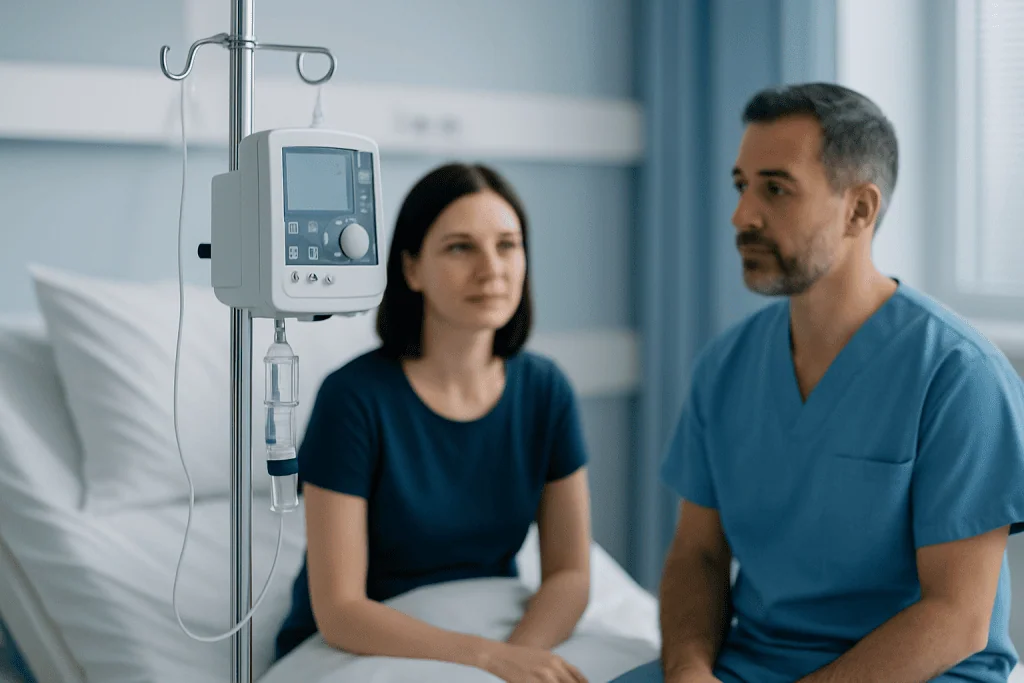
Before you physically leave the hospital, open your medication pack with a nurse or pharmacist and go through it item by item. Injectable medicines come in several forms, prefilled syringes, pens, vials, cartridges, or powder that needs mixing, and the handling steps differ for each. Make sure the packaging matches what you were shown during training and that you know whether anything must be attached, mixed or removed before use.
Confirm the medicine name, strength, dose, frequency, start date, stop date and expiry date. Brand names in Turkey often differ from the names used in your home country, so ask the team to write down the generic (international) name as well. The generic name is what your home pharmacist, your home doctor and, if it comes up, airport security will recognise. It also matters if you need to replace a lost or damaged dose while abroad.
- Ask which items are included: medicine, needles, syringes, alcohol swabs, gauze, plasters and a sharps container.
- Ask which items you may need to buy separately at a pharmacy, and write down their generic names too.
- Ask whether the medicine needs refrigeration, room-temperature storage or protection from light, and for how long it stays usable once opened.
- Ask what to do if a dose is delayed, dropped, leaked or looks damaged, and get the missed-dose advice in writing.
- Count the supply against your travel dates and build in a margin for delays. If your flight is postponed, you should not be on your last syringe.
If you are managing several medicines at once, painkillers, anti-nausea tablets and an injection, for example, a written daily schedule prevents most mistakes. There is a separate guide on building a daily medicine schedule after surgery in Turkey.
Learning the injection routine safely

Do not leave the hospital planning to work it out later from memory or from a video. Ask for a supervised demonstration with the same type of device you will use, then repeat the steps back to the nurse while they watch. This teach-back approach catches small misunderstandings, a needle angle, a skin fold, a cap left on, before they become stressful problems in a hotel bathroom at eleven at night.
A typical teaching session covers hand hygiene, checking the medicine and its expiry date, preparing a clean surface, choosing the injection area, rotating sites so the same spot is not used repeatedly, giving the injection at the pace the device requires, and disposing of the needle immediately afterwards. Follow the instructions specific to your prescription and device. Do not change the dose, the timing or the site pattern on your own; those decisions belong to your treating doctor.
If a companion will help you, they should attend the training too. They need to know how to assist and also when to pause, for example, if the medicine looks cloudy when it should be clear, the device is damaged, or the schedule has been disrupted by travel. If you feel anxious about needles, say so during the session. Many patients feel far more confident after watching the process slowly a second or third time, and the nurse would rather repeat it than send you out unsure. If self-injection genuinely is not workable for you, options such as home nursing support in Turkey after discharge exist and are worth raising before you leave the ward, not after.
Storage, temperature and hotel-room planning
Some injectable medicines must stay within a defined temperature range; others tolerate room temperature for a limited period once dispensed or opened. The safe range depends entirely on the specific product, so follow your label and your pharmacist’s advice rather than another patient’s experience, even if the packaging looks similar. This is one of the points where self-injection medicines after discharge in Turkey demand more planning than tablets: a suitcase in a hot transfer vehicle or a freezing minibar compartment can quietly ruin a medicine that looks perfectly normal afterwards.
If refrigeration is needed, check whether your hotel minibar is actually suitable. Many minibars run warmer or colder than a household fridge and cycle unpredictably, and freezer compartments can accidentally freeze medicine, freezing damages many injectables permanently. Ask reception whether a reliable refrigerator is available, keep the medicine in a sealed, labelled bag away from food, and confirm you can reach it at your dosing times, including early mornings. Never place injectable medicine directly against ice packs unless your pharmacist confirms this is safe for your product.
A few practical habits help in any accommodation:
- Keep the medicine in its original packaging with the pharmacy label attached.
- Store it out of direct sunlight and away from bathroom humidity and radiators.
- Keep it, and all needles, out of reach of children and away from areas housekeeping staff handle.
- Note the time each dose is due in your phone with an alarm, adjusted if you cross time zones.
Sharps disposal: protecting yourself and everyone around you
Used needles, syringes, lancets and pen needles can injure cleaners, family members and waste handlers if they end up in ordinary rubbish. Before discharge, ask for a sharps container or clear advice on obtaining one. If a formal container is not available immediately, ask the team what temporary puncture-resistant alternative is acceptable until you can get one: the answer should come from them, not from improvisation.
After each injection, place the used sharp directly into the container. Do not recap, bend or break needles unless your specific device instructions say otherwise. Keep the container upright, closed and out of reach of children and visitors. In a hotel, never leave used sharps loose in bins, on bathroom counters, or wrapped in towels or bedding: a housekeeping injury caused by your needle is entirely preventable.
Before you travel onward or home, ask how the container should be handled in transit and where it should ultimately be emptied or handed in. Rules differ between countries and airlines, so checking in advance is worth the five minutes.
Turkish pharmacies: names, rules and what you can buy
Pharmacies in Turkey are marked with a red “E” sign and the word eczane. They are widespread in cities, and in every district a rotating duty pharmacy (nöbetçi eczane) stays open overnight and on holidays; any closed pharmacy posts the address of the nearest one on its door. Pharmacists in urban and tourist areas frequently speak some English, and showing the generic medicine name in writing solves most communication problems.
A few points international patients often ask about:
- Antibiotics are prescription-only. Turkey tightened its rules years ago, and pharmacies are expected to dispense antibiotics only against a prescription. Do not plan on buying them over the counter, and do not add any antibiotic to your regimen on your own, whether one is needed is your doctor’s call.
- Familiar brands have local names. The medicine sold as Imodium in many countries is the generic loperamide, and Turkish pharmacies stock loperamide under local brand names. The same logic applies to most common medicines: ask by generic name, not by the brand you know from home.
- Injection supplies are easy to find. Alcohol swabs, gauze, plasters and dressings are sold over the counter. Needles and syringes for a prescribed medicine are dispensed alongside it; bring your prescription or discharge summary if you need replacements.
On cost: what you pay at a Turkish pharmacy depends on the specific product, the brand dispensed, the quantity and whether any of it was already included in your hospital discharge pack. Rather than quoting figures that go out of date, the structure of these costs is explained in medication costs after hospital discharge in Turkey.
Travel days: airports, flights and crossing borders
Everything essential travels in your hand luggage: the medicine, spare needles or pen tips, swabs, the sharps container if your airline permits it, your prescription, your discharge summary and any doctor’s letter you were given. Checked baggage holds can be too hot or too cold for temperature-sensitive medicines, and a lost suitcase must never mean a lost treatment course. If cooling is required in transit, use an insulated bag prepared the way your pharmacist advised.
Airport security in Turkey and elsewhere is used to seeing syringes and injection pens. The process goes fastest when supplies are in original packaging, kept together, and backed by a prescription or letter that matches the generic name on the box. Declare them if asked and allow a little extra time at screening. Rules for what counts as a controlled or restricted medicine differ by country: strong opioid painkillers, certain sedatives and some stimulant medicines require documentation to bring into or out of many countries, including Turkey, and a few need advance permission from the destination country. Check the rules of every country on your route before you fly: your airline and the destination’s official government sources are the right places to ask. If you travel with strong painkillers as well, keep their documentation together with the rest of your paperwork. The wider logistics are covered in managing medicines across borders after treatment in Turkey.
Time zones deserve a moment of planning too. If your injection is due every 24 hours and you cross several zones, agree with your team before departure how to shift the schedule. Do not improvise the adjustment mid-flight.
Continuing treatment after you return home
If the injections continue beyond your trip, arrange the handover early. Share your Turkish discharge summary with your home doctor or pharmacist, including the generic medicine name, dose, duration and any monitoring the prescription requires. Doing this before you land, rather than the day your Turkish supply runs out, keeps the course uninterrupted. A dedicated guide covers returning home with new medicines after treatment in Turkey in detail.
Keep the contact details from your discharge papers stored in your phone and printed with your travel documents, and keep the written instructions with the medicine itself until the course ends. For what is normal and what is not in the days after discharge more generally, the guide on warning signs after discharge in Turkey explains what recovery usually looks like.
Step by step
- Ask for a full medication briefing. Before discharge, review the medicine name, purpose, dose, timing and stop date with your nurse, doctor or pharmacist, and get it in writing with the generic name included.
- Practise the injection before leaving. Watch a demonstration, then repeat the steps under supervision with the same device. If a companion will help, they attend too.
- Check every item in your supplies. Medicine, needles or device parts, swabs, dressings and a sharps container or disposal plan. Check expiry dates and count doses against your travel dates with a margin for delays.
- Plan storage at your accommodation. Confirm refrigeration or room-temperature requirements before you arrive, test the fridge option, and keep everything away from children, food and housekeeping.
- Prepare for travel days. Hand luggage only, original packaging, prescription and doctor’s letter together, extra time at security, schedule adjusted for time zones in advance.
- Use sharps safely every time. Straight into the container after each injection, no recapping, container closed and upright, disposal route confirmed before travel.
- Arrange follow-up before you return home. Send your discharge summary to your home doctor or pharmacist early so the course continues without a gap.
Your checklist
- Written instructions with medicine name, generic name, dose, timing and stop date
- Supervised practice completed before discharge, companion included if relevant
- Prescription, discharge summary and doctor’s letter packed with travel documents
- Enough medicine and supplies for your stay, travel days and possible delays
- Storage plan confirmed for hotel, transfer vehicle and flight
- Sharps container or approved temporary disposal arrangement
- Missed-dose instructions in writing
- Interpreter support arranged if you or your companion need it
- Handover plan agreed with your doctor at home before you fly
Key takeaways
- The safest routine for self-injection medicines after discharge in Turkey begins with supervised, hands-on training before you leave the ward.
- Original packaging, the generic name and your prescription travel together in hand luggage, never in the hold.
- Storage rules are product-specific: follow your own label, not general advice or another patient’s experience.
- Every used needle goes into a puncture-resistant sharps container, never into hotel or household rubbish.
- Antibiotics in Turkey are prescription-only, familiar brands carry local names, and controlled medicines need documentation at borders, plan all three before travel day.
Frequently asked questions
Can you still buy antibiotics over the counter in Turkey?
No. Turkey requires a prescription for antibiotics, and enforcement has tightened considerably over the past decade. Pharmacies are expected to dispense them only against a prescription. Whether an antibiotic is needed at all is a decision for the doctor treating you, never something to add to your own regimen.
What is the Turkish equivalent of Imodium?
Imodium is a brand name for the generic medicine loperamide, and Turkish pharmacies stock loperamide under local brand names. The reliable approach for any familiar medicine is to ask the pharmacist by its generic name, ideally shown in writing. Check with your pharmacist that any over-the-counter product is compatible with your prescribed medicines before using it.
What medicines are not allowed in or out of Turkey?
Controlled substances, strong opioid painkillers, certain sedatives and some stimulant medicines, are restricted in many countries, including Turkey, and typically require a prescription and doctor’s letter to carry, with some needing advance permission from the destination country. Rules differ on every route, so check the official guidance of each country you pass through and your airline’s policy before you fly.
Will airport security allow syringes or injection pens?
Carrying medical sharps through security is routine when they are in original packaging with a matching prescription or doctor’s letter. Keep everything together in your hand luggage, declare it if asked, and allow extra time at screening. Never put essential medicine in checked baggage, both for temperature reasons and because holds and lost luggage are outside your control.
What should I do if I miss a dose?
Do not double the next dose unless your doctor or pharmacist has specifically told you to. Follow the missed-dose instructions written into your discharge plan: the right answer depends on the medicine, your condition and how much time has passed, which is exactly why this instruction should be obtained in writing before you leave the hospital.
Can hotel staff store my medicine in a refrigerator?
Sometimes, but confirm the medicine’s exact storage needs with your pharmacist first, because minibars and commercial kitchen fridges vary in temperature. If hotel storage is used, keep the medicine in its original labelled packaging inside a sealed bag, and make sure you can access it at every dosing time, including early mornings and late evenings.
What if I am nervous about injecting myself?
Needle anxiety is common and worth saying out loud during the teaching session. Ask the nurse to demonstrate slowly, then practise under supervision until the steps feel mechanical rather than frightening. If a companion will assist, include them in the training. If self-injection is genuinely unworkable, raise it before discharge so alternatives such as home nursing can be discussed.
How do I dispose of needles while staying in Turkey?
Ask your discharge team for a sharps container or instructions on obtaining one, place every used needle or device directly into it without recapping, and keep it closed and out of reach. Never leave loose needles in hotel bins, public rubbish bins or luggage pockets, and confirm the final disposal route before you travel onward.
Add us as a Preferred Source to see more of our trusted health content across Google Search, AI Overviews and Discover.

Update history
- PublishedJune 16, 2026
- Medical review approvedAugust 30, 2026
- Last content updateAugust 30, 2026
References2
- CDC Travelers' Health: Traveling Abroad with Medicine wwwnc.cdc.gov
- MedlinePlus: Storing Your Medicines medlineplus.gov
More Patient Guides

Flying With Medication: Airline Rules, Documents and Packing
Every day, travelers hold up security lines worrying about a bag full of tablets that nobody actually wants to confiscate. The rules…
How to Send Your Medical Files Securely Before Treatment in Turkey
Send medical files securely before treatment in Turkey by using approved channels, clear file names and a complete health summary.
Pain Control After Treatment in Turkey: What Patients Should Expect and Ask About
Pain control after treatment in Turkey usually includes a tailored medicine plan, clear warning signs, and follow-up support before you leave Istanbul.

Managing Medicines Across Borders After Treatment in Turkey
Managing medicines across borders after treatment in Turkey means carrying clear documents, checking import rules, and planning refills before you fly.