

Using Ambulance Services in Turkey During Medical Travel

In Turkey, 112 is the single national emergency number, and the public emergency ambulance it dispatches is generally provided without charge, regardless of nationality. Hospital treatment after arrival is billed separately for foreign patients. Planned, non-urgent medical transfers, airport pickups, stretcher journeys, transfers between hospitals, work differently: they are paid services arranged in advance through the treating hospital, and insurers often want documentation before they cover them.
What would you do if something went wrong at 2 a.m. in a hotel room in a city you barely know? Most medical travellers would rather not think about it. Ten minutes of preparation now, one phone number saved, one address written down, one document folder packed, makes both genuine emergencies and routine medical transfers far easier to handle.
This guide explains how using ambulance services in Turkey during medical travel works in practice: how the emergency system operates, when 112 is the right call, how planned ambulance transfers are arranged, what the public service does and does not cover, and what insurers typically expect from you afterwards.
At a glance
- Emergency number: 112 is Turkey’s single national emergency number for ambulance, police and fire. It works from any phone, including foreign SIMs, and the call itself is free.
- Public ambulance: the state emergency ambulance dispatched through 112 generally carries no charge for the response itself, whatever your nationality. Hospital treatment after arrival is billed separately.
- Planned transfers: airport pickups, stretcher journeys and transfers between hospitals are paid services, arranged in advance through the treating hospital rather than through 112.
- Documents: keep your passport (or a copy), medication list, allergy information, a short medical summary and your insurer’s assistance number with you at all times.
- Air ambulance: used only in selected situations, and almost always requires insurer pre-approval, medical clearance and a receiving hospital before anything moves.
How ambulance services in Turkey work for international patients
If you are planning treatment abroad, understanding how to go about using ambulance services in Turkey during medical travel is worth an evening of your attention, because the system has two distinct halves that are easy to confuse.
The first half is the public emergency system. Turkey consolidated its emergency lines into a single number, 112, which now covers medical, police, fire and disaster response nationwide. Dial it and a dispatcher routes your call to the right service. State emergency ambulances operate in every province, and in congested cities such as Istanbul the service also runs motorcycle first responders who can reach a patient before a full ambulance gets through traffic. This system exists for sudden, severe or clearly unsafe situations: the kind where arranging your own transport could cause harm.
The second half is planned medical transport: private ambulances, hospital-operated vehicles, stretcher and wheelchair transfers, and air ambulances. These carry patients who are stable but cannot travel by ordinary car, someone recently out of surgery, someone who cannot sit upright for the drive from the airport, someone who needs monitoring or oxygen during the journey. They are booked in advance, they are paid services, and they are not a substitute for 112 in a genuine emergency.
When to call 112 and when your hospital coordinator is the right contact
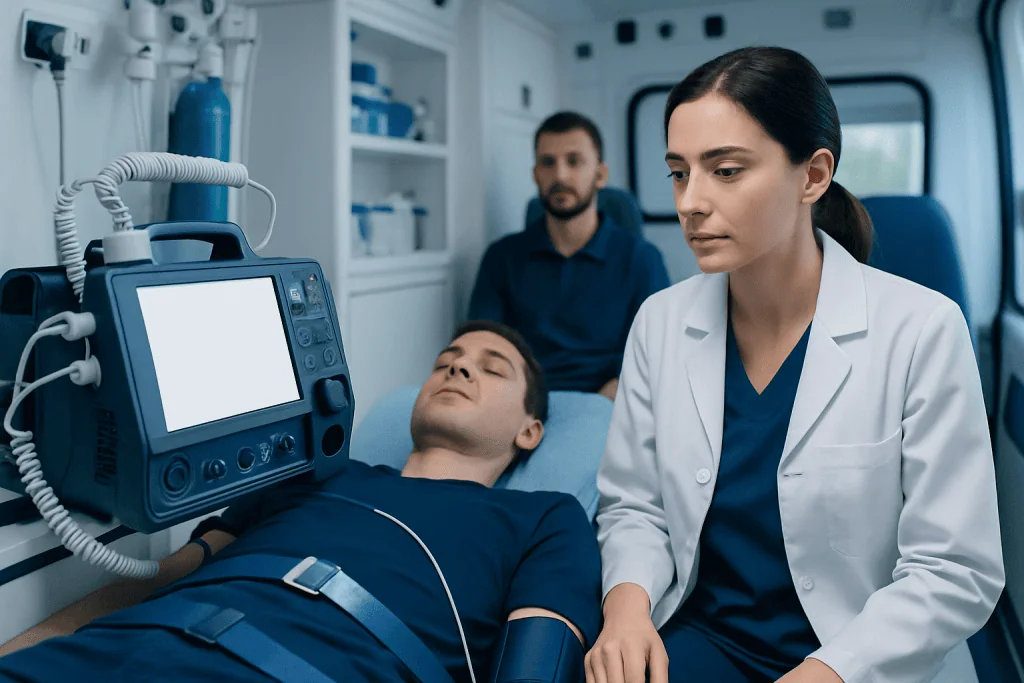
The dividing line is urgency, not convenience. 112 is designed for situations that are sudden and serious, severe chest pain, heavy bleeding, breathing difficulty, suspected stroke, seizures, major injury, severe allergic reactions, sudden deterioration. In those moments, 112 comes first. Do not spend time trying to reach a coordinator, your insurer or anyone else before emergency help is on the way; those calls can follow once the ambulance is moving.
Everything that can be scheduled belongs on the other side of the line: arriving at the airport with a stretcher need, getting from your hotel to the hospital for a booked procedure, moving between facilities on your doctor’s advice, or supervised transport after discharge. For these, the hospital’s international patient team is the right channel, and the earlier they know, the better, planned transfers involve checking vehicle availability, matching equipment and staff to your condition, and sometimes reviewing medical reports first.
One honest caveat: if you are genuinely unsure whether a situation is urgent, treat it as urgent and call 112. A dispatcher can assess; a hotel receptionist or your companion can help make the call if language is a worry. Turkey also has other useful numbers and urgent-care routes worth knowing before you fly: our guide to emergency contacts and urgent care during medical travel in Turkey covers them in detail.
What to say during an emergency call

Dispatchers work from a short list of facts: where you are, what happened, the patient’s approximate age, the main symptom, and whether the patient is conscious and breathing. Give those five things in that order and you have done the essential job. You cannot count on reaching an English-speaking operator on every call, so speak slowly, use short phrases, and let a Turkish speaker take over if one is nearby. Hotel reception, airport staff and shop owners will almost always help if asked.
Location is where foreign visitors most often struggle. Prepare it in advance:
- Save your hotel or apartment’s full address, street, district, building, in your phone, ideally in Turkish spelling, plus your room number.
- Outdoors, name a landmark: a metro station, a mosque, a well-known shop, a street sign.
- Say “ambulans” (ambulance) if English fails: it is close enough to be understood instantly.
- Lead with the main problem: chest pain, bleeding, fall, breathing problem.
- Mention risks that change what responders do: recent surgery, pregnancy, cancer treatment, heart disease, diabetes, blood thinners, known allergies.
- Keep the patient still unless there is immediate danger such as fire or traffic.
Working mobile data makes all of this easier: you can share a live location pin or pull up an address instantly. If you have not sorted connectivity yet, see our guide to using eSIMs and mobile data in Turkey.
Is an ambulance free in Turkey?
The short answer: the public emergency ambulance dispatched through 112 is a state service, and there is generally no charge for the emergency response itself. That applies to foreign visitors as well as residents. The 112 call is also free from any phone.
Two important distinctions sit behind that answer. First, the ambulance and the hospital are billed separately. The ride may cost nothing; the emergency treatment, imaging, medication and any admission that follow are charged to foreign patients in the normal way, which is exactly why travel or medical insurance matters. Turkey does not provide free routine medical care to tourists.
Second, private and planned transport is always a paid service. Private ambulances, hospital-arranged transfers, intercity stretcher journeys and air ambulances are charged, and what they cost depends on the same structural factors everywhere: distance, whether a doctor or nurse travels with you, the equipment on board, urgency, and waiting time. For any planned transfer, ask for a written quote before you confirm: it is the only way to compare options fairly, and your insurer will likely want to see it anyway.
Planned ambulance transfers: airport, hotel, hospital and intercity
Not every ambulance journey is an emergency, and for many people using ambulance services in Turkey during medical travel actually means a calm, scheduled transfer rather than a blue-light response. Typical scenarios: you land after long-haul travel and cannot manage a taxi seat; you are discharged after spinal or orthopaedic surgery and need to travel lying down; your treatment plan moves you between two facilities; you need monitoring or oxygen on the road.
The vehicle is matched to the need. Options range from a wheelchair-accessible car, to a stretcher vehicle, to a fully equipped ambulance with a medical escort. Which one is appropriate is a clinical decision, not a booking preference: your treating doctor’s recommendation, your mobility, your recent procedure and the distance all feed into it, and the transport provider may ask for medical reports before confirming the safest option.
If your transfer connects to an airport arrival, the details that make it work are mundane but essential: flight number, scheduled landing time, terminal, passport details, your mobility status, whether a companion travels with you, and any equipment you carry. Share them as early as the plan is fixed. Last-minute stretcher requests can rarely be accommodated well.
Hospitals, handovers and language support
The journey is only half of safe transport; the handover is the other half. Whoever brings you in, emergency responders or a transfer crew, should be able to tell the receiving team what happened, what was observed on the way, what was given, and what medical background you disclosed. You make that handover dramatically better by carrying a one-page medical summary in English: diagnosis, planned or recent procedures, medications with doses, allergies, implanted devices, and an emergency contact. A piece of paper does not run out of battery.
Language is the other pressure point. Emergency crews may or may not speak English; hospital international patient departments usually arrange interpreters, but that support works best when requested in advance rather than discovered in the moment. Before anything happens, find out how to reach your coordinator after hours, whether interpreter support is available around the clock, and which entrance or emergency department your hospital uses. Store the answers in your phone and keep a printed copy in your travel folder.
Translation apps fill some gaps but have real limits in medical conversations, dosage, consent and symptom nuance do not always survive machine translation. Our guide on using translation apps safely during medical visits explains where they help and where they mislead.
Insurance, documentation and what to keep
Before you travel, read your policy with four specific questions in mind: does it cover emergency ambulance transport, private or planned ambulance transfers, transfers between hospitals, and air ambulance or evacuation? Then ask three practical follow-ups: is pre-authorisation required, does the insurer pay providers directly or reimburse you afterwards, and what documentation will they demand? Insurers reject claims over paperwork far more often than over medicine.
During your trip, keep everything: ambulance run sheets, transfer confirmations, invoices, medical notes, discharge summaries. For planned transfers, ask in writing for the date, route and type of transfer, since insurers often need exactly those details. Originals matter, keep them flat, dry and in one place, ideally alongside your passport and reports. Our guide on keeping valuables and medical documents safe during treatment travel covers practical storage.
Air ambulance and international medical evacuation
Air ambulance sits at the far end of the spectrum and is used only in selected situations: long-distance transfers where commercial flying is not medically appropriate, or patients who need specialised monitoring in the air. Sometimes the answer is a dedicated medical aircraft; sometimes it is a medical escort on a scheduled commercial flight with airline clearance. Either way, the arrangement is genuinely complex: it needs a fit-to-fly assessment from the treating doctor, a medical summary, medication and oxygen requirements, a receiving hospital that has formally accepted the patient, and travel permissions for the route.
The single most important practical point: involve your insurer at the very start. Most policies that cover evacuation require pre-approval and route everything through a designated assistance company. An evacuation arranged privately and presented to the insurer afterwards is a much harder claim.
Your role in the process is coordination, not medicine. Make sure the insurer, the assistance company, the treating hospital, the destination hospital and your family all have accurate contact details and the same understanding of the plan. Most evacuation delays come from one of those parties working from old information.
Step by step
- Save the numbers before you fly. Add 112, your hospital’s main line, your coordinator’s number and after-hours instructions, your hotel, your insurer’s assistance line and your companion’s number. Print the list and keep it with your passport.
- Prepare a one-page medical summary in English. Diagnosis, planned procedure, recent surgeries, medications and doses, blood thinners, allergies, implanted devices, emergency contact.
- Confirm your transfer needs early. Wheelchair, stretcher, oxygen, help with stairs, space for equipment, each detail changes the vehicle and staff required.
- Check your policy in writing. Emergency ambulance, planned transfers, inter-hospital transfers, air ambulance: covered or not, pre-authorisation or not, direct payment or reimbursement.
- Use 112 for anything urgent. Emergency first, everyone else afterwards.
- Keep documents and daily medicines on your person. Never in checked luggage, never in a suitcase travelling separately during a transfer.
- Collect paperwork as you go. Written transfer confirmations, invoices, medical notes and discharge documents, kept together for claims after you return home.
Your checklist
- 112 saved as Turkey’s emergency number.
- Hospital coordinator’s number and after-hours instructions stored and printed.
- Passport or a copy of the ID page with you at all times.
- Medication list, allergy list and recent medical reports accessible.
- Hotel or apartment address saved in Turkish and English.
- Itinerary and hospital address shared with your companion or family.
- Insurance cover confirmed for ambulance, inter-hospital transfer and air ambulance.
- Charger or power bank packed so you can communicate during delays.
- Wheelchair, stretcher, oxygen or interpreter needs flagged in advance.
- All invoices and ambulance documents kept for your records.
Key takeaways
- 112 is Turkey’s single emergency number; the public ambulance it dispatches generally carries no charge, though hospital treatment for foreign patients is billed separately.
- Planned medical transfers are paid services arranged in advance through the hospital, not through 112.
- A one-page English medical summary, saved addresses and printed contact numbers do most of the work in a crisis.
- Insurers approve or reject transport claims on paperwork, get written confirmations and keep every invoice.
- Air ambulance and evacuation require early insurer involvement, medical clearance and an accepting hospital before anything moves.
Frequently asked questions
Is an ambulance free in Turkey?
The public emergency ambulance dispatched through 112 is a state service and generally carries no charge for the response, including for foreign visitors. Private ambulances, planned transfers, intercity stretcher journeys and air ambulances are paid services. Hospital treatment after any ambulance arrival is billed separately for foreign patients.
Is medical care free in Turkey for tourists?
No. Emergency response through 112 is provided without charge, but hospital treatment, emergency or planned, is charged to foreign patients in the usual way. Travel or medical insurance is the sensible protection, and it is worth confirming exactly which transport and treatment scenarios your policy covers before departure.
What should I do if I get sick in Turkey?
For sudden, serious situations, 112 brings an emergency ambulance anywhere in the country. For minor complaints, pharmacies (marked “eczane”) are widespread and pharmacists commonly advise on everyday ailments, while hospitals run walk-in outpatient departments. Patients already in a treatment programme usually have a coordinator who can direct routine, non-urgent concerns to the right clinic.
Is medical tourism safe in Turkey?
Turkey has a large, regulated health sector overseen by the Ministry of Health, and standards vary between providers, as they do in any country. The practical safeguards are the same everywhere: research the hospital and treating team, understand the treatment plan before travelling, confirm insurance cover, and know how emergencies and follow-up are handled. No destination or provider can remove risk entirely.
Can I request an English-speaking ambulance team?
Not reliably in an emergency: you get the nearest available crew. If language is a concern, ask hotel or airport staff or your companion to help communicate while you wait. For planned transfers, interpreter support is much easier to arrange because it can be requested in advance.
Can an ambulance take me to the hospital I choose?
In emergencies, crews follow medical protocols, capacity and urgency, so the destination may not be up to you. For planned transfers, the destination is agreed in advance as part of the booking, which is one more reason to organise non-urgent transport ahead of time rather than on the day.
Are ambulance services in Turkey covered by travel insurance?
It depends on the policy, the reason for transport and whether the insurer judges it medically necessary. Before travelling, ask specifically about emergency ambulance, private transfers, inter-hospital transfers and air ambulance, whether pre-authorisation is required, and whether the insurer pays directly or reimburses you. Keep all invoices and medical notes for claims.
When is an air ambulance needed?
Only when long-distance transport requires medical supervision that ordinary travel cannot safely provide, either a dedicated medical aircraft or a medical escort on a commercial flight. It requires insurer pre-approval in most policies, a fit-to-fly assessment, detailed medical documentation and formal acceptance by the destination hospital, so early coordination is essential.
Add us as a Preferred Source to see more of our trusted health content across Google Search, AI Overviews and Discover.

Update history
- PublishedJune 22, 2026
- Medical review approvedSeptember 13, 2026
- Last content updateSeptember 12, 2026
References2
- UK Foreign Travel Advice: Turkey: Health gov.uk
- CDC Travelers' Health: Türkiye (Turkey) wwwnc.cdc.gov
More Patient Guides

GHIC and EHIC in Turkey: Why They Do Not Cover You
The blue card that quietly covers you across Europe stops working at the Turkish border, and every summer, travelers discover this…

Do You Need Vaccinations for Turkey?
Here is the answer travel clinics give every day: no vaccinations are required to enter Turkey from anywhere in the normal course…

Flying With a Broken Leg or Cast: Airline Rules and Comfort
A broken leg does not cancel a flight, airlines carry passengers in casts every single day. What surprises travelers is that…

Travel Insurance After Cancer: What Patients Should Know
A cancer diagnosis changes how insurers read your name, but it does not end your traveling life. Thousands of people with…