

What Happens in the Recovery Room After a Procedure in Turkey

After a procedure in Turkey you are moved to a recovery room, also called the PACU, where nurses and the anaesthesia team monitor your breathing, blood pressure, oxygen level, pain and nausea as the anaesthetic wears off. You stay until you meet stability criteria, not a fixed time, then transfer to a ward room or, for day cases, to a discharge area with written instructions.
Will you wake up in pain? Will anyone speak your language? Will your companion know how it went? Most patients ask some version of these questions in the last quiet minutes before a procedure, and the answers all sit in one place: the recovery room.
This guide explains what happens in the recovery room after a procedure in Turkey, who is watching you, what they check, roughly how long it takes, and how the move to your ward room or a same-day discharge is decided. Turkish hospitals run this stage the way hospitals run it worldwide. A few practical details simply matter more when you are recovering a long way from home, and those are the details this guide spends extra time on.
At a glance
- Main purpose: Close, continuous monitoring while anaesthesia or sedation wears off
- Also called: PACU (post-anaesthesia care unit) or the wake-up room
- Who you may see: Recovery nurses, the anaesthesiology team, and your treating doctor when needed
- Common checks: Breathing, oxygen level, blood pressure, pulse, temperature, pain, nausea, dressings and drains
- How long it lasts: Often somewhere between half an hour and a few hours, decided by criteria, not the clock
- Visitors: Usually not admitted to the recovery bay itself; companions typically wait nearby and receive updates
- Support for international patients: Interpreter support, updates for your companion, and written instructions where available
What happens in the recovery room after a procedure in Turkey
The recovery room is the first stop after any procedure that involves general anaesthesia, regional anaesthesia or meaningful sedation. Your operation may be finished, but the medicines used during it are still working, and your body needs supervised time to adjust. In this room, a nurse is assigned to watch a small number of patients, often just one or two, which is a far closer level of observation than a normal ward provides.
The priorities are deliberately basic: that you breathe well, wake safely, keep a stable blood pressure and oxygen level, and get early help with pain, nausea or shivering. Nothing about what happens in the recovery room after a procedure in Turkey is unique to Turkey; the same clinical logic applies in London, Berlin or Riyadh. What differs for a travelling patient is the environment, new sounds, a new language, and a companion waiting somewhere they cannot see you.
At Acibadem hospitals, international patient teams handle the practical side of that gap: interpreter support when needed, updates passed to your companion, and plain explanations of where you are and what comes next. It is also worth knowing the difference between recovery and intensive care. Some larger operations include a planned stay in intensive care for closer monitoring: that is a scheduled part of certain treatment plans, not a sign of trouble. Our recovery room and ICU guide for international patients explains how the two differ.
What usually happens when you first arrive

You arrive on a bed or trolley, usually still drowsy, sometimes with no memory of the journey at all. The anaesthesiology team hands over to the recovery nurse: what was done, which medicines were given, and what to watch for. Then the routine equipment goes on or stays on:
- A blood pressure cuff that inflates by itself at set intervals
- A pulse oximeter clipped to a finger, measuring your oxygen level
- Heart monitor stickers on your chest for some procedures
- Your IV line, and often oxygen through a soft mask or nasal tubes
- Any dressings, drains or compression sleeves placed during the procedure
- A warming blanket, because operating theatres are kept cool and many patients wake up cold
You will hear staff speaking quietly, confirming your name, asking you to take a deep breath, or asking about pain. You may drift in and out while this happens. That is expected. These repeated small checks are the whole point of the room: the team is confirming, again and again, that you are waking in a normal pattern. If anything drifts outside the expected range, they are standing right there to respond.
What you may feel, physically and emotionally
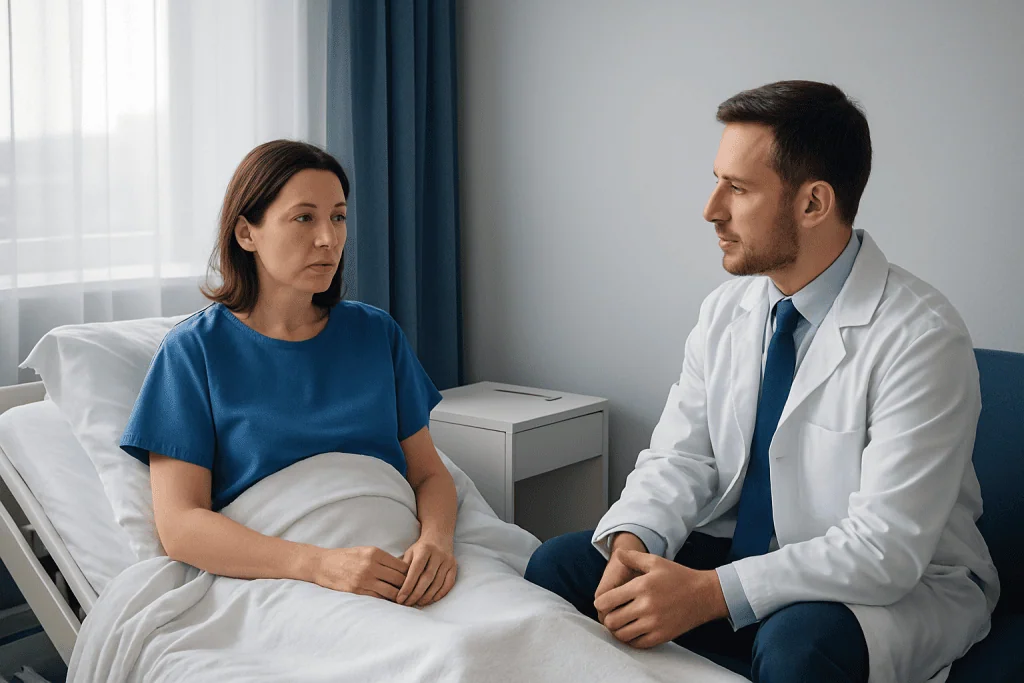
Sleepy, cold, thirsty, sore, foggy: these are the common early sensations. A dry mouth is normal after fasting. A mild sore throat is common if a breathing device supported your airway during general anaesthesia. Time often feels compressed or blurred: many patients are surprised to learn how long they have been in recovery, or that the procedure is already over.
Emotions vary more than people expect. Some patients wake calmly. Others feel tearful, restless, irritable or briefly confused. Shivering is common even when you are not truly cold. None of these reactions automatically means something is wrong; they are known effects of anaesthetic medicines, fasting, the procedure itself and plain physiological stress, and they usually settle as the drugs clear.
Two things are worth saying plainly. First, you are not expected to endure symptoms silently, recovery nurses ask about pain and nausea precisely because they can treat both early, and early treatment works better than late treatment. Second, waking up in a foreign country can sharpen the emotional side of this stage. Feeling vulnerable is understandable. Asking for an interpreter, a simple explanation of where you are, or a message passed to your companion is entirely normal, and staff who work with international patients hear these requests every day.
How pain, nausea and shivering are handled
Recovery nurses assess pain repeatedly, usually by asking you to score it, often on a scale from zero to ten. The score is not a test; it simply tells the team whether the plan your doctors set before surgery is working or needs adjusting. Depending on that plan, relief may come through your IV line, through a regional block placed during surgery, or by other routes your treating team has chosen. You can read more about how this is organised in how we control pain after surgery and invasive procedures at Acibadem.
Nausea gets the same active treatment. Anti-nausea medicines can be given before you even feel sick if you are known to be prone to it, and again in recovery if it appears. Shivering and feeling cold are managed with warmed blankets and, where needed, medication. Small adjustments made in this room often shape how the whole first day feels, which is why speaking up matters more than being stoic. For a closer look at this specific stage, see our guide to the recovery room, nausea and going back to your room after general anaesthesia.
How long you stay, and how the team decides you can leave
There is no fixed timer. Many patients spend somewhere between half an hour and a few hours in recovery, but the honest answer is that departure is decided by criteria, not by the clock. Recovery teams work through a practical checklist, some hospitals use formal scoring systems, that asks, in plain terms:
- Are you awake enough for your stage of recovery?
- Are you breathing well without extra support, or with the support planned for you?
- Are your blood pressure, pulse and oxygen level stable?
- Are pain and nausea at a manageable level?
- Are your dressings, drains and wound sites behaving as expected?
If you are staying in hospital, meeting these goals means transfer to your ward room, where observations continue at a gentler rhythm. If yours is a day procedure, the team usually adds further checks before discharge: whether you can drink fluids, pass urine where that is relevant to your procedure, walk safely with assistance, and understand your instructions, and whether a responsible adult is available to accompany you if the hospital requires one. The full sequence for day cases is covered in our guide from recovery room to same-day discharge.
Occasionally, someone simply needs longer, slower waking, stubborn nausea, blood pressure that wants watching. A longer stay in recovery is the system working as designed, not a setback.
Visitors, privacy and dignity
Two questions come up constantly from patients researching what happens in the recovery room after a procedure in Turkey, and both deserve straight answers.
Can your family or companion come into the recovery room?
Usually not into the recovery bay itself. The PACU is a shared clinical space where several patients are waking at once, monitors are running, and privacy for everyone is hard to maintain with visitors present. The standard pattern in Turkish hospitals, as elsewhere, is that companions wait in a designated area, receive updates, through the international patient team where language is a barrier, and rejoin you once you reach your ward room or the day-unit discharge area. Policies vary by hospital, by unit and by circumstance, so ask what applies to your case during your pre-procedure preparation rather than assuming either way.
Do they cover your privates during surgery?
Yes. This worry is common and rarely voiced, so here is how it actually works. You wear a hospital gown to theatre. Once you are asleep or sedated, sterile drapes cover your body so that only the area being treated is exposed, and only for as long as the work requires. Positioning and preparation are done by a team for whom this is routine, professional work, and you are covered again before you wake. In the recovery room you remain gowned and blanketed, with curtains available between bays. If modesty is especially important to you for personal or religious reasons, say so beforehand, teams accommodate such requests as far as the procedure allows.
Which procedures lead here, and does the type change the experience?
International patients travel to Turkey for a wide range of treatments: orthopaedic surgery such as hip and knee replacement, eye surgery, dental treatment, hair restoration, plastic and reconstructive surgery, bariatric surgery, cardiac care, cancer treatment, fertility treatment, and diagnostic procedures such as endoscopy and colonoscopy. Almost all of these pass through a recovery area, but the experience differs with the type of anaesthesia rather than the destination country.
After light sedation, typical for endoscopic procedures, recovery is often brief and you may remember most of it. After general anaesthesia, waking is slower and memory patchier. After regional anaesthesia, such as a spinal block, you may be fully alert in recovery while waiting for sensation and movement to return to the numbed area, which is monitored just as carefully as waking is. Your pre-procedure consultation is the right place to hear which pattern applies to you.
Questions worth settling before you leave recovery
The recovery room itself is a poor venue for long conversations: you may still be drowsy, and detail will not stick. But before you move on to your room or the discharge area, you or your companion should understand the essentials, ideally in writing and in a language you read comfortably:
- When you can eat and drink, and whether anything is restricted
- How and when to take the medicines your doctor has prescribed
- What level of discomfort is expected for your procedure, and for how long
- How to care for dressings, and when showering is allowed
- What activity is encouraged, walking, stairs, sleeping position
- When your follow-up appointment or post-procedure test is scheduled
- When longer road travel or flying is likely to be reasonable: our procedure-specific guide to flying after surgery in Turkey explains why this varies so much
Asking for repetition is not an imposition. Anaesthetic drugs genuinely impair short-term memory for a while, and every recovery team knows it, written instructions exist precisely because spoken ones evaporate.
Your first hours after the recovery room
Whether you go to a ward room or back to your accommodation, the first hours follow the same principles: rest, fluids if allowed, gentle movement as advised, and symptom control. Even if you feel surprisingly well, anaesthesia and pain medicines can affect balance, judgement and energy for the rest of the day. Move slowly, accept help, and postpone anything important, including signing documents or making travel decisions.
If you are staying in hospital, the ward team continues observations and helps you restart normal routines at a safe pace. If you are discharged the same day, plan for a quiet setting with water, your medicines and the bathroom within easy reach, and a companion staying with you if the hospital has recommended supervision. Our hotel recovery room setup checklist covers how to arrange your accommodation before procedure day so nothing needs organising afterwards.
- Take medicines exactly as your treating doctor instructed.
- Eat and drink only as advised for your procedure.
- Stand up slowly, and ask for help the first few times.
- Do not drive, travel alone or drink alcohol if you were told not to.
- Keep your discharge papers together and readable: they list the warning signs specific to your procedure and the contact details that go with them.
Step by step
- You are transferred from the procedure area. Staff move you to the recovery room on a bed or trolley while monitoring continues. Depending on the anaesthesia used, you may remember this clearly, partly, or not at all.
- Handover and first checks. The anaesthesiology team briefs the recovery nurse on what was done and what to watch. Your blood pressure, pulse, oxygen level, breathing and temperature are checked at regular, close intervals.
- You wake gradually. Some patients are alert quickly; others need longer for the medicines to clear. Drowsiness, blurred time and brief confusion are expected, and the team plans for them.
- Early symptoms are treated. Oxygen, IV fluids, pain relief, anti-nausea medicine and warming blankets are given according to your needs and your doctors’ plan. Reporting symptoms early makes this stage work better.
- Your readiness is assessed against criteria. Once you are stable, awake enough and reasonably comfortable, the team confirms the next step: transfer to your ward room, continued observation, or preparation for same-day discharge.
- You receive next-step instructions. Before leaving recovery or the discharge area, you should have clear guidance on medicines, food and drink, activity, wound care and warning signs, with interpreter support or written translation where you need it.
Your checklist
- Keep your passport, phone, charger and hospital documents together in one easy-to-reach bag.
- Arrange a companion in advance if your procedure requires an accompanying adult after discharge.
- Confirm the after-hours contact details printed on your discharge papers before you leave.
- Confirm when you can drink, eat, walk, shower and, per your doctor’s advice, restart your usual medicines.
- Arrange comfortable transport back to your room, hotel or apartment; ask whether a wheelchair transfer is advisable.
- Wear loose, easy-to-change clothing and slip-on shoes if you expect same-day discharge.
- Ask for written discharge instructions in English or your preferred language where available.
- Have water, light food if allowed, prescribed medicines and extra pillows ready for the first night.
Key takeaways
- The recovery room, or PACU, is a routine safety stage where a nurse monitors you closely while anaesthesia or sedation wears off.
- Sleepiness, chills, thirst, sore throat, nausea and brief confusion are common and treatable, report them rather than endure them.
- You leave when you meet stability criteria, not after a set time; day cases pass extra checks before discharge.
- Companions usually wait nearby rather than inside the recovery bay, and your body is draped and covered throughout surgery except for the area being treated.
- Written instructions in a language you read well are the single most useful thing to carry out of this stage.
Frequently asked questions
How long do people stay in the recovery room after surgery?
Often somewhere between half an hour and a few hours, but there is no fixed timer. Departure depends on meeting practical criteria, stable breathing and circulation, adequate wakefulness, and manageable pain and nausea. Longer procedures, general anaesthesia and individual variation can all extend the stay, and staying longer is not in itself a bad sign.
Can you have visitors in the recovery room after surgery?
Usually not in the recovery bay itself, because it is a shared clinical area where several patients are waking at once. Companions typically wait in a designated area, receive updates, and rejoin you at your ward room or the day-unit discharge area. Policies vary by hospital and situation, so ask what applies to your case beforehand.
Do they cover your privates during surgery?
Yes. You wear a hospital gown to theatre, and once you are asleep or sedated, sterile drapes cover everything except the area being treated, and only for as long as the work requires. You are covered again before you wake, and remain gowned and blanketed in recovery. Modesty requests for personal or religious reasons can be raised in advance.
Will I be in pain when I wake up?
You may feel pressure, soreness or pain depending on the procedure, and recovery nurses will ask about it early and repeatedly. Relief is given according to the plan your treating team set before surgery, so reporting pain promptly, rather than waiting it out, is exactly what the room is designed for.
What if I do not speak Turkish?
Hospitals that regularly treat international patients provide interpreter or international patient support services. At Acibadem, this support covers understanding instructions, asking questions, and coordinating updates with your companion, so language should not be a barrier during recovery.
Is it normal to feel cold, shaky or emotional after anaesthesia?
Yes. Shivering, feeling cold, tearfulness, restlessness and brief confusion are all recognised effects of anaesthetic medicines, fasting and physiological stress. Tell the nurse what you feel, warming blankets, reassurance and medication adjustments often help quickly, and these reactions usually settle as the drugs clear.
When can I eat, drink or go back to my hotel?
That depends on your procedure and how your recovery goes. Day-case patients usually drink fluids in the discharge area first and may need to meet further checks before leaving, often with a responsible adult accompanying them. Your team confirms the timing for food, drink and returning to your accommodation before you go.
Add us as a Preferred Source to see more of our trusted health content across Google Search, AI Overviews and Discover.

Update history
- PublishedJuly 6, 2026
- Medical review approvedSeptember 13, 2026
- Last content updateSeptember 12, 2026
References3
- General anaesthesia: NHS nhs.uk
- After Surgery: MedlinePlus medlineplus.gov
- Anesthesia: Cleveland Clinic my.clevelandclinic.org
More Patient Guides

Septoplasty Recovery: Week by Week
Learn what to expect after deviated septum surgery: a week-by-week septoplasty recovery timeline, when it is usually safe to fly home, and…

Gallbladder Surgery Recovery: Week by Week
Learn what to expect after gallbladder surgery: a week-by-week recovery timeline, pain, diet, wound care, when it is safe to fly home…
Robotic Hysterectomy Recovery: Week by Week
Recovery from robotic hysterectomy week by week: pain, lifting, wounds, driving, flying home safely, warning signs and questions to ask before you…
Breast Reconstruction Recovery: Week by Week
DIEP flap recovery week by week: hospital stay, drains, pain, walking, showering, driving, when it is usually safe to fly home, and…