

After General Anesthesia in Turkey: Recovery Room to Same-Day Discharge

After general anesthesia in Turkey, you wake in a monitored recovery area where nurses check breathing, blood pressure, pain and alertness. Same-day discharge is decided by how you recover, not by the clock: stable observations, controlled pain and nausea, and a responsible adult to accompany you. Most people feel largely themselves within 24 to 48 hours, and should avoid driving, alcohol and important decisions until then.
Who is collecting you after your procedure, and where will you sleep tonight? Those are the two questions most international patients wish they had answered before procedure day, not after it. What happens after general anesthesia in Turkey splits into two parts: the medical side, which the hospital handles, and the practical side, which depends heavily on what you arrange in advance.
This guide explains what happens from the moment your procedure ends: recovery room monitoring, how the drugs actually leave your body, what the team checks before same-day discharge, and how to keep the first 24 hours simple and safe. It is written for planned procedures with an expected same-day or next-day discharge; longer inpatient stays follow their own pathway.
At a glance
- Best for: International patients planning day surgery or same-day discharge after general anesthesia in Turkey
- First stop after surgery: A monitored recovery area (post-anesthesia care unit), not your room or the exit
- Discharge is decided by: Stable vital signs, adequate alertness, controlled pain and nausea, and a responsible adult escort, not a fixed number of hours
- Feeling normal again: The main drugs wear off within hours; subtle effects on judgement and coordination can last a full day or more
- First 24 hours: Rest, fluids as advised, no driving, no alcohol, no important decisions, a companion nearby
- Who is involved: Your surgeon, the anesthesiology team, recovery and ward nurses, and international patient coordinators
What happens immediately after general anesthesia in Turkey
When your procedure ends, the anesthesiologist stops or reverses the anesthetic drugs and you begin to wake while still in theatre or on the way out of it. You are then moved to a recovery area, often called the recovery room or post-anesthesia care unit, where nurses and the anesthesia team monitor you until the immediate effects have worn off. This stage exists precisely because the first hour after anesthesia is when breathing, blood pressure and alertness need the closest watching.
Expect regular checks of your blood pressure, pulse, breathing, oxygen saturation and level of consciousness. Staff will ask about pain, nausea and dizziness, and about throat discomfort if a breathing tube or airway device was used. You may have an oxygen mask, a drip, and monitoring leads attached for a while. None of that means something has gone wrong; it is the standard setup. We describe this stage in more detail in what happens in the recovery room after a procedure in Turkey.
For international patients, a practical layer sits alongside the medical one. Interpreters and international patient coordinators are part of that layer at larger hospitals: they help you and your companion follow what staff are saying, which effects are expected, when you are likely to move to a room, and how the rest of the day is planned. If language is a concern, it is worth raising before the procedure so support is already in place when you wake.
How you may feel in the recovery room
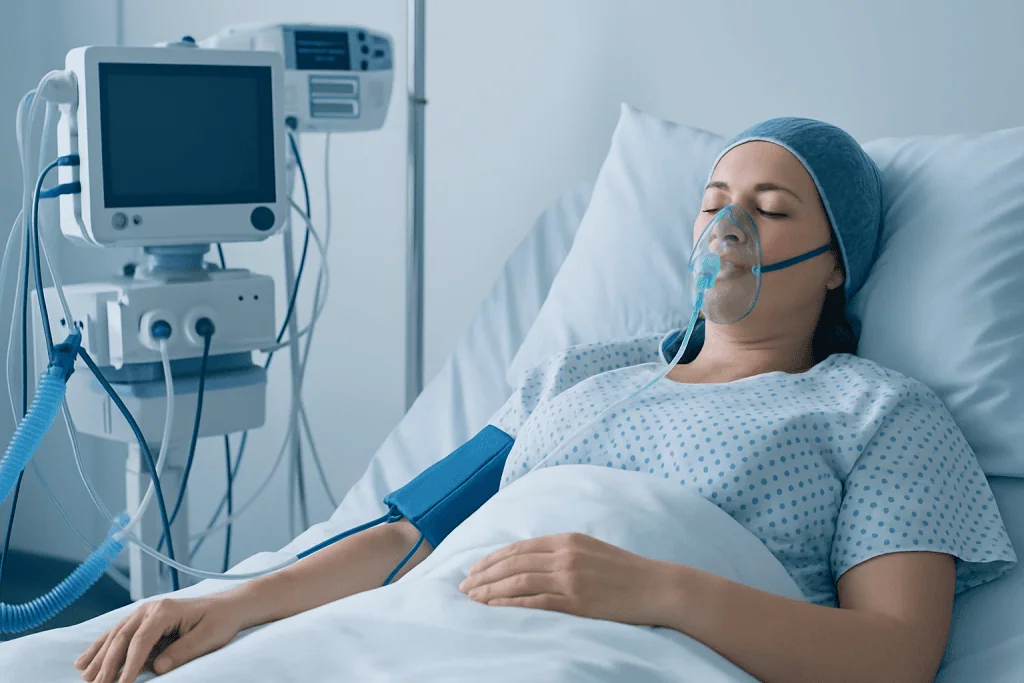
Everyone wakes differently. Some people are clear-headed within minutes; others drift in and out for an hour or more. Common short-term effects include grogginess, shivering or feeling cold, dry mouth, a sore throat, mild nausea, blurred vision, and unsteady balance. Feeling briefly tearful or emotional on waking is also common and passes. These effects reflect the anesthetic drugs and the body’s response to surgery, and they typically ease over the following hours.
You may also notice discomfort from the procedure itself, tenderness, bloating, soreness, or the pull of a dressing, which is separate from the anesthesia. Nurses will ask you to rate your pain on a scale. Answer honestly rather than trying to push through it: pain and nausea control are part of the discharge criteria, so under-reporting does not get you out faster, it usually slows things down.
Nausea deserves a specific mention. A history of motion sickness or previous postoperative nausea makes it more likely, and it is genuinely useful information for the anesthesiology team before the procedure, because there are preventive drugs and technique choices that reduce the risk. In the recovery room, early treatment of nausea works better than late treatment, which is another reason honest reporting matters.
How long the anesthetic actually takes to leave your system
This is the question behind most others. The honest answer has two parts. The drugs that keep you asleep are short-acting by design: their main effect fades within minutes to hours of being stopped, which is why you can be awake and talking soon after surgery. But traces of anesthetic agents and their by-products are cleared more gradually by the liver and kidneys over the following day or so, and the subtle effects, slowed reaction time, softer judgement, patchy short-term memory, outlast the obvious sleepiness.
In practice, most people feel largely themselves within 24 to 48 hours of a routine general anesthetic, though tiredness can linger longer, especially after bigger procedures or in older patients. How quickly you clear the drugs depends on your age, weight, liver and kidney function, the length of the anesthetic, the specific agents used, and what other medicines you take. This variability is exactly why the standard advice, no driving, no alcohol, no important documents or decisions for at least 24 hours, applies even to people who feel fine. Feeling alert and being fully recovered are not the same thing on day one.
Sleeping after you get back to your room or hotel is normal and usually helpful. Anesthesia and surgery are tiring, and dozing on and off through the first afternoon and evening is expected: it is one of the reasons a companion should be nearby during those hours rather than you being alone. There is more on the typical pattern of these effects in post-anesthesia side effects after discharge in Turkey.
When same-day discharge is possible

Same-day discharge after general anesthesia in Turkey is common for many planned procedures, but it is decided by criteria, not by the clock. The team looks for stable breathing and blood pressure, an appropriate level of alertness, pain and nausea that are reasonably controlled, and nothing procedure-related that needs overnight observation. If any of those boxes stays unticked, discharge waits, and occasionally a planned day case becomes an overnight stay. That is a safety decision, not a complication in itself, and it is worth building a little flexibility into your travel plans for it.
Before you leave, you may be asked to drink fluids, sit up, stand, and walk a short distance with support. For some procedures, passing urine is also required first. The team will confirm you understand your medicines, dressing care, eating instructions, and activity limits. If you are travelling internationally, they will usually also ask where you are staying and how far it is from the hospital, because a two-hour transfer on discharge day is a very different proposition from a ten-minute one.
Same-day discharge is coordinated between the surgeon, the anesthesiology team, ward nurses and, for international patients, the hospital’s international patient services. For visitors, that coordination typically covers translated instructions, transfer arrangements that avoid long walks or public transport, and accommodation guidance for the first night.
Your escort, transport, and the first night
The single most important logistical rule: do not plan to leave alone. After a general anesthetic, your coordination, reaction time and judgement can be impaired even when you feel steady, which is why hospitals ask for a responsible adult to accompany you and, for many procedures, to stay with you for the first hours or overnight. Navigating a taxi rank, an unfamiliar hotel lobby or a metro station on your own a few hours after anesthesia is not a reasonable plan. The details of when and why a companion is needed are covered in after sedation or anesthesia in Turkey: when you need someone with you.
Before procedure day, confirm three things: who accompanies you, how you get back to your accommodation, and what the accommodation itself is like, stairs, lift access, distance from the entrance, bathroom layout. If your hotel or apartment is far from the hospital, consider whether staying somewhere closer for the first night makes more sense. A short transfer and a simple room beat a scenic one on discharge day. Our hotel recovery room setup checklist covers the practical details worth arranging in advance.
These logistics matter most if you do not speak Turkish, are travelling with children or an older relative, or simply want the first night to be as low-effort as possible, which is a good reason to settle them before procedure day rather than after it.
Eating, drinking, medicines, and activity after discharge
Your team will tell you when to start drinking and eating again; the advice depends on the procedure. In many cases you begin with small sips of water and progress to light food if it stays down. A large or rich meal on the first evening is rarely a good idea, especially if you are still sleepy or mildly nauseated. Slow and boring is the right pace.
Medicines are the team’s territory, not this guide’s. Take what you have been prescribed, at the times listed on your discharge paperwork, and follow your team’s specific instructions about your regular daily medicines: the decision about when each one resumes belongs to the treating doctor, because it depends on your procedure and your medical history. The best moment to clarify anything unclear is before you leave the ward, while the nurse, the surgical team and an interpreter are all still within reach.
For at least the first 24 hours, the standard restrictions apply regardless of how well you feel:
- No driving, cycling, or riding a scooter
- No alcohol
- No signing of important documents or major decisions
- No tasks requiring sharp concentration or balance, including long solo walks in an unfamiliar city
- Fluids and light food as advised, medicines on schedule, discharge paperwork and contact numbers kept within reach
Rest matters, but so does gentle movement. Depending on your procedure, the team may encourage short walks around your room or corridor to reduce stiffness and support circulation. Follow the activity limits on your paperwork rather than a general rule of thumb, because they differ by operation.
Reading your discharge paperwork: expected effects versus symptoms that need review
Good discharge paperwork does two jobs. First, it describes the effects that are expected in the days after a general anesthetic, grogginess, tiredness, mild nausea, a sore throat from the airway device, tenderness at the procedure site, so that normal recovery does not alarm you. Second, it lists the symptoms that fall outside normal recovery, which clinicians treat as needing prompt review rather than watchful waiting: examples typically include breathing difficulty, chest pain, heavy bleeding, repeated vomiting, fainting, worsening rather than improving drowsiness or confusion, fever, and spreading redness or swelling at the wound.
Before you leave, make sure the paperwork also includes a clear contact route for both routine and urgent questions, ward instructions, the physician’s team, and for international patients the international patient services line. Having that route written down, in a language you read comfortably, is part of a safe discharge; working it out later from a hotel room is not. Wound-specific guidance, including how dressings are managed after you leave, is covered separately in after discharge in Turkey: wound care, dressings, and red flags.
Preparing before procedure day for a smoother recovery
The easiest recovery is the one planned in advance. Before the procedure, make sure you understand the fasting rules, any medicine adjustments your team has specified, what to bring, and roughly how long the day will run from admission through recovery, so your companion can plan realistically. Fasting and preparation are covered in detail in preparing for general anesthesia in Turkey.
Pack for comfort, not style: loose clothing, slip-on shoes, passport or ID, insurance documents if relevant, a written list of your regular medicines, glasses and case, phone charger, and any prescribed support device. If you use a CPAP machine for sleep apnoea, ask in advance whether to bring it to the hospital: it is relevant information for the anesthesiology team either way.
Finally, prepare the room you will return to. Water, permitted light snacks, tissues, medicines, chargers and your discharge instructions should all be within arm’s reach of the bed. If you are in Istanbul or elsewhere in Turkey on a short medical trip, keep the schedule after your procedure empty. Sightseeing, meetings and long transfers belong to another day.
Step by step
- Wake up in monitored recovery. After your procedure, you are taken to a recovery area where nurses and the anesthesia team monitor breathing, pulse, blood pressure, oxygen levels, pain and nausea while you become more alert.
- Report how you feel honestly. Pain, nausea, shivering and dizziness are all treatable, and early treatment works better than late. Good symptom control is part of the discharge criteria, not an obstacle to it.
- Drink and move only when advised. You may be offered water and then light food once the team is satisfied it is safe. Depending on the procedure, you may be asked to sit, stand or take supported steps before discharge.
- Go through the discharge instructions line by line. Medicines and timings, dressing care, showering rules, eating advice, activity limits, expected effects, and the symptoms listed as needing review. Ask for interpretation or written clarification while the team is still in front of you.
- Leave with a responsible adult. Your escort accompanies you to your hotel or home and stays for the first hours, or overnight if advised. You should not drive or manage complicated travel alone after a general anesthetic.
- Keep the first 24 hours simple. Rest, sleep if you feel like it, take fluids as directed and medicines on time, avoid alcohol and driving, and keep your phone charged with the hospital contacts saved.
Your checklist
- Confirm who will escort you after discharge and where they will be during the procedure
- Choose first-night accommodation close to the hospital with lift access if possible
- Save the hospital, surgical team and international patient services numbers in your phone and on paper
- Pack loose clothes and slip-on shoes for discharge day
- Bring a written list of your regular medicines and any allergies
- Ask when you can eat, drink and shower, and follow the team’s instructions on your regular medicines
- Set up your room: water, snacks if permitted, medicines, chargers and paperwork within reach of the bed
- Do not book flights, meetings or sightseeing for procedure day, and build slack into the days after in case a day case becomes an overnight stay
- Arrange interpreter support in advance if you are not comfortable in Turkish or English
Key takeaways
- After general anesthesia, you spend time in a monitored recovery area before any discharge decision is made.
- The main anesthetic drugs wear off within hours, but subtle effects on judgement and coordination can last a day or more, which is why the 24-hour restrictions exist.
- Same-day discharge depends on safety criteria being met, not on how many hours have passed, and occasionally becomes an overnight stay.
- A responsible adult escort, a short transfer, and a simple first night are the three logistics that matter most.
- Clear, written discharge instructions, in a language you read comfortably, covering medicines, food, activity and expected versus concerning symptoms are part of a safe discharge.
Frequently asked questions
How long does it take for general anesthesia to leave your system completely?
The drugs that keep you asleep are short-acting, so their main effect fades within minutes to hours. Full clearance by the liver and kidneys takes roughly a day or more, and subtle effects on reaction time, judgement and memory can persist during that period. Age, the length of the anesthetic and your overall health all affect the speed.
Can you go back to sleep after general anesthesia?
Yes. Feeling sleepy and dozing on and off during the first day is normal and usually helpful, anesthesia and surgery are tiring. This expected drowsiness gradually improves over the first day, and it is one of the reasons a companion should be nearby during those first hours rather than you being alone.
How long does it take to feel back to normal after general anesthesia?
Most people feel largely themselves within 24 to 48 hours of a routine general anesthetic, though tiredness can linger longer, particularly after bigger operations or in older patients. Recovery from the surgery itself follows its own, usually longer, timeline set by your surgical team.
What happens to your body after general anesthesia?
As the drugs are stopped or reversed, breathing, reflexes and consciousness return in stages, which is why you are monitored in a recovery area. Common short-term effects include grogginess, shivering, dry mouth, a sore throat, mild nausea and unsteadiness while the liver and kidneys clear the remaining drugs over the following day.
Can I go back to my hotel the same day after anesthesia in Turkey?
Often yes, if your procedure is planned as a day case and the discharge criteria are met: stable observations, adequate alertness, controlled pain and nausea, and a responsible adult with a simple transport plan back to your accommodation. If the criteria are not met, discharge waits, sometimes overnight.
Will I be allowed to fly soon after general anesthesia?
That depends more on the procedure you had than on the anesthesia itself, and the timing is set by your surgeon and anesthesiology team for your specific case. Factors they weigh include the type of operation, how your recovery is progressing, and the length of the flight, which is why the answer differs from patient to patient.
Do I really need someone to stay with me after same-day discharge?
In most cases, yes, especially for the first hours after a general anesthetic. Even when you feel alert, balance, judgement and reaction time can still be affected, so hospitals ask for a responsible adult escort as a standard safety condition of day-case discharge.
What should I ask for before leaving the hospital?
Written discharge instructions covering medicine timings, dressing and wound care, eating and showering rules, activity limits, expected effects versus symptoms that need review, and a contact route for routine and urgent questions. If anything is unclear, clarify it on the ward: that is far easier than working it out later in a hotel room.
Add us as a Preferred Source to see more of our trusted health content across Google Search, AI Overviews and Discover.

Update history
- PublishedJuly 8, 2026
- Medical review approvedSeptember 1, 2026
- Last content updateSeptember 1, 2026
References2
- General anaesthesia: NHS nhs.uk
- General anesthesia: MedlinePlus Medical Encyclopedia medlineplus.gov
More Patient Guides

Septoplasty Recovery: Week by Week
Learn what to expect after deviated septum surgery: a week-by-week septoplasty recovery timeline, when it is usually safe to fly home, and…

Gallbladder Surgery Recovery: Week by Week
Learn what to expect after gallbladder surgery: a week-by-week recovery timeline, pain, diet, wound care, when it is safe to fly home…
Robotic Hysterectomy Recovery: Week by Week
Recovery from robotic hysterectomy week by week: pain, lifting, wounds, driving, flying home safely, warning signs and questions to ask before you…
Breast Reconstruction Recovery: Week by Week
DIEP flap recovery week by week: hospital stay, drains, pain, walking, showering, driving, when it is usually safe to fly home, and…