Rear Delt Exercises: What Patients Need to Know

Rear delt exercises target the posterior deltoid and nearby upper-back muscles that help stabilize the shoulder. Good technique matters more than heavy weight for shoulder comfort and long-term progress.
Key Takeaways
- Rear delt exercises target the posterior deltoid and nearby upper-back muscles that help stabilize the shoulder.
- Good technique matters more than heavy weight for shoulder comfort and long-term progress.
- Balanced training should include rotator cuff, upper back, chest, and overall shoulder mobility work.
- Pain during exercise is not normal if it is sharp, worsening, or associated with weakness or loss of motion.
- People with prior shoulder injury should start gradually and may benefit from medical evaluation or supervised rehabilitation.
Rear delt exercises help strengthen the back of the shoulder, which supports posture, balanced upper-body movement, and shoulder stability. For most people, the safest approach is to use controlled form, light to moderate resistance, and exercises that do not trigger sharp pain.
Overview: what rear delt exercises do
Rear delt exercises are movements that strengthen the posterior deltoid, the part of the shoulder muscle located at the back of the shoulder. These exercises also work closely with the rotator cuff, middle trapezius, lower trapezius, and rhomboid muscles. Together, these structures help keep the shoulder centered and stable during lifting, reaching, pulling, and many daily activities.
People often focus on the front and side of the shoulders because these muscles are visible and commonly trained in pressing exercises. However, the back of the shoulder plays an important role in balanced movement. When the rear delts and surrounding stabilizers are undertrained, posture can suffer and some people develop discomfort with repetitive overhead or desk-based activities.
For patients and the general public, the main goal is not bodybuilder-style isolation alone. It is to build a shoulder that moves well, tolerates activity, and stays comfortable. A well-designed program usually combines rear delt work with posture training, mobility, and gradual strengthening of the entire shoulder girdle.
Why the rear delts matter for posture and shoulder health
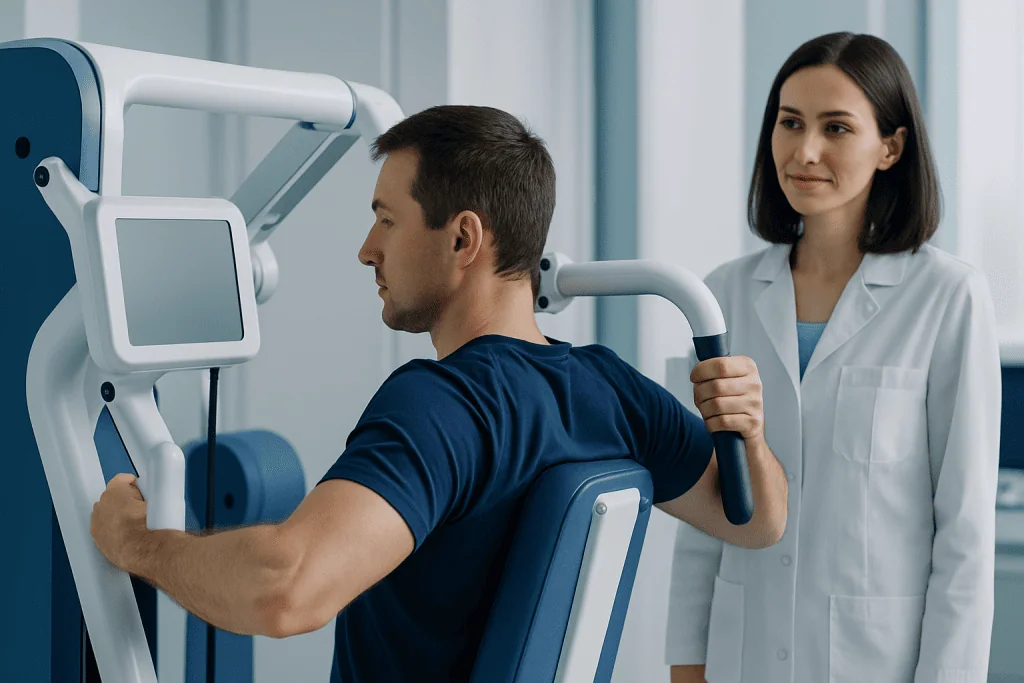
The rear deltoid helps move the arm backward and outward, and it assists with external rotation when working together with other muscles. These actions are especially important when pulling a door, reaching behind the body, rowing, or controlling the arm during sports and exercise. A stronger posterior shoulder can improve how the shoulder blade and upper arm work together.
Rear delt strength may also support better posture, especially in people who spend long periods sitting, driving, or working at a computer. In these situations, the chest and front shoulder can become relatively tight while the upper back and posterior shoulder become less active. Rear delt exercises can help restore balance, although they are most effective when combined with flexibility and ergonomic changes.
Not every shoulder problem is caused by weak rear delts, and exercise should not be seen as a cure-all. Conditions such as shoulder impingement, rotator cuff irritation, or arthritis may also contribute to pain or limited motion. In those cases, exercise selection and technique should be adjusted to the individual.
Examples of rear delt exercises

Several exercises can target the rear delts safely when performed with control. Common options include reverse fly variations with dumbbells or resistance bands, face pulls, chest-supported rear delt raises, band pull-aparts, and rowing movements that emphasize shoulder blade control. For beginners, resistance bands and light dumbbells are often easier to manage than heavier free weights.
A balanced routine does not need many exercises. Two or three rear delt-focused movements, performed two or three times per week, may be enough for many people. The best choice depends on current fitness, pain history, posture, available equipment, and whether a person is training for general health, recovery, or sport.
- Band pull-apart: Useful for learning shoulder blade control and light endurance work.
- Reverse fly: Trains the back of the shoulders directly, especially when done with a slight forward lean and a neutral spine.
- Face pull: Combines rear delt work with upper-back and rotator cuff activation.
- Chest-supported raise or row: Reduces strain on the lower back and helps isolate the target muscles.
People recovering from injury may be advised to begin with tailored physical therapy and rehabilitation rather than a general exercise plan. A clinician can guide movement quality, progression, and symptom monitoring.
How to perform them safely
Safe rear delt training begins with technique. The movement should feel controlled rather than rushed, and the shoulders should stay away from the ears. Many people accidentally turn rear delt exercises into upper-trapezius or momentum-driven movements by lifting too much weight, arching the lower back, or swinging the arms.
It often helps to start with a lighter load than expected. The goal is to feel the back of the shoulder and upper back working without sharp pain in the front or top of the shoulder. A small bend in the elbows is usually appropriate, and the neck should stay relaxed. Breathing steadily and avoiding breath-holding can also improve control.
Warm-up matters as well. Gentle shoulder circles, thoracic spine mobility, and light activation with a band can prepare the area for exercise. If a person already has shoulder symptoms, supervised care such as sports injury rehabilitation may help identify which movements are appropriate and which should be modified or avoided.
Discomfort from muscle effort is common, especially in people who are new to resistance training. In contrast, sharp, catching, radiating, or worsening pain is a sign to stop and reassess. Technique, range of motion, and exercise choice often need to be adjusted before continuing.
Common mistakes and who should be cautious
The most common mistake is using weight that is too heavy. This often causes the torso to swing, the shoulder blades to shrug upward, or the front of the shoulder to take over. Another frequent issue is performing too many pushing exercises, such as bench presses or overhead presses, without enough pulling and posterior shoulder work to balance them.
People should also be cautious with painful overhead positions, very deep ranges of motion, or exercises done to exhaustion when form is already breaking down. Fatigue can change how the shoulder moves and place more stress on sensitive tissues. Progress is usually better with moderate volume, steady practice, and good recovery.
Extra care is needed in people with a history of dislocation, rotator cuff injury, frozen shoulder, inflammatory joint disease, or recent surgery. In these cases, shoulder exercises may still be helpful, but the plan should be individualized. If the shoulder has persistent weakness or instability, assessment may include orthopedic rehabilitation or evaluation by a specialist.
How rear delt exercises fit into a balanced program
Rear delt exercises work best as one part of a broader shoulder and upper-body plan. In addition to strengthening the back of the shoulder, many people benefit from mobility work for the chest and thoracic spine, rotator cuff exercises, and pulling patterns such as rows. Core and hip strength can also influence upper-body mechanics by improving posture and movement control.
A simple weekly routine may include one or two mobility drills, one rotator cuff exercise, one or two rear delt-focused exercises, and one general pulling movement. This kind of balanced program can be more useful than repeatedly training only one muscle. It also supports activities outside the gym, including lifting, carrying, and sports.
Progress should be gradual. A person may begin with light resistance and fewer repetitions, then increase challenge over time if symptoms remain stable. Rest days matter, especially if there is lingering soreness. If progress is limited by pain or stiffness, an evaluation can help rule out issues such as rotator cuff injury or other shoulder disorders.
When to seek medical care
Rear delt exercises should not cause severe or persistent pain. Medical advice is appropriate if shoulder pain lasts more than a few days after exercise, keeps returning, interrupts sleep, or limits everyday tasks such as dressing, lifting, or reaching overhead. Sudden weakness, a popping injury, visible deformity, numbness, or pain after a fall should be assessed promptly.
People with long-standing shoulder pain sometimes continue exercising through symptoms, hoping the problem will settle on its own. In some cases, that is reasonable for mild muscle soreness, but ongoing joint pain deserves attention. A clinician may examine range of motion, strength, posture, and the neck or upper back to identify the source of symptoms.
Diagnosis may involve physical examination and, when needed, imaging such as MRI to look at the rotator cuff, labrum, or other shoulder structures. Acibadem International’s multidisciplinary specialists in JCI-accredited hospitals diagnose and treat shoulder conditions for international patients when further evaluation is needed.
Frequently asked questions
What are rear delt exercises?
Rear delt exercises are movements that strengthen the posterior deltoid, the muscle at the back of the shoulder. They often also train nearby upper-back and rotator cuff muscles that help support shoulder stability and posture.
Can rear delt exercises help shoulder pain?
They may help some people, especially when weakness, poor posture, or muscle imbalance contributes to symptoms. However, shoulder pain can have many causes, so persistent or worsening pain should be evaluated rather than treated with exercise alone.
How often should rear delt exercises be done?
For general fitness, many people do them two or three times per week with rest between sessions. The right frequency depends on a person's goals, exercise history, recovery, and whether there is an existing shoulder problem.
Is it normal to feel soreness after rear delt exercises?
Mild muscle soreness can happen, especially when starting a new routine or increasing effort. Sharp pain, joint pain, numbness, or pain that worsens over time is not typical and should prompt stopping the exercise and seeking advice if symptoms continue.
Are bands or dumbbells better for rear delt exercises?
Both can be effective. Resistance bands are often easier for beginners and for gentle activation, while dumbbells can be useful for gradual strengthening when a person can maintain good form.
Who should talk to a doctor before starting these exercises?
Anyone with a history of shoulder dislocation, rotator cuff injury, recent surgery, inflammatory joint disease, or significant pain with movement should consider medical guidance first. Professional input is also helpful if symptoms interfere with sleep, work, or daily activities.
This article is for general information only and is not a substitute for professional medical advice. Please consult a qualified doctor about your individual situation.
Joint and spine care in Turkey — expert assessment & treatment
JCI-accredited · board-certified surgeons · reply within 24h
Add us as a Preferred Source to see more of our trusted health content across Google Search, AI Overviews and Discover.

More from the Health Library

Retrognathia — Explained by Medical Evidence, Not Myths

Femur Fracture — Explained by Medical Evidence, Not Myths

Medicine Ball: An Evidence-Based Guide for Patients

Macrophages — Explained by Medical Evidence, Not Myths

Spank: A Complete Medical Overview