Sagittal Plane: A Complete Medical Overview

The sagittal plane divides the body into left and right sections. A midsagittal plane divides the body into equal right and left halves.
Key Takeaways
- The sagittal plane divides the body into left and right sections.
- A midsagittal plane divides the body into equal right and left halves.
- Flexion and extension are the main movements described in the sagittal plane.
- Doctors use the sagittal plane in anatomy, MRI and CT interpretation, surgery, and rehabilitation.
- Understanding body planes can make medical explanations and imaging reports easier to follow.
The sagittal plane is an anatomical reference plane that divides the body into left and right portions. It is widely used in medicine, physical examination, imaging, rehabilitation, and exercise science to describe where structures are located and how the body moves.
Overview: what the sagittal plane means
The sagittal plane is one of the main anatomical planes used to describe the human body. It separates the body into right and left portions. When the division runs exactly through the center and creates equal halves, it is called the midsagittal or median plane; when it is off-center, it is called a parasagittal plane.
This concept is not only for anatomy textbooks. In everyday medical practice, the sagittal plane helps clinicians explain posture, joint movement, scan findings, surgical approaches, and rehabilitation goals. It gives healthcare professionals a shared language so that descriptions are precise and consistent.
For patients, understanding the sagittal plane can make terms in imaging reports, orthopedic evaluations, and physical therapy instructions much clearer. For example, when a doctor says a disc problem is seen on a sagittal MRI image or that a joint moves mainly in the sagittal plane, they are referring to this left-right division and the motions seen from the side of the body.
How the sagittal plane compares with other body planes
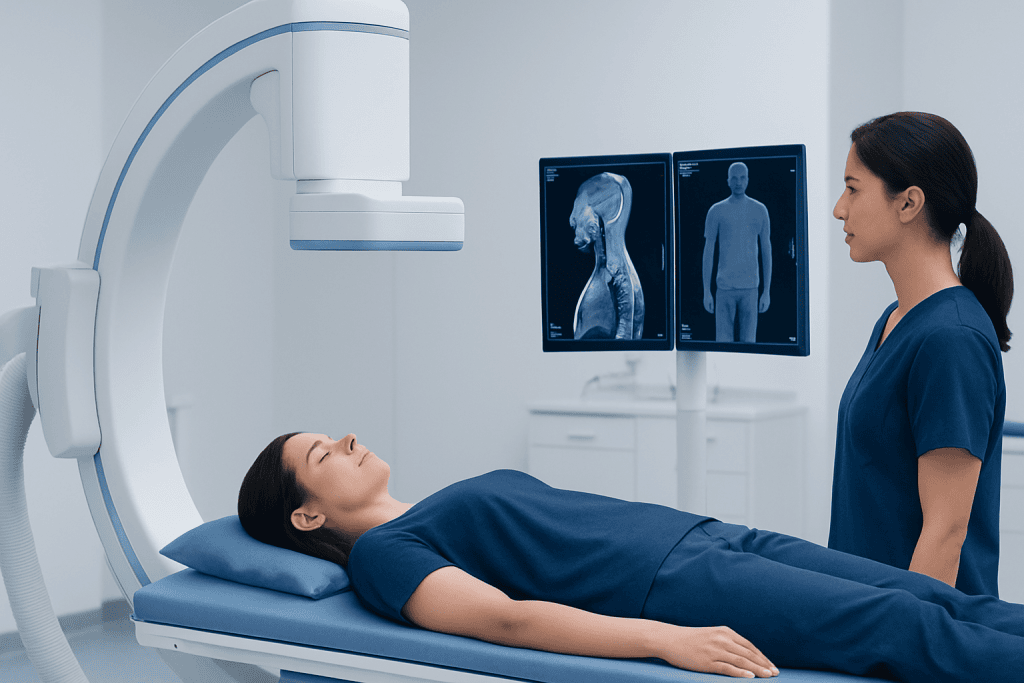
The body is commonly described using three major planes. The sagittal plane divides the body into right and left portions. The coronal, or frontal, plane divides the body into front and back parts. The transverse, or axial, plane divides the body into upper and lower sections.
These planes are especially helpful because many movements happen mainly in one plane. In the sagittal plane, the most typical movements are forward and backward motions, such as bending the elbow, nodding the head, or walking. In the frontal plane, side-to-side motions are more common, while the transverse plane is used for rotational movements.
Imaging studies also rely on these planes. A sagittal image shows the body from the side, a coronal image shows it from the front, and an axial image shows cross-sections from above or below. Seeing how these views relate to each other can help patients better understand MRI, CT, and ultrasound results.
- Sagittal plane: right and left portions
- Coronal plane: front and back portions
- Transverse plane: upper and lower portions
- Oblique plane: a slanted cut that does not fit the three standard planes
Movements that occur in the sagittal plane

The sagittal plane is closely linked to flexion and extension. Flexion usually means decreasing the angle between two body parts, such as bending the knee or bringing the chin toward the chest. Extension usually means increasing that angle, such as straightening the knee or looking upward. These are among the most common movements in daily life.
Many familiar actions take place mainly in the sagittal plane. Walking, running, sitting down, standing up, climbing stairs, and performing a biceps curl all involve forward-backward movement patterns. The ankle also works in this plane during dorsiflexion and plantarflexion, which occur when the foot moves upward or downward.
In rehabilitation and sports medicine, looking at movement in the sagittal plane can reveal useful information about balance, coordination, and joint loading. For example, clinicians may assess how the trunk bends, how the knee straightens, or how the foot lands during gait. This is relevant in common musculoskeletal conditions, including herniated disc and posture-related back pain, where movement patterns can affect symptoms.
Why the sagittal plane matters in medicine and imaging
The sagittal plane is important because it helps doctors localize structures and abnormalities accurately. In physical examination, it can be used to describe spinal curves, head position, joint range of motion, and walking patterns. In surgery and procedural planning, understanding anatomy by plane helps guide safe access and precise treatment.
In radiology, sagittal views are especially useful for evaluating the spine, brain, knees, and other joints. A sagittal MRI of the spine can show the alignment of vertebrae, the shape of the spinal canal, and the condition of the discs between the bones. This can help in the assessment of problems such as degenerative changes, disc bulges, or scoliosis, depending on the body region and the clinical question.
Sagittal images can also support treatment planning. For some patients with persistent spinal symptoms, specialists may use these views when considering conservative care, rehabilitation, or procedures such as spine surgery when medically appropriate. Similarly, sagittal assessment of gait and joint mechanics may inform rehabilitation programs or interventions such as physical therapy and rehabilitation.
Examples of sagittal plane use in everyday healthcare
A patient does not need to study anatomy to encounter the sagittal plane. It appears in many routine healthcare settings. A physical therapist may evaluate whether the pelvis tilts forward or backward while walking. An orthopedic specialist may assess how well the knee extends after an injury. A neurologist may look at trunk posture and gait from the side to understand movement control.
Dental, eye, and ear examinations may also use directional language related to body planes, especially when discussing alignment and symmetry. In obstetric imaging, fetal position may be described with reference to different planes. In exercise medicine, trainers and rehabilitation teams often use sagittal-plane analysis to improve form and reduce strain.
Spinal care is one of the clearest examples. The side view of the neck and back helps clinicians assess normal curves, such as cervical and lumbar lordosis, as well as changes linked to pain or stiffness. When symptoms suggest structural problems, imaging may be combined with specialist evaluation and, in selected cases, orthopedics and traumatology expertise to guide care.
Common misunderstandings about the sagittal plane
One common misunderstanding is that the sagittal plane always means the body is divided into equal halves. In fact, only the midsagittal plane does that. Any vertical plane parallel to the midsagittal plane is still sagittal, but it divides the body into unequal right and left portions.
Another source of confusion is mixing up planes with directions. The sagittal plane is a way of slicing or viewing the body; terms such as anterior, posterior, medial, and lateral describe location. Although these concepts are related, they are not the same.
Patients may also assume that if a report mentions a sagittal image, this means a diagnosis is more serious. It does not. The term simply describes the viewing angle used in the scan. Doctors usually interpret sagittal images together with axial and coronal views, symptoms, examination findings, and medical history before making a diagnosis.
When to seek medical care
The sagittal plane itself is not a disease, so it does not cause symptoms. However, terms related to the sagittal plane often appear in reports or discussions about movement problems, back pain, joint stiffness, or sports injuries. If a patient has persistent pain, reduced range of motion, weakness, numbness, balance changes, or difficulty walking, a medical evaluation is appropriate.
Medical advice is also important after a fall, sports injury, or sudden onset of severe neck or back pain. Urgent care is needed if symptoms are accompanied by loss of bladder or bowel control, progressive weakness, major trauma, or severe neurological symptoms. These situations need prompt professional assessment rather than self-diagnosis based on anatomy terms.
For international patients who need further evaluation, Acibadem International’s multidisciplinary specialists and JCI-accredited hospitals diagnose and treat musculoskeletal, neurological, and spinal conditions with coordinated care. A qualified doctor can explain how sagittal-plane findings on examination or imaging relate to the individual’s symptoms and treatment options.
Frequently asked questions
What is the sagittal plane in simple terms?
The sagittal plane is an imaginary flat surface that divides the body into right and left portions. It helps doctors, therapists, and radiologists describe body structures and movements clearly.
What is the difference between sagittal and midsagittal?
Sagittal refers to any plane that separates the body into right and left portions. Midsagittal is the specific sagittal plane that passes through the exact center, creating equal right and left halves.
What movements happen in the sagittal plane?
The main sagittal-plane movements are flexion and extension. Common examples include bending and straightening the knee, nodding the head, and moving the arm forward and backward.
Why do MRI reports mention sagittal images?
MRI and CT reports mention sagittal images because the viewing angle helps show anatomy from the side. This can be especially useful for the spine, brain, and joints, but the word itself does not indicate how serious a finding is.
Is the sagittal plane only used in anatomy?
No. It is used across many areas of healthcare, including imaging, physical therapy, orthopedics, neurology, sports medicine, and surgery. It is also common in exercise science and gait analysis.
Can understanding the sagittal plane help patients?
Yes. Knowing this term can make it easier to understand scan reports, rehabilitation instructions, and explanations about posture or joint motion. It can also help patients ask clearer questions during medical appointments.
References
- MedlinePlus
- National Institute of Arthritis and Musculoskeletal and Skin Diseases
- National Library of Medicine
- Radiological Society of North America
- American Academy of Orthopaedic Surgeons
This article is for general information only and is not a substitute for professional medical advice. Please consult a qualified doctor about your individual situation.
Joint and spine care in Turkey — expert assessment & treatment
JCI-accredited · board-certified surgeons · reply within 24h
Add us as a Preferred Source to see more of our trusted health content across Google Search, AI Overviews and Discover.