Lat Pulldown: An Evidence-Based Guide for Patients

Lat pulldown mainly trains the latissimus dorsi, with help from the shoulder blades, rear shoulders, and biceps. Good form usually matters more than lifting heavier weight, especially for shoulder and neck comfort.
Key Takeaways
- Lat pulldown mainly trains the latissimus dorsi, with help from the shoulder blades, rear shoulders, and biceps.
- Good form usually matters more than lifting heavier weight, especially for shoulder and neck comfort.
- Pulling the bar to the upper chest with a controlled motion is generally preferred over behind-the-neck variations.
- Pain during lat pulldown is not considered normal and may suggest poor technique, overload, or an underlying shoulder, neck, or elbow issue.
- A clinician or physiotherapist can help if symptoms persist, limit daily activities, or follow an injury.
Lat pulldown is a common strength-training exercise used to build the muscles of the upper back, shoulders, and arms. For most people, it can be a safe and effective movement when technique, range of motion, and training load are matched to the individual.
Overview: What Is a Lat Pulldown?
Lat pulldown is a resistance exercise that strengthens the upper back by pulling a bar or handles downward against weight. It is often used in gyms, rehabilitation settings, and supervised exercise programs because the movement pattern can be adjusted for different body sizes, fitness levels, and goals.
The main target is the latissimus dorsi, a large back muscle that helps bring the arm down and back. The exercise also recruits the muscles that control the shoulder blades, the back of the shoulders, and the biceps. When performed well, lat pulldown can support posture, pulling strength, and shoulder control needed for daily activities such as lifting, carrying, and reaching.
For patients, the key question is usually not whether the exercise is “good” or “bad,” but whether it is appropriate for their body, current symptoms, and training plan. A neutral, evidence-based approach focuses on proper setup, gradual loading, and avoiding movements that provoke pain rather than assuming one single technique suits everyone.
How the Exercise Works and Which Muscles It Trains
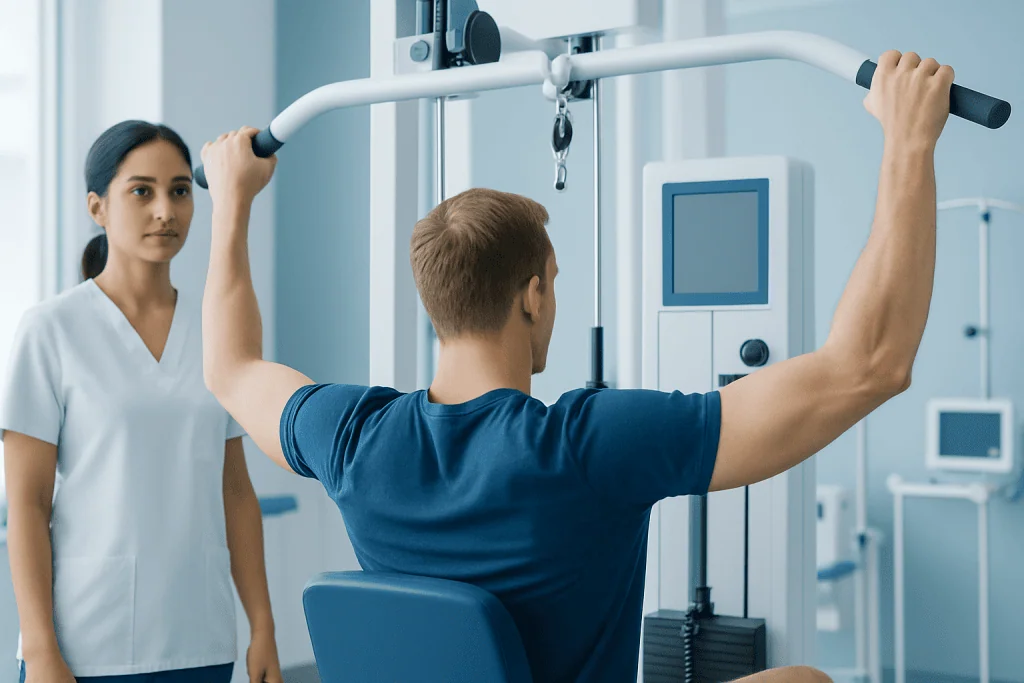
During a lat pulldown, the arms start overhead while the body stays upright or slightly leaned back. The person then pulls the bar or handles downward by extending and adducting the shoulders while guiding the shoulder blades down and back in a controlled way. The weight is then returned slowly to the starting position.
The latissimus dorsi is the primary working muscle, but it does not work alone. The lower trapezius, middle trapezius, rhomboids, teres major, posterior deltoid, and elbow flexors all contribute. Core muscles also help keep the trunk steady so that the force comes from the upper body rather than from swinging or arching the back excessively.
Because several joints and muscle groups are involved, lat pulldown can reveal weak links in movement control. Limited shoulder mobility, poor shoulder blade coordination, neck tension, or grip fatigue may change technique and place extra stress on nearby tissues. This is one reason clinicians often look at the whole movement rather than only the amount of weight lifted.
- Primary target: latissimus dorsi
- Important assistants: trapezius, rhomboids, teres major, rear deltoids, biceps
- Stabilizers: abdominal and spinal muscles
Benefits of Lat Pulldown for General Fitness and Recovery

Lat pulldown may help improve upper-body pulling strength, shoulder stability, and muscular endurance. These qualities can support everyday function, especially for people who spend long hours sitting, have a relatively push-dominant workout routine, or want to improve balanced upper-body conditioning.
In rehabilitation, modified pulling exercises may be used to rebuild strength after deconditioning or to support recovery once an injury has been properly assessed. This does not mean lat pulldown is suitable for every painful shoulder or neck problem, but it can be a useful tool when chosen carefully and progressed gradually. In some cases, a doctor may recommend assessment for related conditions such as shoulder impingement syndrome or rotator cuff problems if symptoms continue.
The exercise can also be easier to scale than pull-ups. Resistance can be increased or decreased in small steps, grip options can be changed, and range of motion can be limited temporarily if needed. For many people, this makes the movement more accessible while still providing a meaningful training effect.
Safe Form: Technique Points That Matter Most
Safe lat pulldown technique usually starts with a stable seated position. Feet stay grounded, the thighs are secured under the pads, and the chest is gently lifted without exaggerated arching. The movement begins by setting the shoulders in a comfortable position, then pulling the bar toward the upper chest rather than yanking it down quickly.
Most clinicians and trainers prefer a front-of-the-body pulldown over a behind-the-neck variation. Bringing the bar behind the neck can place some people in a less comfortable shoulder and neck position, especially if they have limited mobility or existing symptoms. A comfortable grip width and a smooth, controlled path are generally more important than using a very wide grip.
Common signs of poor form include shrugging the shoulders, thrusting the head forward, leaning too far back, bouncing the weight stack, or letting the wrists and elbows move in an awkward path. Using a load that allows controlled repetitions is usually safer and more effective than using a heavier load that changes the movement pattern.
- Keep the movement controlled on both the pull and the return
- Aim the bar toward the upper chest or collarbone area, not behind the neck
- Avoid excessive trunk swinging or jerking
- Stop if there is sharp pain, numbness, or a feeling of instability
Common Problems: Shoulder, Neck, Elbow, and Back Discomfort
Discomfort during lat pulldown is often linked to technique, load, training volume, or an underlying musculoskeletal issue. Shoulder pain may occur if the movement is performed with poor shoulder blade control, insufficient mobility, or repeated end-range positions that irritate sensitive structures. Neck tension can appear when the upper trapezius takes over and the shoulders remain elevated throughout the exercise.
Elbow or forearm discomfort may be related to gripping too tightly, using too much weight, or overloading the biceps and tendons. Lower back strain can happen when a person leans back too far or repeatedly arches the spine to move the weight. In these situations, reducing resistance, adjusting the grip, shortening the range of motion, or pausing the exercise may help until the cause is identified.
Persistent pain deserves attention, particularly if it interferes with sleep, daily activities, or other exercise. Depending on the symptom pattern, a doctor may evaluate for issues such as frozen shoulder or advise supportive care including physical therapy and rehabilitation.
Who Should Modify or Avoid the Exercise?
Lat pulldown may need to be modified in people with recent shoulder injuries, acute neck pain, elbow tendon pain, or limited overhead mobility. It may also be temporarily unsuitable after surgery until a treating clinician confirms that the movement is safe. People with dizziness, poor trunk control, or significant pain during pulling motions may also need an individualized program.
Modification does not always mean stopping all upper-body exercise. A narrower or neutral grip, lighter load, slower tempo, lower range of motion, or alternative row-based exercises may be more comfortable. In some cases, home or clinic-based rehabilitation can restore mobility and strength before returning to full lat pulldown training.
If pain is linked to a known structural problem or does not improve with rest and technique changes, formal evaluation is sensible. Depending on the findings, care may include orthopedic rehabilitation or assessment by specialists in orthopedics and traumatology.
Practical Self-Care, Progression, and Injury Prevention
Most people do best when they approach lat pulldown as a skill as well as a strengthening exercise. A short warm-up for the shoulders and upper back, followed by lighter practice sets, can improve comfort and movement quality. Progression should be gradual, especially after a break from training or after symptoms have settled.
Balanced programming is also helpful. Pulling exercises work best alongside movements that support shoulder mobility, rotator cuff function, posture, and trunk control. Recovery matters too: adequate rest between sessions, good sleep, and avoiding sudden spikes in training volume can lower the chance of overload.
Simple self-checks can reduce risk. If the shoulders repeatedly shrug, the bar path feels uneven, or pain appears during the return phase, the weight may be too high or the setup may need adjustment. A physiotherapist or qualified exercise professional can often correct these issues early, before they become more limiting.
Near the end of a care pathway, some patients may seek specialist assessment to return safely to exercise. Acibadem International’s multidisciplinary specialists and JCI-accredited hospitals evaluate and treat musculoskeletal complaints for international patients when needed.
When to Seek Medical Care
Medical advice is appropriate if shoulder, neck, elbow, or back pain during lat pulldown is severe, recurrent, or lasts beyond a few days despite stopping the exercise and modifying activity. Care is also important if there is swelling, marked weakness, reduced range of motion, or pain that wakes the person at night.
Urgent assessment is recommended after a sudden injury with a popping sensation, visible deformity, inability to lift the arm, numbness, tingling, or symptoms that radiate down the arm. These features may suggest a more significant injury that should not be managed with self-care alone.
Even without an emergency, professional assessment can be useful if exercise confidence has dropped or symptoms keep returning. Early evaluation often helps identify whether the main issue is technique, training load, mobility, or an underlying condition, allowing a safer return to exercise.
Frequently asked questions
What does lat pulldown work?
Lat pulldown mainly works the latissimus dorsi, the large muscles on the sides of the back. It also trains the shoulder blade muscles, rear shoulders, and biceps while the core helps stabilize the body.
Is lat pulldown safe for beginners?
Yes, it can be safe for beginners when the weight is light enough to control and the setup is adjusted correctly. Learning a smooth bar path and avoiding swinging usually matter more than lifting heavy resistance at first.
Why does lat pulldown hurt my shoulders?
Shoulder pain can happen because of poor technique, excessive load, limited mobility, or an existing shoulder problem. Pain is not usually a sign to push through; reducing the weight and getting the movement checked is a safer approach.
Is behind-the-neck lat pulldown recommended?
For many people, no. Pulling the bar in front of the body to the upper chest is generally more comfortable and places the shoulders and neck in a more manageable position.
Can lat pulldown replace pull-ups?
Lat pulldown can be a useful alternative or stepping stone because it trains a similar pulling pattern with more adjustable resistance. However, pull-ups also require greater body control and may not be fully replaced depending on a person's goals.
When should someone stop doing lat pulldown and see a doctor?
They should stop and seek care if they have sharp pain, sudden weakness, numbness, a popping injury, or symptoms that do not improve with rest and technique changes. Medical evaluation is also sensible if pain affects sleep, work, or normal daily movement.
References
- American College of Sports Medicine
- National Institute of Arthritis and Musculoskeletal and Skin Diseases
- American Academy of Orthopaedic Surgeons
- National Strength and Conditioning Association
- World Health Organization
This article is for general information only and is not a substitute for professional medical advice. Please consult a qualified doctor about your individual situation.
Joint and spine care in Turkey — expert assessment & treatment
JCI-accredited · board-certified surgeons · reply within 24h
Add us as a Preferred Source to see more of our trusted health content across Google Search, AI Overviews and Discover.