Red Dots on Skin: An Evidence-Based Guide for Patients

Red dots on skin are a symptom, not a diagnosis, and the cause depends on size, color, texture, and associated symptoms. Common causes include cherry angiomas, heat rash, insect bites, contact irritation, folliculitis, and petechiae or purpura.
Key Takeaways
- Red dots on skin are a symptom, not a diagnosis, and the cause depends on size, color, texture, and associated symptoms.
- Common causes include cherry angiomas, heat rash, insect bites, contact irritation, folliculitis, and petechiae or purpura.
- Red dots that do not fade when pressed, appear suddenly, spread quickly, or occur with fever or easy bruising need prompt medical assessment.
- Diagnosis usually relies on history and skin examination, but blood tests or skin biopsy may sometimes be needed.
- Treatment depends on the cause and may range from simple skin care to treatment for infection, allergy, or a bleeding disorder.
Red dots on skin can come from many causes, including harmless blood vessel growths, irritation, heat, allergy, or tiny areas of bleeding under the skin. The most important step is to notice what the spots look like, whether they blanch, and whether they appear with fever, pain, itching, bruising, or other symptoms.
What red dots on skin can mean
Red dots on skin are common and are often caused by minor, self-limited conditions such as irritation, heat rash, insect bites, or small benign blood vessel changes. However, some red spots can reflect inflammation, infection, allergy, or bleeding under the skin, so the meaning depends on the appearance of the spots and any symptoms that come with them.
Patients often use the same phrase for very different findings. A flat pinpoint red spot may suggest petechiae, while a small raised bright-red bump may be a cherry angioma. A cluster around hair follicles can point to folliculitis, and a widespread itchy rash may suggest an allergic or irritant reaction. Looking carefully at the size, whether the spots are flat or raised, and whether they turn pale when pressed helps narrow the cause.
In many cases, red dots on skin are not an emergency. Still, new spots that appear suddenly, spread rapidly, or occur with fever, weakness, shortness of breath, unusual bruising, or bleeding should not be ignored. A clinician can help determine whether the cause is a simple skin problem or something that needs further testing.
How to tell different red spots apart
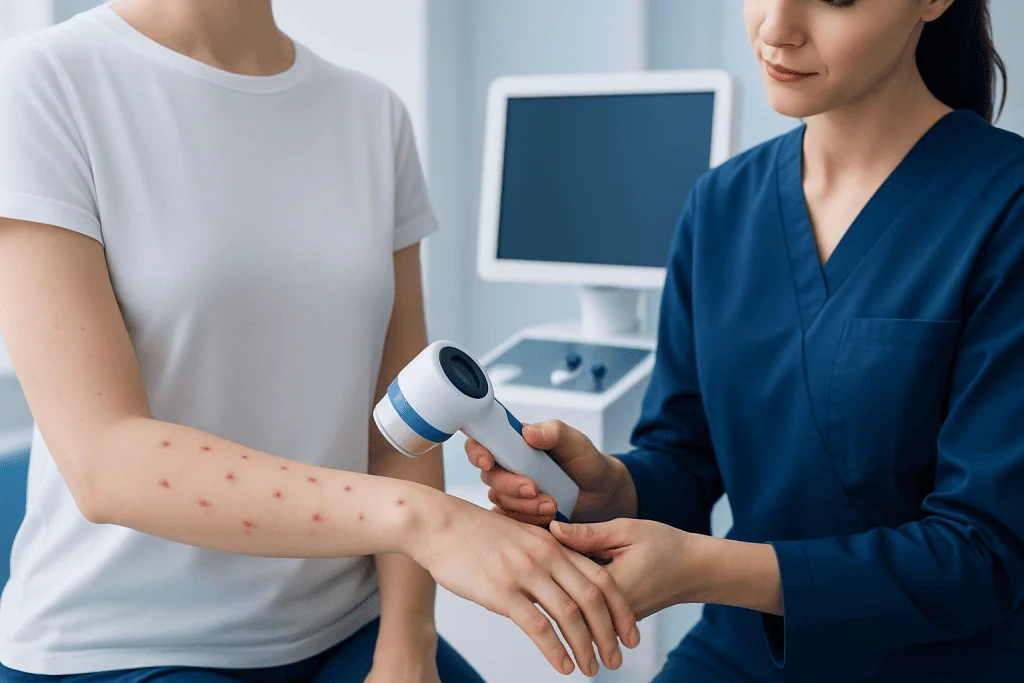
A useful first step is to check whether the spots blanch, meaning they fade briefly when pressed with a clear glass or a finger. Many inflammatory rashes and dilated blood vessels blanch. Petechiae and purpura usually do not blanch because blood has leaked under the skin. This simple observation is helpful, but it does not replace a medical evaluation if there are warning signs.
Size and texture also matter. Pinpoint flat dots may be petechiae. Slightly larger purple-red patches may be purpura. Bright-red dome-shaped bumps that are smooth and well defined are often cherry angiomas, which are common and benign. Itchy bumps may suggest bites, hives, or dermatitis. Tender pustules centered on hair follicles may indicate folliculitis. If a rash is scaly, crusted, or persistent, a skin specialist may consider eczema, psoriasis, fungal infection, or other dermatologic conditions.
Location can give clues as well. Heat rash often appears in areas where sweat is trapped, such as the neck, chest, back, or skin folds. Contact reactions may occur where the skin touched cosmetics, metals, soaps, or plants. Red dots on the legs can be related to friction, circulation issues, vasculitis, or platelet problems. If the appearance is unclear or the lesions persist, assessment by a dermatologist may be useful, especially when there is concern for skin cancer or another chronic skin disorder.
Common causes of red dots on skin

Many everyday causes are harmless. Cherry angiomas are small benign growths made of tiny blood vessels and often become more common with age. Heat rash can happen when sweat ducts become blocked, especially in hot or humid conditions. Insect bites may create itchy red spots, and contact dermatitis can appear after exposure to fragrances, detergents, jewelry, or skincare products. Folliculitis, an inflammation or infection of hair follicles, can cause scattered red bumps or pimples.
Other causes are related to the immune system or infection. Viral illnesses may produce widespread red spots or a rash, sometimes with fever or fatigue. Allergic reactions can cause red, itchy lesions that may come and go. Small blood vessel inflammation, called vasculitis, can lead to red or purple spots, especially on the lower legs, and usually needs medical review. Certain medications may also trigger rashes or make bleeding under the skin more likely.
Some red dots represent bleeding rather than surface irritation. Petechiae are tiny non-blanching spots caused by bleeding from small vessels. They can occur after heavy coughing or vomiting around the face, but they may also relate to platelet disorders, infections, clotting problems, or medication effects. Larger non-blanching areas are called purpura. When a rash is unexplained, recurrent, or associated with bruising, a doctor may investigate blood-related conditions or inflammatory diseases such as leukemia when clinically appropriate, although many cases have much less serious explanations.
- Benign vascular spots such as cherry angiomas
- Heat rash and friction-related irritation
- Insect bites and allergic or irritant contact dermatitis
- Folliculitis and some skin infections
- Viral rashes and medication reactions
- Petechiae, purpura, or vasculitis
Risk factors and warning signs
Risk factors depend on the cause. Hot weather, sweating, tight clothing, and heavy skincare products can increase the chance of heat rash or clogged follicles. Sensitive skin, a history of allergies, and exposure to new detergents, cosmetics, or metals can raise the likelihood of contact dermatitis. Shaving, friction, and humid environments may make folliculitis more likely.
Age can increase the number of cherry angiomas, while medications such as blood thinners or drugs that affect platelets may increase bruising or tiny bleeding spots. Recent infection, autoimmune disease, liver disease, or low platelet counts may also play a role in some patients. Children and adults can both develop red spots, but the context matters; fever and rash in a child, for example, should be assessed more cautiously.
Particular warning signs deserve prompt attention. These include red dots that do not blanch, a rapidly spreading rash, fever, severe headache, neck stiffness, shortness of breath, swelling of the lips or tongue, widespread bruising, nosebleeds, bleeding gums, or marked fatigue. Red spots with pain, skin breakdown, pus, or warmth may indicate infection. In those situations, medical assessment is important rather than waiting for the rash to settle on its own.
How doctors diagnose the cause
Diagnosis starts with a careful history and skin examination. A doctor will usually ask when the red dots appeared, whether they itch or hurt, if they blanch, whether they are spreading, and whether there are symptoms such as fever, joint pain, bleeding, or recent illness. Exposure to new medicines, foods, cosmetics, travel, insect bites, or close contact with illness can also be relevant.
The skin exam focuses on the size, shape, color, distribution, and texture of the lesions. This often provides the main clue to the diagnosis. For example, cherry angiomas are usually easy to recognize on sight, while petechiae may lead the clinician to look for signs of bruising, infection, or clotting problems. If the rash could relate to an underlying systemic condition, blood tests may be ordered to check blood counts, inflammation, or clotting.
Sometimes additional testing is needed. A skin swab may help if infection is suspected. Dermoscopy or specialist dermatology review can clarify uncertain lesions. A skin biopsy may be recommended if vasculitis, unusual inflammation, or another persistent diagnosis is under consideration. If patients need specialist evaluation, care may involve dermatology assessment alongside other services depending on the suspected cause.
Treatment and self-care
Treatment for red dots on skin depends entirely on the cause. Benign cherry angiomas often do not need treatment unless they bleed repeatedly, become irritated, or the diagnosis is uncertain. Heat rash usually improves with cooling the skin, reducing sweating, and wearing loose breathable clothing. Contact dermatitis may settle after avoiding the trigger and using doctor-recommended soothing or anti-inflammatory skin treatments. Folliculitis may improve with hygiene measures, though some cases need medical treatment if bacterial or persistent.
If the spots are linked to allergy, infection, inflammation, or a medication reaction, a doctor may recommend targeted treatment after evaluation. Petechiae and purpura are not treated as a cosmetic issue first; instead, the underlying cause is addressed. If blood test abnormalities are found, care may involve a hematology team. In selected cases where red spots are connected to blood or marrow disorders, broader evaluation such as bone marrow transplantation may be relevant for the underlying disease rather than for the skin finding itself.
Home care should stay simple and gentle. Avoid scratching, harsh exfoliants, and new fragranced products until the cause is clearer. Keep the skin cool and dry if sweat seems to be a trigger. Take photographs if the appearance changes over time, as this can help a doctor compare progression. If the diagnosis is unclear, persistent, or associated with systemic symptoms, professional evaluation is safer than self-treating repeatedly.
Near the end of the care pathway, some patients may benefit from coordinated input from dermatology, internal medicine, allergy, infectious diseases, or hematology. Acibadem International’s multidisciplinary specialists and JCI-accredited hospitals diagnose and treat patients with skin and systemic conditions, including assessment when red dots on skin are part of a wider medical problem.
When to seek medical care
Many isolated red dots are not urgent, especially when they are longstanding, stable, and clearly benign in appearance. A routine medical visit is reasonable if the spots are new, unexplained, recurrent, cosmetically bothersome, or not improving with simple self-care. This is also true if there is itching, scaling, tenderness, or uncertainty about the diagnosis.
Prompt medical advice is important if the red dots do not blanch, spread quickly, or appear with fever, unusual bruising, bleeding, weakness, dizziness, severe pain, or signs of infection. Immediate care is especially important if there is shortness of breath, facial swelling, confusion, neck stiffness, or a rapidly worsening rash. Those features can signal a serious allergic, infectious, or blood-related condition and should be assessed without delay.
Patients with chronic illnesses, weakened immunity, recent chemotherapy, or medications that affect clotting should be extra cautious about new skin findings. In some cases, the skin can provide an early clue to a wider problem. If the findings raise concern for a blood disorder, doctors may coordinate further evaluation through services related to hematology care.
Frequently asked questions
Are red dots on skin usually serious?
Often they are not serious and may come from harmless causes such as cherry angiomas, heat rash, or mild irritation. They deserve more attention if they appear suddenly, do not fade when pressed, spread quickly, or occur with fever, bruising, or bleeding.
What is the difference between petechiae and cherry angiomas?
Petechiae are tiny flat red or purple spots caused by small areas of bleeding under the skin, and they usually do not blanch when pressed. Cherry angiomas are raised or dome-shaped bright-red spots made of blood vessels and are usually benign.
Can stress cause red dots on skin?
Stress itself is not a classic direct cause of pinpoint red dots, but it can worsen itching, scratching, hives, eczema, and other skin conditions that may look red or spotty. If new spots are persistent or unusual, it is best not to assume stress is the only reason.
Should red dots on skin be pressed to see if they blanch?
Gently checking whether a spot fades with pressure can be a useful observation. However, it is only one clue and cannot diagnose the cause, so concerning symptoms still need medical evaluation.
Can medications cause red dots on skin?
Yes. Some medicines can trigger allergic or inflammatory rashes, while others may increase bruising or tiny bleeding spots by affecting clotting or platelets. A doctor should review any recent medication changes if a new rash appears.
When should a child with red dots on skin see a doctor?
A child should be assessed promptly if red spots are accompanied by fever, lethargy, poor feeding, breathing difficulty, widespread bruising, or if the spots do not blanch. Even when the cause turns out to be minor, it is safer to have a clinician examine a child with these warning signs.
References
- American Academy of Dermatology
- National Health Service
- Merck Manual Consumer Version
- Mayo Clinic
- Cleveland Clinic
This article is for general information only and is not a substitute for professional medical advice. Please consult a qualified doctor about your individual situation.
Explore treatments in Turkey — costs, top hospitals & a free quote
JCI-accredited · board-certified surgeons · reply within 24h
Add us as a Preferred Source to see more of our trusted health content across Google Search, AI Overviews and Discover.

More from the Health Library

Potassium Iodide: What Patients Need to Know

Parkinson’s Life Expectancy: An Evidence-Based Guide for Patients

Tocotrienols — Explained by Medical Evidence, Not Myths

Ankle Mobility Exercises: What Patients Need to Know

GERD: A Complete Medical Overview