

Cytology: A Complete Medical Overview

Cytology examines cells rather than larger pieces of tissue. It is commonly used in Pap tests, body fluid analysis, and fine needle aspiration.
Key Takeaways
- Cytology examines cells rather than larger pieces of tissue.
- It is commonly used in Pap tests, body fluid analysis, and fine needle aspiration.
- Results may be normal, abnormal, suspicious, or nondiagnostic, depending on the sample.
- An abnormal cytology result does not always mean cancer.
- Further testing, such as imaging, repeat sampling, or biopsy, may be needed to confirm a diagnosis.
Cytology is the medical study of individual cells collected from body fluids, brushings, scrapings, or a thin needle sample. It helps doctors investigate infection, inflammation, precancerous changes, and some cancers, often with minimally invasive testing.
Overview: what cytology means in medicine
Cytology is the branch of medicine and laboratory science that examines individual cells under a microscope. Doctors use it to look for changes in cell size, shape, arrangement, and staining patterns that may suggest a normal process, infection, inflammation, precancer, or cancer. In everyday healthcare, the word “cytology” often refers both to the science itself and to the test performed on a cell sample.
Unlike a biopsy, which usually studies a larger piece of tissue and the way cells are arranged within it, cytology focuses mainly on isolated cells or small clusters. This makes it especially useful when a quick, minimally invasive sample is needed. Common examples include cervical screening with Pap cytology, testing fluid removed from the chest or abdomen, and fine needle aspiration of a lump.
Cytology is an important diagnostic tool, but it is not always the final step. In some situations, it provides a clear answer; in others, it helps narrow the possibilities and guides what should happen next. A doctor interprets the result together with symptoms, examination findings, imaging, and sometimes additional laboratory or tissue tests.
How cytology samples are collected
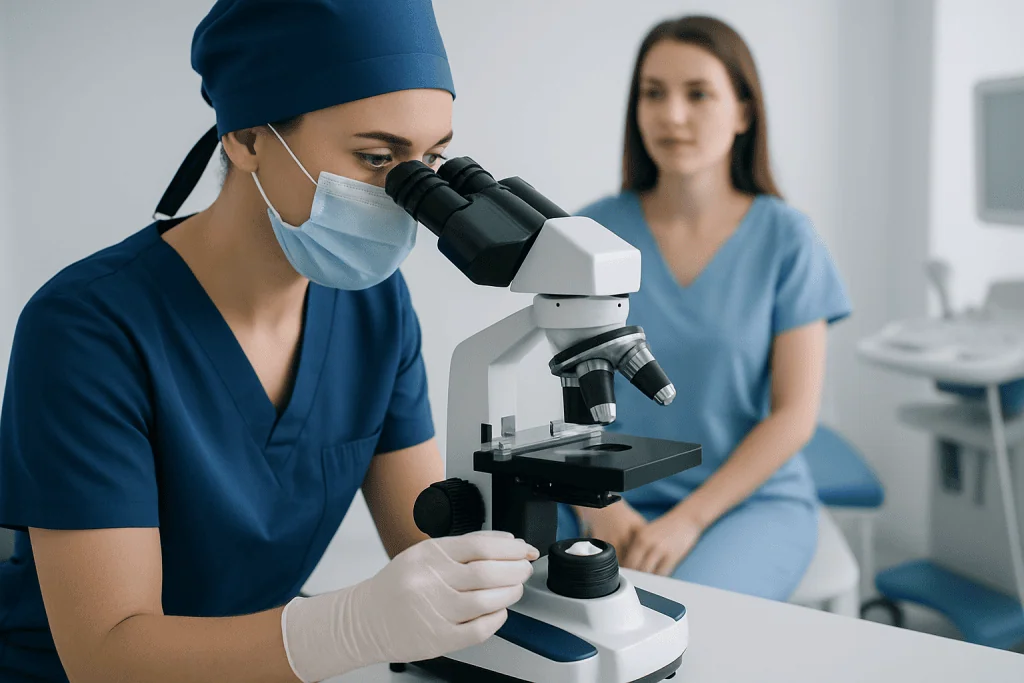
There are several ways to collect cells for cytology, and the method depends on which part of the body is being evaluated. Some samples come from fluids that the body naturally produces or that collect abnormally, such as urine, sputum, or fluid around the lungs. Others are taken by gently scraping or brushing a surface, as in cervical screening or examination of the airways.
Another common method is fine needle aspiration, often called FNA or FNAC. In this procedure, a thin needle is inserted into a lump, lymph node, thyroid nodule, breast lesion, or another area to withdraw cells. Imaging such as ultrasound may be used to guide the needle accurately. This approach can be faster and less invasive than surgery and may help determine whether a mass needs further evaluation.
After collection, the sample is placed on slides or into a preservative solution and sent to the laboratory. A cytotechnologist and/or pathologist examines the cells using a microscope and, when needed, special stains or additional tests. In selected cases, cytology may be paired with a biopsy procedure if a more definitive tissue diagnosis is required.
- Exfoliative cytology: cells shed naturally into fluids, such as urine or sputum
- Brush or scrape cytology: cells collected from a surface, such as the cervix
- Fine needle aspiration cytology: cells drawn from a lump or organ with a thin needle
- Body fluid cytology: cells examined in pleural, peritoneal, cerebrospinal, or other fluids
Why doctors order cytology

Doctors request cytology for several reasons. One major use is screening, which means looking for early cell changes before a person has symptoms. The most familiar example is cervical cytology in a Pap test, which can detect abnormal cervical cells that may require closer follow-up. In this setting, cytology helps identify problems at an early and more treatable stage.
Cytology is also used to investigate symptoms or abnormal findings. A person may have a lump, swelling, persistent cough, abnormal bleeding, fluid buildup, or an imaging result that needs clarification. Examining cells can help determine whether the cause is benign, infectious, inflammatory, or suspicious for malignancy. It may also support the diagnosis of conditions related to cancer or help distinguish them from noncancerous changes.
In people with a known diagnosis, cytology can sometimes be used to monitor disease or evaluate whether treatment has affected cells in a particular area. Because it often requires only a small sample, it may be considered when a less invasive first step is preferred. Still, the test is chosen based on the clinical question, not as a one-size-fits-all investigation.
What cytology can detect
Cytology can identify a wide range of cellular abnormalities. It may show signs of infection, such as changes related to bacteria, fungi, viruses, or parasites. It can also reveal inflammation, irritation, hormonal effects, or reactive changes caused by injury or healing. These findings can help explain symptoms and direct further testing or treatment.
Another key role of cytology is detecting atypical, precancerous, or cancerous cells. For example, cervical cytology can detect dysplastic changes before cancer develops. Fine needle aspiration may suggest whether a thyroid nodule or enlarged lymph node appears benign or suspicious. Fluid cytology can sometimes identify cancer cells that have spread into the pleural or abdominal cavity.
Even so, cytology has limits. Because it examines cells without always showing the surrounding tissue architecture, some conditions cannot be fully classified from cytology alone. A sample may contain too few cells, or the abnormal cells may be hard to distinguish from reactive changes. In these cases, the doctor may recommend further testing such as advanced imaging or a tissue biopsy to make the diagnosis more certain.
Understanding cytology results
Cytology reports are written in medical language, so it is common for patients to need explanation from their doctor. Results may be reported as normal or negative, meaning no abnormal cells were identified. They may also be described as benign, which generally means the cells do not show features of cancer. Infections, inflammation, or reactive changes may also be mentioned.
Some reports describe atypical, abnormal, suspicious, or indeterminate findings. These terms do not all mean the same thing, and they do not automatically mean cancer. “Atypical” may mean the cells look somewhat unusual but are not clearly malignant. “Suspicious” suggests stronger concern, while “malignant” indicates cancer cells were identified. A report may also be labeled “nondiagnostic” or “inadequate” if there were not enough well-preserved cells to interpret.
The meaning of a result depends on the body site and the reason for testing. For example, abnormal cervical cytology may lead to HPV testing or colposcopy, while thyroid or breast cytology may lead to repeat aspiration, imaging, or surgery. If results raise concern for a serious condition, the next step may include referral to specialists involved in oncology care or another relevant field. Patients should ask their doctor what the result means in plain language and whether more tests are needed.
Benefits, limits, and possible next steps
Cytology offers several practical benefits. It is often less invasive than a surgical biopsy, may be performed quickly, and can provide valuable information with relatively little discomfort. For many conditions, it serves as an efficient first-line test that helps doctors decide whether watchful follow-up, treatment, or more detailed investigation is appropriate.
Its main limitation is that a cell sample may not tell the whole story. Some diseases require tissue architecture, molecular testing, or larger samples for a definite diagnosis. False-negative and false-positive results are possible, although laboratories use quality standards to reduce these risks. This is why cytology is most accurate when interpreted together with symptoms, physical examination, medical history, and imaging.
Next steps vary by result. A normal result may simply lead to routine follow-up. An unclear result may lead to repeat sampling. A suspicious or malignant result often leads to more imaging, a core or surgical biopsy, or specialist consultation. In some cases, doctors use cytology as part of a broader workup for conditions such as thyroid cancer or other diseases affecting a specific organ.
Preparation, aftercare, and when to seek medical care
Preparation depends on the type of cytology test. For some samples, such as urine or sputum, a doctor may give instructions about timing and collection technique. Before a fine needle aspiration or cervical sample, patients should tell the care team about pregnancy, allergies, bleeding disorders, blood-thinning medicines, or prior relevant test results. Following instructions carefully can improve the quality of the sample.
After the test, many people can return to normal activities quickly. Mild spotting after cervical sampling or mild soreness after fine needle aspiration can happen, but these symptoms are usually brief. The laboratory processing time varies depending on the test and whether special stains or additional analysis are needed. Patients should ask when and how results will be shared.
Medical care should be sought if there is heavy bleeding, severe pain, fever, increasing redness or swelling at a needle site, breathing difficulty, or any symptom that feels worsening or unusual after the procedure. A person should also contact a doctor promptly if symptoms that led to the test persist even when the result is normal, because additional evaluation may still be needed.
For people who need further assessment, multidisciplinary specialists can coordinate cytology with imaging, pathology, and treatment planning. Acibadem International’s JCI-accredited hospitals care for international patients and may evaluate cytology findings alongside services such as radiology assessment when clinically appropriate.
Frequently asked questions
Is cytology the same as a biopsy?
No. Cytology studies individual cells or small cell groups, while a biopsy usually examines a larger piece of tissue and its structure. Cytology is often less invasive, but a biopsy may be needed when more detail is required for a definite diagnosis.
Does an abnormal cytology result mean cancer?
Not always. Abnormal cells can appear because of infection, inflammation, irritation, hormonal changes, or precancerous changes as well as cancer. The result needs to be interpreted in context, and further tests may be recommended.
What is fine needle aspiration cytology used for?
Fine needle aspiration cytology is commonly used to sample lumps or nodules, such as those in the thyroid, breast, or lymph nodes. It helps doctors decide whether a lesion appears benign, suspicious, or in need of more testing.
How accurate is cytology?
Cytology can be very useful, especially when the sample is collected well and the result matches the clinical picture. However, no test is perfect, and accuracy depends on the body site, the quality of the sample, and the condition being investigated.
How long do cytology results take?
Timing varies by the type of sample and the laboratory workflow. Some results are available in a few days, while others take longer if special stains or extra analysis are needed. The healthcare team can give the most accurate estimate.
Is a cytology test painful?
Many cytology tests cause little or only brief discomfort. A Pap test may feel uncomfortable but is usually quick, and a fine needle aspiration may cause a short sting or pressure. Afterward, mild soreness or spotting can occur depending on the test.
References
- World Health Organization
- American Cancer Society
- National Cancer Institute
- College of American Pathologists
- American Society for Clinical Pathology
This article is for general information only and is not a substitute for professional medical advice. Please consult a qualified doctor about your individual situation.
Oncology care in Turkey — second opinion and treatment plan
JCI-accredited · board-certified surgeons · reply within 24h
Add us as a Preferred Source to see more of our trusted health content across Google Search, AI Overviews and Discover.

More from the Health Library



Related Specialists

Dr. Feyha Kahya Aydoğan
Otorhinolaryngology
Dyt. Tuba Sungur
Nutrition & Diet
Dr. Sedef Başgönül
Infectious Diseases & Clinical Microbiology
Assoc. Prof. Dr. Fatma Tokat
Pathology