Synovial Sarcoma: Symptoms, Causes, and Treatment Options

Synovial sarcoma is a rare soft tissue cancer that often appears as a slow-growing lump near a joint or tendon. It can affect teenagers and adults, and it does not actually start from the joint lining in most cases.
Key Takeaways
- Synovial sarcoma is a rare soft tissue cancer that often appears as a slow-growing lump near a joint or tendon.
- It can affect teenagers and adults, and it does not actually start from the joint lining in most cases.
- Diagnosis usually requires imaging and a biopsy to confirm the tumor type.
- Surgery is the main treatment, often combined with radiation therapy and sometimes chemotherapy.
- Early evaluation of a new or enlarging lump can help guide prompt diagnosis and treatment.
Synovial sarcoma is a rare type of soft tissue sarcoma that often develops near joints, tendons, or muscles, most commonly in the arms or legs. Treatment usually involves surgery, and some people also need radiation therapy, chemotherapy, or other cancer care depending on the tumor’s size, location, and stage.
Overview
Synovial sarcoma is a rare cancer that forms in soft tissues, especially near joints, tendons, and muscles. Despite its name, it usually does not begin in the synovium, the lining of a joint. Instead, it is a type of soft tissue sarcoma that can develop in different areas of the body, most often in the arms or legs.
This cancer tends to affect adolescents and younger adults more often than many other cancers, but it can occur at almost any age. In many people, it starts as a painless lump that slowly enlarges over time. Because growth may be gradual and symptoms can be mild at first, diagnosis is sometimes delayed.
Synovial sarcoma can range from localized disease, where the tumor remains in one area, to more advanced disease that has spread, most commonly to the lungs. The outlook depends on factors such as tumor size, location, whether it has spread, and how completely it can be removed. With specialist care, many people can be treated with a combination of surgery and other therapies tailored to their situation.
Symptoms and how it may feel
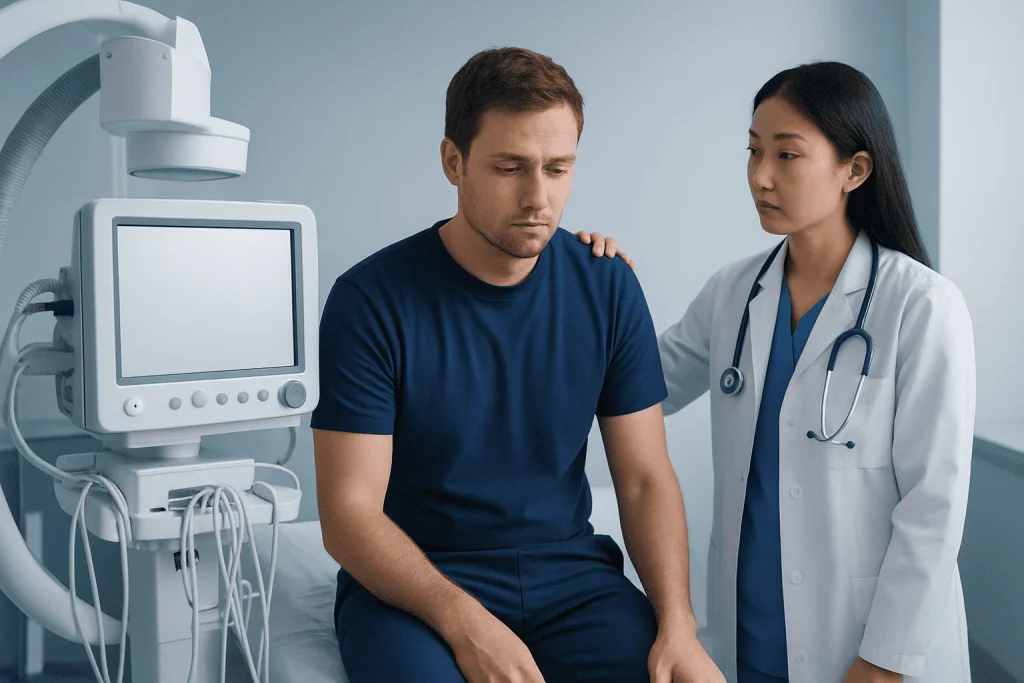
The most common sign of synovial sarcoma is a lump or swelling, often near a knee, ankle, foot, hand, arm, or other large joint area. The lump may feel firm and may or may not be painful. Some people notice that it has been present for months or even years before it is evaluated.
Symptoms depend on where the tumor is located. If it presses on nearby nerves, muscles, or blood vessels, it can cause discomfort, numbness, tingling, weakness, or reduced movement. In tighter spaces, even a relatively small tumor may lead to pain or a feeling of pressure.
Possible symptoms include:
- A new lump or swelling in an arm, leg, hand, foot, or other soft tissue area
- A lump that is growing, feels deep, or returns after removal
- Pain, tenderness, or aching near the mass
- Limited movement in a nearby joint or limb
- Numbness or tingling if a nerve is compressed
- Less commonly, cough or shortness of breath if the disease has spread to the lungs
These symptoms do not always mean cancer. Many benign cysts, lipomas, and sports-related injuries can cause similar complaints. Still, a lump that is enlarging, deep, or persistent should be assessed by a qualified doctor.
Causes, genetics, and risk factors

The exact cause of synovial sarcoma is not fully understood. It is not known to be caused by routine activities, exercise, or a typical injury, although some people first notice the tumor after a minor trauma draws attention to the area. In most cases, there is no clear lifestyle-related trigger.
A key feature of synovial sarcoma is a specific genetic change inside the tumor cells. Most tumors carry a chromosomal translocation involving the SS18 gene and an SSX gene. This is a somatic change, meaning it develops in the cancer cells themselves and is generally not inherited from a parent or passed on to children.
Known risk factors are limited, but clinicians consider the following when assessing a suspicious soft tissue mass:
- Younger age compared with many other adult cancers
- A tumor arising deep in soft tissue near a joint, tendon, or muscle
- A persistent or enlarging mass, especially one larger than about 5 centimeters
- A personal history of prior radiation exposure, which can increase the risk of some sarcomas overall, though this is not specific to synovial sarcoma
Because synovial sarcoma is rare, most people with a lump will not have it. Even so, any mass that continues to grow, causes pain, or feels fixed in place should be examined rather than watched indefinitely.
How synovial sarcoma is diagnosed
Diagnosis usually begins with a medical history and physical examination, followed by imaging. Doctors often use magnetic resonance imaging to look closely at a soft tissue mass and understand its size, depth, and relationship to nearby muscles, nerves, blood vessels, and joints. Depending on the location, an ultrasound, X-ray, or MRI scan may be part of the evaluation.
Imaging can suggest that a tumor may be a sarcoma, but it cannot confirm the exact type. A biopsy is needed to make the diagnosis. In many cases, this is done with a core needle biopsy, which removes small samples of tissue for laboratory testing. The biopsy should ideally be planned by a team experienced in sarcoma care so that any future surgery can be performed safely and effectively.
Pathologists examine the tissue under a microscope and may use immunohistochemistry and molecular tests to identify the characteristic genetic change associated with synovial sarcoma. Once the diagnosis is confirmed, doctors may order staging tests such as chest imaging because the lungs are a common site of spread. Some patients may also need PET-CT or additional scans to assess the full extent of disease.
Because this is a rare cancer, treatment planning is often best done by a multidisciplinary team that may include orthopedic oncology surgeons, medical oncologists, radiation oncologists, radiologists, and pathologists. This team approach helps ensure that the diagnosis is accurate and that treatment is coordinated from the start.
Treatment options and what care may involve
Surgery is usually the main treatment for localized synovial sarcoma. The goal is to remove the tumor completely with a margin of healthy tissue around it while preserving as much limb function as possible. Advances in sarcoma surgery mean that many people can avoid amputation, though the exact approach depends on the tumor’s size, location, and involvement of nearby structures. In some cases, treatment may include orthopedic oncology surgery performed by specialists experienced in limb-sparing procedures.
Radiation therapy is often used either before or after surgery. Before surgery, it may help shrink the tumor and make removal easier. After surgery, it may lower the risk of the cancer coming back in the same area. The timing is individualized based on wound healing considerations, tumor location, and the expected benefit.
Chemotherapy may be recommended for some patients, especially if the tumor is large, high grade, difficult to remove, or has spread. Synovial sarcoma can be more responsive to chemotherapy than some other soft tissue sarcomas, but not everyone needs it. When the disease is advanced or metastatic, treatment may also include systemic therapies aimed at controlling growth, relieving symptoms, and maintaining quality of life.
Supportive care is also important throughout treatment. Physical therapy, pain management, rehabilitation, and emotional support can help patients recover function and cope with treatment demands. If lung spread is suspected or confirmed, care may include further imaging, systemic therapy, and selected procedures depending on the individual case.
Recovery, follow-up, and living with synovial sarcoma
Recovery after treatment depends on the location of the tumor, the type of surgery performed, and whether radiation or chemotherapy was used. Some people return to normal activity gradually, while others need longer-term rehabilitation to improve strength, mobility, and daily function. Scarring, stiffness, fatigue, and emotional stress are all common parts of recovery and deserve attention.
Follow-up care is an essential part of synovial sarcoma management because this cancer can recur locally or spread after initial treatment. Doctors usually recommend regular physical examinations and imaging over several years. Chest imaging is commonly included because the lungs are a frequent site of recurrence or metastasis.
Many patients find it helpful to keep a record of pathology results, imaging reports, treatments received, and follow-up schedules. This can make future consultations easier, especially if care involves several specialists. Questions about fertility, work, exercise, and travel are also appropriate to discuss during recovery planning.
For international patients seeking coordinated cancer care, Acibadem International’s multidisciplinary specialists and JCI-accredited hospitals diagnose and treat complex sarcomas using individualized treatment plans. When helpful, patients may also be referred for broader cancer treatment and rehabilitation support as part of ongoing care.
Can synovial sarcoma be prevented?
There is no known way to prevent synovial sarcoma in most cases. It is not linked to a specific diet, exercise habit, or everyday environmental exposure that people can reliably avoid. Because the genetic change involved usually develops only in the tumor cells, routine screening of healthy family members is not generally recommended.
The most practical form of self-care is early attention to warning signs. A new lump that persists, grows, feels deep, or becomes painful should not be ignored. This is especially true if it measures more than a few centimeters or interferes with movement.
General healthy habits still matter during and after treatment. Good nutrition, physical activity within medical guidance, smoking avoidance, and keeping follow-up appointments can support recovery and overall well-being. However, these measures do not replace specialist evaluation of a suspicious mass.
When to seek medical care
Medical care should be sought for any soft tissue lump that is growing, deep, firm, painful, or present for more than a few weeks without a clear explanation. This does not mean the lump is cancer, but it is a reason for proper assessment. Early evaluation helps clarify whether the mass is benign or needs further testing.
Prompt review is also important if a previously treated lump returns, if there is worsening pain near a mass, or if numbness, weakness, or reduced movement develops in the nearby limb. People with a known diagnosis of synovial sarcoma should contact their care team about new respiratory symptoms such as persistent cough, chest pain, or shortness of breath, as these may require imaging.
Whenever possible, suspected sarcomas should be assessed in a center familiar with rare soft tissue tumors. Specialist input can help with biopsy planning, staging, and treatment decisions from the outset.
Frequently asked questions
Is synovial sarcoma a bone cancer or a joint cancer?
Synovial sarcoma is not usually a bone cancer, and it does not typically start from the joint lining despite its name. It is a soft tissue sarcoma that often develops near joints, tendons, or muscles.
What are the first signs of synovial sarcoma?
The first sign is often a slowly growing lump, commonly in an arm or leg near a joint. Some people also notice pain, swelling, stiffness, or numbness if the mass presses on nearby structures.
How is synovial sarcoma confirmed?
Doctors usually begin with imaging such as MRI, but a biopsy is needed to confirm the diagnosis. The tissue sample is examined under a microscope and may undergo molecular testing to identify the characteristic genetic change.
Can synovial sarcoma be cured?
Some cases can be treated successfully, especially when the tumor is found before it has spread and can be removed completely. The outlook varies based on tumor size, grade, location, response to treatment, and whether metastasis is present.
Does synovial sarcoma spread quickly?
Growth behavior varies from person to person. Some tumors enlarge slowly at first, but synovial sarcoma can still be serious because it has the potential to spread, especially to the lungs, which is why timely diagnosis and follow-up are important.
Will everyone with synovial sarcoma need chemotherapy?
No. Surgery is usually the main treatment for localized disease, and radiation is also commonly used. Chemotherapy is considered in selected situations, such as larger tumors, higher-risk disease, or cancer that has spread.
References
- National Cancer Institute
- American Cancer Society
- National Comprehensive Cancer Network
- World Health Organization
- European Society for Medical Oncology
This article is for general information only and is not a substitute for professional medical advice. Please consult a qualified doctor about your individual situation.
Joint and spine care in Turkey — expert assessment & treatment
JCI-accredited · board-certified surgeons · reply within 24h
Add us as a Preferred Source to see more of our trusted health content across Google Search, AI Overviews and Discover.