How to Identify a Wart? Causes, Explanations, and Next Steps

A wart is often a small, rough skin growth that disrupts normal skin lines. Tiny black dots, a firm texture, and tenderness with pressure can help distinguish some warts from calluses or other bumps.
Key Takeaways
- A wart is often a small, rough skin growth that disrupts normal skin lines.
- Tiny black dots, a firm texture, and tenderness with pressure can help distinguish some warts from calluses or other bumps.
- Most warts are not dangerous, but pain, bleeding, rapid change, unusual color, or uncertain diagnosis should prompt medical review.
- Doctors usually diagnose warts by skin examination and only occasionally need additional testing or biopsy.
- Treatment depends on the wart type, location, symptoms, and whether it is improving on its own.
Most warts are harmless, common skin growths caused by human papillomavirus (HPV). To identify a wart, people usually look for a small, well-defined bump with a rough or grainy surface, broken skin lines, and sometimes tiny dark dots, while staying alert for warning signs that should be checked by a doctor.
Overview: how to identify a wart
For many people, a wart is a harmless and very common skin growth. In simple terms, understanding how to identify a wart starts with its appearance: it is usually a small, clearly outlined bump that feels rough, interrupts the normal lines of the skin, and may contain tiny dark pinpoints. Even so, skin changes that are painful, bleeding, changing quickly, or difficult to recognize deserve medical attention.
Warts develop when certain types of human papillomavirus infect the outer layer of the skin. They can appear on the hands, feet, face, around the nails, or the genital area, and their look varies by location. This is why identifying a wart is not only about spotting a raised bump, but also about noticing where it is, how it feels, and whether it has features that suggest another condition.
A practical way to think about recognition is reassurance first, red flags second, and diagnosis third. Most suspected warts can be assessed safely by looking at the lesion, comparing it with surrounding skin, and watching for signs that point away from a simple wart. If there is any doubt, a dermatologist or qualified doctor can examine the area and confirm the diagnosis.
What a wart usually looks and feels like

Many common warts are flesh-colored, white, tan, gray, or slightly darker than the surrounding skin. They often have a rough, grainy, or cauliflower-like surface. Unlike normal skin, the natural lines across the skin may stop or bend around the lesion rather than continuing through it.
Some warts have tiny black dots inside them. These are not dirt; they are small clotted blood vessels and can be a useful clue. A wart may also feel firmer than nearby skin. Depending on its location, it can be painless or mildly tender, especially if it is on an area exposed to pressure or friction.
Different types of warts can look different:
- Common warts: often rough, raised bumps on fingers, hands, knees, or elbows.
- Plantar warts: found on the soles of the feet and may grow inward because of pressure from walking.
- Flat warts: smoother, flatter, and smaller, often appearing in groups.
- Filiform warts: narrow, thread-like projections, often on the face.
- Periungual warts: rough growths around fingernails or toenails.
People often search online for wart images, but photos cannot replace an in-person evaluation when the diagnosis is uncertain. Lighting, skin tone, and lesion location can all change how a wart appears in pictures.
How to tell a wart from a callus, corn, mole, or skin tag
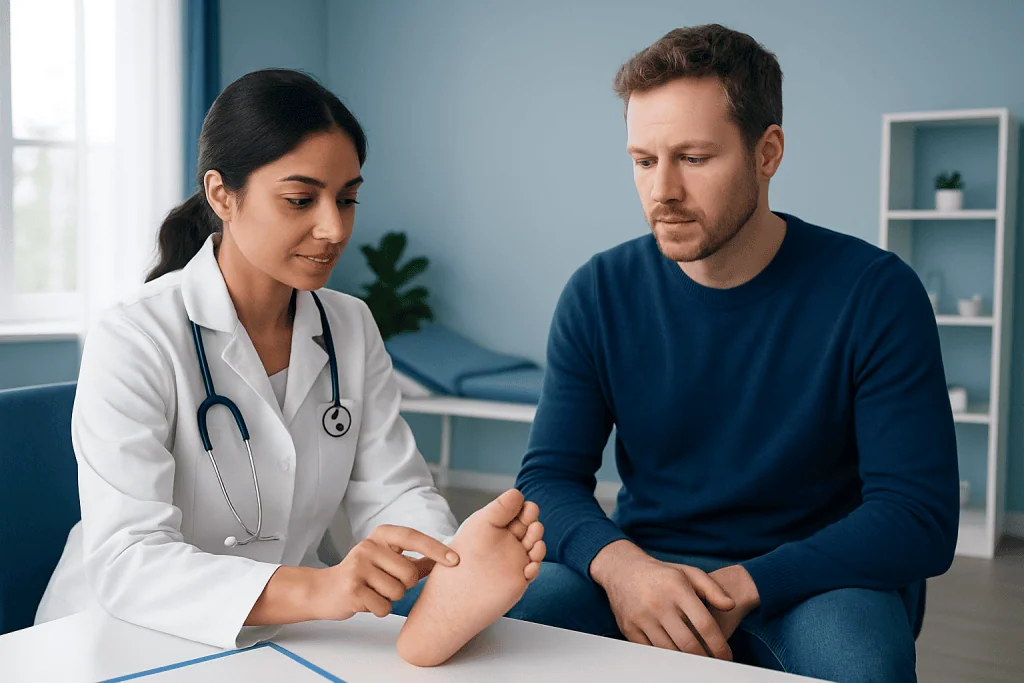
One of the most useful parts of learning how to identify a wart is knowing what it can be confused with. Calluses and corns are common look-alikes, especially on the feet. A callus usually forms where there is repeated friction or pressure, tends to feel more evenly thickened, and often allows skin lines to continue across it. A wart more often interrupts those lines and may show tiny dark dots.
Plantar warts can be especially confusing because they may be pushed inward by body weight. A person may notice pain when pinching the sides of the lesion or walking on it, while a corn may hurt more with direct downward pressure. This is not a perfect rule, but it can offer a clue.
Moles are usually pigmented rather than rough and grainy, although they vary widely. Skin tags are soft, flexible, and often attached by a small stalk, whereas warts are firmer and more fixed to the skin surface. Other lesions, including benign growths and some skin cancers, can also resemble warts, especially if they crust, bleed, or change shape.
If a growth is new, unusual in color, irregular at the edges, or simply does not look typical, it should not be assumed to be a wart. In those situations, professional evaluation is the safest next step.
Causes and risk factors
Warts are caused by infection with certain strains of human papillomavirus. The virus enters through tiny breaks in the skin. It can spread by direct skin contact or, less commonly, by touching contaminated surfaces such as floors in shared changing areas. Not everyone exposed to HPV develops a visible wart, because the skin barrier and immune response differ from person to person.
Several factors can make warts more likely. These include frequent skin trauma such as nail biting, shaving nicks, or picking at the skin; walking barefoot in communal wet areas; and having close skin contact with someone who has warts. Children and teenagers often develop warts more easily, but adults can get them too.
People with eczema, weakened immunity, or chronic skin irritation may be more susceptible. Moisture and friction can also help the virus enter the skin. Once a wart develops, touching or scratching it may spread the virus to nearby areas.
Although common skin warts are caused by HPV, they are different from genital warts and should not be treated as the same issue. The body area, wart appearance, and likely HPV type vary. A doctor can help if there is any uncertainty about the kind of lesion present.
When to seek medical care
Most warts can be monitored initially, especially if they are small, not painful, and clearly look typical. However, certain features should lead to medical review. These include bleeding without injury, rapid growth, persistent pain, pus, marked redness, color change, irregular borders, or a lesion that repeatedly cracks open.
Medical assessment is also important when a suspected wart is on the face, genitals, around the nails, or on a foot in someone with diabetes, poor circulation, or reduced sensation. People with weakened immune systems should also seek earlier advice. If there is any chance the lesion is not a wart, it is safer to have it checked before trying treatment at home.
A good general rule is to see a doctor if the bump does not improve, keeps returning, spreads quickly, or interferes with walking, hand use, shaving, or daily comfort. This kind of evaluation can also help rule out other skin conditions, including skin cancer, when a lesion has warning signs.
How doctors diagnose a wart
Doctors most often diagnose a wart by examining the skin. They look at the size, shape, surface texture, location, and border of the growth, and they compare it with surrounding skin. Sometimes they gently pare away a small amount of thickened skin to look for the tiny pinpoint blood vessels that support the diagnosis.
In some cases, a clinician may use a dermatoscope, a handheld magnifying device with light, to see surface details more clearly. This can help separate a wart from a callus, seborrheic keratosis, molluscum contagiosum, or pigmented lesions. If the growth is atypical, dark, ulcerated, or not responding as expected, a biopsy may be recommended.
Biopsy means removing a small tissue sample so it can be examined under a microscope. This is not needed for most ordinary warts, but it is a useful step when the diagnosis is uncertain. It allows the doctor to rule out other skin conditions rather than continuing treatment for a lesion that may not be a wart.
If treatment is needed, a dermatologist may discuss options such as topical medicines, freezing, or minor office procedures. In selected cases, patients may be evaluated through services related to dermatology care to confirm the diagnosis and plan treatment.
Treatment options and what not to do
Many warts go away on their own over time, so treatment is not always urgent. If a wart is bothersome, spreading, or painful, common treatment options include topical salicylic acid, cryotherapy using liquid nitrogen, and other office-based procedures. The best choice depends on the wart type, location, age of the patient, skin sensitivity, and whether previous treatment has failed.
Some warts around the nails or on the soles may be stubborn and need repeated treatment. Doctors may also consider prescription topicals, curettage, electrosurgery, laser-based approaches, or other targeted therapies in selected cases. If the lesion is thick, recurrent, or in a difficult area, a doctor may discuss options that overlap with skin lesion removal.
It is important not to cut, burn, or pick at a suspected wart. Home methods that damage the skin can lead to pain, infection, scarring, and delayed diagnosis of another condition. Over-the-counter remedies should not be used on the face, genitals, or uncertain lesions unless a healthcare professional advises it.
If a skin growth turns out not to be a wart, treatment may be completely different. For example, a changing pigmented lesion may need assessment through specialist skin evaluation rather than wart remedies. Accurate identification protects both the skin and the person from unnecessary treatment.
Prevention, self-care, and next steps
Preventing warts focuses on protecting the skin and reducing spread. People can lower risk by not sharing nail clippers, razors, socks, or shoes; wearing sandals in communal wet areas; and keeping cuts or scrapes clean and covered. Avoiding picking, biting, or shaving over a wart can also reduce spread to other areas.
At home, it helps to keep the area clean and dry and to avoid friction when possible. If an over-the-counter treatment is being used, it should be applied exactly as directed and stopped if there is significant irritation or uncertainty about the diagnosis. Any lesion that worsens despite care should be re-evaluated.
For international patients who need expert assessment, Acibadem International offers diagnosis and treatment through multidisciplinary specialists at JCI-accredited hospitals. This can be helpful when a persistent skin growth needs confirmation, especially if it may overlap with other dermatologic conditions.
The key next step is not to panic. Most warts are manageable and often harmless, but a careful look at the lesion’s surface, skin lines, color, location, and behavior can guide whether simple observation is reasonable or whether a doctor should examine it soon.
Frequently asked questions
What is the easiest way to identify a wart at home?
A wart often looks like a small, well-defined bump with a rough or grainy surface. It may interrupt normal skin lines and sometimes contains tiny black dots. If the growth is bleeding, changing quickly, or does not look typical, it should be checked by a doctor.
How can someone tell a plantar wart from a callus?
A plantar wart often breaks up the normal skin lines and may show tiny dark pinpoints, while a callus usually has more uniform thickening with skin lines continuing across it. Plantar warts can also feel tender because they are pressed inward by walking. Since these differences are not always obvious, medical review can help confirm the diagnosis.
Are warts dangerous?
Most common skin warts are harmless and are not a sign of serious illness. However, a skin lesion should not be assumed to be a wart if it is painful, rapidly growing, unusually colored, bleeding, or irregular in shape. Those features need professional assessment.
Do all warts have black dots?
No, not all warts show black dots. These dots represent tiny clotted blood vessels and can be easier to see in some warts than others. A wart can still be present even if those dots are not visible.
Should a person treat a wart at home or wait?
If a wart looks typical, is small, and is not causing trouble, watchful waiting is sometimes reasonable because many warts eventually clear. Home treatment may be appropriate for some hand or foot warts, but not for uncertain lesions or those on sensitive areas such as the face or genitals. A doctor should guide treatment if there is any doubt.
When should someone see a doctor for a suspected wart?
A doctor should be seen if the lesion is painful, bleeding, infected, changing in appearance, recurring often, or making walking or hand use difficult. Medical review is also important for lesions on the face, genitals, or around the nails, and for people with diabetes or weakened immunity. Early assessment helps confirm whether it is truly a wart.
References
- American Academy of Dermatology
- National Health Service
- Mayo Clinic
- Merck Manual Consumer Version
This article is for general information only and is not a substitute for professional medical advice. Please consult a qualified doctor about your individual situation.
Explore treatments in Turkey — costs, top hospitals & a free quote
JCI-accredited · board-certified surgeons · reply within 24h
Add us as a Preferred Source to see more of our trusted health content across Google Search, AI Overviews and Discover.