

Quadriceps Muscles: What Patients Need to Know

The quadriceps muscles are a group of four muscles on the front of the thigh. They are essential for knee extension, hip support, walking, balance, and rising from a chair.
Key Takeaways
- The quadriceps muscles are a group of four muscles on the front of the thigh.
- They are essential for knee extension, hip support, walking, balance, and rising from a chair.
- Common problems include strains, tendon irritation, weakness, and tightness.
- Pain, swelling, bruising, or difficulty bearing weight may need medical assessment.
- Treatment often includes rest, guided exercise, physical therapy, and gradual return to activity.
- Strength, flexibility, warm-up, and proper training habits can help prevent injury.
Quadriceps muscles are the four large muscles at the front of the thigh that help straighten the knee and support walking, standing, climbing stairs, and many daily movements. When they are weak, tight, or injured, they can contribute to thigh pain, knee problems, and reduced mobility, but most issues improve with proper evaluation, exercise, and activity changes.
Overview: what the quadriceps muscles do
The quadriceps muscles are the four muscles at the front of the thigh: rectus femoris, vastus lateralis, vastus medialis, and vastus intermedius. Together, they mainly straighten the knee, a movement called knee extension. They also help control the knee when a person walks, sits down, stands up, climbs stairs, runs, or lands from a jump.
These muscles work closely with the hip, knee, hamstrings, gluteal muscles, and tendons. Because they are involved in so many everyday activities, even mild weakness or tightness in the quadriceps can affect comfort and movement. People may notice pain at the front of the thigh, around the kneecap, or above the knee when the quadriceps are overused or injured.
Patients often hear about the quadriceps only after a sports injury, but these muscles matter just as much in daily life and healthy aging. Strong, balanced quadriceps support posture, reduce strain on the knee joint, and help lower the risk of falls. This makes them important not only for athletes, but also for office workers, older adults, and anyone recovering from a leg or knee problem.
Anatomy and how these muscles work together
Although they act as a group, each of the quadriceps muscles has a slightly different role. The rectus femoris crosses both the hip and knee, so it helps with both hip flexion and knee extension. The three vastus muscles mainly act on the knee and provide much of the power needed to straighten the leg.
At the lower end of the thigh, the quadriceps connect to the quadriceps tendon, which attaches to the kneecap. From there, force is transferred through the patellar tendon to the shinbone. This chain allows the thigh muscles to move and stabilize the knee. When any part of this system is irritated or injured, symptoms may be felt in the thigh, around the kneecap, or just below it.
The quadriceps also act as shock absorbers. During walking downhill, sitting into a chair, or descending stairs, they lengthen under tension to control movement. This is one reason why weakness or overload can contribute to knee discomfort, including problems such as knee pain or tendon irritation after a sudden increase in training.
Common symptoms and signs of quadriceps problems
Quadriceps symptoms vary depending on the cause. A mild strain may feel like soreness, tightness, or tenderness in the front of the thigh. A more significant injury can cause sudden pain, swelling, bruising, weakness, or trouble walking. Some people describe a pulling sensation during sprinting, kicking, or jumping.
Problems related to the quadriceps tendon or muscle imbalance may cause pain above the kneecap or discomfort when using stairs, squatting, or getting up from a chair. Weak quadriceps can also make the knee feel less stable, especially during downhill walking or after prolonged sitting.
Symptoms that deserve attention include:
- Sharp or persistent front-thigh pain
- Swelling, bruising, or a visible deformity
- Difficulty straightening the knee
- Weakness when standing or climbing stairs
- Pain that does not improve with rest
- A popping sensation at the time of injury
Not all thigh pain comes from the quadriceps. Hip conditions, nerve irritation, circulation problems, or referred pain from the lower back can sometimes feel similar. That is why the pattern of pain, the exact location, and the movement that triggers symptoms all matter in assessment.
Causes, injuries, and risk factors
Quadriceps problems often develop from overload, sudden force, or poor movement mechanics. A quadriceps strain may happen during sprinting, kicking, jumping, or abrupt direction changes. It is more likely if the muscle is fatigued, tight, or asked to do more work than it is prepared for. Overuse can also irritate the quadriceps tendon, especially in sports that involve repeated jumping or heavy leg work.
Not every issue is a tear. Some people develop weakness after inactivity, surgery, or prolonged knee pain. Others have muscle imbalance, where the quadriceps, hamstrings, glutes, and core are not working together efficiently. This can place extra stress on the knee and thigh. Conditions affecting the knee joint, including meniscus tear, may also change how a person moves and secondarily strain the quadriceps.
Risk factors include:
- Sudden increase in exercise intensity or duration
- Inadequate warm-up before activity
- Previous thigh or knee injury
- Muscle tightness or poor flexibility
- Weak hip, gluteal, or core muscles
- Poor running, jumping, or lifting mechanics
- Aging-related muscle loss or reduced conditioning
In some cases, severe trauma can lead to a quadriceps tendon rupture, especially in older adults or people with chronic tendon degeneration. This is less common than simple strains, but it is important because it can impair the ability to actively straighten the knee and usually needs specialist care.
How doctors diagnose quadriceps muscle problems
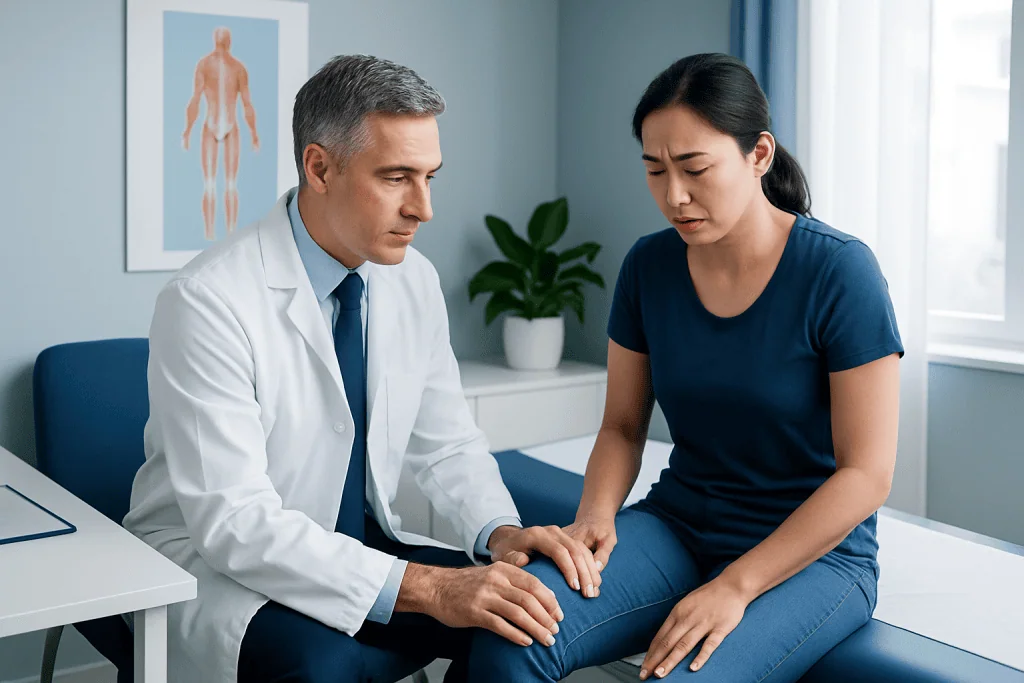
Diagnosis begins with a careful history and physical examination. A doctor will ask when the symptoms started, whether there was a specific injury, what movements provoke pain, and whether swelling, bruising, weakness, or loss of function is present. The examination usually includes checking tenderness, range of motion, strength, walking pattern, and the ability to straighten the knee.
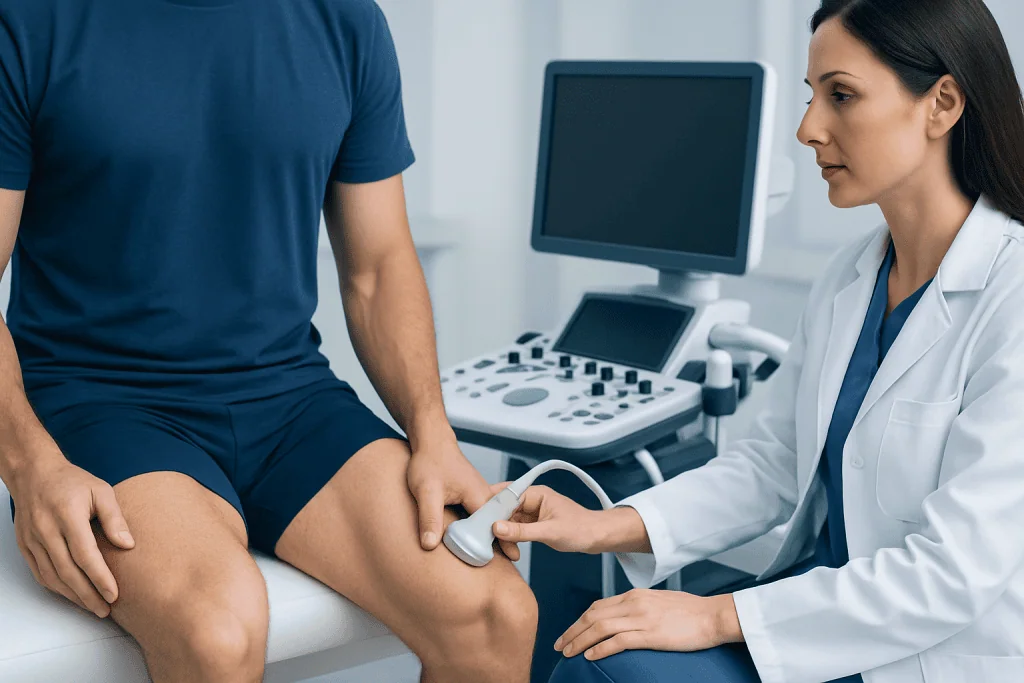
Many mild quadriceps strains can be diagnosed clinically. However, imaging may be helpful when symptoms are severe, persistent, or unclear. Ultrasound can show muscle and tendon injuries, while MRI may be used when a tear, significant tendon damage, or another soft-tissue problem is suspected. X-rays do not show the muscle itself well, but they may help assess the bones and kneecap if trauma or another knee condition is a concern.
Sometimes the main issue is not the quadriceps muscle alone but the knee joint, tendon, or surrounding structures. In these situations, a clinician may evaluate whether the patient could benefit from a broader musculoskeletal review, imaging, or specialist support such as orthopedic assessment. An accurate diagnosis helps guide treatment and avoids returning to full activity too soon.
Treatment options and recovery
Treatment depends on the cause and severity of the problem. For many mild strains or overuse symptoms, early care focuses on relative rest, reducing aggravating activity, and gradually restoring movement. Ice may be used for comfort in the first stage after an acute injury, and some patients may be advised to use compression or temporary activity modification. A doctor may also discuss short-term pain relief options if needed.
Exercise-based rehabilitation is central to recovery. This usually includes gentle range-of-motion work followed by progressive strengthening of the quadriceps, hamstrings, gluteal muscles, and core. Stretching may be added when appropriate, but it should not be forced during the painful early phase of an acute strain. Balance and movement retraining can also be important, especially for athletes or older adults.
If tendon irritation, persistent weakness, or altered movement patterns are present, structured physical therapy and rehabilitation may help improve function and reduce the chance of recurrence. Recovery time varies. Mild problems may improve within days to weeks, while moderate strains and tendon injuries can take longer. A gradual return to sport or heavy exercise is usually safer than trying to push through pain.
Severe tears or quadriceps tendon ruptures may need surgical treatment, particularly when the patient cannot actively straighten the knee or there is major loss of function. In selected cases, doctors may recommend knee treatment or other knee-focused care if underlying joint disease is contributing to ongoing quadriceps dysfunction. At the end of the care pathway, multidisciplinary specialists at Acibadem International and its JCI-accredited hospitals also diagnose and treat muscle, tendon, and knee conditions for international patients.
Prevention, exercise habits, and self-care
Healthy quadriceps muscles are supported by regular conditioning rather than occasional intense effort. A consistent routine that includes lower-body strength work, flexibility, and gradual progression is often more protective than sudden bursts of training. Warm-up matters too. Light aerobic activity followed by movement-specific drills can prepare the muscles for running, cycling, or gym-based exercise.
Simple self-care steps can help reduce strain on the quadriceps:
- Increase training volume gradually
- Use proper form during squats, lunges, and stairs
- Balance quadriceps strengthening with hamstring and gluteal work
- Include recovery days after intense sessions
- Address footwear and training surface when relevant
- Do not ignore recurring thigh or knee pain
For people who spend long hours sitting, regular standing and mobility breaks may help reduce stiffness. Older adults may benefit from supervised strengthening to maintain independence and reduce fall risk. After an injury, following a guided plan is often safer than returning to running, football, or gym training as soon as the pain eases.
Nutrition, sleep, and overall health also influence muscle recovery. Adequate protein intake, hydration, and management of chronic conditions can support healing. Patients with repeated muscle injuries may benefit from a broader medical review to look for training errors, joint problems, or less common underlying factors.
When to seek medical care
Many mild quadriceps symptoms improve with rest and gradual activity adjustment, but some situations deserve prompt medical attention. A person should seek care if pain is severe, if there is significant swelling or bruising, or if walking becomes difficult. Inability to straighten the knee, a sudden pop during injury, or a visible gap above the kneecap can suggest a more serious tendon injury.
Medical advice is also important if symptoms persist despite home care, keep returning, or interfere with work, sleep, exercise, or daily tasks. Patients with fever, marked redness, unexplained swelling, or calf pain should not assume the problem is only muscular, as other causes may need urgent evaluation.
A doctor can help determine whether the problem is a simple strain, tendon issue, knee-related condition, or another source of leg pain. Early assessment can be especially helpful for athletes, older adults, and people recovering from surgery or chronic knee disorders, because timely treatment often supports a safer and more complete recovery.
Frequently asked questions
What are the quadriceps muscles?
The quadriceps muscles are a group of four muscles at the front of the thigh. Their main job is to straighten the knee, and they also help with walking, standing, climbing stairs, and controlling movement when sitting down or landing.
Why do the quadriceps muscles hurt?
Quadriceps pain can happen because of muscle strain, overuse, tightness, weakness, tendon irritation, or a related knee problem. Pain may begin after sports, exercise, a sudden movement, or even after a period of inactivity followed by increased activity.
How long does a quadriceps strain take to heal?
Healing time depends on how mild or severe the injury is. Minor strains may improve within days to a few weeks, while more significant tears can take longer and may need a structured rehabilitation plan.
Can weak quadriceps cause knee pain?
Yes. Weak quadriceps can change how the knee tracks and absorbs force, which may increase stress around the kneecap and joint. Strengthening the thigh along with the hips and core often helps support better knee function.
Should a person stretch a painful quadriceps muscle?
Gentle stretching may help in some cases, but it is usually best to avoid forceful stretching right after an acute injury. If pain is significant or worsens with stretching, medical or physical therapy advice is a safer option.
When is quadriceps pain serious?
Quadriceps pain may be more serious if it follows a sudden injury and is accompanied by swelling, bruising, a popping sensation, marked weakness, or inability to straighten the knee. Persistent or unexplained thigh pain also deserves medical assessment.
This article is for general information only and is not a substitute for professional medical advice. Please consult a qualified doctor about your individual situation.
Joint and spine care in Turkey — expert assessment & treatment
JCI-accredited · board-certified surgeons · reply within 24h
Add us as a Preferred Source to see more of our trusted health content across Google Search, AI Overviews and Discover.

More from the Health Library

Black Loose Motion: What Patients Need to Know

Baby Hairs — Explained by Medical Evidence, Not Myths

The Tragus in the Ear: Structure and Function

Kiefer food: A Complete Medical Guide for Patients

Reading and Sleep: An Evidence-Based Guide for Patients

Buspar: An Evidence-Based Guide for Patients
Orthopedic Surgery & Traumatology Specialists at Acibadem

Dr. Alp Er Tunga Bölükbaşı
Orthopedic Surgery & Traumatology
Dr. Alper Gölpınar
Orthopedic Surgery & Traumatology
Prof. Dr. Alper Kaya
Orthopedic Surgery & Traumatology
Fzt. Alperen Mustafa Oğuz
Physical Medicine & Rehabilitation