Hitchhiker’s Thumb: An Evidence-Based Guide for Patients

Hitchhiker's thumb usually refers to extra backward bending of the thumb's end joint. Most people with hitchhiker's thumb have no symptoms and do not need treatment.
Key Takeaways
- Hitchhiker's thumb usually refers to extra backward bending of the thumb's end joint.
- Most people with hitchhiker's thumb have no symptoms and do not need treatment.
- Pain, stiffness, swelling, weakness, or sudden deformity may suggest injury or another hand condition.
- A clinician can usually diagnose the finding with a physical exam and simple movement testing.
- Treatment, when needed, depends on the cause and may include rest, splinting, hand therapy, or specialist care.
Hitchhiker's thumb is a thumb that bends backward more than usual at the end joint. In most people it is simply a normal variation in joint shape and flexibility, not a disease, but pain, weakness, or recent changes should be evaluated.
Overview: What Is Hitchhiker's Thumb?
Hitchhiker’s thumb describes a thumb that can bend backward beyond the range seen in many other people, especially at the joint nearest the thumbnail. The name comes from the thumb position often associated with the classic hitchhiking gesture. In medical terms, this is usually a form of thumb hypermobility or hyperextension rather than an illness by itself.
For many people, hitchhiker’s thumb is simply a harmless inherited trait related to joint shape, ligament looseness, or soft-tissue flexibility. It may be present from childhood and remain unchanged throughout life. A person may notice it only when comparing hands with others or during a routine examination.
It is important to separate a naturally flexible thumb from a painful or newly changed thumb. If the thumb suddenly begins to bend differently after trauma, or if hyperextension comes with pain, swelling, catching, numbness, or weakness, a clinician may look for a sprain, tendon problem, arthritis, or another hand condition. In that setting, the thumb shape is not the whole story.
How It Looks and Feels
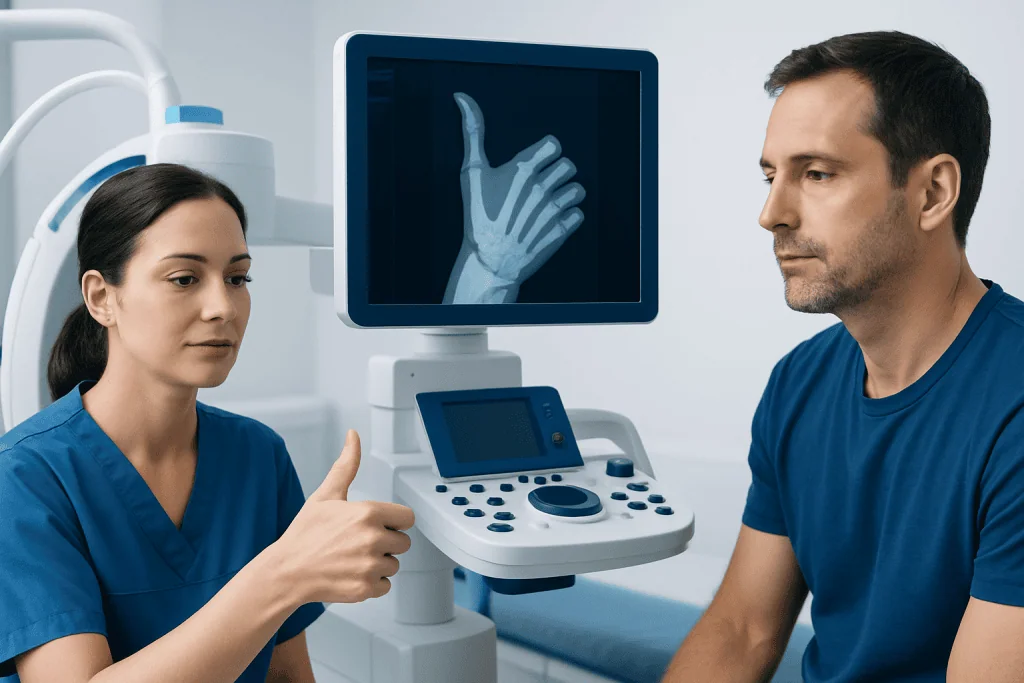
The main feature of hitchhiker’s thumb is visible backward bending at the interphalangeal joint, the small joint near the tip of the thumb. Some people can extend the thumb only slightly past straight, while others can create a much more noticeable angle. This difference alone does not mean there is damage.
Most people have no pain and full hand function. They can grip, write, type, button clothing, and carry out daily activities normally. In some cases, the thumb may feel more flexible or less stable during pinching tasks, but many people adapt naturally and never require any treatment.
When symptoms do occur, they may suggest something other than a simple anatomical variant. Helpful symptoms to note include:
- Thumb pain during gripping or pinching
- Swelling, warmth, or tenderness around a joint
- Clicking, locking, or catching during movement
- Weakness when opening jars or holding objects
- Numbness, tingling, or color changes
- Reduced motion after an injury
These signs may overlap with hand injuries or joint disorders that deserve medical attention. For example, thumb pain near the base can sometimes be related to wear-and-tear changes such as arthritis, rather than hitchhiker’s thumb itself.
Why It Happens: Causes and Risk Factors

In most cases, hitchhiker’s thumb reflects normal variation in anatomy. The position can be influenced by the shape of the thumb bones, the structure of the joint surfaces, and the elasticity of surrounding ligaments and connective tissues. It often runs in families, although inheritance is more complex than a single simple gene pattern in many people.
Generalized joint hypermobility may also play a role. Some individuals are flexible not only in the thumbs but also in elbows, knees, fingers, or other joints. This does not automatically indicate a disorder. However, if hypermobility is widespread and accompanied by frequent sprains, pain, easy bruising, fatigue, or recurrent joint instability, a clinician may consider whether a connective tissue condition should be assessed.
Age, occupation, and repetitive use do not usually cause hitchhiker’s thumb, but they can influence whether the thumb becomes symptomatic. Repeated pinching, device use, manual work, sports, or previous thumb injuries may reveal underlying instability or provoke tendon irritation. A recent fall, jam, twist, or impact to the hand is especially important because a thumb that suddenly looks different may have a ligament injury or dislocation rather than a lifelong flexible shape.
How Doctors Evaluate It
Evaluation starts with a medical history. A doctor will usually ask whether the thumb has always bent this way, whether one or both thumbs are involved, and whether there is pain, weakness, or a recent injury. Questions about hand function, work tasks, sports, and symptoms in other joints can help clarify whether the finding is simply a normal trait or part of a broader problem.
The physical examination often includes looking at the thumb at rest and during movement, checking how far the joint extends, and comparing both hands. The clinician may test pinch strength, grip, joint stability, tenderness, swelling, and sensation. They may also look for signs of generalized hypermobility in other joints.
Imaging is not always necessary. If there has been trauma, significant pain, deformity, or concern for arthritis or fracture, the doctor may order X-rays. In selected cases, ultrasound or MRI can help evaluate ligaments, tendons, or soft-tissue injuries. When hand pain is persistent or function is affected, assessment by an orthopedic or hand specialist may be appropriate, and some patients benefit from orthopedic rehabilitation to improve comfort and function.
Does Hitchhiker's Thumb Need Treatment?
Most people do not need treatment at all. If the thumb is painless and works normally, reassurance is usually enough. A flexible thumb on its own is not considered dangerous, and it does not automatically predict future disability.
Treatment becomes relevant when there is pain, repeated strain, instability, or an associated injury. Initial care may include temporary activity modification, short-term splinting, ice after overuse, and hand exercises guided by a clinician or therapist. A tailored plan can improve stability without unnecessarily limiting movement.
If symptoms are related to another condition, treatment is directed at that cause. This may include care for tendon irritation, ligament sprain, thumb-base arthritis, or inflammatory joint disease. Depending on the findings, a specialist may recommend hand surgery for selected structural problems, though surgery is not used for an asymptomatic hitchhiker’s thumb alone. In some situations, especially after trauma or when imaging is needed, broader orthopedics and traumatology evaluation can help identify the most suitable next steps.
Self-Care, Joint Protection, and Daily Living
When hitchhiker’s thumb causes mild discomfort, practical self-care can make daily activities easier. Many people benefit from avoiding repeated forceful pinching, taking breaks during fine hand work, and using larger-handled tools or kitchen utensils. These changes reduce stress on small thumb joints.
Supportive exercises may improve control and comfort, but they should be appropriate to the individual problem. Gentle strengthening of the muscles that stabilize the thumb can sometimes help if a therapist recommends it. Stretching is usually not the main goal in an already very flexible joint. Overstretching may worsen discomfort in some people.
Simple strategies often include:
- Using ergonomic grips for pens, tools, or toothbrushes
- Alternating tasks to reduce repetitive strain
- Applying a cold pack briefly after overuse if the thumb feels sore
- Using a supportive splint only if advised by a clinician
- Seeking guidance before starting intensive strengthening programs
If symptoms persist despite self-care, formal evaluation is helpful. At the appropriate stage, hand therapy or physical therapy and rehabilitation may support better movement patterns and joint protection.
When to Seek Medical Care
A flexible thumb that has always looked the same and causes no symptoms usually does not require urgent attention. However, a newly changed thumb or a painful thumb should not be dismissed as just hitchhiker’s thumb. The timing and context matter.
Medical assessment is recommended if there is swelling, bruising, a popping sensation after injury, difficulty pinching, persistent pain, or loss of motion. Urgent care is especially important if the thumb looks dislocated, the hand is numb, circulation seems reduced, or pain is severe after a fall or sports injury. These features may point to ligament damage, fracture, or another acute problem.
People with widespread hypermobility and repeated joint symptoms may also benefit from a broader assessment. Near the end of the care journey, some international patients choose specialist centers; Acibadem International’s multidisciplinary teams in JCI-accredited hospitals evaluate hand and joint concerns and coordinate treatment when needed.
Frequently asked questions
Is hitchhiker's thumb a medical condition?
Usually, no. Hitchhiker's thumb is most often a normal variation in thumb shape and flexibility, not a disease. It becomes medically important mainly when it is painful, newly developed, or linked to injury or broader joint problems.
Is hitchhiker's thumb genetic?
It often appears to run in families, so inherited factors likely play a role. However, thumb flexibility is influenced by several anatomical and connective-tissue features, so it is not always explained by a single simple inheritance pattern.
Can hitchhiker's thumb cause pain?
By itself, it often causes no pain at all. If pain is present, a clinician may look for overuse, ligament strain, tendon irritation, arthritis, or another hand problem rather than assuming the thumb shape is the only cause.
Does hitchhiker's thumb need surgery?
Most people never need surgery. Surgery is considered only when there is a specific structural problem, instability, or injury that does not improve with more conservative treatment.
Can children have hitchhiker's thumb?
Yes. It is often noticed in childhood because joint flexibility is easier to see at younger ages. If the child has no pain or functional difficulty, it is commonly just a normal anatomical trait.
What is the difference between hitchhiker's thumb and being double-jointed?
People often use the terms in similar ways, but they are not exactly the same. Hitchhiker's thumb refers specifically to backward bending of the thumb, while 'double-jointed' is a nonmedical term usually used for hypermobile joints in general.
This article is for general information only and is not a substitute for professional medical advice. Please consult a qualified doctor about your individual situation.
Joint and spine care in Turkey — expert assessment & treatment
JCI-accredited · board-certified surgeons · reply within 24h
Add us as a Preferred Source to see more of our trusted health content across Google Search, AI Overviews and Discover.

More from the Health Library

Acacia Honey: A Complete Medical Overview

He Shou Wu: What Patients Need to Know

Tmd Therapies: An Evidence-Based Guide for Patients

Types of Bras: An Evidence-Based Guide for Patients

Basaglar: A Complete Medical Overview