Neer Test — Explained by Medical Evidence, Not Myths

The neer test is a clinical shoulder exam used to look for signs of impingement-related pain. A positive neer test does not confirm one single diagnosis on its own.
Key Takeaways
- The neer test is a clinical shoulder exam used to look for signs of impingement-related pain.
- A positive neer test does not confirm one single diagnosis on its own.
- Doctors combine the neer test with medical history, other shoulder maneuvers, and imaging when needed.
- Pain during the test may be linked to rotator cuff irritation, bursitis, or other shoulder conditions.
- Persistent shoulder pain, weakness, injury, or loss of movement should be medically evaluated.
The neer test is a simple physical exam maneuver used to assess shoulder pain, especially when a clinician suspects irritation in the rotator cuff or surrounding tissues under the acromion. It is useful as part of a broader assessment, but medical evidence shows it is not a stand-alone diagnosis and should be interpreted alongside symptoms, movement testing, and sometimes imaging.
Overview: what the neer test is and what it means
The neer test is a physical examination maneuver used during an assessment of shoulder pain. In this test, the arm is gently raised in a specific way to see whether that movement reproduces pain. If it does, the result may suggest irritation of structures in the shoulder, often in the area where the rotator cuff tendons and bursa pass beneath the top of the shoulder blade.
Importantly, the neer test is best understood as a clue, not a final answer. A positive result does not prove a single diagnosis, and a negative result does not completely rule out shoulder disease. Modern medical practice relies on a combination of symptoms, physical examination findings, function, and imaging when appropriate.
This evidence-based view helps separate the test from common myths. The neer test is not a scan, does not show a tear directly, and cannot by itself distinguish among all causes of shoulder pain. Instead, it helps a clinician decide whether shoulder impingement-like pain is likely and what the next step in evaluation should be.
How the neer test is performed
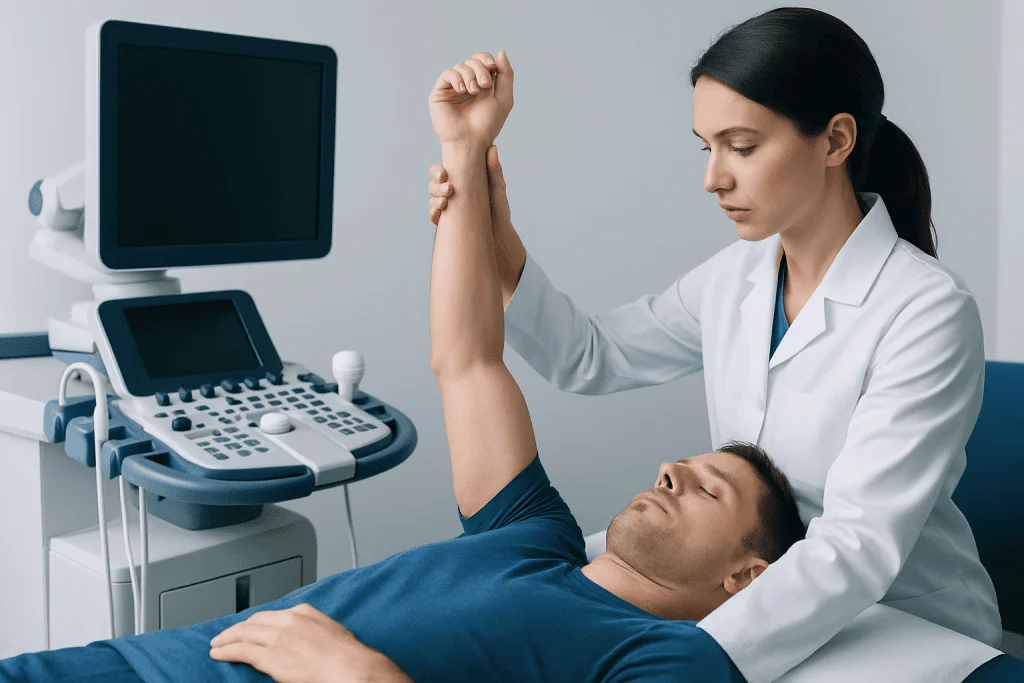
During the maneuver, the clinician stabilizes the shoulder blade and raises the patient’s straightened arm forward and upward. This motion narrows the space under the acromion, which can compress irritated tissues and reproduce symptoms. The test is usually done slowly and compared with the other shoulder.
The patient is typically asked whether the movement causes pain and where that pain is felt. Discomfort at the front or side of the shoulder may support the possibility of subacromial irritation. However, pain can also come from other sources, including the acromioclavicular joint, the biceps tendon, stiffness in the joint capsule, or pain referred from the neck.
Because many shoulder problems can overlap, clinicians rarely rely on this maneuver alone. It is often paired with other tests for strength, range of motion, stability, and tenderness. In practical terms, the neer test is one part of a structured exam rather than a yes-or-no verdict.
What a positive neer test may suggest

A positive neer test means that the shoulder movement reproduced pain in a way that raises suspicion for impingement-related pathology. This may happen when the rotator cuff tendons or the subacromial bursa are irritated as the arm is elevated. Common related diagnoses include rotator cuff tendinopathy, subacromial bursitis, and some forms of shoulder impingement syndrome.
Even so, the result is not specific to one condition. Some people with rotator cuff problems have a positive neer test, but so do some people with bursitis, stiffness, or mixed shoulder disorders. This is why clinicians interpret the finding in context, especially alongside strength testing and the person’s activity pattern.
Symptoms that often lead to this test include pain when reaching overhead, discomfort while dressing, pain at night when lying on the affected side, and reduced shoulder function. Weakness, painful arc of motion, or pain with lifting may further guide the evaluation, but they still do not replace a full clinical assessment.
Limits of the neer test: what medical evidence says
Evidence from orthopedic and sports medicine research shows that the neer test can be helpful, but it has limitations. Like many physical exam maneuvers, its accuracy varies depending on who performs it, what condition is being looked for, and what comparison standard is used. In other words, it is neither perfect at detecting disease nor perfect at excluding it.
One reason is that shoulder pain is complex. Several structures sit close together, and more than one problem may be present at the same time. A patient may have tendon irritation, mild bursitis, muscle weakness, and movement pattern changes together, making one isolated test less reliable than a full examination.
For that reason, experienced clinicians often use clusters of findings rather than a single sign. They ask about how symptoms began, whether there was trauma, what movements cause pain, whether there is weakness or clicking, and whether neck symptoms are present. This broader approach is more useful than overinterpreting a single positive neer test.
Common causes and risk factors behind shoulder pain
Shoulder pain that prompts a neer test can arise from many causes. Repetitive overhead activity is a common factor, especially in swimming, tennis, throwing sports, painting, or jobs that involve lifting overhead. Age-related tendon wear, poor shoulder mechanics, and weakness of the rotator cuff or shoulder blade muscles can also contribute.
Other possible causes include bursitis, tendon inflammation, tendon degeneration, partial or full-thickness tears, joint stiffness, osteoarthritis in nearby joints, or recovery after an injury. Sometimes the pain is not coming mainly from the shoulder at all. Neck conditions, nerve irritation, or pain referred from another area may create similar symptoms.
- Repetitive overhead work or sports
- Previous shoulder injury
- Age-related tendon changes
- Weakness or poor control of the shoulder blade muscles
- Limited shoulder mobility or joint stiffness
- Sudden increase in training or workload
Recognizing these risk factors matters because treatment is aimed at the cause, not just the test result. For example, weakness and movement dysfunction may respond best to rehabilitation, while a traumatic tear or significant structural damage may require a different plan.
How doctors confirm the diagnosis
Diagnosis starts with a medical history and physical examination. A doctor or physiotherapist asks when the pain began, whether there was trauma, where the pain is located, whether daily activities are affected, and whether there is weakness, catching, or night pain. The clinician then checks active and passive range of motion, muscle strength, tenderness, and several shoulder-specific maneuvers in addition to the neer test.
If symptoms are persistent, severe, or unclear, imaging may be recommended. X-rays can help identify bone shape, arthritis, calcifications, or other structural contributors. Ultrasound and MRI are more useful for soft tissues such as the rotator cuff tendons, bursa, and labrum, especially when a tear or significant inflammation is suspected.
When symptoms do not improve or a structural problem needs closer evaluation, further orthopedic assessment may be appropriate. In some cases, a care plan may include targeted rehabilitation or procedures depending on the underlying issue, such as shoulder arthroscopy for selected structural shoulder problems after careful evaluation.
Treatment options and self-care
Treatment depends on the underlying diagnosis, symptom severity, and how long the problem has been present. Many people improve with conservative care. This often includes temporary activity modification, avoiding painful overhead movements, guided physical therapy, and exercises that strengthen the rotator cuff and shoulder blade muscles while improving flexibility and control.
Doctors may also recommend pain-relief strategies such as rest, ice or heat, and short-term medicines when appropriate for the individual. If inflammation is prominent, some patients may be offered an injection after assessment. The main goal is not simply to reduce pain, but to restore comfortable movement and function while addressing the reason the pain developed.
If there is a significant tear, persistent weakness, recurrent symptoms despite rehabilitation, or a structural problem seen on imaging, surgery may be discussed. Depending on the diagnosis, treatment planning can overlap with care used for rotator cuff repair or physical therapy and rehabilitation. At the end of evaluation, specialists may tailor care to the person’s sport, work demands, age, and recovery goals.
For international patients needing further assessment, Acibadem International’s multidisciplinary specialists in JCI-accredited hospitals evaluate and treat shoulder conditions using individualized orthopedic and rehabilitation plans.
When to seek medical care
Medical review is advisable if shoulder pain lasts more than a few days, keeps returning, interferes with sleep, or limits daily tasks such as dressing, reaching, or lifting. A clinician should also assess pain associated with weakness, reduced range of motion, or symptoms that are not improving with simple self-care.
Urgent care is more important after a fall, sports injury, or sudden pulling event, especially if there is immediate weakness, visible deformity, severe swelling, or the inability to raise the arm. Numbness, tingling, fever, chest pain, or pain that seems to come from the neck also deserve prompt evaluation because they may suggest a different problem.
While self-care can help mild overuse-related discomfort, repeated or significant shoulder pain should not be self-diagnosed based on the neer test alone. A qualified doctor can determine whether the issue is impingement, tendon disease, bursitis, stiffness, or another condition and guide safe treatment.
Frequently asked questions
What is the neer test used for?
The neer test is used during a shoulder exam to see whether elevating the arm reproduces pain consistent with irritation in the subacromial space. It can support suspicion of impingement-related problems, but it does not diagnose a specific condition by itself.
Does a positive neer test mean a rotator cuff tear?
No. A positive neer test may occur with rotator cuff irritation, bursitis, impingement syndrome, or other shoulder problems. A tear is considered based on the full exam, symptoms, strength testing, and sometimes imaging such as ultrasound or MRI.
Can the neer test be done at home?
A person can mimic the movement, but self-testing is not very reliable and may worsen pain if done forcefully. Because shoulder pain has many causes, it is better to have the maneuver interpreted by a qualified clinician as part of a full assessment.
Is the neer test painful?
It can be uncomfortable if the shoulder tissues are irritated, because the movement narrows the space under the acromion. The test is usually brief, and clinicians perform it in a controlled way to gather information without causing unnecessary pain.
What other tests are usually done with the neer test?
Doctors often combine it with range-of-motion checks, strength tests, and other shoulder maneuvers such as Hawkins-type impingement tests or rotator cuff tests. They also examine the neck and shoulder blade movement to avoid missing another cause of pain.
When is imaging needed after a positive neer test?
Imaging may be needed if symptoms are severe, follow an injury, do not improve with conservative care, or if a tear or another structural problem is suspected. X-rays, ultrasound, or MRI may be used depending on the clinical question.
This article is for general information only and is not a substitute for professional medical advice. Please consult a qualified doctor about your individual situation.
Joint and spine care in Turkey — expert assessment & treatment
JCI-accredited · board-certified surgeons · reply within 24h
Add us as a Preferred Source to see more of our trusted health content across Google Search, AI Overviews and Discover.

More from the Health Library

Inj HCG — Explained by Medical Evidence, Not Myths

Carotene: A Complete Medical Overview

Sweat Bees — Explained by Medical Evidence, Not Myths
Muscle of the Lower Arm: An Evidence-Based Guide for Patients

Cranberry Pills: What Patients Need to Know