Skin Tags Around Eyes: What Patients Need to Know

Skin tags around eyes are typically benign and often cause no symptoms beyond irritation or cosmetic concern. Growths near the eyelid should be checked because warts, cysts, moles, and some skin cancers can look similar.
Key Takeaways
- Skin tags around eyes are typically benign and often cause no symptoms beyond irritation or cosmetic concern.
- Growths near the eyelid should be checked because warts, cysts, moles, and some skin cancers can look similar.
- Home removal is not recommended around the eyes due to the risk of bleeding, infection, scarring, and eye injury.
- Office-based treatment may include careful snip excision, cryotherapy, or cautery, depending on the lesion and its location.
- Medical review is especially important if a growth changes color, bleeds, grows quickly, affects vision, or becomes painful.
Skin tags around eyes are usually harmless, soft growths of skin that commonly appear on the eyelids or nearby folds. Because the eye area is delicate and other conditions can look similar, a clinician should confirm the diagnosis before any removal is attempted.
Overview: what skin tags around the eyes are
Skin tags around eyes are small, soft, flesh-colored growths that hang from the skin on a thin stalk. They are medically known as acrochordons. These growths are usually benign, meaning they are not cancerous, and many people notice them on the upper or lower eyelids, at the lash line margin, or in the skin folds near the eye.
Although skin tags are common, not every bump near the eye is a skin tag. The eyelid area can also develop cysts, warts, moles, and other benign or less common serious lesions. That is why a proper examination matters, especially when the growth is new, changing, or very close to the eye surface.
Most skin tags do not affect eye health directly. However, they can rub against glasses, become irritated by makeup or skincare products, or bother a person cosmetically. Larger tags may occasionally create a heavy sensation on the lid or interfere with blinking if they are in an awkward position.
How to recognize symptoms and typical features
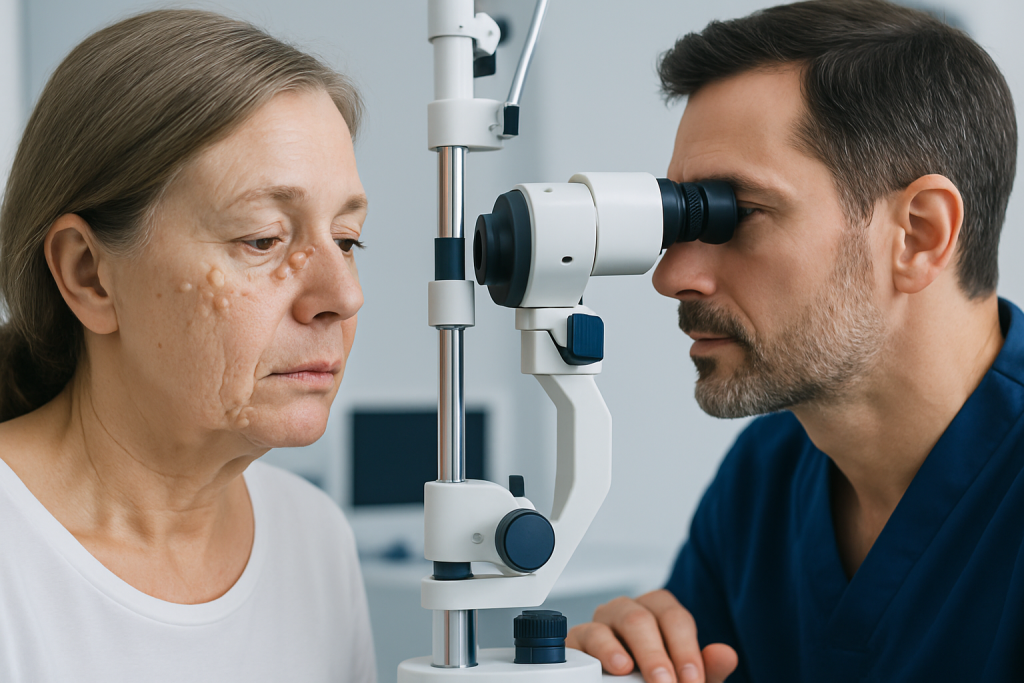
In many cases, skin tags around eyes cause no pain. They are often discovered incidentally while washing the face, applying eye cream, or looking closely in a mirror. Their appearance is usually more noticeable than their symptoms.
Common features include a soft texture, a smooth or slightly wrinkled surface, and a small stalk attaching the growth to the skin. They may be skin-colored, slightly darker than the surrounding skin, or lightly pink. Most are very small, but some can gradually enlarge over time.
Symptoms, when present, are usually related to friction rather than the skin tag itself. A person may notice:
- Rubbing or irritation from blinking
- Discomfort when wearing eye makeup or contact lenses
- Catching on towels, fingers, or eyeglass frames
- Occasional tenderness if the tag twists or is traumatized
If a lesion crusts, bleeds without clear injury, changes shape or pigment, or causes persistent eyelid inflammation, it should not be assumed to be a simple skin tag. In that setting, medical assessment becomes more important.
Why they develop: causes and risk factors

The exact cause of skin tags is not fully understood, but they are strongly associated with friction where skin folds or surfaces rub together. On and around the eyelids, repeated contact from blinking, touching the area, or local skin folds may contribute to their development in people who are predisposed.
Skin tags are more common in adults and may become more frequent with age. They are also seen more often in people with overweight or obesity, insulin resistance, type 2 diabetes, and metabolic syndrome. Pregnancy can sometimes be associated with new skin tags, likely because of hormonal and metabolic changes.
Family tendency may play a role as well. Some people simply seem more likely to develop multiple tags over time. While poor hygiene does not cause skin tags, irritation from cosmetics, rubbing, or chronic skin friction can make them more noticeable.
Because other eyelid lesions can look similar, doctors may also consider conditions such as skin cancer or benign eyelid growths during assessment. The risk of a serious cause is lower when the lesion has the classic soft, stalk-like appearance, but appearance alone is not always enough if the spot is atypical.
Diagnosis and how doctors tell them apart from other eyelid growths
Diagnosis usually begins with a clinical examination. A doctor, dermatologist, ophthalmologist, or oculoplastic specialist looks at the size, shape, color, texture, and exact location of the lesion. In many cases, an experienced clinician can identify a classic skin tag by inspection.
The eye area deserves special attention because several conditions can mimic skin tags. These include seborrheic keratoses, viral warts, milia, papillomas, moles, cysts, and inflammatory lesions. Less commonly, some skin cancers on the eyelid can initially resemble a harmless bump, especially if they are irregular, ulcerated, or changing.
If there is any uncertainty, the clinician may recommend removing the lesion and sending it for laboratory review. This is more likely when a growth is unusually pigmented, firm, broad-based, rapidly enlarging, or repeatedly bleeding. In addition, lesions that are very close to the eye margin may need specialist evaluation to protect the eyelid and tear film.
When a growth affects blinking, lid position, or the eye surface, an eye specialist may be involved. In some patients, imaging is not needed, but a slit-lamp or magnified eyelid exam can help define whether the growth is limited to the skin or involves nearby structures. Broader skin assessment may be appropriate if a person has multiple lesions or concerns about other changing spots.
Treatment options and why home removal is risky
Treatment is not always medically necessary. If the diagnosis is clear and the skin tag is not causing irritation, visual problems, or cosmetic concern, observation may be reasonable. However, many people choose removal because the lesion catches, becomes inflamed, or sits in a very visible area.
In a medical setting, removal methods may include careful snip excision, freezing with cryotherapy, or cautery to remove or destroy the tissue. The best option depends on the lesion’s size, its distance from the eye, whether there is a narrow stalk, and whether laboratory analysis is needed. For growths on the eyelid margin or very close to the eye, precision matters and specialist care may be advised.
Home removal is not recommended for skin tags around eyes. Over-the-counter freezing kits, tying off the tag, cutting it with scissors, or applying acids can damage the thin eyelid skin and may injure the eye itself. Risks include bleeding, infection, burns, scarring, incomplete removal, and treating the wrong condition.
If a procedure is needed, patients may be referred for dermatology care or, when the eyelid position and eye surface are involved, to specialists in ophthalmology. Larger or complex eyelid lesions may also need coordinated management with plastic and reconstructive surgery to preserve both appearance and function.
Prevention and self-care for the delicate eye area
There is no guaranteed way to prevent skin tags around eyes, but some practical habits may help reduce irritation. Gentle skincare, avoiding rubbing the eyelids, and using non-irritating makeup or cleansers can protect the thin skin in this area. Removing eye makeup carefully and not pulling at a growth may reduce repeated trauma.
General health measures may also help lower the likelihood of developing multiple skin tags over time. Maintaining a healthy weight, staying physically active, and managing blood sugar if diabetes or insulin resistance is present can support overall skin and metabolic health. These steps do not remove existing skin tags, but they may address some of the associated risk factors.
People should avoid picking, shaving, or trimming lesions near the eye. If a tag becomes irritated, keeping the area clean and avoiding friction from cosmetics or tight eyewear may help until medical review. It is also sensible to monitor the area for changes in size, color, or symptoms.
Regular skin checks can be useful, especially for those with many skin lesions, a personal history of suspicious spots, or high sun exposure. Not every eyelid bump is preventable, but prompt evaluation makes treatment simpler when needed.
When to seek medical care
A routine appointment is appropriate if a skin tag around the eye is bothersome, new, growing, or difficult to identify. Medical review is also a good idea before any removal attempt, since the eye area is sensitive and some lesions need a different approach.
Earlier evaluation is important if the lesion bleeds repeatedly, becomes painful, develops a crust or sore, changes color, grows quickly, or interferes with vision or blinking. Swelling, redness, discharge, or signs of infection should also prompt medical advice. People with a history of skin cancer should be especially cautious with any new eyelid growth.
Emergency care is not usually needed for a typical skin tag, but urgent help is appropriate if there is sudden eye pain, a chemical or freezing injury from self-treatment, significant bleeding, or vision changes. These symptoms suggest the problem may involve the eye itself rather than only the skin.
Near the end of the care pathway, some patients benefit from multidisciplinary evaluation, particularly if the diagnosis is uncertain or the lesion is in a complex eyelid location. Acibadem International’s multidisciplinary specialists and JCI-accredited hospitals diagnose and treat eyelid and skin lesions for international patients when specialist assessment is required.
Frequently asked questions
Are skin tags around eyes dangerous?
They are usually harmless benign growths and do not damage the eye on their own. However, because some other eyelid lesions can look similar, a clinician should confirm the diagnosis, especially if the spot is changing or symptomatic.
Can skin tags around eyes go away on their own?
Most skin tags do not disappear spontaneously. They often stay the same size or enlarge slowly over time, although some may twist, dry out, and detach. If a lesion changes unexpectedly, it should still be checked rather than assumed to be resolving.
Is it safe to remove a skin tag near the eye at home?
No, home removal is not considered safe in the eye area. Cutting, tying off, or freezing a lesion near the eyelid can lead to bleeding, infection, scarring, and accidental injury to the eye.
Which doctor treats eyelid skin tags?
A primary care doctor may first assess the growth, but dermatologists, ophthalmologists, and oculoplastic or plastic surgeons may also treat it depending on its location. Lesions on the eyelid margin or very close to the eye often need more specialized care.
Do skin tags around eyes mean diabetes?
Not necessarily. Skin tags are more common in people with insulin resistance or type 2 diabetes, but many people with skin tags do not have either condition. If a person develops many new tags or has other risk factors, a doctor may consider evaluating metabolic health.
Will removal leave a scar?
Any skin procedure can leave a mark, but careful medical removal in the eyelid area is designed to minimize scarring. The result depends on the tag's size, the removal method, individual healing, and whether the lesion was inflamed beforehand.
This article is for general information only and is not a substitute for professional medical advice. Please consult a qualified doctor about your individual situation.
Explore treatments in Turkey — costs, top hospitals & a free quote
JCI-accredited · board-certified surgeons · reply within 24h
Add us as a Preferred Source to see more of our trusted health content across Google Search, AI Overviews and Discover.

More from the Health Library

Traumatized by Betrayal — Explained by Medical Evidence, Not Myths

Crystal Meth: A Complete Medical Overview

Herniorrhaphy Types: An Evidence-Based Guide for Patients

Trichophobia: An Evidence-Based Guide for Patients

Sleep Inertia: What Patients Need to Know