Leg Exercises Using Bodyweight — Explained by Medical Evidence, Not Myths
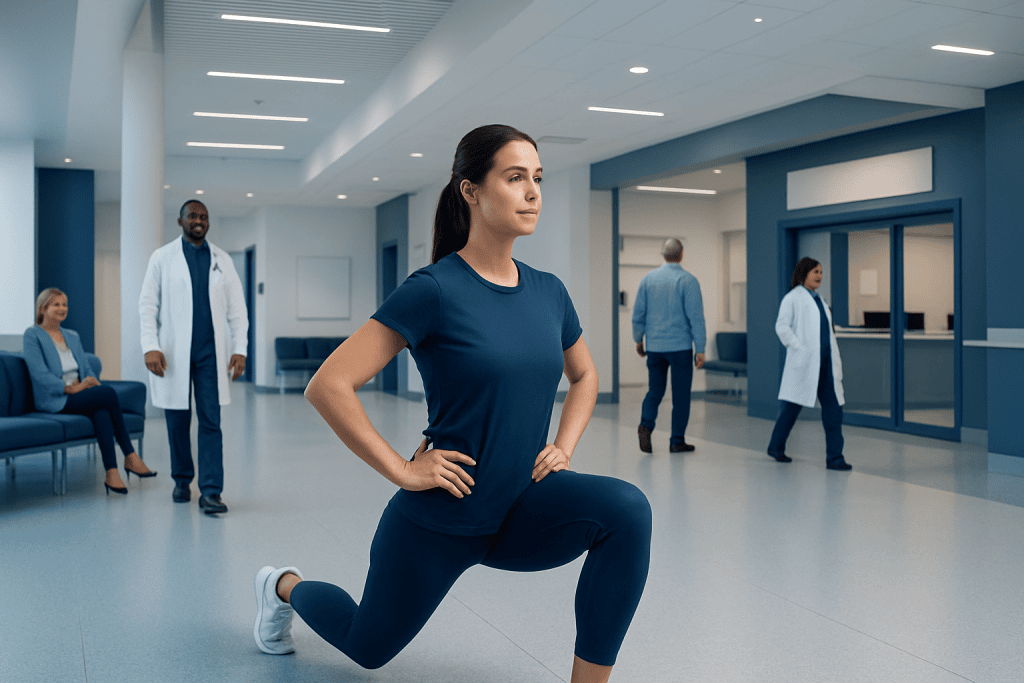
Bodyweight leg training can improve strength, stability, and mobility when movements are performed with good form. Exercises should be selected based on goals, fitness level, and any history of knee, hip, ankle, or back problems.
Key Takeaways
- Bodyweight leg training can improve strength, stability, and mobility when movements are performed with good form.
- Exercises should be selected based on goals, fitness level, and any history of knee, hip, ankle, or back problems.
- Gradual progression matters more than high repetition counts or exercise myths seen online.
- Pain during or after exercise is a signal to modify the activity and seek professional advice if symptoms continue.
- A balanced routine should include squat, hinge, lunge, bridge, calf, and balance patterns.
Leg exercises using bodyweight can be an effective way to improve lower-body strength, balance, mobility, and daily function without gym equipment. The most useful routine is not the hardest one, but the one that matches a person’s joints, fitness level, and movement quality.
Overview: Do leg exercises using bodyweight really work?
Yes. Leg exercises using bodyweight can effectively strengthen the muscles of the thighs, hips, glutes, calves, and core, especially for beginners, older adults, and people returning to activity. They also help train coordination, balance, and joint control, which are important for walking, climbing stairs, standing up from a chair, and reducing injury risk.
Medical evidence does not support the idea that a workout must involve heavy equipment to be useful. Muscle strength and endurance improve when muscles are challenged consistently, movement quality is maintained, and exercises are progressed over time. For many people, bodyweight training is a practical starting point because it is accessible and can be adapted to different abilities.
This topic is often presented as a list of “best moves,” but a more evidence-based approach focuses on movement patterns rather than trends. A complete lower-body routine usually includes a squat pattern, a hip-hinge pattern, single-leg control, calf work, and balance practice. The right combination depends on a person’s age, goals, and any symptoms such as knee pain, stiffness, or instability.
How bodyweight leg training helps the body
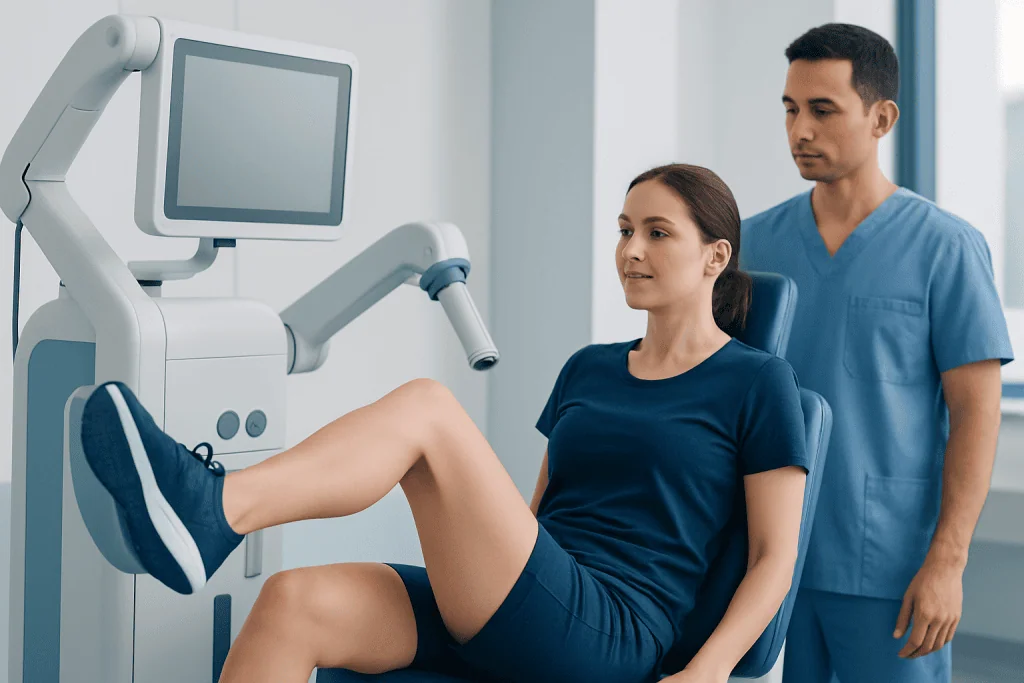
The lower body contains large muscle groups that support posture and movement throughout the day. When trained regularly, these muscles can improve force production, shock absorption, and joint alignment during everyday activities. Better lower-body strength may also support healthy aging by helping preserve mobility and independence.
Bodyweight exercises do more than build muscle. They can improve neuromuscular control, meaning the brain and muscles work together more efficiently. This is especially important around the knees, hips, and ankles, where good control can reduce unnecessary strain during stairs, walking, and directional changes.
There are also metabolic and cardiovascular benefits when bodyweight leg exercises are performed in circuits or repeated sets. However, more repetitions are not always better. If form worsens, the knees collapse inward, the back rounds excessively, or pain appears, the exercise is no longer giving the intended benefit.
- Strength: supports daily tasks and exercise performance
- Balance: helps reduce falls and improves single-leg control
- Mobility: supports comfortable movement through useful ranges
- Joint function: may help the body tolerate load more effectively
- Convenience: allows training at home with little or no equipment
Core movement patterns and evidence-based exercise choices
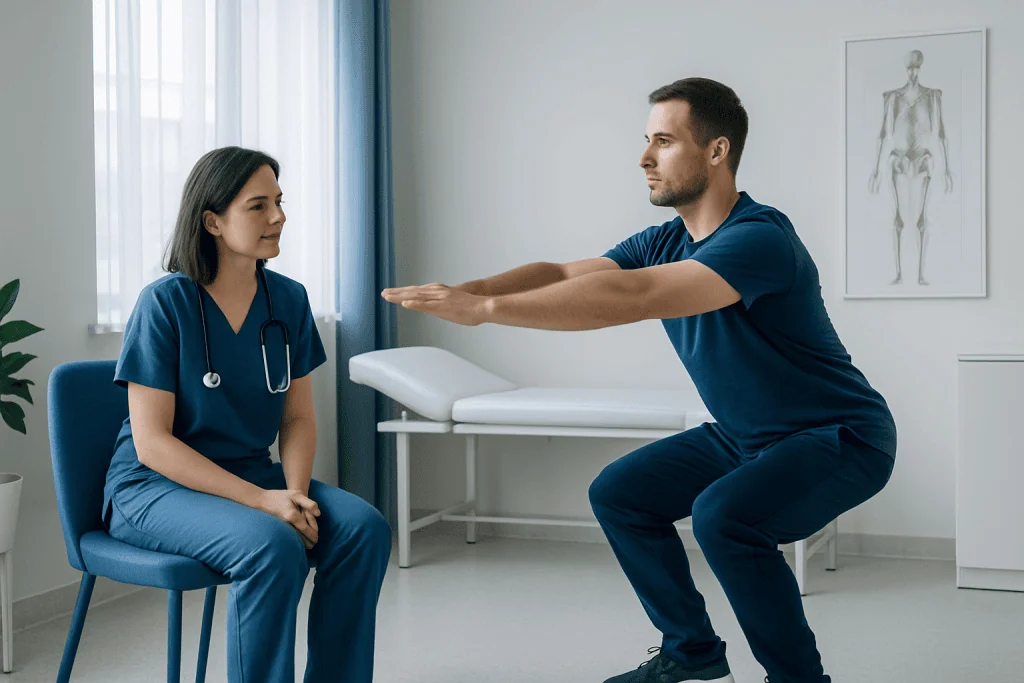
Instead of chasing complicated routines, it is often better to cover the main movement patterns with a few well-chosen exercises. A squat pattern trains the front of the thighs, hips, and glutes. Examples include chair squats, sit-to-stands, wall sits, and supported squats. A hinge pattern shifts more work to the glutes and hamstrings; examples include hip hinges and glute bridges.
Single-leg patterns improve balance and side-to-side control. These include split squats, reverse lunges, step-downs, and supported single-leg sit-to-stands. Calf raises are also important because the calf muscles help with walking efficiency, ankle stability, and push-off. Side-lying leg raises or band-free hip abduction drills may support hip stabilizers, though they should complement rather than replace larger movement patterns.
Medical and rehabilitation practice generally favors exercises that can be adjusted to the person. For someone with deconditioning or recovery needs, a chair squat may be more appropriate than a jump squat. People with symptoms related to knee pain or lower back pain may need smaller ranges of motion, slower tempo, or additional support while form is retrained.
- Squat pattern: chair squats, sit-to-stands, wall-supported squats
- Hinge pattern: hip hinges, glute bridges
- Single-leg control: split squats, reverse lunges, step-downs
- Calf strength: standing calf raises, single-leg calf raises if appropriate
- Balance: tandem stance, single-leg stance near a support
Myths to avoid and signs of good technique
One common myth is that leg training must leave the muscles extremely sore to be effective. In reality, progress is more reliably linked to consistency, sufficient challenge, and recovery. Mild muscle fatigue can be expected, but severe soreness that interferes with walking or continues for several days may suggest the session was too aggressive.
Another myth is that knees should never move forward during squats or lunges. For many people, some forward knee movement is normal and helps distribute load naturally, provided the movement is controlled and comfortable. What matters more is whether the exercise is tolerable, balanced, and performed with stable alignment rather than forcing a rigid posture.
Good technique often includes an even foot position, steady breathing, controlled speed, and joint alignment that stays relatively stable during the movement. The trunk should remain organized rather than collapsing, and the movement should look similar from repetition to repetition. People with persistent pain, swelling, locking, or repeated giving-way should stop self-directed progression and seek assessment, which may involve physical therapy and rehabilitation to improve mechanics safely.
How to build a safe and effective routine
An evidence-based routine starts with the current ability level. A person who is sedentary or recovering from illness may begin with sit-to-stands, glute bridges, supported calf raises, and balance practice two or three times a week. Someone with more experience may use deeper squats, split squats, single-leg calf raises, and longer time under tension.
Progression does not require equipment at first. Useful ways to progress include increasing range of motion, slowing the lowering phase, adding a pause, increasing repetitions gradually, or moving from double-leg to single-leg variations. Rest days matter because muscles, tendons, and joints need time to adapt.
A sample balanced session may include five to six movements performed for one to three sets each, with a level of effort that feels challenging but controlled. If a person is unsure how to choose or adapt exercises after injury, surgery, or recurring symptoms, a clinician may recommend assessment by specialists in orthopedics or rehabilitation to guide a safer plan.
- Warm up with 5 to 10 minutes of light movement
- Choose 1 squat exercise, 1 hinge exercise, 1 single-leg exercise
- Add calf work and 1 balance drill
- Keep pain low and form steady
- Progress one variable at a time
Special considerations for joint pain, age, and recovery
Not every leg exercise suits every person. People with arthritis, previous ligament injury, tendon pain, or balance limitations often do better with supported movements and moderate ranges before advancing. For example, a chair squat may be more comfortable than a deep squat, and a reverse lunge may feel better than a forward lunge because it can be easier to control.
Older adults may benefit especially from bodyweight leg training because it targets strength, reaction, and stability relevant to daily life. Exercises that mimic everyday tasks, such as standing from a chair or stepping up, can be highly functional. Balance practice should be done near a stable support to reduce fall risk.
After an injury or a long period of inactivity, the priority is usually restoring tolerance to movement rather than pushing intensity. Persistent swelling, true locking, sudden weakness, or repeated joint instability may indicate a problem that needs medical evaluation, such as a meniscus, ligament, or hip issue. In some cases, clinicians may use MRI or other assessment tools to clarify the cause of symptoms before a rehabilitation plan is advanced.
When to seek medical care
Bodyweight training is generally safe for many people, but medical advice is important when symptoms suggest more than routine exercise discomfort. A doctor should assess pain that is sharp, worsening, associated with swelling, or present at rest or at night. Medical review is also sensible when a person cannot bear weight comfortably, notices numbness, or has new joint instability.
People with known bone, joint, neurological, or cardiovascular conditions should ask a qualified clinician what type and intensity of exercise is appropriate for them. This is especially important after surgery, a fracture, a major sprain, or a period of immobilization. Individual guidance can help reduce setbacks and improve confidence in returning to activity.
Acibadem International’s multidisciplinary specialists and JCI-accredited hospitals assess and treat musculoskeletal concerns for international patients when symptoms need further evaluation. The aim is not simply to stop exercise, but to identify the cause of symptoms and choose the safest path back to movement.
Frequently asked questions
Are leg exercises using bodyweight enough to build strength?
For many people, yes. Beginners, older adults, and those returning to exercise can improve strength and function significantly with bodyweight training, especially when exercises become gradually more challenging. More advanced athletes may eventually need added resistance for further strength gains.
What are the best bodyweight leg exercises for beginners?
A practical starting group includes chair squats or sit-to-stands, glute bridges, supported split squats, calf raises, and simple balance drills. These movements train major muscle groups while allowing the person to focus on comfort and control. The best choice depends on pain levels, mobility, and current fitness.
Can bodyweight leg exercises help knee pain?
They can help some people when the exercises are well selected and progressed gradually. Improved strength in the hips, thighs, and calves may support knee function and movement control. However, exercise should be modified or assessed professionally if pain is severe, increasing, or associated with swelling or instability.
How often should someone train legs with bodyweight exercises?
Many people do well with two to three sessions per week, allowing rest between sessions. The exact frequency depends on age, recovery, training history, and symptom response. Quality and consistency usually matter more than daily high-volume workouts.
Should a person stop if muscles feel sore afterward?
Mild soreness can be normal, especially when starting a new routine. Severe soreness, limping, joint swelling, or pain that lasts several days is a sign to reduce intensity and review exercise technique. Ongoing symptoms should be discussed with a qualified clinician.
Are squats bad for the knees?
Not inherently. Squats are a normal movement pattern, and when they are adapted to the person’s ability and performed with control, they are often well tolerated. The depth, speed, support, and overall load may need adjustment in people with symptoms or previous injury.
This article is for general information only and is not a substitute for professional medical advice. Please consult a qualified doctor about your individual situation.
Joint and spine care in Turkey — expert assessment & treatment
JCI-accredited · board-certified surgeons · reply within 24h
Add us as a Preferred Source to see more of our trusted health content across Google Search, AI Overviews and Discover.

More from the Health Library

Kefir: A Complete Medical Overview
Backwards Exercise: An Evidence-Based Guide for Patients

My Chart: What Patients Need to Know

Baby Eczema: An Evidence-Based Guide for Patients

Cranberry Juice Benefits — Explained by Medical Evidence, Not Myths