Macrocephaly: A Complete Medical Overview

Macrocephaly describes a larger-than-expected head size, usually identified by measuring head circumference. Some cases are benign or familial, while others are related to brain, fluid, genetic, or developmental conditions.
Key Takeaways
- Macrocephaly describes a larger-than-expected head size, usually identified by measuring head circumference.
- Some cases are benign or familial, while others are related to brain, fluid, genetic, or developmental conditions.
- Doctors assess growth pattern, development, neurological signs, and family history to decide whether further testing is needed.
- Urgent evaluation is important if macrocephaly is accompanied by vomiting, seizures, developmental regression, or a bulging fontanelle in infants.
- Treatment depends on the underlying cause and may range from observation to specialist care.
Macrocephaly is a medical term for a head circumference that is larger than expected for a person’s age and sex. It is not a diagnosis by itself; in some people it is a normal family trait, while in others it may point to an underlying condition that needs medical assessment.
Overview: What macrocephaly means
Macrocephaly means that the head is larger than expected compared with standard growth charts for age and sex. In clinical practice, it is usually identified when head circumference measures above the normal range or when head growth is happening faster than expected over time. The term describes a finding, not a single disease.
Many people with macrocephaly are otherwise healthy. Some infants and children simply inherit a larger head size from one or both parents, and their development remains normal. In other cases, however, a large head can reflect extra fluid around or within the brain, increased brain volume, changes in the skull, or a broader genetic or neurological condition.
Because the causes vary, doctors look at the whole picture rather than the measurement alone. A child’s symptoms, developmental milestones, neurological examination, family history, and growth pattern all help determine whether macrocephaly is likely to be benign or whether it needs closer investigation.
Signs, symptoms, and growth patterns
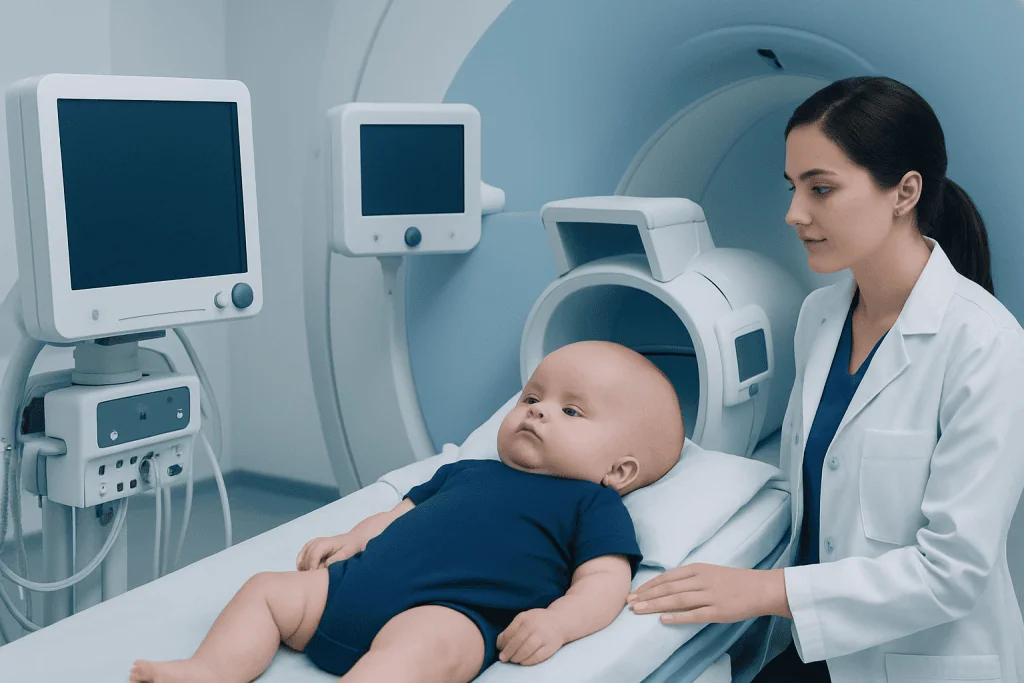
Macrocephaly itself often does not cause symptoms. In many babies, the first sign is simply a head circumference that plots above the usual range at a routine checkup. Sometimes the head has always been proportionally large; in other situations, the head size crosses upward through percentile lines over weeks or months, which may prompt further attention.
When macrocephaly is part of an underlying condition, other features may be present. These can include delayed motor or language milestones, poor feeding, irritability, unusual sleepiness, muscle stiffness or floppiness, balance problems, headaches, vomiting, vision changes, or seizures. In infants, clinicians also look for a tense or bulging soft spot, separated skull sutures, or eyes that appear driven downward.
Doctors pay close attention to the pattern of growth. A head that is large but stable and matched by normal development may be reassuring, especially if family members also have larger head sizes. By contrast, rapid head enlargement, new neurological symptoms, or loss of previously achieved skills suggests that evaluation should not be delayed.
- Possible associated signs include developmental delay, headaches, vomiting, or seizures.
- Stable large head size may be benign, especially with a family history.
- Rapidly increasing head circumference is more concerning than a single large measurement.
Causes and risk factors

Macrocephaly has several possible causes. One common and often harmless explanation is benign familial macrocephaly, in which larger head size runs in the family. Another is benign enlargement of the spaces around the brain in infancy, a condition that may be seen on imaging and often improves with time while the child continues to be monitored.
Some cases are related to increased cerebrospinal fluid, as in hydrocephalus, where fluid builds up in or around the brain. Macrocephaly can also be linked to increased brain tissue volume, bleeding, cysts, tumors, skull bone disorders, prior infection, or metabolic and genetic syndromes. In older children or adults, the context may differ, and a large head may reflect a long-standing trait or a condition that developed later.
Risk factors depend on the underlying cause rather than the head size itself. These may include a family history of large head size or genetic disorders, prematurity in some settings, congenital anomalies, or developmental and neurological concerns. A clinician may also consider whether there have been complications during pregnancy, birth, or early infancy that could affect the brain or skull.
Importantly, not every child with macrocephaly has a serious disorder. The goal of medical evaluation is to separate normal variation from conditions that need treatment or follow-up. That distinction usually requires more than a single measurement.
How doctors diagnose macrocephaly
Diagnosis begins with careful measurement of head circumference and comparison with standardized growth charts. In infants and young children, doctors also review earlier measurements to see whether the head has always been large or has recently started growing more quickly. Height and weight are considered as well, since body proportions can provide useful clues.
A full history and physical examination are essential. The doctor asks about pregnancy and birth history, family head size, developmental milestones, headaches, vomiting, seizures, irritability, sleep changes, and vision concerns. The neurological examination looks at muscle tone, reflexes, eye movements, coordination, alertness, and signs of raised pressure inside the skull.
Further testing is not needed in every case. If there are concerning findings, imaging may be recommended. In young infants with an open fontanelle, cranial ultrasound can sometimes provide an initial look. Depending on the clinical situation, doctors may also use advanced MRI scanning or CT imaging to assess brain structure, fluid spaces, and the skull. Blood tests or genetic evaluation may be considered when a metabolic or inherited condition is suspected.
The main purpose of diagnosis is to identify whether macrocephaly is isolated and benign or part of a condition that needs treatment. This process can involve pediatrics, neurology, neurosurgery, genetics, or developmental specialists, depending on the findings.
Treatment options and follow-up
There is no single treatment for macrocephaly because management depends entirely on the cause. If a child has benign familial macrocephaly and is developing normally, treatment may not be needed beyond regular checkups and repeat head measurements. Reassurance can be appropriate when the clinical picture supports a normal variant.
When an underlying disorder is found, treatment is directed at that condition. For example, excess brain fluid may require monitoring by neurology or neurosurgery, and some cases of hydrocephalus are treated with procedures such as brain shunt surgery to relieve pressure and divert fluid. If a mass, cyst, or structural problem is identified, management may involve neurosurgical treatment or other specialist care.
Children with developmental delays, feeding difficulties, or motor challenges may also benefit from supportive therapies such as physiotherapy, occupational therapy, speech therapy, or early intervention services. These do not treat head size directly, but they can improve function and development when macrocephaly is part of a broader condition.
Follow-up is often as important as initial treatment. Repeat examinations allow doctors to track head growth, development, neurological status, and response to therapy. Parents and caregivers are usually advised on warning signs that should prompt urgent reassessment.
Prevention and self-care
Macrocephaly itself cannot always be prevented, especially when it is inherited or related to congenital or genetic factors. Even so, good prenatal care, routine newborn and well-child visits, and keeping scheduled developmental checkups can help problems be recognized early. Early assessment often makes management more straightforward and supports better planning for care.
At home, caregivers should focus on observation rather than trying to measure or interpret head size on their own. It is more helpful to note changes such as increasing irritability, repeated vomiting, loss of milestones, feeding difficulty, poor balance, unusual eye movements, or a head that seems to be enlarging quickly between medical visits.
General self-care also includes following specialist advice, attending follow-up imaging or developmental appointments when recommended, and discussing any family history of neurological or genetic conditions. In adults with a long-standing large head and no symptoms, no specific self-care may be needed, but new headaches, cognitive changes, or neurological symptoms still deserve medical review.
Near the end of the care pathway, some families seek coordinated specialty input. Acibadem International’s multidisciplinary specialists and JCI-accredited hospitals evaluate and treat patients with neurological and developmental conditions, including causes of macrocephaly, when international care is needed.
When to seek medical care
Medical advice should be sought if a baby, child, or adult has a noticeably large head, especially if the size seems to be increasing quickly or is out of proportion to the rest of the body. A routine pediatric visit is a good starting point for infants and children, because repeated measurements over time are often more informative than a single observation.
Prompt medical evaluation is important if macrocephaly is accompanied by any warning signs. These include repeated vomiting, poor feeding, unusual sleepiness, seizures, severe or persistent headache, developmental delay, regression of skills, balance problems, vision changes, or a bulging soft spot in an infant. These symptoms do not always mean a serious condition is present, but they should not be ignored.
Emergency care may be needed if there are signs of increased pressure in the skull, sudden neurological decline, or seizures that are prolonged or severe. In these situations, rapid assessment helps identify whether urgent imaging or specialist treatment is required.
Frequently asked questions
Is macrocephaly always a sign of a serious problem?
No. Macrocephaly can be a normal family trait, especially when development and neurological examination are normal. It becomes more concerning when head growth is rapid or when it occurs with symptoms such as vomiting, seizures, or developmental delay.
How is macrocephaly measured?
Doctors usually measure the head circumference with a tape measure placed around the largest part of the head. That number is then compared with standard growth charts for the person’s age and sex. Repeated measurements over time are often more useful than a single measurement.
Can babies with macrocephaly develop normally?
Yes. Many babies with macrocephaly, especially those with benign familial macrocephaly, grow and develop normally. Regular follow-up helps confirm that development stays on track and that head growth remains consistent.
Does macrocephaly require a brain scan?
Not always. Imaging is usually considered when there are concerning symptoms, abnormal neurological findings, developmental issues, or rapid head growth. The decision depends on the child’s age, examination findings, and overall clinical picture.
What conditions can cause macrocephaly?
Possible causes include benign familial macrocephaly, benign enlargement of spaces around the brain, hydrocephalus, genetic syndromes, bleeding, cysts, tumors, or certain metabolic and skeletal conditions. A doctor determines the likely cause by combining history, examination, and sometimes imaging or genetic testing.
Can macrocephaly be treated?
Treatment is aimed at the underlying cause rather than the head size alone. Some people only need observation and follow-up, while others may need specialist care, developmental therapies, or neurosurgical treatment. The right approach depends on what evaluation shows.
This article is for general information only and is not a substitute for professional medical advice. Please consult a qualified doctor about your individual situation.
Explore treatments in Turkey — costs, top hospitals & a free quote
JCI-accredited · board-certified surgeons · reply within 24h
Add us as a Preferred Source to see more of our trusted health content across Google Search, AI Overviews and Discover.

More from the Health Library

Peroneals: What Patients Need to Know

Gentle Exfoliator for Milia — Explained by Medical Evidence, Not Myths

Coronary Angiogram and Angiography — Explained by Medical Evidence, Not Myths

Verapamil: A Complete Medical Overview

Mandibular Tori: An Evidence-Based Guide for Patients