Immunohistochemistry — Explained by Medical Evidence, Not Myths

Immunohistochemistry uses antibodies to detect certain proteins in a tissue sample. It is commonly performed on biopsy or surgical specimens in a pathology laboratory.
Key Takeaways
- Immunohistochemistry uses antibodies to detect certain proteins in a tissue sample.
- It is commonly performed on biopsy or surgical specimens in a pathology laboratory.
- Results help doctors distinguish between different diseases, especially types of cancer.
- An immunohistochemistry report is interpreted together with the biopsy appearance and other tests.
- The test itself is done on tissue already collected, so patients usually do not feel anything during the staining process.
Immunohistochemistry is a laboratory method that helps pathologists identify specific proteins in tissue samples by using antibodies and special stains. It does not diagnose every condition on its own, but it often plays an important role in confirming a diagnosis, classifying tumors, and guiding treatment decisions.
What immunohistochemistry means
Immunohistochemistry, often shortened to IHC, is a laboratory technique used to find specific proteins inside cells within a tissue sample. The test works by applying antibodies that attach to selected proteins. A color-producing reaction then makes those proteins visible under a microscope, allowing a pathologist to see not only whether a marker is present, but also where it is located in the tissue.
This matters because many diseases can look similar at first glance on routine microscopy. Immunohistochemistry adds another layer of evidence by showing the biological features of the cells. In practical terms, it can help confirm whether a tissue is normal, inflamed, infected, benign, or cancerous, and it can also help define exactly what type of tumor is present.
Importantly, immunohistochemistry is not a single disease test and it is not a treatment. It is a diagnostic tool used as part of pathology. Doctors interpret IHC results together with the patient’s symptoms, imaging findings, medical history, and the tissue’s overall microscopic appearance rather than relying on one marker alone.
How the test is performed in the lab
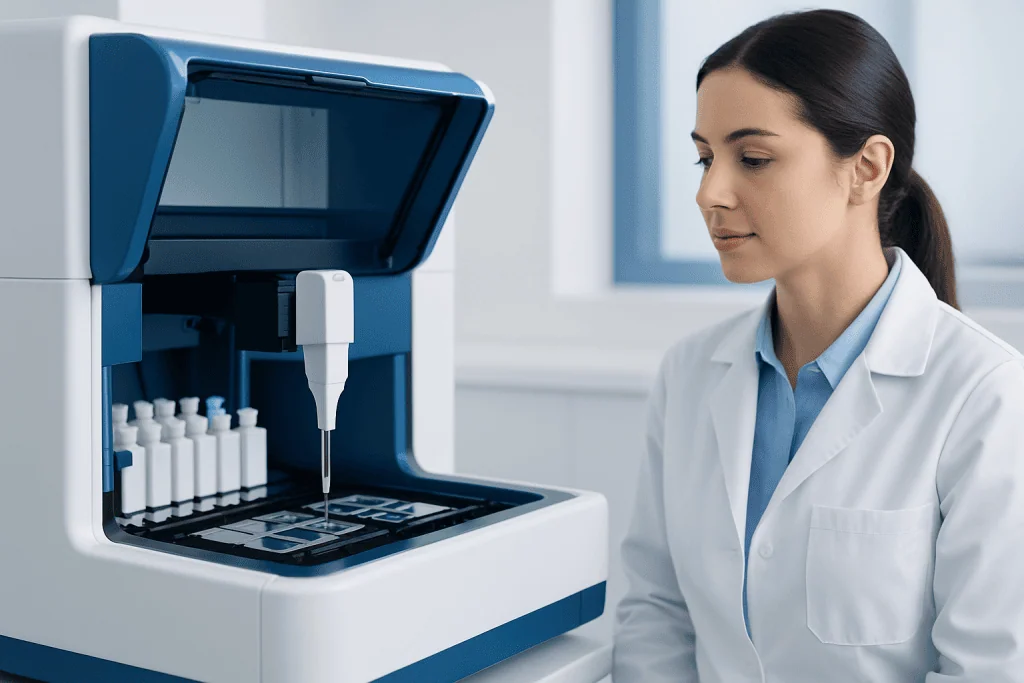
Immunohistochemistry is usually performed on tissue obtained from a biopsy, endoscopy, needle sample, or surgery. After the tissue is collected, it is preserved, processed, and placed into thin sections on glass slides. The laboratory then applies antibodies designed to bind to specific targets that may be present in the cells.
If the target protein is present, the antibody attaches to it. A detection system creates a colored stain so the pathologist can examine the pattern under a microscope. The color, intensity, and location of staining can all be meaningful. For example, a protein may appear in the cell membrane, nucleus, or cytoplasm, and each pattern can provide useful clues.
Patients usually do not experience the staining step directly, because it happens after the tissue has already been taken. Any discomfort is generally related to the biopsy or procedure used to obtain the sample, not to immunohistochemistry itself. Turnaround time varies because the lab may need to run several markers and compare them with the routine pathology findings.
Why doctors order immunohistochemistry

One of the main reasons doctors request immunohistochemistry is to clarify a difficult diagnosis. When a tissue sample has cells that are unusual or not easy to classify, IHC can help show where those cells likely came from and what type of process is occurring. This is especially valuable in cancer diagnosis, where treatment often depends on the exact tumor type rather than on appearance alone.
In oncology, immunohistochemistry may help distinguish one tumor from another, identify the tissue of origin of a metastasis, and assess biomarkers that influence treatment planning. Depending on the clinical question, pathologists may use panels of markers rather than a single stain. This broader approach can improve accuracy because no marker is perfect in isolation. Related evaluations may be part of broader cancer workups or connected to treatment planning in oncology care.
IHC is also used outside cancer care. It may support the evaluation of some infections, inflammatory disorders, skin conditions, or immune-related diseases. In all of these settings, the goal is the same: to add reliable, tissue-based evidence that helps the clinical team make a more precise diagnosis.
What conditions and cancers it can help identify
Immunohistochemistry is especially well known for its role in identifying and classifying tumors. It can help pathologists tell apart carcinomas, lymphomas, melanomas, sarcomas, and many other tumor groups. It may also help determine whether a cancer found in one area started there or spread from another organ, which can affect both staging and treatment decisions.
For example, in breast pathology, IHC is commonly used to assess receptors and other markers that help classify the tumor. In hematologic disease, markers can help define types of lymphoma or leukemia in tissue. In gastrointestinal, lung, gynecologic, and endocrine pathology, marker patterns may help distinguish tumors with overlapping microscopic features. This type of analysis may support care pathways involving pathology services and, when needed, medical oncology.
Beyond cancer, IHC can sometimes detect proteins linked to certain infections or cellular changes associated with autoimmune or inflammatory disease. It may also be used in dermatopathology and neuropathology. Even so, the usefulness of the test depends on the quality of the sample, the right choice of markers, and careful interpretation by an experienced pathologist.
How to understand immunohistochemistry results
An immunohistochemistry report may list the markers tested and describe whether each one is positive, negative, weak, strong, focal, diffuse, or equivocal. These terms do not automatically mean good or bad news by themselves. They describe how the tissue stained and help build a diagnostic pattern. A positive result for one marker may be expected in one condition and less useful in another.
Pathologists look at combinations of findings, not single words in isolation. A result can support a diagnosis, argue against it, or narrow the possibilities. In some cases, an apparently simple positive or negative answer still needs context, because different tissues can share markers and some tumors show unusual staining patterns. That is why reading an IHC report without the rest of the pathology report can be misleading.
Patients are often concerned if extra stains were ordered after a biopsy. In most cases, this simply means the pathologist is being thorough. Additional testing is common when the first review raises important questions that need a more precise answer. If anything in the report is unclear, the treating doctor or pathologist can explain what the markers mean for that specific diagnosis.
Limits, accuracy, and common myths
A common myth is that immunohistochemistry is a stand-alone test that can always give a final diagnosis by itself. In reality, IHC is highly useful but not infallible. Marker expression can vary from one tumor to another, and technical factors such as tissue preservation, antibody selection, and staining quality can influence the result. For this reason, pathologists interpret IHC together with routine histology and, when needed, molecular or genetic tests.
Another misunderstanding is that more stains always mean something serious was found. Often, the opposite is true: extra stains are ordered to improve accuracy and avoid premature conclusions. Pathology is a stepwise process, and careful confirmation is part of good medical practice.
It is also important to know that immunohistochemistry does not treat disease and does not replace clinical judgment. Rather, it helps answer a focused question about the tissue. If a diagnosis remains uncertain, doctors may recommend repeat sampling, additional imaging, another pathology review, or specialized testing. In complex cases such as suspected lymphoma, a multidisciplinary discussion may be especially helpful.
When to seek medical care
People do not usually seek care because of immunohistochemistry itself. Instead, they seek medical attention for the symptoms or abnormal findings that led to a biopsy, such as a persistent lump, unexplained bleeding, changes in a mole, ongoing digestive symptoms, swollen lymph nodes, or imaging results that need clarification. If a doctor recommends a biopsy or pathology review, it is wise to follow up promptly.
Medical review is also important if a pathology report shows uncertain, suspicious, or abnormal findings and more tests are advised. Patients should ask for an explanation of what was found, why IHC was ordered, and whether the results affect treatment planning. If the diagnosis is complex, a second pathology opinion may sometimes be appropriate.
Near the end of the diagnostic process, care often involves coordination between pathologists, surgeons, radiologists, and medical specialists. Acibadem International’s multidisciplinary specialists and JCI-accredited hospitals diagnose and treat conditions that may require immunohistochemistry for international patients.
Frequently asked questions
Is immunohistochemistry the same as a biopsy?
No. A biopsy is the procedure used to remove a tissue sample, while immunohistochemistry is one of the laboratory methods that may be performed on that sample afterward. In many cases, IHC is ordered only if the pathologist needs more detail to confirm or classify the diagnosis.
Does a positive immunohistochemistry result mean cancer?
Not necessarily. A positive result means the tested marker was found in the tissue, but that finding must be interpreted in context. Some markers are seen in normal cells, benign conditions, inflammation, or different kinds of tumors.
Why would a pathologist order several IHC stains?
Different markers answer different questions. A panel of stains often gives a clearer picture than a single test because diseases can share some features. Using several stains is a common and careful approach, especially when the tissue pattern is not straightforward.
How long does it take to get immunohistochemistry results?
Timing varies by laboratory, the number of markers needed, and how complex the case is. Some results are available within a few days, while more specialized workups can take longer. The treating doctor can usually give the best estimate based on the specific biopsy.
Can immunohistochemistry guide treatment decisions?
Yes, in many cases it can. Certain markers help classify tumors more precisely and may identify features that influence treatment planning. Even so, treatment decisions are usually based on the full pathology report along with imaging, stage, symptoms, and overall health.
Should patients worry if their report says additional stains were needed?
Usually, no. Additional stains often reflect a careful effort to improve diagnostic accuracy rather than a sign of a worse result. It is reasonable to ask the doctor which questions the stains were meant to answer and what the final interpretation shows.
References
- World Health Organization
- National Cancer Institute
- College of American Pathologists
- American Cancer Society
- MedlinePlus
This article is for general information only and is not a substitute for professional medical advice. Please consult a qualified doctor about your individual situation.
Explore treatments in Turkey — costs, top hospitals & a free quote
JCI-accredited · board-certified surgeons · reply within 24h
Add us as a Preferred Source to see more of our trusted health content across Google Search, AI Overviews and Discover.

More from the Health Library



Related Specialists
Dr. Seçkin Bayar
Clinical Laboratory
Dr. Abdullah Doğan
Cardiovascular Surgery
Dt. Aslı Yetğın Yazar
Oral & Dental Health
Assoc. Prof. Dr. Umut Dişel
Internal Medicine