

Vestibulo Ocular Reflex — Explained by Medical Evidence, Not Myths

The vestibulo ocular reflex, often shortened to VOR, helps keep images stable on the retina while the head moves. A healthy VOR makes the eyes move rapidly in the opposite direction to head movement.
Key Takeaways
- The vestibulo ocular reflex, often shortened to VOR, helps keep images stable on the retina while the head moves.
- A healthy VOR makes the eyes move rapidly in the opposite direction to head movement.
- Dizziness does not always mean there is a VOR problem; many ear, neurologic, vision and medical conditions can have similar symptoms.
- Clinicians may assess VOR function through bedside eye-movement examinations and specialized vestibular tests.
- Vestibular rehabilitation can help selected people adapt to or compensate for vestibular impairment.
- Sudden severe dizziness with neurologic symptoms requires urgent medical assessment.
The vestibulo ocular reflex is an automatic system that keeps vision steady when the head moves. It relies on close communication between the inner ear, brainstem and eye muscles, and disruption can contribute to dizziness, imbalance or visual blurring during movement.
Vestibulo ocular reflex: the evidence-based explanation
The vestibulo ocular reflex (VOR) is an involuntary reflex that keeps the visual world clear while a person moves their head. When the head turns in one direction, the eyes normally move by a matching amount in the opposite direction. This response happens extremely quickly, helping a person read signs while walking, follow a moving environment, or keep their gaze fixed on a face during conversation.
The reflex is not controlled consciously. Sensors in the inner ear detect head rotation and linear movement, then send signals through the vestibular nerve to areas of the brainstem. These signals are processed and sent to the eye muscles so that eye position is adjusted almost immediately. The VOR is one part of a wider balance system that also uses vision, sensory information from muscles and joints, and brain processing.
A VOR problem can make the visual scene seem to bounce, jump or blur with head movement. However, these symptoms are not specific to VOR dysfunction. They may also occur with migraine, medication effects, eye conditions, neck problems, anxiety, dehydration, or other vestibular and neurologic conditions. Careful clinical assessment is therefore more useful than trying to self-diagnose from symptoms alone.
How the VOR keeps vision stable
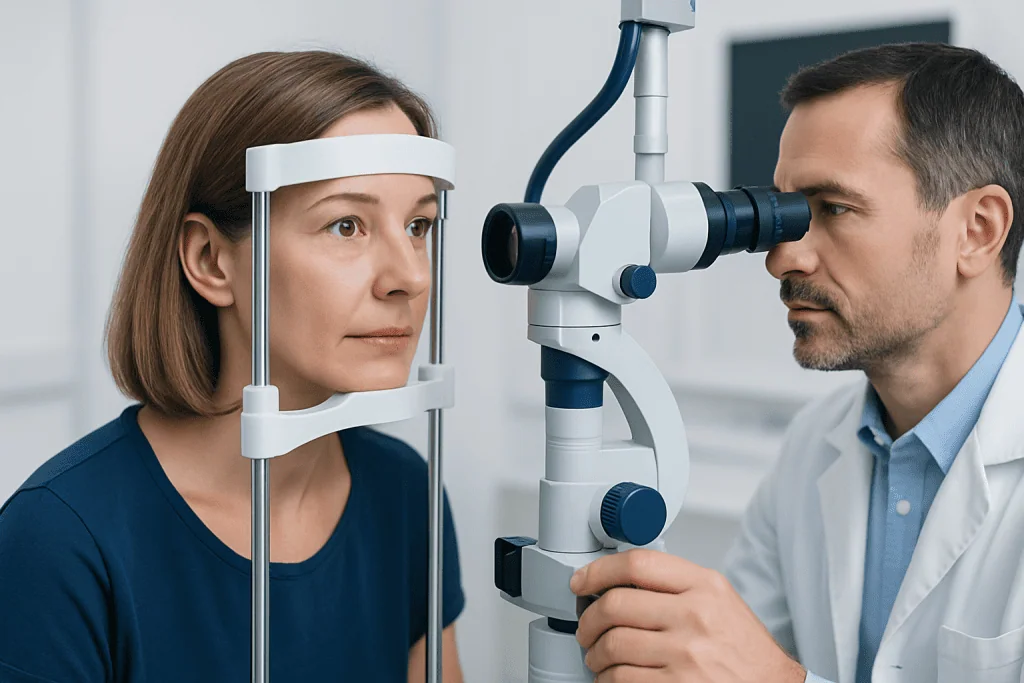
In its simplest form, the VOR works like a stabilizing camera mechanism. If the head turns left, fluid movement within the semicircular canals of the inner ear signals that rotation. The brain responds by directing the eyes to move right, allowing the person to continue looking at the same target. This is particularly important during rapid, everyday movements, when visual tracking alone would be too slow.
The inner ear contains three semicircular canals in each ear, positioned at different angles. Together, they detect rotational head movements in multiple planes. Two additional structures, called the otolith organs, detect gravity and linear acceleration, such as moving forward in a car, riding in an elevator, or leaning. Their signals also contribute to stable gaze and orientation.
The VOR can adapt over time. For example, the brain may recalibrate eye movements when visual conditions change or after one side of the vestibular system becomes weaker. This ability to adapt is one reason targeted vestibular exercises can be useful for some people. Adaptation varies between individuals and depends on the underlying cause, overall health and consistency with a clinician-guided program.
Symptoms that may suggest VOR dysfunction

When vestibular input is reduced, uneven between the two ears, or not being processed normally, a person may have difficulty maintaining steady vision during head movement. A classic symptom is oscillopsia, the sensation that the environment is bouncing or moving when walking, turning the head, or traveling over uneven ground. Some people describe blurred vision rather than visible movement.
Possible symptoms associated with vestibular dysfunction include dizziness, unsteadiness, nausea, motion sensitivity, difficulty walking in busy visual environments, and reduced confidence with activities that involve quick head turns. Symptoms may be brief or ongoing and may be more noticeable in low light, on uneven surfaces, or when a person is tired. The pattern of symptoms can provide useful clues, but it does not identify the cause by itself.
It is important to separate dizziness from vertigo. Dizziness is a broad term that may mean light-headedness, imbalance, faintness or a disconnected feeling. Vertigo is a false sensation of spinning or movement. A vestibular condition may cause vertigo, but not all dizziness or vertigo is caused by the inner ear, and not every vestibular disorder significantly affects the VOR.
- Blurred or bouncing vision when walking or turning the head
- Feeling off balance, especially outdoors or in darkness
- Nausea or discomfort with moving visual scenes
- Difficulty focusing on a target while the head is moving
- Dizziness after rapid changes in head position
What can affect the vestibulo ocular reflex
VOR changes can occur when the vestibular organs or vestibular nerve are affected. Examples include vestibular neuritis, an inflammatory condition affecting the vestibular nerve, and inner-ear disorders that alter balance signals. Benign paroxysmal positional vertigo (BPPV) causes brief vertigo with particular head movements because small calcium crystals shift within an inner-ear canal; it may affect eye movements during positional testing but is not the same as a generalized loss of VOR function.
Some causes affect one side of the vestibular system more than the other, creating an imbalance of signals. Others affect both sides, which can make gaze stabilization particularly difficult during walking. Head injury, certain neurologic diseases, aging-related vestibular decline, and medications that can affect the inner ear or nervous system may also contribute in selected cases. A clinician reviews the full medical history before drawing conclusions.
Not all abnormal eye movements indicate a vestibular disorder. Vision problems, migraine-related dizziness, central nervous system conditions and fatigue can influence gaze stability or test performance. For this reason, an assessment may involve an ear, nose and throat specialist, neurologist, audiologist, ophthalmologist, or vestibular physiotherapist, depending on the symptoms and examination findings.
How clinicians assess VOR function
Assessment begins with a history of the symptoms: when they began, whether they are triggered by head movement or position, how long they last, and whether there is hearing change, headache, recent infection, injury, medication use or neurologic symptoms. The clinician may also ask about falls, walking difficulties and the impact on work, driving or daily activities.
A commonly used bedside assessment is the head impulse test. While the person fixes their eyes on a target, the clinician makes small, rapid head turns and observes whether the eyes remain on the target. If the eyes move with the head and then make a corrective movement back to the target, this may suggest reduced vestibular function on one side. Interpretation requires training because technique and the wider clinical context matter.
Specialized tests may include video head impulse testing, which records eye movements during head impulses; caloric testing, which assesses responses from parts of the horizontal semicircular canals; rotational chair testing; balance testing; hearing tests; and positional maneuvers. Imaging or blood tests are not needed for every person, but may be considered when symptoms, examination findings or medical history suggest another condition.
Treatment, rehabilitation and self-care
Treatment focuses on the underlying cause rather than the VOR alone. For example, BPPV is often treated with specific repositioning maneuvers performed by a trained clinician. Acute vestibular conditions may require short-term symptom management and follow-up, while medication review can be important if a medicine may be contributing to dizziness or balance symptoms. Treatment plans should be individualized, especially for people with hearing loss, migraine, neurologic disease or recurrent symptoms.
Vestibular rehabilitation is a form of physiotherapy designed to improve gaze stability, balance and confidence with movement. Exercises may involve looking at a stationary target while moving the head, progressing gradually in speed, duration and complexity. Other activities may address walking, visual motion sensitivity and balance. Exercises should be prescribed or supervised when possible, as the correct level of challenge depends on the diagnosis and a person’s safety.
General self-care can support recovery and safety. People may benefit from staying physically active within safe limits, taking time when changing position, using good lighting at home, wearing appropriate footwear, and reducing trip hazards. During active dizziness, driving, climbing ladders or operating machinery may be unsafe. Rest alone does not always promote vestibular adaptation, so prolonged avoidance of all movement should be discussed with a clinician.
Acibadem International’s multidisciplinary specialists and JCI-accredited hospitals assess dizziness and balance concerns for international patients, coordinating care when vestibular, neurologic, hearing or eye evaluations are needed.
When to seek medical care
Medical assessment is appropriate for new, persistent, recurrent or worsening dizziness, vertigo, imbalance, or blurred vision with head movement. A clinician can help determine whether symptoms are likely related to the inner ear, vision, migraine, medications, circulation, the nervous system or another cause. Evaluation is especially important if symptoms affect walking, work, driving, exercise or daily independence.
Urgent medical care is needed for sudden dizziness or vertigo accompanied by weakness or numbness of the face, arm or leg; difficulty speaking; severe new headache; double vision; fainting; chest pain; inability to walk; confusion; or sudden hearing loss. These symptoms may indicate a condition that needs prompt evaluation and should not be attributed to a vestibular problem without assessment.
People should also arrange timely review after a head injury, if they have repeated falls, or if vomiting prevents adequate fluid intake. Keeping a brief symptom record—such as timing, triggers, duration, associated hearing symptoms and recent illnesses—can help make the medical visit more informative.
Frequently asked questions
What is the vestibulo ocular reflex in simple terms?
The vestibulo ocular reflex is the automatic eye movement response that helps keep vision stable when the head moves. It uses motion signals from the inner ear to move the eyes in the opposite direction of the head. This allows a person to keep looking at an object while walking, turning or nodding.
Can a vestibulo ocular reflex problem cause dizziness?
Yes, a problem affecting the vestibular system can contribute to dizziness, imbalance and difficulty keeping vision clear during movement. However, dizziness has many possible causes, including migraine, medication effects, blood pressure changes and neurologic conditions. A healthcare professional can help identify the most likely explanation.
What does it feel like when the VOR is not working well?
Some people notice that their vision becomes blurred, shaky or as if the environment is bouncing while they walk or turn their head. They may also feel unsteady, motion-sensitive or nauseated. Symptoms can differ depending on whether the problem is sudden, affects one ear or both ears, and whether another condition is present.
How is the vestibulo ocular reflex tested?
A clinician may perform a head impulse test while the person looks at a fixed target. Specialized testing can use video goggles to measure eye movements during head turns, and other tests may assess balance or inner-ear responses. The choice of test depends on the symptoms and examination.
Can vestibular exercises improve VOR function?
Vestibular rehabilitation can improve gaze stability and balance for many people with certain vestibular disorders. Exercises aim to help the brain adapt to altered vestibular input or use other balance information more effectively. A personalized plan from a qualified clinician or vestibular physiotherapist is generally safest and most effective.
Is VOR dysfunction permanent?
The outlook depends on the underlying cause. Some people recover substantially after an acute vestibular illness, while others improve through compensation and rehabilitation even if vestibular function does not fully return. Persistent or recurrent symptoms should be reviewed because treatment needs may change over time.
References
- National Institute on Deafness and Other Communication Disorders
- American Academy of Otolaryngology–Head and Neck Surgery
- Bárány Society
- Merck Manual Professional Edition
- Cleveland Clinic
This article is for general information only and is not a substitute for professional medical advice. Please consult a qualified doctor about your individual situation.
Explore treatments in Turkey — costs, top hospitals & a free quote
JCI-accredited · board-certified surgeons · reply within 24h
Add us as a Preferred Source to see more of our trusted health content across Google Search, AI Overviews and Discover.

More from the Health Library



Related Specialists

Assoc. Prof. Dr. İzzet Doğan
Medical Oncology
Assoc. Prof. Dr. Sabri Berkem Ökten
Gynecology & Obstetrics
Assoc. Prof. Dr. Kemal Öncü
Gastroenterology
Fzt. Aslı Hacıoğlu
Physical Medicine & Rehabilitation