Cortical Cataract: A Complete Medical Overview

Cortical cataracts form as spoke-like or wedge-shaped cloudy areas in the outer portion of the lens. Glare, halos, reduced contrast and difficulty seeing at night are common concerns, although symptoms vary.
Key Takeaways
- Cortical cataracts form as spoke-like or wedge-shaped cloudy areas in the outer portion of the lens.
- Glare, halos, reduced contrast and difficulty seeing at night are common concerns, although symptoms vary.
- Age is the most common contributor, but diabetes, eye injury, smoking and long-term steroid use can increase risk.
- An eye examination with pupil dilation is used to diagnose cataracts and assess their effect on vision.
- Surgery is usually considered when cataract-related vision changes limit everyday activities or eye care needs.
A cortical cataract is a type of cataract that begins in the outer layer of the eye’s natural lens and may gradually affect vision, especially in bright light or at night. Regular eye examinations can identify its extent, while cataract surgery is the established treatment when vision changes interfere with daily life.
Cortical Cataract Overview
A cortical cataract is a clouding of the natural lens inside the eye. It develops in the lens cortex, the layer surrounding the denser central nucleus. The cloudy areas often begin near the lens edge and can extend inward in a pattern that may look like spokes on a wheel when viewed during an eye examination.
The lens normally focuses light onto the retina, the light-sensitive tissue at the back of the eye. When lens proteins and fibers become less transparent, light can scatter rather than pass through cleanly. This may make images appear hazy, reduce contrast or create bothersome glare, even if standard vision-chart results are still relatively good.
Cortical cataracts commonly develop gradually and may affect one or both eyes, though they do not spread from one eye to the other. They are not contagious and do not represent a growth on the eye. Cataracts are a common age-related eye change, and their impact depends more on location and density than on the name of the cataract type alone.
How Cortical Cataracts Affect Vision
Symptoms can be subtle at first. Because a cortical cataract often starts at the lens periphery, a person may have little difficulty until the cloudy spokes extend closer to the central visual pathway. Changes may become more noticeable in certain lighting conditions, particularly when sunlight, headlights or indoor lights enter the eye.
Common experiences include blurred or misty vision, glare from bright lights, halos around lights, reduced contrast, fading or yellowing of colors, and more difficulty driving at night. Some people notice that frequent changes in glasses prescription no longer provide clear vision. Others may have double vision in one eye, known as monocular double vision.
The degree of vision change does not always match the cataract’s appearance. A relatively small cortical opacity can cause significant glare if it lies along the path of incoming light, while a larger peripheral opacity may cause few symptoms. Dry eye, refractive errors, retinal disease and glaucoma can also affect sight, so an examination is important rather than assuming all visual changes are caused by a cataract.
Causes and Risk Factors

Most cortical cataracts are associated with the natural aging process. Over time, changes in lens proteins, water balance and lens fibers can reduce transparency. This process is usually slow, and cataracts may take years to become noticeable. Cataracts can occur at any adult age, but their likelihood rises with increasing age.
Several health and lifestyle factors may contribute to earlier development or faster progression. Diabetes is an important risk factor because changes in blood glucose can affect the lens. A history of eye injury, inflammation within the eye, previous eye surgery or substantial exposure to ultraviolet light may also play a role. Smoking and prolonged or repeated use of corticosteroid medicines are associated with a higher cataract risk.
Less commonly, cataracts may be present from birth or develop in childhood because of genetic factors, metabolic conditions, infections during pregnancy or other medical causes. People with a family history of cataracts or an inherited eye condition may be advised to have regular eye assessments. An ophthalmologist can help clarify whether a cataract pattern suggests a particular underlying cause.
- Older age
- Diabetes and long-term poor glucose control
- Smoking
- Long-term corticosteroid treatment
- Eye injury, inflammation or prior eye surgery
- Unprotected ultraviolet light exposure
Diagnosis and Eye Examination
An optometrist or ophthalmologist diagnoses a cortical cataract through a comprehensive eye examination. The assessment usually begins with a discussion of symptoms, general health, medications, previous eye conditions and how vision affects activities such as driving, reading or work.
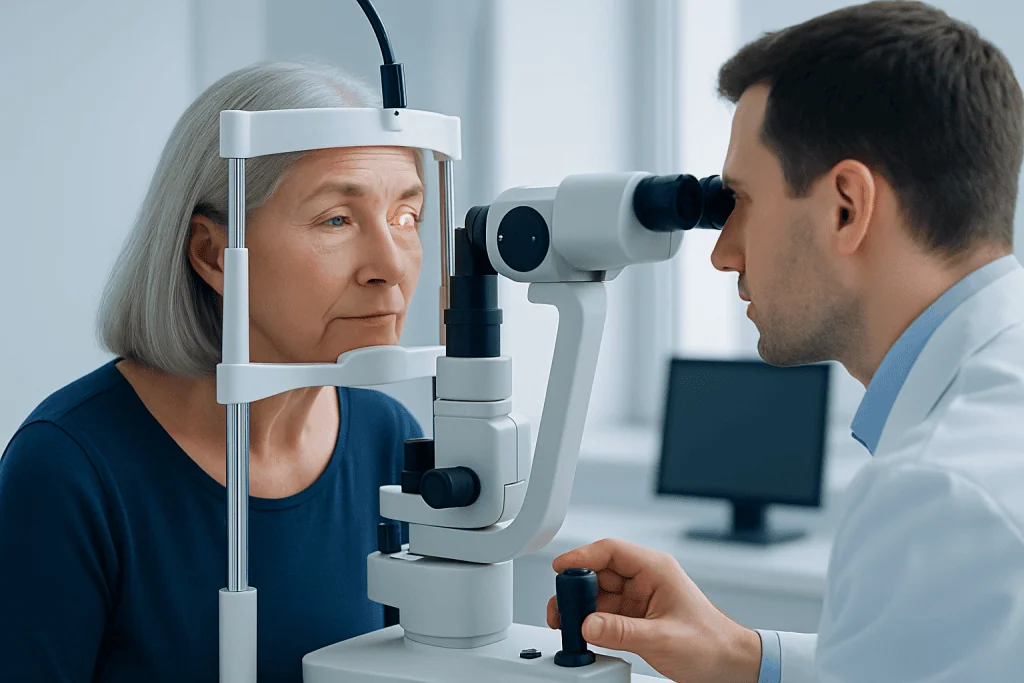
Visual acuity testing measures how clearly each eye sees at a distance, and refraction determines whether an updated glasses prescription improves vision. The clinician then examines the front of the eye with a slit lamp, a microscope that allows detailed viewing of the cornea, lens and other structures. Dilating drops may be used to widen the pupil so the lens and retina can be examined more fully.
The eye specialist also checks for other possible reasons for reduced vision. These may include macular degeneration, diabetic retinopathy, glaucoma, corneal disease or optic nerve problems. If cataract surgery is being considered, further measurements of the eye are taken to support planning for the artificial intraocular lens that replaces the cloudy natural lens.
Treatment Options and Timing of Surgery
In the early stages, a cortical cataract may be managed by monitoring symptoms and optimizing vision with updated glasses, appropriate lighting, anti-glare measures or magnifying aids. These approaches can improve comfort for some people, but they cannot remove or reverse the cloudiness in the lens. No eye drop, supplement or exercise has been proven to dissolve an established cataract.
Cataract surgery is the only definitive treatment. It is usually recommended based on an individual’s visual needs rather than waiting for a cataract to become “mature.” Surgery may be appropriate when glare, blurred vision or reduced contrast makes daily tasks difficult, affects driving safety, interferes with work or hobbies, or prevents the clinician from monitoring or treating another eye condition.
During the usual procedure, the surgeon removes the cloudy lens through a small incision and replaces it with a clear artificial intraocular lens. Modern cataract surgery is commonly performed as an outpatient procedure. The choice of lens and surgical approach is individualized and depends on eye measurements, lifestyle goals, other eye diseases and the person’s overall health.
People should discuss expected benefits, possible risks and recovery instructions with their surgeon. Vision often improves after healing, but the final result can be influenced by conditions affecting the retina, cornea or optic nerve. Acibadem International’s multidisciplinary specialists and JCI-accredited hospitals evaluate and treat cataracts for international patients when surgical care is needed.
Prevention and Everyday Eye Care
Not all cortical cataracts can be prevented, particularly those related to aging. However, protecting overall eye health may help reduce modifiable risks. Wearing sunglasses that block ultraviolet A and ultraviolet B rays, along with a brimmed hat in strong sunlight, is a practical way to limit ultraviolet exposure.
People with diabetes can support eye health by working with their healthcare team to manage blood glucose, blood pressure and cholesterol. Avoiding smoking is also beneficial for eye and general health. Anyone using steroid medication should not stop it independently, but can ask the prescribing clinician whether the dose, duration and eye-monitoring plan remain appropriate.
A balanced eating pattern that includes fruits, vegetables, whole grains and protein sources supports general health, although it should not be viewed as a cure for cataracts. Regular comprehensive eye examinations are especially valuable for adults with diabetes, a past eye injury, long-term steroid treatment, a family history of eye disease or new changes in vision.
When to Seek Medical Care
A routine appointment with an eye care professional is appropriate for gradually increasing glare, blurred vision, difficulty reading, problems with night driving, halos around lights or a glasses prescription that no longer seems effective. These symptoms may be due to a cataract, but they can also occur with other eye conditions that need assessment.
Urgent medical evaluation is important for sudden vision loss, a curtain or shadow across vision, new flashes of light, a sudden increase in floaters, significant eye pain, marked redness, severe headache with visual symptoms, or vision changes after an eye injury. These are not typical signs of an uncomplicated cortical cataract and may indicate a different condition requiring prompt care.
People considering cataract surgery can ask how the cataract is affecting their vision, whether another eye condition is present, what type of intraocular lens may be suitable and what recovery may involve. A personalized discussion helps ensure that the timing of treatment reflects both eye findings and the person’s daily visual needs.
Frequently asked questions
Is a cortical cataract serious?
A cortical cataract is usually not an emergency and often develops slowly. However, it can increasingly affect visual comfort, driving and daily activities as it progresses. Regular eye examinations help determine its effect and rule out other causes of vision loss.
What does a cortical cataract look like?
During an eye examination, it may appear as white or gray wedge-shaped spokes starting at the outer edge of the lens. These changes are inside the eye and are not usually visible to the person or to others without specialized examination equipment.
Can glasses correct a cortical cataract?
New glasses may improve vision in the early stages if refractive error is also present. However, glasses cannot clear the cloudy lens or fully correct symptoms such as glare and halos when the cataract becomes more significant. Cataract surgery is the definitive treatment.
How quickly does a cortical cataract progress?
Progression varies widely between individuals. Some cortical cataracts change little over years, while others become troublesome more quickly because of age, diabetes, steroid use or other factors. Eye examinations can monitor changes over time.
Is cataract surgery needed immediately after diagnosis?
No. Surgery is generally not needed simply because a cataract is found. It is usually considered when cataract-related vision changes interfere with daily activities, safety, work, hobbies or management of another eye condition.
Can a cortical cataract cause night-driving problems?
Yes. Light scattering from a cortical cataract can make headlights and streetlights seem glaring, create halos and reduce contrast in low-light settings. Anyone who feels unsafe driving at night should arrange an eye assessment and consider limiting night driving until vision is evaluated.
References
- American Academy of Ophthalmology
- National Eye Institute
- Mayo Clinic
- National Health Service
- World Health Organization
This article is for general information only and is not a substitute for professional medical advice. Please consult a qualified doctor about your individual situation.
Explore treatments in Turkey — costs, top hospitals & a free quote
JCI-accredited · board-certified surgeons · reply within 24h
Add us as a Preferred Source to see more of our trusted health content across Google Search, AI Overviews and Discover.