Dhi hair transplant Risks & Side Effects Explained by Surgeons

Common short-term effects include redness, mild swelling, itching, scabbing and temporary numbness. Less common complications include infection, bleeding, folliculitis, visible scarring and unsatisfactory graft growth.
Key Takeaways
- Common short-term effects include redness, mild swelling, itching, scabbing and temporary numbness.
- Less common complications include infection, bleeding, folliculitis, visible scarring and unsatisfactory graft growth.
- Hair shedding after transplantation can be expected in the early months; visible new growth usually takes time.
- Careful candidate assessment, sterile technique and aftercare reduce risk but cannot guarantee a particular cosmetic result.
- A surgeon should assess the cause and pattern of hair loss, donor hair supply and general health before treatment.
DHI hair transplant risks are generally manageable when the procedure is planned and performed by qualified clinicians, but no hair restoration method is risk-free. Understanding normal healing, possible complications and realistic results can help people make an informed decision.
DHI Hair Transplant Risks: The Short Answer
DHI hair transplant risks are usually mild and short-lived. Redness, swelling, tenderness, small scabs, itching and temporary reduced sensation can occur in the donor and recipient areas during healing. These effects are commonly part of the normal recovery process and generally improve with appropriate aftercare.
Less common but important complications can include infection, prolonged bleeding, inflammation around follicles, scarring, uneven hair direction, low graft survival or a result that does not meet expectations. The likelihood of complications depends on factors such as the person’s health, the quality and availability of donor hair, the surgical plan, clinic hygiene and following recovery instructions.
DHI, or direct hair implantation, is one approach to hair transplantation. It may be suitable for some people with pattern hair loss, but it does not stop future loss of the person’s existing, non-transplanted hair. A consultation with an experienced hair restoration clinician is essential to assess whether the procedure is appropriate and to discuss expected outcomes.
How DHI Hair Transplantation Works
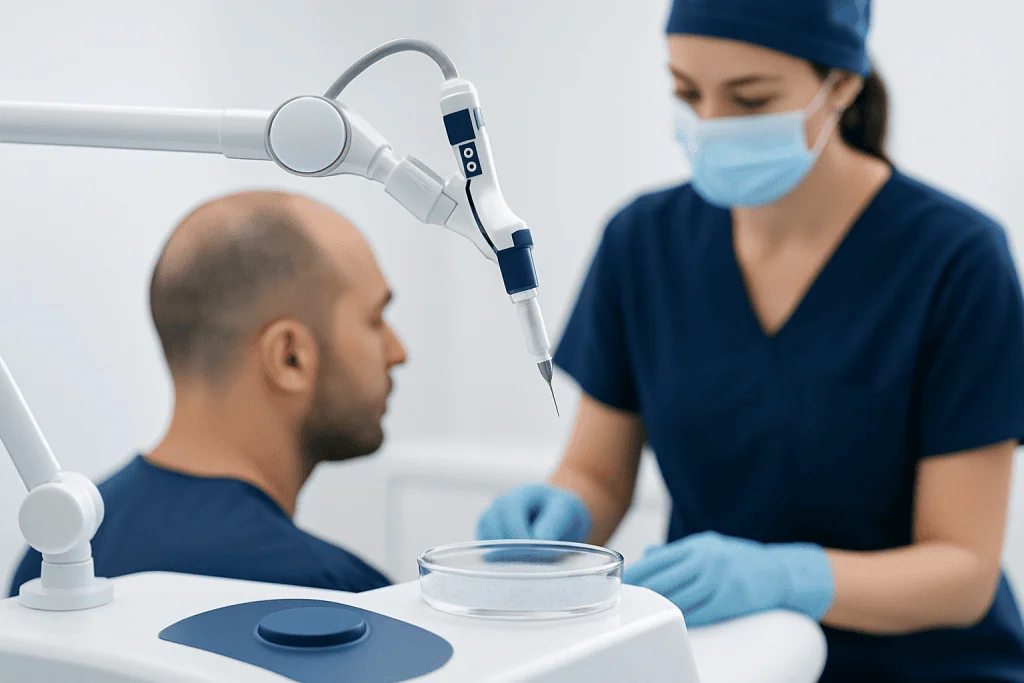
In DHI, individual follicular units are usually removed from a donor area, most often the back or sides of the scalp, using a small punch instrument. The grafts are then implanted into areas of thinning or baldness with a pen-like implantation device. This device is designed to place grafts at a selected angle, direction and depth.
Like follicular unit extraction (FUE), DHI commonly relies on individually harvested grafts rather than removing a strip of scalp. The main practical difference is the method used to implant grafts. Whether DHI offers an advantage for a particular person depends on the hair-loss pattern, scalp features, number of grafts needed and the team’s experience, rather than the name of the technique alone.
People considering this option can read more about DHI hair transplantation as part of an informed discussion with a qualified clinician. A careful treatment plan should protect the donor area and consider how hair loss may progress over time.
The transplanted follicles may shed their hair shafts in the weeks after surgery. This does not necessarily mean the transplant has failed. The follicles commonly enter a resting phase before new hairs begin to grow, so results develop gradually rather than immediately.
Who May Be a Suitable Candidate?

Suitable candidates typically have stable or reasonably predictable hair loss, adequate donor hair density and realistic expectations about coverage. DHI may be considered for adults with androgenetic alopecia, also called male- or female-pattern hair loss, when a specialist believes donor follicles can be safely redistributed.
A clinician should first identify the cause of hair loss. Sudden diffuse shedding, patchy hair loss, scalp inflammation, iron deficiency, thyroid disorders, medication effects and some autoimmune conditions may require medical evaluation or treatment before hair transplantation is considered. Transplantation may not be appropriate while an active scalp disorder is untreated.
Smoking, poorly controlled diabetes, bleeding disorders, immune suppression, certain medicines and a history of abnormal scarring can affect surgical planning and healing. People should disclose all medical conditions, allergies, supplements and prescribed or non-prescribed medicines. They should not stop medication without advice from the clinician who prescribed it.
Good candidacy also includes emotional readiness and realistic cosmetic goals. A transplant redistributes existing follicles; it does not create new donor hair. When donor supply is limited, the surgeon may recommend a conservative hairline or non-surgical management to preserve options for the future.
What Happens During the Procedure?
Before the procedure, the team examines the scalp, photographs the hair pattern and discusses a proposed hairline and distribution of grafts. The donor and recipient areas are usually trimmed or prepared, then local anaesthetic is used to numb the skin. People remain awake, although the exact arrangements vary by clinic and individual needs.
Follicular units are extracted one at a time from the donor region. The clinical team sorts and protects the grafts while planning their placement. With DHI, grafts are loaded into an implantation device and inserted into the recipient area. The surgeon aims to follow natural hair direction and avoid excessive density that could compromise graft survival or donor-area appearance.
The procedure may take several hours and sometimes be divided into sessions, depending on the number of grafts and the treatment plan. Mild pressure, pulling or discomfort may be felt despite local anaesthesia, but significant pain should be communicated to the team promptly.
Following the procedure, the scalp has many tiny wounds in both the donor and recipient areas. Written aftercare instructions should explain cleansing, sleep position, activity restrictions, medicines if prescribed and how to contact the clinic with concerns. Clear instructions are an important part of reducing DHI hair transplant risks.
Common Side Effects and Recovery Timeline
During the first few days, mild swelling of the forehead or scalp, redness, tenderness and small crusts around implanted grafts are common. Some people also notice tightness, itching or temporary numbness. The appearance can vary according to skin type, the number of grafts and the individual healing response.
Small scabs typically form around the grafts and should not be picked or forcibly removed. The clinic will advise when and how to wash the scalp. Protecting grafts from rubbing, scratching and accidental trauma is particularly important in the early recovery period.
Within several weeks, many transplanted hairs fall out. This temporary shedding is often referred to as shock shedding and can be emotionally difficult, but it may be a normal phase after transplantation. New growth often starts gradually after a few months, while the cosmetic result continues to mature over many months.
The donor region usually heals with tiny dot-like scars that may be difficult to see once surrounding hair grows. However, scarring can be more noticeable in some individuals, especially if many grafts are taken, healing is impaired or hair is worn very short. Recovery advice should be individualized by the operating clinical team.
- First week: redness, scabbing and mild swelling are common; graft protection is important.
- Weeks 2 to 8: crusting resolves and temporary shedding may occur.
- Months 3 to 6: early new growth may become visible.
- Months 9 to 12 and beyond: density and hair texture may continue to mature.
Possible Complications and How Risk Is Reduced
Although serious problems are uncommon, infection can develop after any skin procedure. Warning signs include increasing pain, spreading redness, warmth, pus, fever or feeling unwell. Folliculitis, an inflammation around hair follicles, can also occur and may cause tender bumps or pustules. Prompt medical assessment helps identify whether treatment is needed.
Other potential DHI hair transplant complications include prolonged swelling, bleeding, delayed healing, persistent numbness, cysts, ingrown hairs and scarring. Graft-related concerns include poor survival, patchy density, an unnatural-looking hairline, hair growing in an unwanted direction or continued thinning of the surrounding native hair. Revision procedures may be possible in selected cases, but should not be assumed.
Risk reduction starts before surgery. A clinician should assess scalp health, donor capacity, hair-loss progression and relevant medical conditions. Sterile technique, experienced graft handling, an appropriate number of grafts and careful placement are important. Equally, people should follow aftercare advice, avoid smoking if advised, protect the scalp from sun exposure and attend follow-up appointments.
Results can be influenced by future androgenetic hair loss. A clinician may discuss evidence-based medical options to help maintain existing hair when appropriate. These options are not suitable for everyone, so decisions should be based on individual medical history and a balanced discussion of benefits and possible adverse effects.
When to Seek Medical Care
Contact the operating clinic or another qualified healthcare professional promptly if pain, swelling or redness is worsening rather than improving, or if there is discharge, an unpleasant smell, fever, persistent bleeding or a rash. These symptoms may indicate infection, an allergic reaction or another issue that needs assessment.
Urgent medical care is appropriate for signs of a severe allergic reaction, such as difficulty breathing, swelling of the lips, tongue or face, fainting, or widespread hives. These symptoms are not expected after routine hair transplantation and should not be managed by waiting at home.
People should also arrange review if they are concerned about delayed healing, significant scarring, persistent numbness, painful bumps or unexpectedly extensive hair loss. A clinician can determine whether the change is part of normal recovery, shock shedding or a complication requiring treatment.
Acibadem International’s multidisciplinary specialists and JCI-accredited hospitals assess and treat hair and scalp concerns for international patients, including evaluation of suitability and follow-up after hair restoration procedures.
Making an Informed Decision About DHI
A reputable consultation should include discussion of the diagnosis, donor-area limitations, the expected number of sessions, alternative approaches and the possibility of ongoing hair loss. It should also include an honest explanation that a transplant can improve coverage but cannot reliably recreate the density of an untouched scalp.
Before choosing a provider, people can ask who will perform the graft extraction and implantation, what medical oversight is available, how complications are managed and what follow-up is provided. They may also ask to see outcomes in patients with similar hair type, degree of hair loss and treatment goals, while recognizing that individual results vary.
It can be helpful to discuss whether hair transplantation should be combined with medical management or whether waiting is safer when hair loss is rapid or the pattern is unclear. An individualized plan is generally more valuable than selecting a procedure based solely on a marketing term.
For people concerned about ongoing thinning, a dermatologist or hair restoration surgeon can assess the scalp and explain appropriate options. Shared decision-making supports a treatment choice that balances potential benefits, DHI hair transplant risks and long-term hair preservation.
Frequently asked questions
Are DHI hair transplant risks different from FUE risks?
DHI and FUE both commonly involve harvesting individual follicular units, so many risks overlap. These include temporary swelling, scabbing, infection, scarring, shock shedding and variable graft growth. The implantation method differs, but the clinician’s planning, technique and aftercare remain central to safety.
Is swelling normal after a DHI hair transplant?
Mild scalp or forehead swelling can occur in the first days after a transplant and often settles with time. The treating team may recommend practical measures to support recovery. Worsening swelling, severe pain, spreading redness or fever should be assessed promptly.
Can a DHI hair transplant fail?
Not all transplanted follicles will necessarily grow, and the degree of growth can vary. Poor graft survival, patchy density, continued loss of existing hair or an outcome that does not meet cosmetic expectations are possible. A careful assessment of donor supply and a realistic long-term plan can reduce, but not eliminate, these risks.
When can a person wash their hair after DHI?
The timing and technique for washing depend on the clinic’s protocol and the individual procedure. People should follow their surgical team’s written instructions and avoid rubbing, scratching or dislodging early grafts. If instructions are unclear, they should contact the clinic before washing.
Does DHI leave scars?
DHI typically leaves small scars where follicles were extracted and implanted. These often become less noticeable as healing progresses and surrounding hair grows, but scarring can be more visible in some people. Skin type, healing tendency, graft number and surgical technique all affect scar appearance.
How long does it take to see DHI hair transplant results?
Initial transplanted hairs may shed in the weeks after the procedure, followed by a period with little visible change. New growth often becomes noticeable after several months, and the appearance can continue to improve for around a year or longer. The exact timeline differs between individuals.
References
- American Academy of Dermatology Association
- International Society of Hair Restoration Surgery
- Mayo Clinic
- National Health Service
This article is for general information only and is not a substitute for professional medical advice. Please consult a qualified doctor about your individual situation.
DHI Hair Transplant in Turkey — costs, top hospitals & a free quote
JCI-accredited · board-certified surgeons · reply within 24h
Add us as a Preferred Source to see more of our trusted health content across Google Search, AI Overviews and Discover.

Hair Transplant
Modern FUE and DHI hair restoration with natural, lasting results.
More from the Health Library



Related Specialists
Assoc. Prof. Dr. Bahadır Topuz
Urology
Prof. Dr. Erkan Özcan
Psychiatry
Dr. Caner İşkorur
Emergency Service
Assoc. Prof. Dr. Gökhan Ergene
Thoracic Surgery