Drugs for Hair Fall: Procedure, Recovery and Results

The most appropriate drug for hair fall depends on the cause, not just the amount of shedding. Topical minoxidil is a widely used first-line medicine for pattern hair loss in adults.
Key Takeaways
- The most appropriate drug for hair fall depends on the cause, not just the amount of shedding.
- Topical minoxidil is a widely used first-line medicine for pattern hair loss in adults.
- Prescription medicines such as finasteride, spironolactone, oral minoxidil, or other treatments may be suitable for selected patients.
- Hair treatment with medicines has no surgical recovery period, but visible benefits usually require several months of consistent use.
- Temporary shedding can occur when starting minoxidil, while sudden, patchy, painful, or scarring hair loss needs medical assessment.
Drugs for hair fall can help slow shedding and improve hair density when the cause is suitable for medication, especially pattern hair loss. A dermatologist can identify the type of hair loss, recommend a safe treatment plan, and set realistic expectations for results.
Drugs for Hair Fall: Overview, Procedure and Results
Drugs for hair fall can reduce shedding and support regrowth in some forms of hair loss, particularly hereditary pattern hair loss. No medication works for every type of hair fall, so the most effective option depends on an accurate diagnosis, overall health, age, sex, pregnancy plans, and the pattern of hair thinning.
Hair fall is a broad term that may describe normal daily shedding, gradual thinning around the crown or hairline, sudden diffuse shedding, or distinct bald patches. Medicines tend to work best when hair follicles are still present but producing finer, shorter hairs. They are less likely to restore hair where follicles have been permanently damaged by a scarring scalp condition.
Drug treatment is not a surgical procedure and does not require a physical recovery period. The usual process involves a clinical assessment, sometimes scalp examination or blood tests, followed by regular treatment and follow-up. With medicines such as minoxidil, early changes may be seen after three to six months, while a fair assessment of results often takes six to twelve months. Continuing treatment is usually needed to maintain benefits.
Choosing the Right Medicine for the Type of Hair Loss
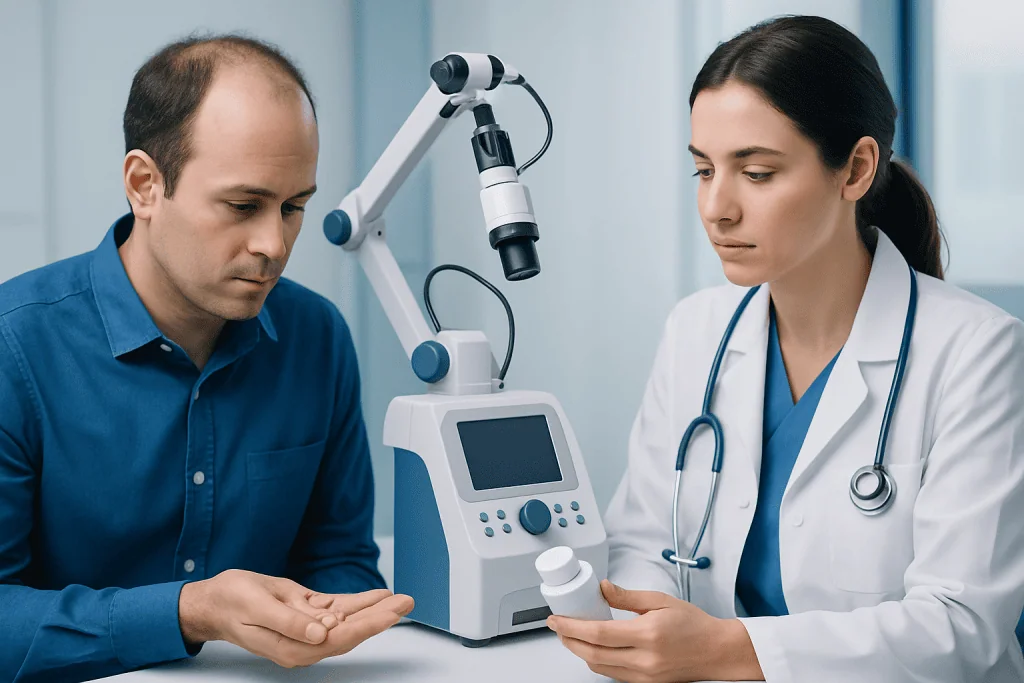
Androgenetic alopecia, also called pattern hair loss, is the most common reason people seek drugs for hair fall. It often causes gradual thinning at the top of the scalp in men and widening of the central part in women. Topical minoxidil is commonly used for this condition, while prescription medicines that reduce the effects of androgens may be considered for appropriate patients.
Other causes need different care. Telogen effluvium is a temporary increase in shedding that can follow illness, surgery, childbirth, major stress, rapid weight loss, nutritional deficiency, or some medicines. Managing the trigger is often more important than starting a hair-loss drug. Alopecia areata can cause round patches of hair loss and may require dermatologist-led treatments that target inflammation or immune activity. Scarring hair loss needs timely review because early treatment may help protect remaining follicles.
A clinician may ask about family history, recent illnesses, dietary changes, menstrual history, medicines, styling practices, and scalp symptoms. Examination with dermoscopy can help distinguish conditions, and selected people may need tests for iron status, thyroid disease, or other contributing concerns. Options such as oral minoxidil, finasteride, dutasteride, or spironolactone should only be considered after an individual safety review, as approval status and suitability differ between countries and patient groups.
What is the most successful treatment for hair loss?

There is no single most successful treatment for every form of hair loss. For people with pattern hair loss, topical minoxidil is one of the best-supported starting medicines and is suitable for many adults. The most successful plan is usually the one that matches the diagnosis, can be used consistently, and has an acceptable safety profile for the individual.
For adult men with androgenetic alopecia, prescription finasteride may slow further loss and improve density, and combining it with topical minoxidil may offer greater benefit than either treatment alone for some patients. Finasteride is not suitable for everyone and requires discussion of possible sexual, mood-related, fertility, and pregnancy-related considerations. Dutasteride may sometimes be prescribed by specialists, often outside its approved hair-loss indication, but it has similar important precautions.
For women with pattern hair loss, topical minoxidil is often the first medication considered. In selected cases, a doctor may discuss oral minoxidil or medicines such as spironolactone, particularly where signs of androgen sensitivity are present. Hair transplantation can improve coverage for carefully selected people with stable pattern loss, but it does not stop the underlying process; medical treatment may still be recommended to preserve existing hair.
Is there a downside to using minoxidil?
Minoxidil can be helpful, but it does have potential downsides. Topical minoxidil may cause scalp itching, dryness, flaking, redness, or contact dermatitis, sometimes due to ingredients in the formulation rather than minoxidil itself. Applying more than directed does not improve results and may increase the chance of side effects.
Some people notice temporary increased shedding during the first weeks after starting treatment. This can happen as hairs shift into a new growth cycle and does not always mean treatment is failing. Unwanted facial or body hair can occur if the medicine spreads beyond the scalp, so users should apply it carefully and wash their hands afterward.
Topical minoxidil is absorbed into the bloodstream only in small amounts when used correctly, but people should seek medical advice if they develop dizziness, a fast heartbeat, chest discomfort, faintness, or swelling. Oral minoxidil can have more whole-body effects, including changes in blood pressure, fluid retention, and increased heart rate, and should only be used under medical supervision. Minoxidil is generally avoided during pregnancy and breastfeeding unless a qualified clinician advises otherwise.
What did Jennifer Lopez use for hair loss?
There is no reliable, medically verified public information confirming which treatment Jennifer Lopez used for hair loss, if any. Celebrity interviews, advertisements, and social media posts may discuss beauty routines or hair products, but they should not be treated as evidence that a particular medicine is effective or appropriate for another person.
Hair extensions, frequent heat styling, tight hairstyles, coloring, and chemical treatments can affect hair appearance and may contribute to breakage or traction-related hair loss in some people. However, it is not possible to determine an individual’s diagnosis or treatment from photographs, public appearances, or promotional content.
Rather than copying a celebrity routine, a person concerned about hair fall should focus on the cause of their own shedding. A dermatologist can help distinguish hair breakage from follicle-related hair loss and recommend evidence-based treatment where needed.
What are the big 3 hair loss treatments?
The phrase big 3 hair loss treatments usually refers to topical minoxidil, finasteride, and ketoconazole shampoo. It is an informal term used online rather than an official medical treatment guideline. These options are most often discussed for androgenetic alopecia, particularly male pattern hair loss.
- Minoxidil: a topical medicine that can prolong the growth phase of hair follicles.
- Finasteride: a prescription medicine that reduces conversion of testosterone to dihydrotestosterone, a hormone involved in pattern hair loss.
- Ketoconazole shampoo: an antifungal shampoo often used for dandruff or seborrheic dermatitis; its role in direct hair regrowth is less established.
Ketoconazole may improve scalp flaking or inflammation when these are present, but it should not be viewed as a replacement for proven hair-loss treatments. Finasteride is not appropriate during pregnancy and is not routinely suitable for all women. A clinician can help decide whether one medicine, a combination, or a different approach is safer and more likely to help.
When to Seek Medical Care
Medical assessment is recommended for sudden or rapidly worsening hair loss, round bald patches, loss of eyebrows or eyelashes, scalp pain, burning, pus, marked scaling, or shiny areas without visible follicles. These features may point to a condition that needs prompt treatment. A person should also consult a clinician if hair fall begins after a new medicine, significant illness, childbirth, restrictive dieting, or unexplained weight change.
Anyone using a hair-loss medicine should contact their clinician about troublesome side effects. Urgent medical care is appropriate for chest pain, fainting, severe shortness of breath, significant swelling, or a rapid heartbeat. Acibadem International coordinates diagnosis and treatment for international patients through multidisciplinary specialists at its JCI-accredited hospitals.
Frequently asked questions
How long do drugs for hair fall take to work?
Hair growth is slow, so medicines generally need consistent use for several months before changes are visible. With minoxidil, some people notice early shedding before improvement. A clinician will often review progress after six to twelve months using examination and, when helpful, standardized photographs.
Can hair-loss medicines reverse a receding hairline?
Medicines may slow further recession and sometimes thicken miniaturized hairs, especially when treatment begins early. Regrowth at the front hairline can be less predictable than improvement at the crown. Results vary according to the duration and severity of pattern hair loss.
Can minoxidil and finasteride be used together?
For selected adult men with pattern hair loss, a clinician may recommend topical minoxidil and prescription finasteride together. Combination treatment is not automatically suitable for everyone, because finasteride has important potential side effects and pregnancy-related precautions. A medical review is needed before starting or changing treatment.
Do women have safe medication options for hair fall?
Many women with pattern hair loss can use topical minoxidil, subject to individual advice. In certain circumstances, a doctor may also consider oral minoxidil or spironolactone. Pregnancy plans, breastfeeding, menstrual history, blood pressure, and other health conditions all affect which option is appropriate.
Will hair fall return after stopping treatment?
With pattern hair loss, benefits from medicines are usually maintained only while treatment continues. If minoxidil or another effective medicine is stopped, the hair supported by treatment may gradually shed over the following months. A clinician can advise whether tapering, switching, or continued treatment is appropriate.
Should biotin or other supplements be taken for hair fall?
Supplements are most useful when testing or dietary assessment identifies a true deficiency, such as low iron in an appropriate clinical context. Taking high-dose vitamins without a demonstrated need may not improve hair growth and can sometimes interfere with laboratory tests or cause harm. A balanced diet and treatment of confirmed underlying conditions are generally more useful than routine supplements.
References
- American Academy of Dermatology Association
- United States Food and Drug Administration
- National Institute of Arthritis and Musculoskeletal and Skin Diseases
- British Association of Dermatologists
This article is for general information only and is not a substitute for professional medical advice. Please consult a qualified doctor about your individual situation.
Hair transplant in Turkey — costs, graft counts & a free assessment
JCI-accredited · board-certified surgeons · reply within 24h
Add us as a Preferred Source to see more of our trusted health content across Google Search, AI Overviews and Discover.

More from the Health Library



Related Specialists

Fzt. Yaren Yıldız
Physical Medicine & Rehabilitation
Dr. Meltem Hüner
Infectious Diseases & Clinical Microbiology
Dr. Ahmet Ali Aktaş
General Surgery
Dr. Selim Tansal
Cardiovascular Surgery