Tricep Tendonitis Treatment: How It Works, Results and What to Expect

Tricep tendonitis is usually managed with temporary activity modification and progressive rehabilitation rather than surgery. Pain at the back of the elbow that worsens with pushing or straightening the arm is a common feature.
Key Takeaways
- Tricep tendonitis is usually managed with temporary activity modification and progressive rehabilitation rather than surgery.
- Pain at the back of the elbow that worsens with pushing or straightening the arm is a common feature.
- Recovery varies with tendon irritation, activity demands and adherence to a graded return-to-exercise plan.
- Imaging may be used when symptoms persist, strength is reduced or a partial or complete tendon tear is suspected.
- Sudden pain, swelling, bruising or inability to straighten the elbow after an injury needs prompt medical assessment.
Tricep tendonitis treatment focuses on reducing strain on the tendon, controlling pain and gradually rebuilding strength around the elbow. Most people improve without surgery when the condition is assessed early and rehabilitation is progressed carefully.
Overview: How tricep tendonitis treatment works
Tricep tendonitis treatment usually starts with reducing the movements that repeatedly overload the tendon, such as heavy pushing, dips, forceful throwing or repetitive overhead work. The aim is not complete long-term rest, but a temporary reduction in painful load followed by a gradual, structured return to strength and daily activity. This gives the irritated tendon an opportunity to settle while helping the arm maintain movement and function.
The triceps tendon connects the triceps muscle at the back of the upper arm to the point of the elbow, called the olecranon. It helps straighten the elbow. Tendon pain in this area is sometimes called triceps tendinopathy, because longer-lasting symptoms can involve changes in the tendon rather than short-term inflammation alone. A clinician can also distinguish it from other causes of posterior elbow pain, including bursitis, arthritis, nerve irritation or a different elbow tendon condition.
Most people improve with non-surgical care. Treatment is individualized according to symptoms, examination findings, sports or work requirements, and whether there has been a sudden injury. Surgery may be considered when there is a substantial tendon tear, loss of elbow extension strength, or persistent symptoms despite a well-supervised course of conservative treatment.
Symptoms, causes and who may benefit from treatment
Tricep tendonitis commonly causes aching, tenderness or stiffness just above or at the back of the elbow. Pain may be most noticeable while pushing up from a chair, doing press-ups, bench pressing, throwing, lifting, or fully straightening the elbow against resistance. Some people notice mild swelling or discomfort after activity, while others experience reduced confidence or strength when pushing.
The problem often develops from a rapid increase in training volume, repeated forceful elbow extension, poor recovery between sessions, or changes in technique or equipment. It can affect athletes who perform weight training, throwing or racket sports, as well as people whose work involves repeated lifting or pushing. Previous elbow injury, reduced shoulder or wrist control, and training through persistent pain may contribute.
Non-surgical treatment is generally appropriate for people with gradual-onset symptoms and preserved elbow function. A treatment plan is especially useful when pain is limiting work, exercise, sleep or daily tasks. A sudden pop, marked bruising, a visible change in the tendon area, or new inability to actively straighten the elbow can indicate a tendon rupture rather than simple tendonitis and should be assessed promptly.
Assessment and diagnosis before treatment

A clinician usually begins by asking when symptoms started, which activities provoke pain, whether there was a single injury, and how the problem affects function. During the examination, they may check tenderness along the tendon, elbow movement, triceps strength, swelling, and nearby joints and nerves. Comparing the affected arm with the other side can help identify meaningful weakness or loss of motion.
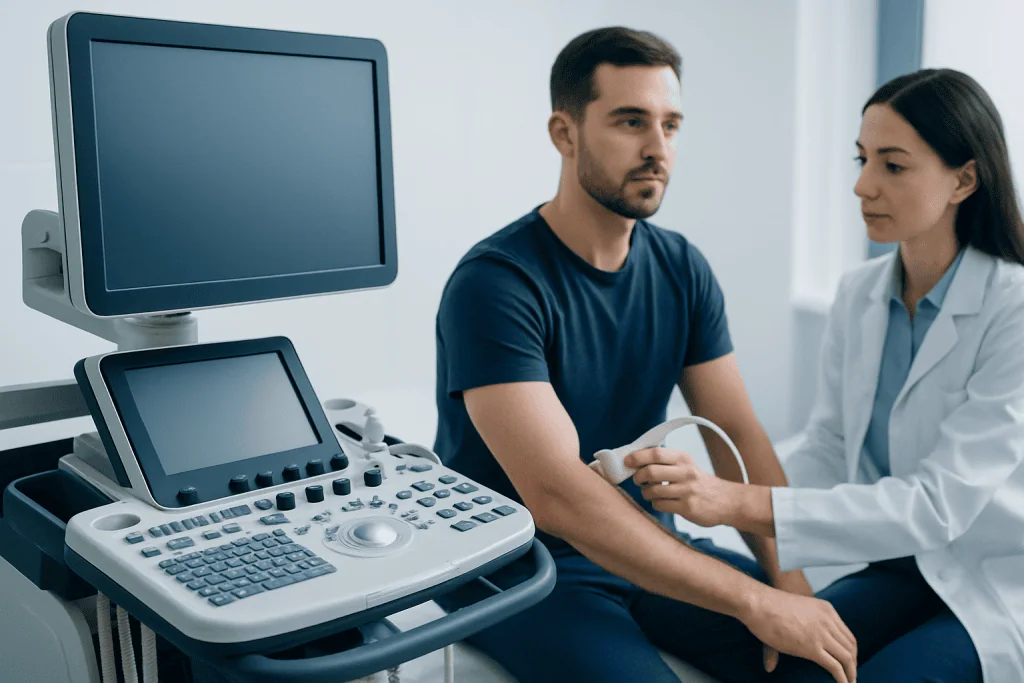
Many cases can be diagnosed clinically. X-rays may be requested if a bone injury, arthritis or calcification is suspected. Ultrasound can examine the tendon dynamically and may help identify thickening or tears. Magnetic resonance imaging may be useful when symptoms are severe, the diagnosis is unclear, or a partial or complete tear needs to be defined before considering surgery.
Accurate assessment matters because treatment differs for tendon irritation and tendon rupture. Persistent pain should not automatically be attributed to tendonitis. A clinician may also consider conditions affecting the elbow joint, the olecranon bursa, the neck, or nerves traveling into the forearm and hand.
Step-by-step: non-surgical tricep tendonitis treatment
Early care usually begins with relative rest. This means pausing or modifying the specific activity that reliably triggers symptoms, rather than avoiding all arm use. For example, a person may temporarily reduce heavy pressing, deep elbow bends under load, or repetitive throwing. Ice or heat may be used for short-term comfort according to personal preference, while over-the-counter pain relief may be considered with advice from a pharmacist or clinician, especially for people with medical conditions or regular medicines.
The next step is progressive rehabilitation, ideally guided by a physiotherapist or other qualified rehabilitation professional. Gentle range-of-motion work may be followed by controlled triceps loading. Exercises commonly progress from low-load isometric contractions to slow resistance exercises, then to sport- or work-specific movements. The right pace is based on symptoms during and after exercise, not on a fixed calendar alone.
Contributors beyond the elbow may also be addressed. This can include shoulder-blade control, shoulder and wrist strength, lifting technique, training schedule, sleep and recovery habits. Physical therapy and rehabilitation can provide a tailored plan, help refine movement patterns and guide a safe return to exercise. Injections are not routine first-line treatment for tendon pain and should only be discussed after a clear diagnosis, because the potential benefits and risks vary by injection type and tendon location.
- Reduce painful loading, while maintaining comfortable movement.
- Reintroduce tendon strength work gradually and consistently.
- Increase weights, repetitions and training frequency one variable at a time.
- Return to demanding pushing or throwing only when strength and function are appropriate.
When surgery is considered: procedure, benefits and risks
Triceps tendon surgery is not the usual treatment for uncomplicated tendonitis. It is mainly considered for a complete rupture, selected significant partial tears, or persistent disabling symptoms that have not improved with appropriately delivered conservative care. An orthopedic specialist reviews examination findings, imaging, activity goals and overall health before recommending an operation.
For a torn tendon, the procedure generally involves reattaching the tendon to the bone at the elbow using strong sutures and, in some cases, anchors or tunnels in the bone. It is performed under anesthesia, so the person does not feel pain during surgery. The exact method depends on the tear pattern, tissue quality and whether the injury is recent or longstanding. In some situations, an orthopedic elbow surgery consultation can clarify whether repair is necessary and what recovery would involve.
Potential benefits of successful repair include restoration of elbow extension strength and improved function. Risks include infection, bleeding, stiffness, wound problems, nerve irritation, blood clots, ongoing pain, tendon re-tear and the possible need for further treatment. Although complications are uncommon, no procedure can guarantee a particular result. The treating team explains individualized risks and expected rehabilitation before surgery.
Recovery timeline and realistic results
Recovery from non-surgical tricep tendonitis varies. Mild, recent irritation may settle over several weeks when aggravating loads are reduced and rehabilitation begins early. Symptoms that have been present for months, or that are linked to continuing high-demand activity, can take several months to improve. A gradual upward trend in comfort, strength and function is more meaningful than the absence of every sensation immediately.
After tendon repair surgery, the elbow is commonly protected in a brace or splint initially, followed by carefully guided motion and strengthening. Rehabilitation often takes months because the repaired tendon needs time to heal before it can safely tolerate heavy resistance, contact, throwing or intense upper-body training. Return to a demanding sport or occupation depends on healing, strength testing, range of motion and the surgeon’s guidance.
Results are generally best when the diagnosis is accurate, the person follows activity restrictions, and loading is increased progressively rather than quickly. Continuing to test the tendon with painful maximal lifts or repeated forceful movements can delay recovery. If symptoms plateau or worsen, reassessment is more helpful than simply pushing through pain.
How long does it take for tricep tendonitis to heal?
There is no single healing time for tricep tendonitis. Mild cases may improve within a few weeks, while longer-lasting tendon pain often requires several months of progressive loading and activity adjustment. The duration depends on how long symptoms have been present, the degree of tendon involvement, daily demands on the elbow and whether a person can modify the activities that trigger pain.
Recovery does not always occur in a straight line. A small temporary increase in symptoms after rehabilitation can happen, but pain that becomes steadily worse, affects daily use, or is accompanied by weakness should be reviewed. A clinician or physiotherapist can adjust the plan and check for another cause of pain or a tendon tear.
Is tricep tendon surgery painful?
Triceps tendon surgery is performed with anesthesia, so pain is not felt during the operation. Afterward, discomfort, swelling and stiffness are expected for a period of time, but these are managed with the pain-control plan provided by the surgical team. The arm may be protected in a splint or brace, and patients are given instructions on wound care, safe movement and medicines.
Postoperative discomfort typically improves as the tissues heal, although rehabilitation can involve temporary soreness as movement and strength are rebuilt. Severe or increasing pain, fever, wound drainage, marked swelling, new numbness or color changes in the hand should be reported promptly to the surgical team.
What is the fastest way to heal tricep tendonitis?
The fastest safe approach is usually early load management combined with a targeted rehabilitation plan. This means stopping or reducing the exact movements that provoke pain, maintaining comfortable arm movement, and then rebuilding triceps capacity gradually. Trying to train through significant pain, taking complete rest for a prolonged period, or rapidly returning to heavy lifting can slow progress.
Good recovery also depends on addressing the reason the tendon became overloaded. A clinician or physiotherapist may review training volume, exercise technique, recovery days and related shoulder or wrist weakness. Adequate sleep, balanced nutrition and avoiding sudden spikes in activity can support recovery, but they do not replace an appropriate diagnosis and rehabilitation plan.
Does tendonitis ever fully go away?
Yes. Many people with tendonitis or tendinopathy regain comfortable daily function and return to their usual exercise or work after appropriate treatment. Some may continue to notice occasional mild symptoms during unusually heavy or unfamiliar activity, particularly if the tendon is loaded more quickly than it has been conditioned to tolerate.
Long-term improvement is supported by maintaining strength, increasing training demands gradually and responding early to recurring pain. A previous tendon problem does not mean a person must permanently avoid exercise. It does mean that a thoughtful return-to-load plan is important, especially after prolonged symptoms or a tendon injury.
When to seek medical care
Medical assessment is advisable when elbow pain lasts more than a few weeks, repeatedly returns, limits work or sport, or does not improve with sensible activity changes. It is also appropriate when there is visible swelling, progressive weakness, reduced ability to straighten the arm, nighttime pain, numbness or tingling, or uncertainty about the diagnosis.
Urgent assessment is important after a sudden injury that causes a pop, immediate weakness, substantial bruising, deformity or inability to extend the elbow. These symptoms can be associated with a significant tendon tear and benefit from timely evaluation. People with fever, increasing redness or warmth around the elbow, or a wound should also seek prompt care.
Acibadem International’s multidisciplinary specialists and JCI-accredited hospitals can assess elbow tendon problems and coordinate orthopedic, imaging and rehabilitation care for international patients. A qualified clinician can help identify the safest treatment plan based on the individual’s symptoms, examination and goals.
Frequently asked questions
Can tricep tendonitis heal without surgery?
Yes. Most cases of gradual-onset triceps tendon pain improve without surgery through activity modification, symptom management and progressive strengthening. Surgery is more commonly considered for substantial tendon tears or persistent, function-limiting symptoms that have not responded to appropriate non-surgical care.
Should a person exercise with tricep tendonitis?
Comfortable movement and carefully selected exercises are often part of recovery, but painful heavy pushing or forceful elbow extension may need to be reduced temporarily. A physiotherapist can help select exercises and progress them according to symptoms and function.
What activities commonly aggravate triceps tendon pain?
Heavy bench pressing, dips, push-ups, overhead throwing, forceful pushing and repetitive lifting can aggravate the triceps tendon. The exact trigger differs between individuals, so identifying and temporarily modifying the provoking movement is useful.
Can massage cure tricep tendonitis?
Massage may provide short-term relief for surrounding muscle tightness in some people, but it does not repair an overloaded tendon on its own. Recovery is more reliably supported by managing aggravating activity and gradually rebuilding tendon strength.
Is heat or ice better for tricep tendonitis?
Either may be used briefly for comfort depending on what feels helpful. Ice can be soothing after an activity-related flare, while heat may feel better for stiffness before gentle movement. Neither replaces a progressive rehabilitation plan.
What happens if tricep tendonitis is ignored?
Continuing activities that repeatedly provoke pain can allow symptoms to persist and may reduce confidence or strength in the arm. Persistent pain should be assessed so that the diagnosis is confirmed and a suitable loading plan can be developed.
References
- American Academy of Orthopaedic Surgeons
- American Society for Surgery of the Hand
- National Institute of Arthritis and Musculoskeletal and Skin Diseases
- Mayo Clinic
This article is for general information only and is not a substitute for professional medical advice. Please consult a qualified doctor about your individual situation.
Joint and spine care in Turkey — expert assessment & treatment
JCI-accredited · board-certified surgeons · reply within 24h
Add us as a Preferred Source to see more of our trusted health content across Google Search, AI Overviews and Discover.