Ultrasound Thyroglossal Duct Cyst: Preparation, Procedure and Results

Ultrasound is painless, does not use radiation and usually needs little or no preparation. A thyroglossal duct cyst is usually a benign developmental neck cyst, but it can become infected or cause symptoms.
Key Takeaways
- Ultrasound is painless, does not use radiation and usually needs little or no preparation.
- A thyroglossal duct cyst is usually a benign developmental neck cyst, but it can become infected or cause symptoms.
- Ultrasound helps distinguish a cyst from other neck lumps and confirms that normal thyroid tissue is present.
- The usual definitive treatment for recurrent, infected or bothersome cysts is the Sistrunk procedure.
- Prompt medical assessment is important for a rapidly enlarging lump, breathing or swallowing difficulty, fever, or persistent hoarseness.
An ultrasound thyroglossal duct cyst examination is usually the first imaging test for a painless lump in the middle of the neck. It can show whether the lump is cyst-like, assess the nearby thyroid gland and help clinicians plan follow-up, including surgery when appropriate.
Overview: What an ultrasound thyroglossal duct cyst scan shows
An ultrasound thyroglossal duct cyst scan is a non-invasive imaging examination used to assess a lump that commonly appears in the centre of the neck, often near or just below the hyoid bone. The scan uses sound waves rather than radiation to create real-time images of soft tissues. It can help determine whether a lump contains fluid, has features of a thyroglossal duct cyst, or needs further assessment.
A thyroglossal duct cyst forms from tissue left behind during fetal development, when the thyroid gland moves from the base of the tongue into its usual position in the lower front of the neck. The remaining tract normally disappears. If part of it remains, it may later form a fluid-filled cyst. These cysts can be noticed in childhood, but some are first identified in teenagers or adults.
Ultrasound is commonly the first test because it is quick, comfortable and particularly useful for evaluating the thyroid gland and structures in the neck. Imaging findings are interpreted alongside symptoms, a physical examination and, when needed, further tests such as needle sampling or cross-sectional imaging.
How the ultrasound works and who may need it
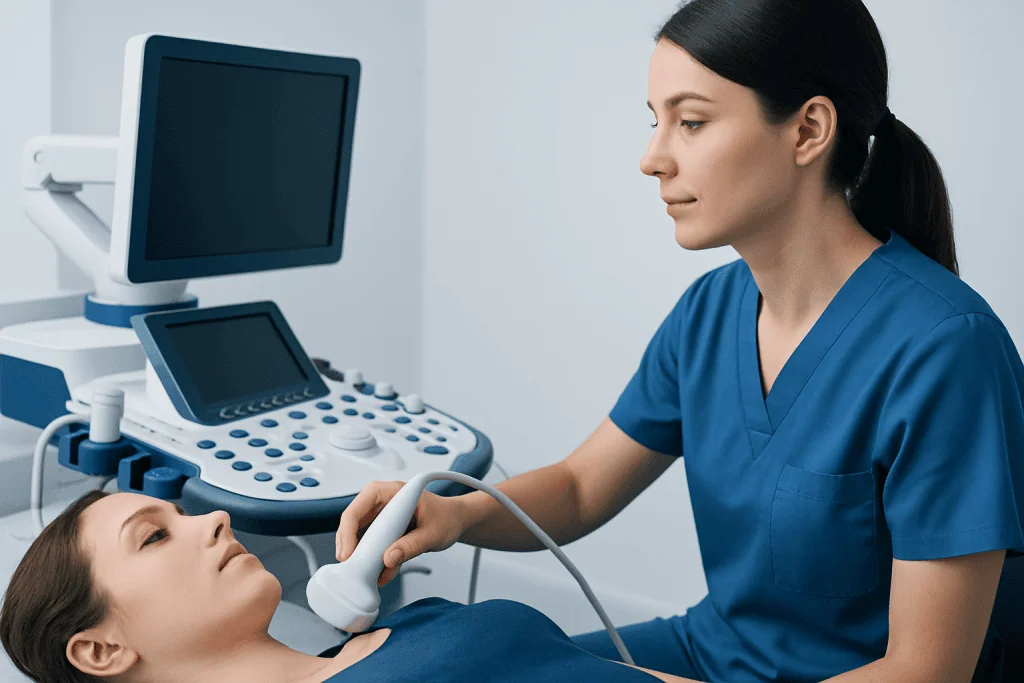
During an ultrasound, a trained sonographer or radiologist places a small handheld probe on the skin of the neck. The probe emits high-frequency sound waves and receives returning echoes from tissues underneath the skin. A computer converts these echoes into images that the clinician can review immediately.
The test may be recommended for a visible or palpable midline neck lump, especially one that moves when the person swallows or sticks out their tongue. It may also be used when a known cyst becomes tender, enlarged or infected, or before an operation to map the cyst and examine the thyroid gland.
Ultrasound is suitable for children and adults, including pregnant people, because it does not involve ionising radiation. It may not provide every detail needed for a deep, complicated or unusually located lump. In those situations, a clinician may recommend CT or MRI to obtain additional information for diagnosis or surgical planning.
Preparation and step-by-step procedure

Most people do not need special preparation for an ultrasound thyroglossal duct cyst examination. They can generally eat, drink and take regular medicines as usual unless their healthcare team gives different instructions. Wearing an open-collar top and avoiding necklaces can make access to the neck easier.
At the appointment, the person lies on their back with the head slightly tilted backward. Clear gel is applied to the skin. The sonographer moves the probe gently over the front and sides of the neck, obtaining images of the lump, surrounding tissues, lymph nodes and thyroid gland. The person may be asked to swallow or move their tongue so that the examiner can observe how the lump moves.
The scan commonly takes about 15 to 30 minutes, although timing varies with the clinical question and the findings. It is not painful, though pressure from the probe may be mildly uncomfortable if the area is inflamed or tender. Afterward, the gel is wiped away and normal activities can usually resume immediately.
The images are reviewed by a radiologist or another qualified clinician, who sends a report to the referring doctor. The report may describe the cyst’s size, location, fluid content, wall appearance and blood flow, as well as whether the thyroid appears to be in its normal position.
Understanding results, benefits and limits
A typical thyroglossal duct cyst often appears on ultrasound as a well-defined fluid-containing area in the midline of the neck. However, the internal appearance can vary. Protein-rich fluid, bleeding into the cyst or inflammation may make the contents look more complex. The report is not considered in isolation; the treating clinician will compare it with the examination and medical history.
The main benefits of ultrasound are that it is painless, widely available, radiation-free and able to examine the thyroid gland at the same visit. It can also help identify signs that suggest inflammation, such as a thicker wall or surrounding tissue changes, and can guide a needle procedure if sampling or drainage is clinically necessary.
Ultrasound cannot always confirm the diagnosis with complete certainty. Other conditions, including enlarged lymph nodes, dermoid cysts, thyroid nodules and other congenital neck masses, can sometimes resemble a thyroglossal duct cyst. A solid area within or near a cyst, atypical lymph nodes, or unexpected findings may lead to further imaging, specialist assessment or a biopsy.
Most thyroglossal duct cysts are benign. Rarely, cancer can arise in or around the cyst, usually in adults. This is uncommon, but persistent, firm, irregular or changing lumps should be evaluated carefully rather than assumed to be harmless.
Should I be worried about a thyroglossal duct cyst?
In most cases, a thyroglossal duct cyst is not dangerous and is not cancer. Many are painless and grow slowly, or remain stable for long periods. Even so, every new or persistent neck lump deserves medical assessment so that its cause can be identified and an appropriate plan can be made.
A cyst may become more noticeable after an upper respiratory infection because inflammation can cause it to swell. It can also become infected, leading to pain, redness, warmth, fever or drainage through the skin. Infection should be assessed promptly because treatment may include antibiotics and, in selected situations, drainage.
When a cyst causes repeated infections, discomfort, swallowing concerns, a visible lump or diagnostic uncertainty, an ear, nose and throat specialist may advise surgical removal. This is commonly performed with the Sistrunk procedure, which removes the cyst, its tract and a small central portion of the hyoid bone to reduce the likelihood of recurrence.
How fast does a thyroglossal duct cyst grow?
There is no single growth pattern. Some thyroglossal duct cysts remain the same size for years, while others enlarge gradually over weeks or months. A person may only notice a longstanding cyst once it becomes large enough to see or feel.
A sudden increase in size is more often related to infection, inflammation or bleeding into the cyst than to rapid permanent growth. Swelling may appear during or after a cold or throat infection. A clinical review is important if the lump enlarges quickly, becomes painful, turns red, or is accompanied by fever.
Rapid enlargement can also occur with conditions other than a thyroglossal duct cyst, which is why an ultrasound and medical examination are useful. A clinician may arrange further testing when the appearance, symptoms or age at presentation are not typical.
Treatment, recovery and possible risks
Observation may be reasonable for a small, uncomplicated cyst when a specialist is confident of the diagnosis and symptoms are absent. However, cysts do not usually disappear permanently on their own. Recurrent infection, drainage, discomfort, cosmetic concerns or uncertainty about the diagnosis are common reasons to discuss definitive treatment.
The standard operation is called the Sistrunk procedure. It is usually performed under general anaesthesia and removes the cyst, the central section of the hyoid bone and tissue along the possible tract toward the base of the tongue. Removing more than the visible cyst is important because simple drainage or excision alone has a higher chance of the lump returning.
How painful is the sistrunk procedure? Most people have mild to moderate soreness, tightness or discomfort in the front of the neck for several days after surgery. Pain is usually managed with the medicines recommended by the surgical team. Temporary discomfort when swallowing, mild bruising and swelling can occur, while severe or worsening pain should be reported.
Possible surgical risks include bleeding, infection, fluid collection, scarring, anaesthesia-related complications and recurrence of the cyst. Less common risks depend on the cyst’s location and individual anatomy. The surgeon can explain the expected benefits and risks after reviewing the imaging and the person’s overall health.
How long does it take to recover from thyroglossal duct cyst surgery?
Recovery after thyroglossal duct cyst surgery varies with age, the extent of the operation, whether infection was present and the person’s general health. Many people go home on the day of surgery or after a short hospital stay, depending on the surgical plan. Initial neck soreness and swelling commonly improve during the first one to two weeks.
Light daily activities may often be resumed within several days, but strenuous exercise, heavy lifting and contact activities are usually postponed until the surgeon confirms that healing is progressing well. The incision needs to be kept clean and dry according to the care instructions. Follow-up is arranged to assess wound healing and review the pathology result.
Complete healing of deeper tissues takes longer than the visible skin healing. The scar may remain pink or firm at first and gradually mature over months. The treating team should be contacted for fever, increasing redness, pus-like drainage, expanding swelling, bleeding, trouble breathing or trouble swallowing.
Acibadem International’s multidisciplinary specialists and JCI-accredited hospitals assess and treat thyroglossal duct cysts for international patients, with care coordinated between ENT, radiology, anaesthesia and surgical teams when needed.
When to seek medical care
A person should arrange a medical appointment for any new, persistent or unexplained neck lump. Assessment is especially important when the lump does not improve after an illness, continues to grow, feels firm or fixed, or occurs with voice changes, persistent throat symptoms or unexplained weight loss.
Urgent medical care is needed if neck swelling is rapidly increasing or is associated with difficulty breathing, difficulty swallowing saliva, severe pain, high fever, marked redness, confusion or significant bleeding. These symptoms may indicate infection or another problem needing prompt treatment.
People who have had previous surgery for a thyroglossal duct cyst should seek review if a lump returns, drainage develops, or recurrent infections occur. Follow-up with an ENT specialist helps clarify the cause and supports timely treatment when required.
Frequently asked questions
Is ultrasound enough to diagnose a thyroglossal duct cyst?
Ultrasound is often the first and most useful imaging test because it can show a fluid-filled neck lesion and assess the thyroid gland. However, the final diagnosis also depends on the examination, symptoms and medical history. CT, MRI, needle sampling or surgical pathology may be needed if the findings are unusual or unclear.
Does an ultrasound for a thyroglossal duct cyst hurt?
The examination is generally painless and does not use needles or radiation. The probe may cause mild pressure over the lump, which can be uncomfortable if the area is infected or very tender. The procedure usually takes less than half an hour.
Do I need to fast before a neck ultrasound?
Fasting is not usually required for a neck ultrasound. Most people can eat, drink and take usual medications normally. The imaging centre or referring clinician should be asked about any individual instructions.
Can a thyroglossal duct cyst go away without surgery?
A cyst may become less noticeable after inflammation settles, but it generally does not resolve permanently on its own. Observation may be appropriate in selected people with no symptoms and a clear diagnosis. Surgery is often considered when the cyst is recurrent, infected, enlarging or troublesome.
How painful is the Sistrunk procedure?
Pain after a Sistrunk procedure is usually described as manageable soreness or tightness in the front of the neck. Discomfort is generally greatest in the first few days and improves as healing progresses. The surgical team provides an individual pain-management plan and aftercare guidance.
How long does it take to recover from thyroglossal duct cyst surgery?
Many people return to light activity within several days, while early swelling and discomfort often settle over one to two weeks. Returning to strenuous exercise may take longer and should follow the surgeon's advice. Scar maturation and deeper tissue healing continue over several months.
References
- American Academy of Otolaryngology–Head and Neck Surgery
- American College of Radiology
- National Institute of Diabetes and Digestive and Kidney Diseases
- Merck Manual Professional Edition
This article is for general information only and is not a substitute for professional medical advice. Please consult a qualified doctor about your individual situation.
Ultrasound in Turkey — costs, top hospitals & a free quote
JCI-accredited · board-certified surgeons · reply within 24h
Add us as a Preferred Source to see more of our trusted health content across Google Search, AI Overviews and Discover.

Check-up & Preventive Medicine
Comprehensive health screenings designed for early detection and prevention.
2 specialists in this unitMore from the Health Library



Related Specialists

Dr. Cansel Karaali
Anesthesiology
Prof. Dr. Bülent Özçelik
Gynecology & Obstetrics
Assoc. Prof. Dr. Muhammet Ahmet Karakaya
Anesthesiology
Assoc. Prof. Dr. Tunay Erden
Orthopedic Surgery & Traumatology