Valium Dose for MRI: Preparation, Procedure and Results

Valium is the brand name for diazepam, a benzodiazepine that can reduce anxiety before an MRI. The right Valium MRI dosage cannot be safely chosen without a clinician’s assessment and the imaging centre’s instructions.
Key Takeaways
- Valium is the brand name for diazepam, a benzodiazepine that can reduce anxiety before an MRI.
- The right Valium MRI dosage cannot be safely chosen without a clinician’s assessment and the imaging centre’s instructions.
- Diazepam can cause drowsiness, impaired coordination and slowed breathing, especially when combined with alcohol, opioids or other sedatives.
- Patients should not drive, operate machinery or make important decisions after taking diazepam for an MRI.
- Non-medication approaches and open MRI options may help some people complete imaging comfortably.
- Severe sleepiness, trouble breathing or an unexpected reaction after a sedative requires urgent medical assessment.
A Valium dose for MRI may be prescribed for people whose anxiety, claustrophobia or pain makes it hard to remain still during the scan. The correct plan is individualized by the prescribing clinician and imaging team, with attention to other medicines, health conditions and the need for a responsible adult to provide transport home.
Overview: Valium for MRI Anxiety
A Valium dose for MRI is sometimes used when anxiety, claustrophobia, pain or difficulty staying still could prevent a person from completing magnetic resonance imaging (MRI). Valium is a brand name for diazepam, a prescription medicine in the benzodiazepine group. It may help a person feel calmer, but it does not remove the need to follow MRI safety screening and preparation instructions.
There is no single Valium MRI dosage that is suitable for everyone. A prescribing clinician considers factors such as age, body size, previous response to sedatives, liver or breathing problems, sleep apnea, pregnancy status and all current medicines. The imaging department may also have specific policies about who can prescribe it, when it should be taken and whether monitoring or a different form of sedation is needed.
MRI uses a strong magnetic field and radio waves to create detailed images. It does not use ionizing radiation. The scan requires stillness and can involve time in a narrow, noisy scanner, so planning ahead can make the experience more manageable.
How Diazepam Works and Who May Benefit
Diazepam increases the activity of gamma-aminobutyric acid (GABA), a chemical messenger that helps reduce activity in the brain. Its calming effect can lessen anticipatory anxiety and make it easier for some people to lie still in the scanner. It may also cause sleepiness, slower reactions, reduced concentration and unsteadiness.
Potential candidates include adults with a history of claustrophobia, marked anxiety during a prior MRI, severe discomfort when lying flat, or involuntary movement that may affect image quality. The decision should be made before the appointment whenever possible, rather than on arrival at the imaging department.
Diazepam may not be appropriate for everyone. Extra caution or an alternative plan may be needed for people with significant respiratory disease, untreated sleep apnea, serious liver impairment, a history of problematic sedative or alcohol use, certain neuromuscular conditions, or an allergy to benzodiazepines. Children, older adults and people who are pregnant or breastfeeding require individualized specialist advice.
For MRI-related anxiety, the imaging team may also discuss options such as additional coaching, music or headphones, a support person where permitted, a wider-bore scanner, or supervised sedation. The best option depends on the examination and the individual’s safety needs.
Before the Scan: Safe Valium MRI Dosing Preparation

Patients should contact the ordering clinician or imaging centre well before the appointment if they think they may need medicine for MRI anxiety. They should not use a family member’s prescription, take an old supply without medical advice, or change the prescribed plan themselves. Safe valium mri dosing includes confirming the medicine name, timing instructions and whether a test dose is appropriate.
A complete medication review is important. Patients should tell the clinician about prescription medicines, over-the-counter products, herbal supplements, alcohol use and recreational substances. Combining diazepam with opioids, sleeping tablets, some antihistamines, alcohol or other medicines that slow the nervous system can increase sedation and may dangerously suppress breathing.
Before any MRI, patients must complete screening for metal and implanted devices. They should report pacemakers, neurostimulators, cochlear implants, aneurysm clips, insulin pumps, medication patches, retained metal fragments, recent surgery and possible pregnancy. A sedative does not change these MRI safety requirements.
- Arrange for a responsible adult to take the patient home and, if advised, stay with them afterward.
- Ask whether eating, drinking and regular medicines should be changed before the scan; instructions vary by examination and sedation plan.
- Bring identification, the medication list and details of implants or prior imaging reactions.
- Plan to avoid driving, cycling, operating machinery and drinking alcohol for the rest of the day unless the clinician gives different instructions.
What Happens on the Day of an MRI
On arrival, the radiology team confirms the safety questionnaire, the reason for the scan and any sedation plan. The patient should tell staff exactly what medicine was taken and when. If contrast material is planned, staff may also ask about kidney health, previous contrast reactions and relevant laboratory results.
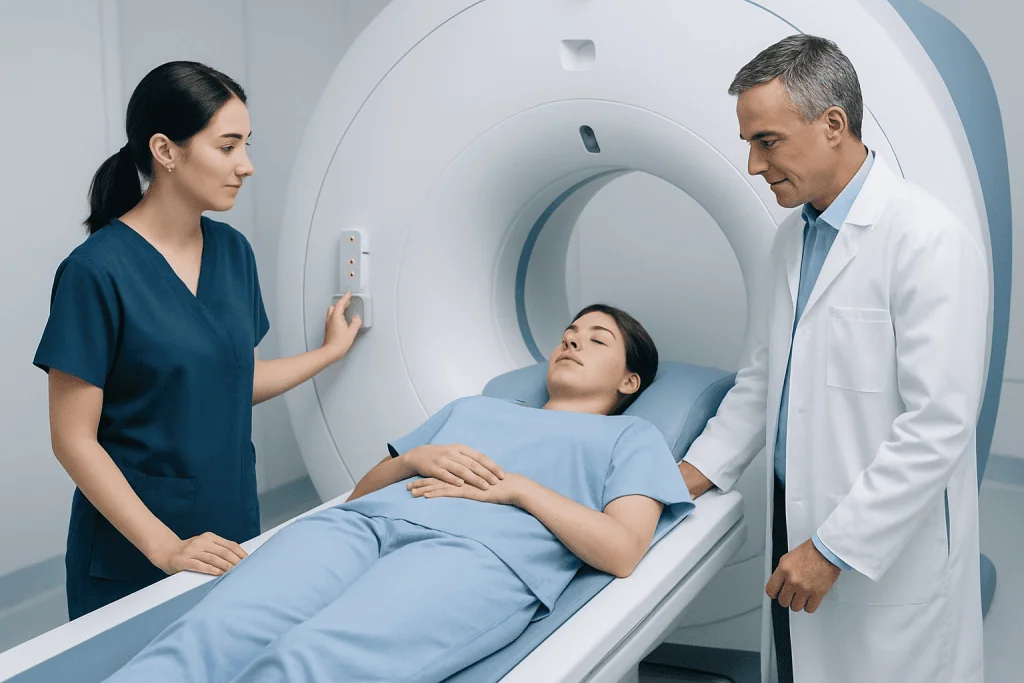
The patient changes into appropriate clothing and removes metal items, including jewelry, watches, hairpins, hearing aids and bank cards. They lie on a movable table, and a positioning device called a coil may be placed around the body part being scanned. Ear protection is provided because MRI sequences can be loud.
During the scan, the table moves into the scanner. The technologist communicates through an intercom, and the patient usually receives an alert device to call for help. Remaining still is important because movement can blur images and may require some sequences to be repeated. A support person, relaxation instructions or pauses between sequences may be possible depending on local policy and the type of MRI.
If anxiety remains overwhelming despite preparation, the scan can sometimes be paused or rescheduled with a different strategy. In selected cases, clinician-supervised sedation or anesthesia may be considered. This requires a higher level of planning, monitoring and recovery arrangements than an oral anti-anxiety medicine.
Benefits, Risks and Recovery Timeline
The main possible benefit of diazepam before MRI is improved comfort and reduced movement, which may help the imaging team obtain useful pictures without repeating or postponing the examination. It can be particularly helpful when a person’s anxiety is the main barrier to completing a clinically important scan.
Common effects include drowsiness, dizziness, fatigue, blurred attention, slowed thinking and poor coordination. These effects may begin before the scan and can last for several hours; some people feel tired into the following day. The recovery timeline varies because diazepam can remain in the body longer than some other anxiety medicines.
More serious risks are uncommon when the medicine is appropriately prescribed, but include excessive sedation, confusion, falls and slowed or difficult breathing. Risk rises when diazepam is combined with alcohol, opioids or other sedatives. A person who becomes difficult to wake, has slow or shallow breathing, develops bluish lips or face, faints, or has severe confusion needs emergency medical help.
After the scan, patients should leave with their arranged escort, rest as needed and follow the prescribing clinician’s advice. They should avoid alcohol and sedating medicines unless specifically instructed otherwise. The radiologist interprets the images and sends a report to the requesting clinician, who explains what the results mean in the context of symptoms and medical history.
Alternatives and Practical Self-Care
Many people can complete an MRI without medication through preparation and supportive techniques. Asking the imaging centre what the scanner looks and sounds like, practicing slow breathing, closing the eyes before entering the scanner and using guided imagery may reduce distress. Some centres can offer music, mirrors, headphones or an opportunity to visit the scanner room in advance.
Open or wide-bore MRI systems may feel less confined for some patients, although availability and image requirements differ. For certain scans, an alternative imaging test may occasionally be appropriate, but this decision should be made by the referring clinician because MRI often provides information that ultrasound, X-ray or CT cannot provide.
People with persistent panic symptoms or claustrophobia may benefit from discussing longer-term treatment with a qualified clinician. Approaches such as cognitive behavioral therapy can help address the fear rather than only managing a single scan. If anxiety is affecting daily life, evaluation for an underlying anxiety condition may be useful.
Acibadem International’s multidisciplinary specialists and JCI-accredited hospitals can support international patients who need coordinated MRI planning, including assessment of anxiety and sedation needs when clinically appropriate.
When to Seek Medical Care
Patients should contact the prescribing clinician or imaging centre before the appointment if they have had a previous severe reaction to a sedative, have started a new medicine, are pregnant or may be pregnant, have worsening breathing problems, or cannot arrange safe transport home. It is also important to call ahead if there is an implanted device or possible metal exposure that has not yet been reviewed for MRI compatibility.
Urgent medical care is needed after taking diazepam if there is trouble breathing, inability to stay awake, severe weakness, fainting, new severe confusion, facial or throat swelling, or signs of an allergic reaction. Emergency services should be contacted rather than attempting to drive to a healthcare facility.
For less urgent concerns, such as lingering drowsiness, dizziness or unsteadiness, the patient should rest in a safe setting and contact the clinician for individualized advice. They should not take an extra dose to manage anxiety unless specifically instructed to do so by the prescriber.
Frequently asked questions
What is a typical Valium dose for MRI?
A typical dose cannot be safely recommended without individual medical assessment. The prescriber determines whether diazepam is appropriate and gives specific instructions based on the patient’s health, medicines, age and prior response to sedatives. Patients should take only the amount prescribed for that appointment.
How long before an MRI should Valium be taken?
The timing should follow the prescribing clinician’s and imaging centre’s instructions. It is usually planned so the calming effect is present during the scan, but timing varies with the medicine plan and the appointment process. Patients should not take it before confirming when and where they need to check in.
Can a patient drive after taking Valium for an MRI?
No. Diazepam can impair alertness, coordination and reaction time even if the person feels relatively well. A responsible adult should provide transport home, and the patient should avoid driving and hazardous activities for the period advised by the clinician.
Can Valium be taken with other anxiety or pain medicines?
It may be unsafe to combine diazepam with opioids, alcohol, sleep medicines or other sedating drugs because the combination can overly slow the brain and breathing. Every medicine, supplement and substance should be disclosed to the prescriber and imaging team. The patient should not stop or add regular medicines without medical advice.
What if Valium does not relieve MRI claustrophobia?
The patient should tell the imaging staff before or during the scan rather than taking more medicine independently. The team may be able to pause, provide additional support or reschedule with a different imaging or sedation approach. Some people need a supervised sedation plan rather than oral medication alone.
Will Valium affect MRI results?
Diazepam does not usually alter the physical MRI images directly. By helping a person remain still, it may reduce motion blur and improve the chance of obtaining diagnostic images. However, it can affect alertness and coordination afterward, which is why recovery precautions are important.
References
- American College of Radiology
- U.S. Food and Drug Administration
- National Institute of Mental Health
- National Health Service
- Radiological Society of North America
This article is for general information only and is not a substitute for professional medical advice. Please consult a qualified doctor about your individual situation.
Explore treatments in Turkey — costs, top hospitals & a free quote
JCI-accredited · board-certified surgeons · reply within 24h
Add us as a Preferred Source to see more of our trusted health content across Google Search, AI Overviews and Discover.