World’s Smallest Pacemaker: An Evidence-Based Patient Guide

A leadless pacemaker is implanted inside the right ventricle through a vein in the groin, rather than under the skin of the chest. It has no wires, called leads, running from the chest to the heart, which avoids some lead- and pocket-related complications.
Key Takeaways
- A leadless pacemaker is implanted inside the right ventricle through a vein in the groin, rather than under the skin of the chest.
- It has no wires, called leads, running from the chest to the heart, which avoids some lead- and pocket-related complications.
- Leadless pacing is most often considered when a person needs single-chamber ventricular pacing, although some devices can coordinate atrial and ventricular timing in selected cases.
- The procedure is usually minimally invasive, but it still involves catheter-based treatment, imaging, follow-up and individual risk assessment.
- Driving restrictions and insurance coverage depend on the reason for pacemaker implantation, local rules and the person’s clinical recovery.
The world's smallest pacemaker generally refers to a leadless pacemaker, a capsule-sized device implanted directly in the heart to support a slow heartbeat. It can be a valuable option for carefully selected people, but it does not suit every rhythm condition or every person who needs pacing.
Overview: what is the world's smallest pacemaker?
The term world’s smallest pacemaker is commonly used for a leadless pacemaker, including the Micra family of devices. Unlike a conventional pacemaker, it is a small self-contained device placed directly inside the lower right heart chamber, called the right ventricle. It monitors the heartbeat and delivers a small electrical impulse when the heart beats too slowly.
A traditional pacemaker is usually implanted beneath the skin below the collarbone and connected to the heart by one or more insulated wires. A leadless system has no chest incision for a generator pocket and no transvenous leads. It is delivered through a catheter inserted into a vein in the groin, then secured to the inner wall of the heart.
Pacemakers are used to manage certain slow or interrupted heart rhythms, collectively known as bradyarrhythmias. A specialist assesses symptoms, heart rhythm recordings, underlying heart structure and the expected type of pacing before recommending a device. A leadless device is not inherently better than a standard pacemaker; the best choice depends on the person’s medical needs.
How a leadless pacemaker works
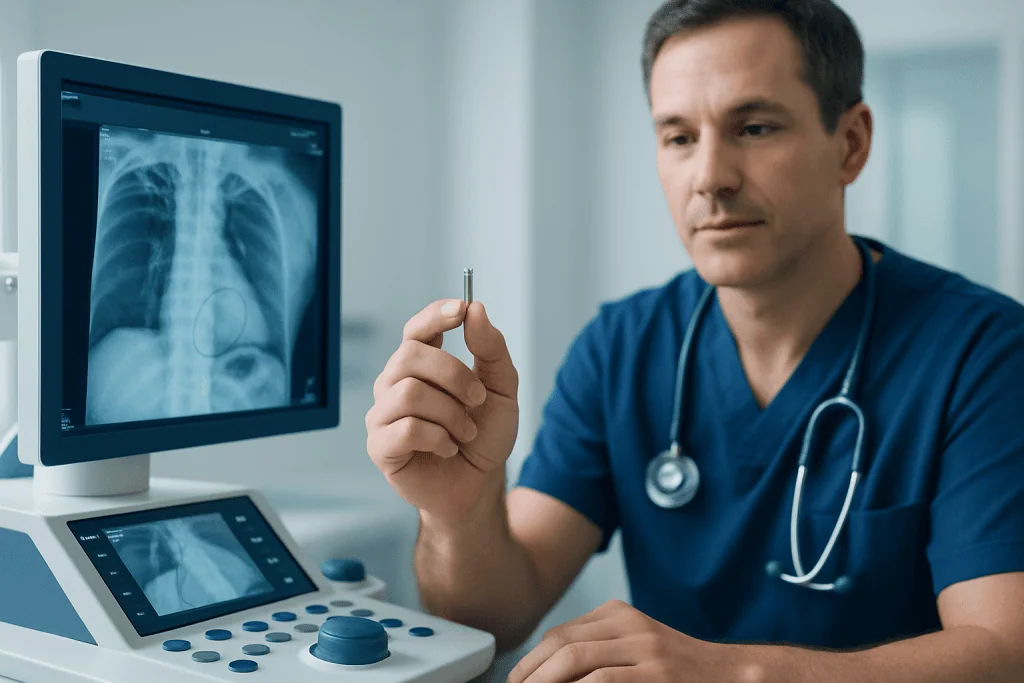
The device contains a battery, electronic circuitry and electrodes in one compact unit. It continuously senses electrical activity in the heart. If it detects that the ventricular rate is below a programmed limit or that an expected beat is absent, it provides a precisely timed electrical pulse to trigger a heartbeat.
Most leadless devices provide ventricular pacing. Some newer systems use motion sensing to estimate atrial activity and help coordinate the upper and lower chambers in suitable people with normal sinus rhythm. This may offer a more natural sequence of contraction for selected patients, but it is not the same as having a full conventional dual-chamber pacing system in every situation.
Device settings are checked wirelessly during follow-up appointments. The pacing team can review battery status, pacing needs and stored rhythm information, and may adjust programming without surgery. Remote monitoring may also be offered depending on the device and local care pathway.
People who have symptoms such as fainting, new severe dizziness, chest discomfort or shortness of breath should seek prompt medical assessment rather than assuming a pacemaker issue is the cause.
Who may be a candidate for a leadless pacemaker?

Leadless pacing may be considered for people with a documented slow heart rhythm who need pacing support primarily in the right ventricle. Examples can include some people with permanent atrial fibrillation and a slow ventricular rate, or selected people with sinus node dysfunction or atrioventricular block. The decision requires an individualized review by a cardiac electrophysiology team.
A leadless system may be particularly helpful when avoiding chest leads or a device pocket is clinically important. This can include people with a history of device-pocket infection, limited venous access, a high likelihood of lead-related difficulties or particular lifestyle and anatomical considerations. These factors do not automatically mean that a leadless device is appropriate.
It may not be suitable for someone who needs defibrillation therapy, cardiac resynchronization therapy, extensive atrial pacing or other advanced pacing functions. Heart anatomy, the presence of other implanted devices, kidney disease, bleeding risk and the need for future treatments also influence planning. Related rhythm disorders, including atrial fibrillation, should be assessed as part of the overall care plan.
- Symptoms must be matched with a clinically meaningful rhythm abnormality.
- Electrocardiography, ambulatory monitoring and echocardiography may be used during assessment.
- The expected long-term pacing requirement is considered before selecting a device type.
Leadless pacemaker procedure: step by step
Before the procedure, the care team reviews medications, allergies, kidney function, infection risks and imaging findings. Some medicines may need temporary adjustment, particularly drugs that affect bleeding, but patients should only make changes on instructions from their clinician. The procedure is generally performed in a cardiac catheterization or electrophysiology laboratory.
The person receives local anesthetic at the groin and may receive sedation or anesthesia according to their needs and the clinical plan. A clinician inserts a delivery catheter through a large vein in the groin and guides it into the right side of the heart using X-ray imaging. The pacemaker is positioned on the inner heart wall and attached with small fixation tines.
Once in place, the team tests sensing, pacing thresholds and device stability. If measurements are satisfactory, the delivery system is removed and pressure or a closure method is used at the groin entry site. A person may receive pacemaker implantation as a leadless or conventional procedure depending on the agreed treatment plan.
Monitoring after implantation commonly includes heart rhythm observation and examination of the groin. The duration of hospital stay varies with the person’s condition, the reason for implantation and local practice. The team provides written guidance on activity, wound care and follow-up before discharge.
Benefits, disadvantages and risks
The main potential benefit of a leadless pacemaker is that it avoids a surgical chest pocket and transvenous leads. This can reduce the possibility of certain complications involving leads, such as fracture, displacement or vein obstruction, and avoids pocket-related concerns such as discomfort or infection. The groin access site usually heals without a chest scar.
What is the disadvantage of a leadless pacemaker? Its most important limitation is that it may not provide all of the pacing functions a person needs. Depending on the device, it may provide only ventricular pacing or have more limited atrial pacing capability than a conventional system. Battery depletion also requires a long-term plan; a new device may be implanted, while retrieval of an older device can be more complex after it has become incorporated into heart tissue.
Although complications are uncommon, they can occur. Potential risks include bleeding, bruising or vessel injury at the groin, infection, blood clots, device movement, perforation of the heart wall, fluid around the heart and an unsatisfactory pacing result that requires further treatment. The individual’s overall health and heart anatomy affect risk.
A candid discussion with the implanting specialist should compare leadless and conventional systems, including future device needs. The goal is not the smallest device alone, but reliable pacing that fits the person’s rhythm diagnosis and anticipated care.
Recovery, activity and driving after implantation
After a leadless pacemaker procedure, people are usually asked to rest flat for a period to protect the groin access site. Mild bruising or tenderness can occur. The team may recommend avoiding heavy lifting, strenuous exercise and activities that strain the groin for a short time, while gradually returning to normal daily activity as advised.
Follow-up is important even when a person feels well. It confirms that the device is functioning appropriately and that pacing settings match the person’s needs. Patients should carry their device identification information and tell healthcare professionals, including dentists and imaging teams, that they have a pacemaker.
Why can’t you drive with a pacemaker? A pacemaker itself does not permanently prevent driving. Temporary restrictions may apply after implantation because of recovery from the procedure and because the underlying slow rhythm may have caused fainting, near-fainting or impaired alertness. The permitted return to driving varies by country, whether driving is private or commercial, and the original symptoms; patients should follow their cardiologist’s advice and local licensing rules.
Urgent medical advice is appropriate for increasing groin swelling or bleeding, fever, worsening redness, fainting, persistent palpitations, chest pain or new breathlessness. Acibadem International’s multidisciplinary cardiac specialists and JCI-accredited hospitals can assess rhythm disorders and provide pacemaker care for international patients.
Costs, Medicare and when to seek medical care
How much does the Micra pacemaker cost? There is no single reliable price because total costs vary by country, hospital, device type, clinical complexity, testing, physician fees, anesthesia, hospital stay and insurance arrangements. A hospital financial counseling or international patient services team can provide an individualized estimate after the recommended treatment plan is known. Cost should not be used as the sole basis for choosing between leadless and conventional pacing.
Will Medicare pay for a leadless pacemaker? In the United States, Medicare may cover a leadless pacemaker when it is medically necessary and the patient meets coverage requirements. Coverage can depend on the specific Medicare plan, the clinical indication, the facility and whether deductibles or coinsurance apply. Patients should confirm current benefits with Medicare, their plan administrator and the treating hospital because policies and individual responsibilities can change.
When to seek medical care A person should arrange medical assessment for recurrent fainting, near-fainting, unexplained dizziness, unusual fatigue, a persistently slow pulse, shortness of breath or reduced ability to exercise. Emergency care is needed for chest pain, severe trouble breathing, collapse, prolonged loss of consciousness or symptoms suggesting a stroke. These symptoms have many possible causes, so timely evaluation is important.
For people already living with a pacemaker, a scheduled device check should not be delayed. New symptoms should be reported even if remote monitoring is in place, because monitoring complements but does not replace clinical assessment.
Frequently asked questions
Is the world's smallest pacemaker the same as a leadless pacemaker?
The phrase usually refers to a leadless pacemaker, a self-contained pacing device placed inside the heart. The exact device available and its features vary by country and clinical setting. A cardiology specialist can explain which device type is appropriate for a person’s rhythm condition.
Can a leadless pacemaker be removed?
A leadless pacemaker can sometimes be retrieved, particularly relatively soon after implantation, using specialized catheter techniques. Over time, tissue may grow around the device, which can make removal more difficult. When the battery reaches the end of service, clinicians may instead implant another device and decide whether the earlier one can safely remain in place.
How long does a leadless pacemaker battery last?
Battery longevity varies according to the model, programmed settings and how often the device needs to pace. It is commonly measured in years, but no individual timeline can be predicted without device follow-up data. Regular checks help the care team estimate remaining battery life and plan ahead.
Can a person have an MRI with a leadless pacemaker?
Some leadless pacemaker systems are designed to be used under specified MRI conditions. MRI eligibility depends on the exact device, implantation status and the imaging protocol. The imaging department and pacemaker clinic should verify compatibility before any MRI is scheduled.
Will a leadless pacemaker cure a slow heart rhythm?
A pacemaker does not remove the underlying cause of most slow rhythms. It prevents the heart rate from dropping too low by providing pacing support when needed. This can reduce symptoms related to bradycardia in appropriately selected people.
What follow-up is needed after leadless pacemaker implantation?
Follow-up includes device checks to assess battery status, sensing, pacing thresholds and stored rhythm information. Some people also use remote monitoring, depending on their device and care program. They should still attend planned appointments and report new symptoms promptly.
References
- American Heart Association
- Heart Rhythm Society
- U.S. Food and Drug Administration
- Centers for Medicare & Medicaid Services
- European Society of Cardiology
This article is for general information only and is not a substitute for professional medical advice. Please consult a qualified doctor about your individual situation.
Explore treatments in Turkey — costs, top hospitals & a free quote
JCI-accredited · board-certified surgeons · reply within 24h
Add us as a Preferred Source to see more of our trusted health content across Google Search, AI Overviews and Discover.