Vision Therapy Controversy: How It Works, Results and What to Expect

Vision therapy is a personalized program designed to improve specific visual skills, such as eye teaming, focusing, and tracking. Evidence is strongest for office-based treatment of symptomatic convergence insufficiency in children and some adults.
Key Takeaways
- Vision therapy is a personalized program designed to improve specific visual skills, such as eye teaming, focusing, and tracking.
- Evidence is strongest for office-based treatment of symptomatic convergence insufficiency in children and some adults.
- Vision therapy does not replace glasses, medical treatment, or educational assessment for learning difficulties.
- Progress should be measured with symptom reports and repeat clinical tests, not only by how a person feels on a given day.
- New double vision, sudden vision loss, eye pain, severe headache, or neurologic symptoms require prompt medical assessment.
The vision therapy controversy reflects an important distinction: structured, clinician-supervised exercises can improve certain diagnosed eye-coordination problems, particularly convergence insufficiency, but claims for dyslexia, general learning difficulties, or all visual symptoms are not supported by the same level of evidence. A comprehensive eye examination and a clear diagnosis are essential before starting treatment.
Overview: why vision therapy is controversial
Vision therapy is a structured series of supervised and home-based activities intended to improve particular visual functions. Depending on the diagnosis, it may target how the eyes work together, how they focus at near distance, how they move across a page, or how the brain uses visual information. It is different from simply wearing glasses, although glasses or contact lenses may be an important part of care.
The vision therapy controversy is not mainly about whether eye exercises exist or whether some patients feel better. It concerns which conditions respond reliably, what treatment approach has been studied, and whether broad claims are justified. Research supports carefully prescribed therapy for selected binocular vision disorders, especially symptomatic convergence insufficiency. Evidence is much less convincing for claims that vision therapy treats dyslexia, attention problems, developmental learning disorders, or an unrelated decline in school performance.
A useful starting point is to separate visual discomfort from learning ability. A child or adult can have both a learning difference and a visual condition, and each deserves appropriate assessment. Treating a proven eye-coordination difficulty may make reading more comfortable, but it should not be presented as a cure for dyslexia or a substitute for educational, developmental, or neurological evaluation.
How vision therapy works and who may be a candidate

Vision therapy uses repeated, graded visual tasks to train a defined skill. Sessions are commonly guided by an optometrist, ophthalmologist, orthoptist, or another appropriately trained eye-care professional, with home exercises between visits. Programs may use lenses, prisms, targets at different distances, computer-based activities, and controlled eye-movement or focusing tasks.
Potential candidates include people with symptomatic convergence insufficiency, a condition in which the eyes have difficulty turning inward together for near work. Symptoms may include eyestrain, headaches with reading, blurred or double vision at near distance, losing place while reading, or difficulty sustaining close work. Some patients with accommodative disorders, selected eye-movement problems, or visual difficulties after a neurologic injury may be considered for rehabilitation after specialist assessment.
Candidacy depends on the cause of symptoms. A complete examination should first check visual acuity, refractive error, eye health, eye alignment, focusing ability, and binocular function. Convergence insufficiency is one example where targeted treatment may be considered after objective testing. Symptoms such as persistent double vision can also arise from nerve, muscle, brain, thyroid, or other medical conditions and should not be assumed to be suitable for exercises alone.
- Therapy is most appropriate when there is a specific, measurable visual diagnosis.
- Goals should be practical, such as reducing near-work symptoms or improving measured convergence.
- Patients should understand the expected time commitment and the plan for reassessment.
What happens during vision therapy: step by step
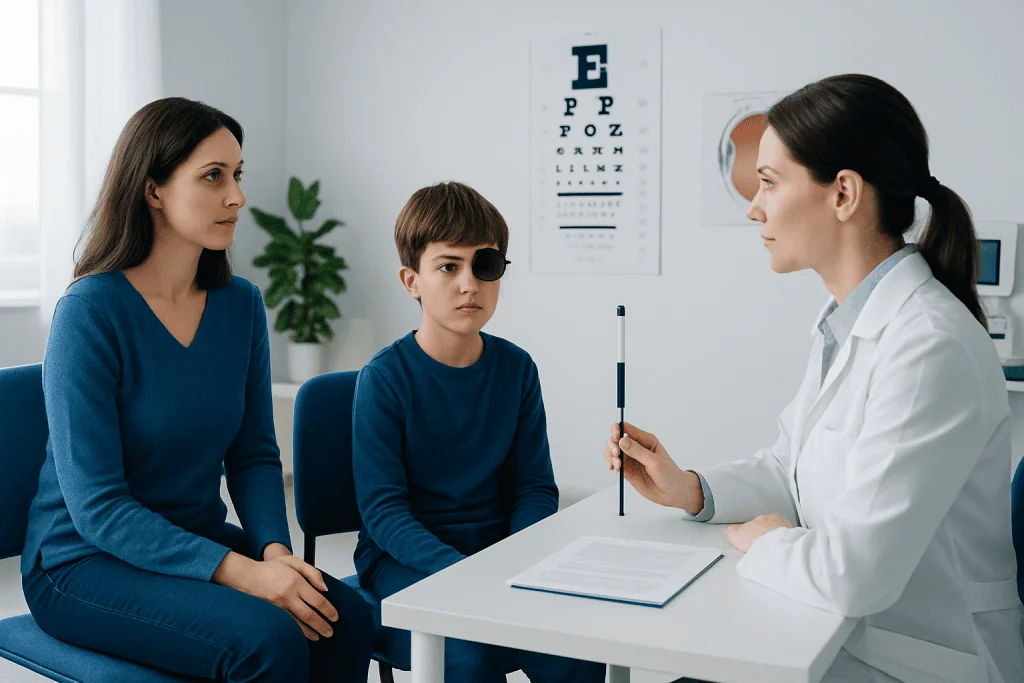
Before therapy begins, the clinician establishes a diagnosis and baseline measurements. These may include near and distance vision, need for glasses, eye alignment, convergence ability, focusing performance, eye movements, and a standardized symptom questionnaire. The clinician should explain what the proposed program is intended to improve and what it is not expected to treat.
During office sessions, the patient performs tasks that gradually increase in difficulty. For example, therapy for convergence insufficiency may involve activities that encourage both eyes to maintain alignment while looking at targets moved closer to the face. Other exercises may train focus changes between near and far targets, accurate eye movements, or visual attention within a specifically diagnosed rehabilitation plan.
Home practice is usually assigned to reinforce office work. Consistency matters, but exercises should be performed exactly as advised; pushing through substantial pain, prolonged double vision, severe headache, or marked dizziness is not the goal. The clinician reviews symptoms and measurements at intervals and may adjust, pause, or stop the plan if it is not helping.
For people whose symptoms are related to a correctable refractive error, an up-to-date prescription may be the first intervention. In some situations, other options such as prisms, management of eye disease, or comprehensive ophthalmology care may be more appropriate than vision therapy.
How long does it take to see results from vision therapy?
The timeline varies with the diagnosis, severity of symptoms, age, adherence to home activities, and the type of program. Some people notice reduced eyestrain or improved comfort with near work within several weeks. Meaningful change often requires a structured course lasting weeks to months, with regular reassessment rather than an expectation of immediate improvement.
For symptomatic convergence insufficiency, research has evaluated office-based therapy programs commonly delivered over a number of weeks. However, no single timeline applies to every patient. If symptoms have not improved and objective measures have not changed after an agreed review period, the diagnosis, treatment plan, adherence, and possible alternative causes should be reconsidered.
Progress may not be linear. A person can have better tolerance for reading but still experience symptoms when tired, ill, or facing unusually demanding visual tasks. Clear baseline measures and scheduled follow-up make it easier to distinguish true improvement from normal day-to-day variation.
Does vision therapy actually work?
Vision therapy can work for particular, accurately diagnosed visual disorders, but effectiveness depends on the condition and the treatment delivered. The best-known evidence supports office-based vergence and accommodative therapy, usually with home reinforcement, for children with symptomatic convergence insufficiency. Some adults may also benefit, although the available evidence and individual circumstances should be discussed with an eye-care specialist.
It is important not to generalize that evidence to every concern involving reading, concentration, behavior, or academic performance. Major ophthalmology and pediatric organizations state that dyslexia and most learning disabilities are not caused by vision problems and are not treated by eye exercises, tinted lenses, or vision therapy. Individuals with learning concerns may benefit from evidence-based educational and developmental support alongside appropriate eye care.
There is also ongoing clinical interest in visual rehabilitation after concussion or other neurologic conditions. Symptoms can be real and disabling, but the evidence base is variable and treatment should be coordinated with relevant specialists. A detailed evaluation helps identify whether a person has a treatable binocular, accommodative, ocular health, neurologic, or non-visual cause of symptoms.
Why are ophthalmologists against vision therapy?
Ophthalmologists are not uniformly against all vision therapy. Many support evidence-based treatment for diagnosed binocular vision conditions and work with orthoptists and other eye-care professionals in managing eye alignment and visual function. The concern is primarily about unsupported claims, inconsistent program quality, and treatment offered without a thorough medical eye examination.
Professional disagreement can arise when the word “vision therapy” is used for very different interventions. A defined program for convergence insufficiency is not the same as a broad promise to improve intelligence, eliminate dyslexia, correct an unrecognized eye disease, or resolve every reading difficulty. Clinicians generally want recommendations to match high-quality evidence, objective findings, and the patient’s actual diagnosis.
Patients can ask practical questions before enrolling: What specific condition is being treated? Which measurements show it is present? What evidence supports this program? How will results be assessed? What happens if symptoms persist? A clinician who welcomes these questions can help the patient make an informed decision.
How to tell if vision therapy is working
Improvement should be assessed in two ways: symptoms and objective clinical measures. A patient may report less headache, blur, fatigue, skipped lines, or double vision during close work. At follow-up, the clinician may repeat tests of eye alignment, near point of convergence, focusing, eye movements, and binocular function to determine whether the targeted skill has changed.
Keeping a simple symptom record can be useful. Patients or parents may note the length of time comfortable reading, frequency of double vision, need for breaks, and whether symptoms interfere with school, work, or daily activities. The aim is not perfect performance every day, but a sustained improvement in the symptoms and functions identified at the start of care.
Warning signs that warrant reassessment include worsening symptoms, no meaningful change after a reasonable trial, new distance double vision, new headaches, reduced vision, eye pain, or neurologic symptoms. Therapy should be revised or stopped if it is not appropriate, rather than continued indefinitely without measurable benefit.
Benefits, limitations, safety, and when to seek medical care
For an appropriate candidate, possible benefits include greater comfort with reading and screens, fewer near-work symptoms, better ability to maintain single vision, and improved measured binocular or focusing function. The main limitations are the time commitment, the need for regular practice, variable response, and the fact that therapy cannot correct every cause of visual discomfort. It does not replace glasses when refractive correction is needed, nor does it treat eye disease requiring medical or surgical care.
Temporary eyestrain, headache, visual fatigue, or brief discomfort can occur during challenging exercises. These symptoms should be discussed with the treating clinician, particularly if they are persistent or severe. Sudden vision loss, a curtain or shadow in vision, sudden or persistent double vision, severe eye pain, a red painful eye, severe headache, facial weakness, speech difficulty, weakness on one side, or loss of balance require urgent medical evaluation.
For non-urgent but persistent reading-related symptoms, an eye examination is a sensible first step. Acibadem International’s multidisciplinary specialists and JCI-accredited hospitals can assess visual symptoms and coordinate appropriate eye and neurological care for international patients when needed.
Frequently asked questions
Can vision therapy replace glasses?
No. Vision therapy does not correct refractive errors such as myopia, hyperopia, or astigmatism. Glasses or contact lenses may be needed before or alongside therapy so that the eyes receive a clear image.
Is vision therapy the same as eye exercises found online?
Not necessarily. Clinical vision therapy is individualized after an examination and includes monitored goals and follow-up testing. Online exercises may not be suitable for a person’s symptoms and could delay assessment of an underlying eye or neurological condition.
Can vision therapy treat dyslexia?
Vision therapy is not an established treatment for dyslexia. Dyslexia is a language-based learning disorder and is best addressed through appropriate educational assessment and evidence-based learning support. An eye examination can still be helpful when a child has visual symptoms during reading.
Can adults benefit from vision therapy?
Adults may benefit when they have a correctly diagnosed binocular or focusing disorder, particularly if symptoms interfere with near work. The likely benefit depends on the diagnosis, the program used, and whether another medical condition is contributing to symptoms.
What should be checked before starting vision therapy?
A comprehensive eye examination should assess vision clarity, need for corrective lenses, eye health, alignment, focusing, and eye coordination. The clinician should also review symptoms, medical history, medications, and any neurologic or learning concerns that may need separate evaluation.
Is double vision always suitable for vision therapy?
No. Double vision can have many causes, including conditions affecting the eye muscles, nerves, brain, thyroid, or general health. New, sudden, or persistent double vision should be assessed promptly by a qualified medical professional before exercises are considered.
References
- American Academy of Ophthalmology
- American Association for Pediatric Ophthalmology and Strabismus
- American Optometric Association
- National Eye Institute
- American Academy of Pediatrics
This article is for general information only and is not a substitute for professional medical advice. Please consult a qualified doctor about your individual situation.
Explore treatments in Turkey — costs, top hospitals & a free quote
JCI-accredited · board-certified surgeons · reply within 24h
Add us as a Preferred Source to see more of our trusted health content across Google Search, AI Overviews and Discover.