Surgical Instrument Tracking Software Providers: Procedure, Recovery and Results

Instrument tracking software records the movement and processing status of reusable surgical instruments and trays. Hospitals may use barcode, RFID or other identification methods to connect instruments with sterilization and procedure records.
Key Takeaways
- Instrument tracking software records the movement and processing status of reusable surgical instruments and trays.
- Hospitals may use barcode, RFID or other identification methods to connect instruments with sterilization and procedure records.
- A well-designed tracking workflow can support traceability, maintenance planning, inventory control and recall response.
- The software is implemented by hospital teams rather than used as a treatment or procedure for an individual patient.
- Patients can ask whether a hospital follows recognized sterile processing and infection-prevention standards.
Surgical instrument tracking software providers supply systems that help hospitals document where reusable instruments and trays are throughout the reprocessing and operating-room workflow. These systems support traceability, inventory oversight and quality processes, but they do not replace trained sterile processing staff or clinical infection-prevention practices.
Overview: how surgical instrument tracking software providers support care
Surgical instrument tracking software providers develop digital systems used by hospitals and ambulatory surgery centers to document the life cycle of reusable surgical instruments. In practical terms, the software can help staff identify an instrument or tray, record its cleaning and sterilization steps, monitor where it is stored, and document its use for a procedure. The goal is reliable traceability within a larger sterile processing and operating-room safety program.
These systems are not medical devices that a patient wears or receives, and there is no patient recovery period from their use. Instead, they are part of hospital operations. By making records more accessible and standardized, tracking software may help teams investigate a quality concern, locate affected trays during a recall, plan maintenance and reduce uncertainty about whether a set is ready for use.
Software choice should be based on the facility’s clinical workflow, instrument volume, equipment, regulatory requirements, cybersecurity practices and staff training needs. A system is most effective when it is paired with validated reprocessing procedures, manufacturer instructions for use, routine audits and qualified sterile processing professionals.
How the tracking process works
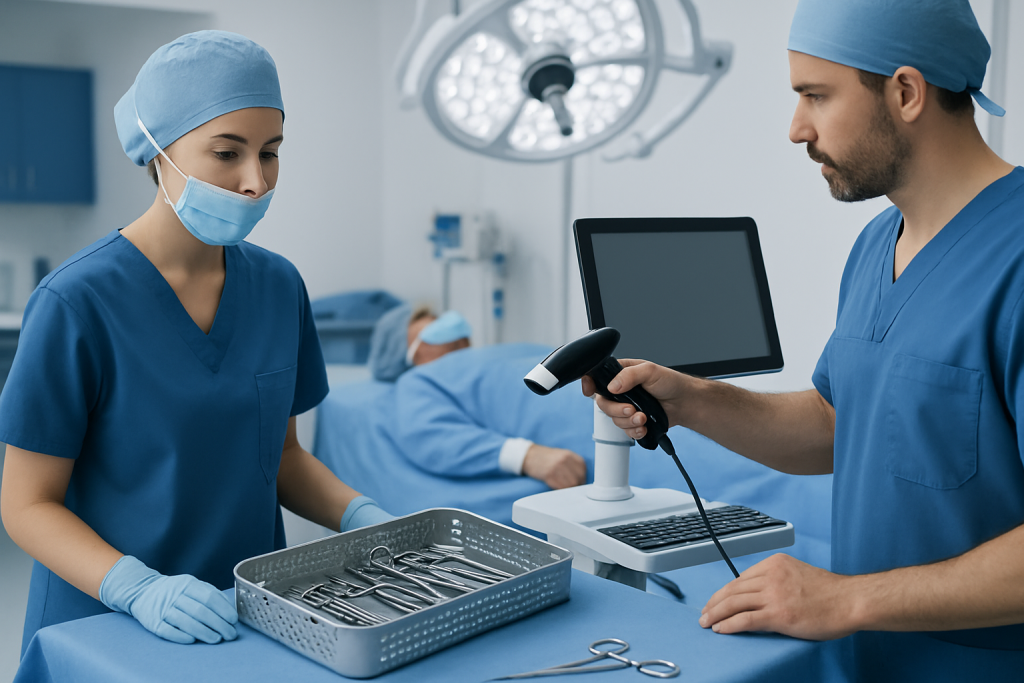
Most systems begin with a unique identifier assigned to an individual instrument, a tray or both. Staff may scan a barcode, use radio-frequency identification (RFID), or enter information through another approved method. The identifier connects the item to a digital record that may include its location, processing history, maintenance status and availability.
As a tray moves through the workflow, staff document key checkpoints. These commonly include receipt of used instruments, decontamination, assembly and inspection, packaging, sterilizer load information, release after required monitoring, storage and transport to the operating room. Depending on the system and local workflow, records may also be linked to the procedure or patient encounter for traceability.
Tracking software does not itself clean or sterilize an instrument. Sterilization requires appropriate equipment, chemicals or steam cycles, monitoring and trained handling. Digital documentation is an added layer that helps teams confirm that required steps were recorded and that instruments are not released before they meet facility policies.
Who uses it and what implementation involves

Sterile processing departments, operating-room teams, infection-prevention professionals, biomedical engineering teams, supply-chain staff and quality leaders may all use information from an instrument tracking system. Hospitals may introduce the system when they need clearer tray visibility, more consistent records, better maintenance tracking or an improved process for managing recalls and missing instruments.
Implementation is a workflow project rather than a clinical procedure. It usually involves mapping how instruments move through the facility, building item and tray records, applying identifiers, connecting the system with sterilization equipment or other hospital software where appropriate, and training staff. Facilities also need policies for handling scanning errors, damaged labels, downtime and manual documentation.
There is no single system that is automatically suitable for every hospital. A facility should assess how accurately the software captures its actual workflow, whether reports are useful for quality review, how it protects data, and whether staff can use it consistently. Validation, training and ongoing monitoring are essential because incomplete or incorrect entries can limit the value of any digital record.
Step-by-step: the instrument reprocessing workflow
After a surgical procedure, used instruments are transported in accordance with facility policy to the decontamination area. Staff identify the tray or instruments and record receipt in the tracking system. Reusable devices then undergo cleaning according to their manufacturer instructions, often including manual and mechanical cleaning steps. Cleaning is critical because sterilization is not a substitute for effective removal of soil and debris.
Next, trained personnel inspect instruments for cleanliness, function and damage, then assemble sets and package them for sterilization. The tracking record can associate the set with the selected sterilizer cycle, load number and required monitoring information. After the cycle, staff review the appropriate indicators and documentation before items are released according to policy.
Once cleared, sterile sets are stored and later transported for use. Scanning at each handoff can show where a tray is located and whether it is available. If a later concern arises, such as a recall or a question about a sterilization load, the organization can use the record to identify related items and follow its established quality and patient-notification processes.
- Identification and receipt of used instruments
- Cleaning and decontamination
- Inspection, assembly and packaging
- Sterilization, monitoring and documented release
- Storage, transport and procedure-use documentation
Benefits, limitations and possible risks
The potential benefits of instrument tracking include improved visibility of inventory, clearer processing documentation, faster location of trays, support for preventive maintenance and more organized response to a product recall or quality review. It may also help reduce manual searching and support communication between sterile processing and operating-room teams.
However, software cannot guarantee that an instrument is sterile or that a surgical site infection will not occur. The accuracy of the information depends on reliable scanning, correct setup, staff training and adherence to established reprocessing standards. Equipment failures, network downtime, missing identifiers and data-entry mistakes can create gaps if contingency procedures are not in place.
Patients should understand that infection prevention is multi-layered. It includes appropriate hand hygiene, environmental cleaning, antibiotic use when clinically indicated, safe surgical technique, validated instrument reprocessing and ongoing surveillance. Tracking technology can strengthen documentation and traceability, but it is only one component of this broader safety approach.
What are the 5 basic categories of surgical instruments?
Surgical instruments are commonly grouped by their primary function. A widely used five-category framework includes cutting and dissecting instruments, grasping and holding instruments, clamping and occluding instruments, retracting and exposing instruments, and suturing or stapling instruments. Examples include scissors and scalpels for cutting; forceps for grasping; hemostats for clamping; retractors for exposure; and needle holders for suturing.
Some education resources use slightly different categories or list additional groups, such as suctioning, dilating, probing and measuring instruments. The exact classification may therefore vary by specialty and training program. For tracking purposes, facilities may organize instruments by tray, procedure, specialty, manufacturer or maintenance requirements in addition to function.
Correct identification matters because different instruments have different cleaning challenges and manufacturer instructions. Complex devices, hinged instruments and instruments with lumens may require particular attention during cleaning, inspection and sterilization.
What is CensiTrac used for?
CensiTrac is a brand of sterile processing and surgical instrument tracking software. Hospitals may use it to document and manage the movement of instruments and trays through decontamination, assembly, sterilization, storage and use in procedural areas. Features can vary by version and facility configuration.
In general, a platform of this type may support barcode or RFID-based identification, tray assembly records, sterilizer load documentation, inventory management, maintenance information and reporting. It can also help a facility retrieve records during internal quality reviews or when responding to an instrument-related recall.
The presence of a named tracking platform does not by itself indicate the quality of a hospital’s sterile processing service. Safe care depends on the complete system: trained personnel, appropriate equipment, compliance with instructions for use, infection-prevention policies and routine quality oversight.
What is SPM sterile processing software?
SPM sterile processing software generally refers to a digital platform designed to support sterile processing management. It may be used to track surgical instruments and trays, guide or document workflow steps, record sterilization loads, manage inventory and provide reports for operational or quality purposes.
In many hospital settings, this software connects information from the sterile processing department with the operating room and supply chain. This can help staff determine whether a set is being cleaned, assembled, sterilized, stored, in transit or assigned to a procedure. The exact functions depend on the specific product and how the hospital configures it.
Before adopting any sterile processing platform, organizations should review integration needs, user access, data security, downtime planning, training requirements and alignment with applicable standards. Local policies should always take priority over a software prompt when patient safety or validated reprocessing instructions require a different action.
What does SPM stand for in sterile processing?
In sterile processing, SPM commonly stands for Sterile Processing Management. The term may describe the management function of a sterile processing department or be used in the name of a software product that supports that work. Its meaning can vary slightly depending on the hospital, vendor or educational context.
Sterile processing management includes organizing people, equipment, supplies, documentation and quality systems so reusable medical devices are processed safely and consistently. It involves more than tracking software: leaders must ensure staff competency, appropriate workflow separation, equipment maintenance, policy compliance and continuous quality improvement.
Patients do not need to choose a software platform. They can reasonably ask their care team whether the facility uses established processes to clean, inspect, sterilize and trace reusable instruments, especially when preparing for planned surgery.
When to seek medical care
Instrument tracking software is not a reason for a patient to seek urgent care. However, after any operation, patients should follow their surgeon’s discharge instructions and contact the surgical team if they have concerns about wound healing, increasing pain, fever, worsening redness, drainage, unexpected bleeding or other symptoms that concern them.
Urgent assessment may be needed for serious symptoms such as trouble breathing, chest pain, fainting, severe bleeding, confusion, or rapidly worsening illness. The appropriate level of care depends on the symptom and the individual’s medical history; emergency services should be used when symptoms are severe or potentially life-threatening.
For people planning surgery, a preoperative appointment is a good time to discuss infection-prevention practices, medical conditions, medications and recovery expectations. Acibadem International’s multidisciplinary specialists and JCI-accredited hospitals support diagnosis and treatment for international patients across surgical specialties.
Frequently asked questions
Is surgical instrument tracking software used directly on patients?
No. Surgical instrument tracking software is used by hospital teams to document and manage reusable instruments, trays and processing steps. A patient may benefit indirectly from organized traceability and quality processes, but the software is not a treatment or diagnostic test.
Can tracking software prove that an instrument was sterile?
Software can document that required workflow steps and sterilizer-load information were recorded. Sterility depends on validated cleaning, packaging, sterilization, monitoring, storage and handling processes performed according to applicable instructions and policies. Accurate documentation is helpful, but it does not replace those processes.
What information can be recorded for a surgical tray?
Depending on the system, a tray record may include its contents, identification number, location, assembly information, sterilization load details, maintenance history and procedure-use information. The exact data collected varies by facility policy and software configuration.
Do all reusable surgical instruments need individual tracking?
Not necessarily. Some facilities track individual instruments, while others primarily track trays or sets, based on their workflow, risk assessment, regulatory requirements and operational needs. Higher-value, complex or repair-prone devices may receive more detailed tracking.
Can patients ask about instrument sterilization before surgery?
Yes. Patients can ask their surgeon or hospital team about infection-prevention practices and how reusable instruments are processed. Clinical teams may not be able to share every operational detail, but they can explain the facility's general safety and quality approach.
What happens if a hospital identifies a reprocessing concern?
Hospitals follow established quality and infection-prevention procedures to assess the concern, identify potentially affected items or procedures, and determine appropriate next steps. Tracking records may help make this review more efficient and accurate. Any patient communication is guided by clinical assessment, institutional policy and applicable regulations.
References
- World Health Organization
- Centers for Disease Control and Prevention
- Association for the Advancement of Medical Instrumentation
- Association of periOperative Registered Nurses
- U.S. Food and Drug Administration
This article is for general information only and is not a substitute for professional medical advice. Please consult a qualified doctor about your individual situation.
Explore treatments in Turkey — costs, top hospitals & a free quote
JCI-accredited · board-certified surgeons · reply within 24h
Add us as a Preferred Source to see more of our trusted health content across Google Search, AI Overviews and Discover.