

DHI Hair Transplant in Turkey: DHI vs FUE and Sapphire FUE
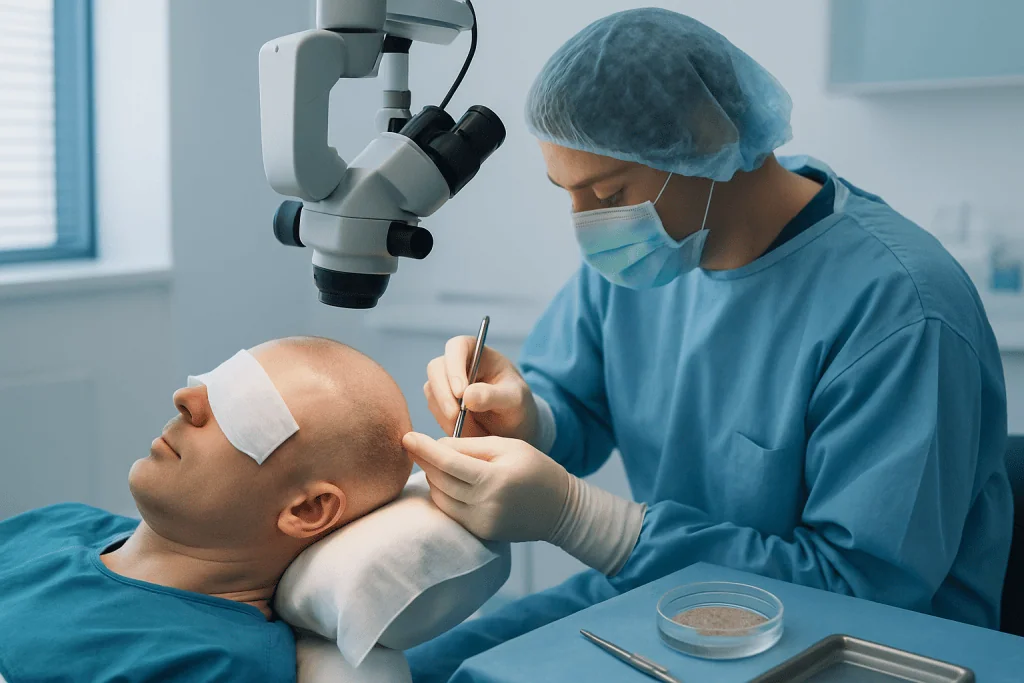
A DHI hair transplant in Turkey is one of the procedures most often researched by men and women in the UK who have been living with pattern hair loss and have reached the point of considering surgery. DHI, or direct hair implantation, is a form of follicular unit extraction in which each harvested follicle is loaded into a specialised pen and placed directly into the recipient area, allowing the surgeon to control angle, direction and depth as the hairline is built up. It supports natural-looking density and a hairline design that respects how your hair actually grows.
This page sets out who DHI suits and who it does not, how it differs from conventional FUE and sapphire FUE, what happens on the day and during recovery, the honest risks, and how the pathway differs between the UK, the US and Türkiye. It is written for adults weighing a decision that is elective, personal and permanent, and it assumes you will also talk to your own GP or dermatologist before travelling.
What is a DHI hair transplant, and who is it for?
DHI hair transplant is a minimally invasive hair restoration technique in which individual follicles are harvested one by one from a donor area, usually the back and sides of the scalp, and implanted directly into thinning or bald areas with a specialised implanter pen. Because the pen creates the channel and places the graft in a single motion, the surgeon controls the angle and depth of each follicle as it is positioned. The aim is a hairline and density that follow the natural pattern of your own growth.
Who it typically suits
- Adults with established pattern hair loss whose hair loss has stabilised or is being managed medically.
- People with a healthy donor area of sufficient density and quality to supply the grafts needed.
- Patients who want a defined hairline or refined density in a specific area, where precise placement matters.
- Those with realistic expectations about coverage, timing and the number of sessions that may be required.
Who should not have it, or should wait
- People whose hair loss is still progressing rapidly, since the pattern may change and undo the plan.
- Patients with a limited or weak donor area, where harvesting could leave visible thinning at the back.
- Those with unmanaged scalp conditions, uncontrolled diabetes, bleeding disorders or certain autoimmune hair loss diagnoses, which need medical assessment first.
- Anyone expecting a full head of youthful hair in a single session; transplantation redistributes hair, it does not create new follicles.
A specialist evaluates your hair loss pattern, donor area quality, medical history and expectations before planning graft numbers and hairline design. For some people the honest advice is medical treatment, a different technique or no surgery at all.
Why patients from the UK and the US travel to Turkey for DHI
Hair transplantation is not funded by the NHS for pattern hair loss, and in the US it is almost never covered by health insurance. That makes it a self-pay procedure everywhere, so patients compare not only cost but also the setting in which the operation is carried out and the continuity of care around it.
Türkiye has developed deep clinical experience in hair restoration over two decades, and Istanbul in particular receives large numbers of international patients each year. What distinguishes a hospital-based pathway from a standalone clinic is the infrastructure behind the surgeon rather than the technique itself.
- Hospital medicine. At Acıbadem, DHI is performed within a hospital group where anaesthesia, intensive care, laboratory and imaging services are available on site. For a local-anaesthetic outpatient procedure that backup is rarely needed, but it exists.
- JCI accreditation. Seven of the group’s more than 20 hospitals hold Joint Commission International accreditation, an independent review of patient safety, infection control and clinical governance.
- One network. Your consultation, blood tests, procedure and early follow-up happen within a single organisation with a shared medical record, rather than across separate providers.
- Experience with international patients. English-speaking coordinators, translated documentation and familiarity with the questions UK, Irish, US, Canadian and Australian patients ask.
- No waiting list. Once your remote review is complete, dates are agreed around your availability rather than a queue.
The flight from London is about four hours, and from New York around ten, which is short enough for a single trip to cover assessment, surgery and the first post-operative check.
How a DHI hair transplant in Turkey works with Acıbadem, step by step
The pathway is designed so that the medical decision is made before you book travel, not after you land.
- Remote medical review. You send clear photographs of the front, crown, sides and donor area, a summary of your medical history and current medicines, and a note on what you hope to achieve. A specialist reviews them and indicates whether you appear suitable, which technique seems appropriate and roughly how many grafts may be needed. This review is free and carries no commitment.
- Personal plan. You receive a written plan covering the proposed technique, the estimated number of grafts, the length of stay recommended and any preparation, followed by a personal quote. The price band below gives context for UK, US and Türkiye pathways.
- Arrival and coordinator. A patient coordinator meets you, arranges transfers between airport, hotel and hospital, and remains your point of contact throughout the stay.
- Consultation and pre-operative tests. The surgeon examines your scalp in person, confirms or adjusts the plan, designs the hairline with you and orders blood tests or a medication review where needed. This is the point at which the plan can still change.
- The procedure. Performed under local anaesthesia as an outpatient, typically over 6 to 8 hours, with breaks.
- Recovery in Istanbul. The first washes are done or supervised by the care team, and you attend at least one follow-up before flying home.
- Follow-up after returning home. Photograph-based reviews at agreed intervals, with a direct line to the team for questions during the shedding and regrowth phase.
Procedures are carried out at hospitals within the group, for example Acıbadem Taksim in central Istanbul, and your coordinator confirms the location in your plan.
The procedure: DHI vs FUE vs sapphire FUE, anaesthesia and duration
All three approaches begin with the same principle: follicular units are extracted individually from the donor area so there is no linear scar. They differ in how the grafts are placed.
Conventional FUE
After extraction, the surgeon opens small channels in the recipient area with fine steel blades and the grafts are then placed into those channels in a separate step.
Sapphire FUE
Sapphire FUE follows the same two-step logic but uses blades with a sapphire tip to open the channels. Patients considering a sapphire FUE hair transplant in Turkey are usually offered it when a larger area needs to be covered in one session.
DHI
DHI removes the separate channel-opening step. Each follicle is loaded into a specialised implanter pen and inserted directly, so the channel is created and the graft placed in one movement. This gives close control over angle and direction and is often favoured for hairline work and for adding density between existing hairs. Because it is more time-intensive per graft, it may be combined with another technique when a large number of grafts is planned.
Anaesthesia, duration and stay
- Anaesthesia: local. You are awake but the scalp is numbed; you can take breaks, eat and use the bathroom.
- Duration: 6 to 8 hours, depending on the number of grafts and the technique.
- Hospital stay: outpatient, with no overnight stay. You return to your hotel the same day with written instructions.
When comparing FUE vs DHI in Turkey, the honest answer is that the technique is chosen for your scalp, not the other way round. The surgeon confirms the approach at the in-person consultation once your donor area and recipient zones have been examined.
Recovery and aftercare timeline
Initial recovery takes roughly 7 to 10 days; full hair growth is judged at 12 to 18 months. Knowing the sequence in advance makes the quieter months easier to tolerate.
Days 1 to 3
Mild swelling, redness and pinpoint scabbing at each graft site are common and expected. Swelling may move towards the forehead and eyes before settling. The team performs or supervises the first wash and shows you the technique. Sleep with your head slightly raised and avoid touching the recipient area.
Days 4 to 10
Scabs soften and lift with gentle daily washing as instructed. Avoid scratching, sun exposure, strenuous exercise, swimming and hats until cleared by the care team. Most people are comfortable travelling home within this window and can return to desk work; a physically demanding job may need longer.
Weeks 2 to 8
Transplanted hairs commonly shed before new growth begins. This shock loss is a normal part of the cycle rather than a sign of failure, although it can be disheartening. Follow the medication and washing schedule you were given.
Months 3 to 12
New hairs emerge fine and sometimes uneven in texture, then thicken and darken gradually. Photographs sent to the team at agreed intervals allow progress to be tracked objectively.
Months 12 to 18
The result is considered mature. Any discussion of touch-up work or a second session belongs here, not earlier.
Preparation matters as much as aftercare. Patients are usually advised to stop smoking and alcohol and to pause certain blood-thinning medicines before the procedure, only where medically appropriate and after discussion with the prescribing doctor.
What it costs: UK, US and Türkiye
Typical self-pay ranges from the Turkey Medical Price Index. Türkiye figures are guide ranges for hospital treatment; your personal quote follows a free medical review.
Source: Turkey Medical Price Index (quarterly edition). Ranges depend on the extent of treatment, materials and hospital stay; they are not a quote.
Safety and risks
Hair transplantation under local anaesthesia is a low-acuity surgical procedure, but it is still surgery, and it is permanent. A calm view of the risks is part of giving informed consent.
Who is not suitable
Unstable or rapidly progressing hair loss, a depleted donor area, active scalp infection or inflammatory scalp disease, poorly controlled diabetes, bleeding disorders, and hair loss driven by an untreated medical cause are all reasons to decline or postpone. Patients who cannot pause anticoagulants safely, or who have unrealistic expectations of coverage, should also be counselled against proceeding.
Complications
- Bleeding, bruising and swelling beyond the expected mild degree.
- Infection of the donor or recipient area, or folliculitis during regrowth.
- Numbness or altered sensation over the scalp, usually temporary.
- Poor graft survival, patchy growth or an unnatural hairline angle.
- Visible thinning of the donor area if too many grafts are harvested.
- Shock loss of existing hair around the transplanted zone.
- Reactions to local anaesthetic, which are uncommon but require immediate medical care.
What cases that go wrong abroad usually share
Reports of poor outcomes tend to have common features: the plan was made from a single photograph without a proper medical history; the number of grafts was decided commercially rather than by donor capacity; much of the work was delegated to unsupervised technicians; there was no hospital backup if something went wrong; and follow-up ended at the airport.
How a hospital setting changes that
In a JCI-accredited hospital, patient identification, sterilisation, infection control and emergency response are audited processes rather than promises. Blood tests are done on site, a physician is responsible for your care, and anaesthesia and intensive care services exist in the same building should they ever be needed. None of this removes risk, but it changes how risk is managed.
UK and US vs Türkiye
The clinical procedure is the same wherever it is performed well. The pathway around it is what differs.
How the pathway differs
- Funding. In the UK, hair transplantation for pattern hair loss is not available on the NHS; in the US it is not covered by health insurance. Everywhere it is self-pay, so the price band below compares like with like.
- Waiting. Private clinics in the UK and US book by availability rather than a formal waiting list, but consultation, surgery and follow-up are usually spread over several months and several visits. In Türkiye the assessment, surgery and first review are compressed into one planned trip.
- Aftercare. At home, your surgeon is geographically close for the first year. Abroad, early follow-up happens in Istanbul and later follow-up is remote, so the quality of the remote process matters.
- Travel. A trip of roughly a week, a companion if you want one, and a flight home while the scalp is still healing.
What the lower cost does and does not mean
Costs in Türkiye are lower mainly because surgeon and staff salaries, hospital overheads, rent and running costs are lower than in London or New York. The implanter pens, extraction punches, sterilisation systems and medicines are the same international products. Lower cost does not mean fewer grafts, a rushed procedure or a lesser standard of care in a hospital setting, but it also does not by itself mean equivalent care; that depends on where and by whom the procedure is done.
What to compare like for like
Ask each provider the same questions: who performs the extraction and implantation and what is the physician’s role; how many grafts and by what technique; where the procedure takes place and what backup exists; what the follow-up schedule is; and what is included in the quote, such as medicines, transfers and accommodation. Only then is the price band meaningful.
Planning the trip
Practical planning is straightforward once the medical plan is agreed, but a few points repay attention.
Documents and entry
- A passport valid for your stay; check the current validity requirement before booking.
- UK, Irish, US, Canadian and Australian passport holders enter Türkiye visa-free for up to 90 days for tourism or medical purposes. Rules can change, so check the official guidance before travel.
- Printed or digital copies of your medical plan, medication list and any relevant letters from your GP.
How long to stay
Most patients stay around five to seven days: arrival and consultation, the procedure day, supervised washes and a review before flying home. If your plan involves a large number of grafts or combined techniques, your coordinator may recommend a longer stay. Do not schedule the flight home for the day after surgery.
Companion
A companion is not medically required for a local-anaesthetic outpatient procedure, but many people value company during a long day and the first evenings. Coordinators can arrange accommodation for two.
Travel insurance
Standard travel insurance excludes planned medical treatment abroad and often excludes complications arising from it. Look for a policy that specifically covers elective treatment overseas, and read the exclusions. Separately, ask the hospital what its own aftercare commitment covers.
What to bring
- Button-front shirts and zip tops that do not need to be pulled over the head.
- A soft travel pillow to keep the head elevated on the flight home.
- Your regular medicines in original packaging, with prescriptions.
- Comfortable loose clothing for the procedure day, and something to read or listen to.
Back home: follow-up, records and insurance
The trip ends in Istanbul; the treatment does not. The months of shedding and regrowth are managed from home, and it helps to set this up before you leave.
Follow-up with your GP or own doctor
Tell your GP or dermatologist that you have had the procedure, and give them a copy of the operative note, the medication list and the aftercare instructions. Continue any medical treatment for hair loss only as agreed between the transplant team and your own doctor. Send photographs to the Acıbadem team at the agreed intervals so progress is documented consistently.
Sharing records
Ask for your records in English before you leave: the procedure report with technique and graft numbers, the anaesthetic record, blood test results and discharge instructions. Keep digital copies; UK and US clinicians can act on them more readily than on a verbal account.
When to seek help
Contact the team, and see a doctor locally, if you notice spreading redness, warmth or discharge, fever, bleeding that does not stop with gentle pressure, increasing rather than decreasing pain, or a rash after new medication. Do not wait for a scheduled review.
Insurance, NHS and your own doctor
Private medical insurance in the UK and the US rarely covers elective treatment abroad or its complications; check your policy wording with your provider before travelling. In the UK, the NHS treats complications as it would for any other patient, but it does not provide revision or cosmetic follow-up for a procedure carried out privately. US readers may be able to use HSA or FSA funds for some costs, and travel-medical policies vary widely; confirm in writing.
Questions to ask before deciding
Whether you are comparing a provider in Manchester, Miami or Istanbul, the same questions separate a considered plan from a sales conversation. Take this list to every consultation.
About the medical decision
- Is my hair loss stable enough for surgery, and should I be on medical treatment first or alongside it?
- How was my donor capacity assessed, and how many grafts can be taken now without compromising future options?
- Why DHI rather than FUE or sapphire FUE for my case, or why a combination?
About the team and setting
- Which parts of the procedure does the physician perform personally, and who else is in the room?
- Where exactly is the procedure carried out, and what emergency and anaesthesia backup exists on site?
- Is the facility accredited, and by whom?
About the plan and follow-up
- What exactly is included in the quote, and what would cost extra?
- What is the follow-up schedule for the first eighteen months, and how do I reach the team?
- What happens if I have a complication after I return home?
- What would make you advise me not to proceed?
About expectations
- What density and hairline is realistic for me, and what will it look like at three, six and twelve months?
- Is a second session likely, and when would that be decided?
Write the answers down and compare them side by side with the price band below rather than in isolation. Discuss them with your own GP or dermatologist as well; a second opinion from someone with no commercial interest is worth the appointment. Whether DHI is appropriate for you, and which technique is right, is determined by a physician’s evaluation.
What is the difference between DHI and FUE?
Both harvest follicles individually from the donor area, so neither leaves a linear scar. In conventional FUE the surgeon opens channels first and places grafts in a second step, whereas in DHI each follicle is loaded into an implanter pen and placed directly, combining channel creation and placement in one movement. DHI is often chosen for hairline definition and adding density between existing hairs; FUE is often used when a large area needs covering. The surgeon recommends the technique after examining your scalp.
What is sapphire FUE and how does it compare with DHI?
Sapphire FUE is conventional FUE in which the recipient channels are opened with sapphire-tipped blades rather than steel. It remains a two-step method, unlike DHI, which places grafts directly with a pen. Some plans combine the two, using sapphire FUE for broader coverage and DHI for the hairline. Which is appropriate depends on your donor capacity, the area to be covered and the surgeon's assessment.
Is a DHI hair transplant painful?
The procedure is performed under local anaesthesia, so the scalp is numbed while you remain awake. The injections that deliver the anaesthetic cause brief discomfort, after which most patients report pressure rather than pain. Mild soreness, tightness and swelling are common in the first days and are managed with the medicines you are given.
How long does the procedure take and do I stay overnight?
A DHI session typically takes 6 to 8 hours, depending on the number of grafts and whether techniques are combined, with breaks for meals and rest. It is an outpatient procedure with no overnight stay, so you return to your hotel the same day. You attend the hospital again for supervised washing and a check before flying home.
When will I see results after a DHI hair transplant?
Initial healing takes around 7 to 10 days, after which the transplanted hairs commonly shed before regrowth begins. New hair usually starts to appear over the following months, initially fine in texture, and thickens gradually. The result is assessed at 12 to 18 months, which is also when any decision about a second session is made.
How long should I stay in Turkey for a DHI hair transplant?
Most patients stay around five to seven days to allow for an in-person consultation and tests, the procedure, supervised washes and a review before departure. A larger plan or combined techniques may need a longer stay. Your coordinator confirms the recommended length in your written plan, and you should not fly home the day after surgery.
Do I need a visa to travel to Turkey from the UK for treatment?
UK passport holders, along with Irish, US, Canadian and Australian passport holders, currently enter Türkiye visa-free for up to 90 days, including for medical travel. Entry rules and passport validity requirements can change, so check official government guidance before booking. Bring copies of your medical plan in case you are asked about the purpose of your visit.
Will the NHS or my insurer look after me if something goes wrong?
The NHS treats complications such as infection as it would for any other patient, but it does not provide revision or cosmetic follow-up for a procedure carried out privately abroad. Private medical insurance rarely covers elective treatment overseas or its complications, and standard travel insurance excludes planned treatment, so check policy wording with your provider. Ask the hospital in writing what its own aftercare commitment includes.
Your care team
Physicians of the Acıbadem network who perform this treatment in Istanbul.
 Where it is performed Acibadem Taksim Hospital İstanbul · JCI-accredited hospitals
 Clinical guide & data
The evidence-based pages behind this guide.