

Hair Transplant Cost UK vs Turkey: What the Difference Buys
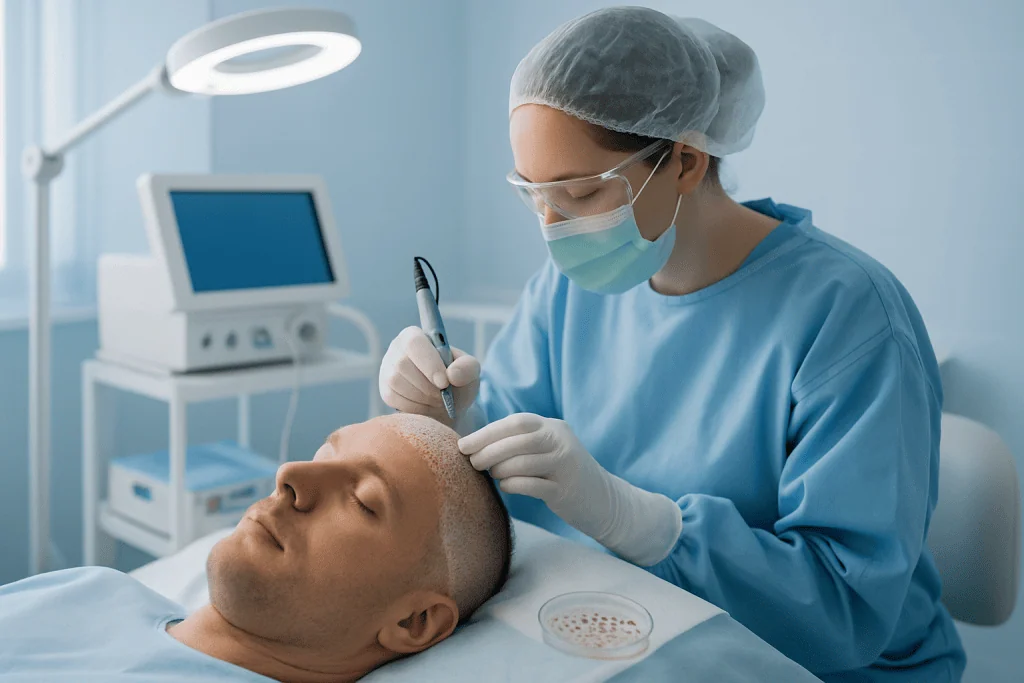
Comparing hair transplant cost in the UK vs Turkey is where most people begin, and it is a fair place to start: the same follicular unit extraction (FUE) procedure, performed by a qualified surgeon in a fully equipped hospital, is generally priced differently in the two countries. What the comparison cannot tell you on its own is whether two quotes describe the same thing. Graft numbers, who actually performs the extraction, whether the setting is a hospital or a stand-alone clinic, and what happens after you fly home all vary far more than the headline figure suggests.
This guide sets out how FUE works, who it suits and who it does not, how the treatment pathway in Türkiye differs from the UK and the US, what a large session of around 5,000 grafts involves, and how Turkey compares with other destinations such as Mexico. It is written for adults who want to decide carefully, with their own doctor involved, rather than quickly.
What an FUE hair transplant is and who it suits
FUE hair transplant is a minimally invasive hair restoration method. Individual follicular units are taken one by one from donor areas, usually the back and sides of the scalp, and moved to thinning or bald regions so that hair can grow there in a natural-looking pattern. It is a surgical procedure, carried out under local anaesthesia, and the follicles used are the patient’s own.
People who tend to be suitable candidates share a few features:
- Pattern hair loss that has stabilised, so the new hairline is planned against a predictable future.
- A donor area with enough density to supply the planned number of grafts without leaving it visibly thin.
- Good general health, including well-controlled blood pressure, diabetes or thyroid conditions where present.
- Realistic expectations about density, coverage and the time results take to appear.
Who should not have a hair transplant
A transplant is not the right answer for everyone, and a careful assessment can end with a recommendation not to proceed. Reasons include diffuse, unpatterned thinning that affects the donor area as well; scarring forms of alopecia or an active scalp condition; a donor supply too limited for the area to be covered; very early hair loss in a young adult whose final pattern is still evolving; and medical conditions that make even minor surgery unwise. Some people are better served by medical treatment alone, or by treating the underlying cause of their hair loss first.
Whatever you read here, your own GP or dermatologist remains an important part of that decision, particularly if your hair loss began suddenly or is accompanied by other symptoms.
Why patients from the UK and the US travel to Türkiye for a hair transplant
Türkiye has become closely associated with hair transplantation, and for many UK and US patients the reasons are practical rather than purely financial. Istanbul is roughly a four-hour flight from London and around ten hours from New York, which makes a planned procedure and a short recovery period feasible within ordinary annual leave.
The more important reason is the setting in which the procedure is performed. At Acıbadem, FUE is hospital medicine: it takes place within a group whose network of more than 20 hospitals includes 7 that are accredited by the Joint Commission International (JCI), the same standards framework used by many hospitals in the United States. Accreditation covers infection control, medication safety, sterilisation, staff credentialing and emergency preparedness, not just the procedure room.
Being one integrated network matters in ways that are easy to overlook when everything goes to plan:
- Anaesthesiology teams, intensive care units and imaging are on the same site, so an unexpected reaction or an unrelated medical problem is managed within the hospital rather than by referral elsewhere.
- More than 3,300 physicians across specialties mean that a dermatologist, endocrinologist or cardiologist can be consulted if the pre-operative assessment raises a question.
- International patient departments have long experience with visitors from the UK, Ireland, the US, Canada and Australia, including interpreters, records in English and coordination with your doctor at home.
Finally, there is no waiting list. Once your medical review is complete and you are found suitable, the procedure can be scheduled around your travel rather than around capacity. Procedures are carried out at hospitals such as Acıbadem Taksim Hospital in central Istanbul, which many visiting patients find convenient for accommodation and follow-up visits.
How a hair transplant with Acıbadem works, step by step
The pathway is designed so that the clinical decision is made before you book a flight, not after you arrive. In outline, it works like this:
- Remote medical review. You submit clear photographs of the scalp from several angles, a description of when hair loss began and how it has progressed, your medical history and any medicines you take. A physician reviews this material without charge and indicates whether FUE is likely to be appropriate.
- Personal plan and quote. If you appear suitable, you receive a written plan covering the proposed approach, the estimated graft range, the expected number of days in Istanbul and a personal quote. This is the point at which the price band shown below becomes a specific figure for your case.
- Arrival and coordinator. A patient coordinator meets you on arrival, arranges transfers between the airport, your accommodation and the hospital, and remains your single point of contact throughout the stay.
- Consultation and pre-operative tests. The surgeon examines the scalp and donor area in person, confirms or adjusts the plan, and draws the proposed hairline with you. Blood tests and any other checks indicated by your history are completed in the hospital’s own laboratory.
- The procedure. FUE is performed under local anaesthesia as an outpatient procedure, typically lasting four to eight hours depending on the number of grafts.
- Recovery in Istanbul. You return for a check and the first supervised wash, and receive written aftercare instructions before you are cleared to travel.
- Follow-up at home. The team stays in contact at agreed intervals with photographs and, where needed, video consultations, and your records are shared with your own doctor.
Nothing about the plan is fixed until the in-person examination. If the surgeon finds that the donor area cannot support the numbers discussed remotely, the plan is revised rather than forced.
The FUE procedure: technique, anaesthesia, duration and hospital stay
Before the procedure, the scalp and donor area are assessed and the hairline is planned according to facial proportions and donor capacity. You may be asked to stop blood-thinning medicines, alcohol and smoking for a short period if this is medically appropriate, and you will be given hair-washing and eating instructions for the day itself. Any change to prescribed medication is agreed with the medical team, never made on your own initiative.
On the day, the procedure is carried out under local anaesthesia. Individual follicular units are extracted from the donor area, sorted and kept in suitable conditions while the recipient area is prepared, and then placed one by one into the thinning or bald region following the planned hairline and the natural direction of growth. Because each follicle is handled individually, the session is long: four to eight hours is typical, with breaks for the patient. The duration depends chiefly on the number of grafts and the character of the hair.
FUE is an outpatient procedure. There is no overnight hospital stay, and you return to your accommodation the same day with a protective dressing and instructions for the first night.
How many grafts, and what a 5,000-graft hair transplant involves
Graft number is the single biggest driver of both duration and cost, which is why questions about a 5,000-graft hair transplant in Turkey are so common. A session of that size is at the upper end of what a donor area can supply, and whether it is realistic for you depends entirely on the density and extent of your donor hair, the size of the area to be covered and the surgeon’s judgement about how much can be safely harvested without leaving the back and sides noticeably thin. The surgeon, not the quote, decides that number. The Price Index below shows how the cost band relates to graft ranges in the UK, the US and Türkiye; a personal figure follows the medical review.
Recovery and aftercare timeline
Initial healing after FUE takes around seven to ten days. Full results take considerably longer, typically twelve to eighteen months, and understanding that gap in advance prevents a great deal of unnecessary worry.
The first days
After the procedure you receive instructions for gentle washing, sleeping position and protecting the grafted area. Mild swelling, redness or crusting is common and usually improves within days. Most patients rest on the first day, sleep with the head slightly raised as advised, and attend the hospital for a check and supervised wash before travelling home.
Days seven to ten
This is the period of initial healing. Crusting resolves, the donor area settles and many people feel comfortable in public without a cap, although sun exposure should still be avoided. Strenuous exercise, sun exposure and scratching should be avoided until the medical team confirms that healing is complete. Your surgeon will explain what to expect in the following weeks, including changes in the appearance of the transplanted area that are a normal part of the process rather than a sign of failure.
Months to a year and beyond
New growth appears gradually and continues to thicken over the following months. Twelve to eighteen months is the realistic horizon for judging the outcome, which is why reputable teams schedule follow-up photographs at intervals rather than a single early review. Patience during this period is the norm, not the exception.
Throughout, the rule is simple: if something looks or feels different from what you were told to expect, contact the team or your own doctor rather than waiting.
What it costs: UK, US and Türkiye
Typical self-pay ranges from the Turkey Medical Price Index. Türkiye figures are guide ranges for hospital treatment; your personal quote follows a free medical review.
Source: Turkey Medical Price Index (quarterly edition). Ranges depend on the extent of treatment, materials and hospital stay; they are not a quote.
Safety and risks
FUE is a low-risk surgical procedure when it is planned and performed properly, but it is still surgery, and honest information about what can go wrong is part of informed consent.
Who is not suitable
People with active scalp infection or inflammatory skin disease, uncontrolled diabetes or bleeding disorders, a history of poor wound healing or keloid scarring, or hair loss whose cause has not been established are generally advised not to proceed, at least until those issues are addressed. A limited donor area is a reason to reduce the plan or decline it, not to stretch it.
Complications
Recognised complications include infection, bleeding, folliculitis around the grafts, prolonged swelling, numbness or altered sensation in the donor or recipient area, small scars in the donor zone, and unsatisfactory outcomes such as poor growth, an unnatural hairline or visible over-harvesting at the back of the head. Reactions to local anaesthetic are uncommon but possible. Most complications are minor and treatable; the aesthetic ones are the hardest to correct, which is why planning matters so much.
What cases that go wrong abroad tend to share
When hair transplants performed abroad end badly, certain features recur. Planning was rushed, often with the first proper examination taking place on the day of surgery. Large graft numbers were promised before anyone had examined the donor area. The procedure took place in a stand-alone clinic with no on-site anaesthesiology, intensive care or laboratory to fall back on. It was unclear who actually performed the extraction and placement. And there was no structured follow-up once the patient had left the country.
How a hospital setting changes that
A hospital pathway addresses each of those points directly: a physician reviews your case before you travel, the surgeon examines you and confirms the plan before anything is done, emergency and specialist support is on the same site, the treating team is identifiable and accountable, and follow-up continues after you return home. It does not remove risk, but it changes who carries it and how it is managed.
UK and US vs Türkiye: how the hair transplant pathway differs
Comparing a hair transplant in the UK vs Turkey is not only a question of cost; the pathway itself is different.
In the UK, hair transplantation is not available through the NHS for cosmetic hair loss, so patients pay privately. Private surgeons of good standing exist, but capacity is limited, consultations may involve a wait, and a large FUE session can require a long day or be split over two. Aftercare is local and convenient. In the US, the situation is similar: self-pay, wide variation in who performs the work, and geography that can mean a long drive for follow-up anyway.
In Türkiye, the pathway is compressed around a short trip: remote review, a scheduled date without a waiting list, examination and procedure within days of each other, then remote follow-up supported by your own doctor at home. The trade-off is travel, time away and the need to plan aftercare across two countries.
What the lower cost does and does not mean
The gap in the price band below reflects lower surgical and nursing salaries, lower hospital overheads and lower general costs in Türkiye. It does not reflect different instruments, cheaper consumables or a different technique; the punches, blades, microscopes and holding solutions used in a well-run hospital are the same products used in London or New York. Lower cost is therefore not in itself a warning sign. What matters is whether the lower figure still buys a surgeon-led procedure in a properly equipped hospital with follow-up, or whether it has been achieved by removing exactly those things.
Hair transplant: Mexico vs Turkey
For readers in the US and Canada, Mexico is a closer alternative, and a shorter flight is a genuine advantage in the first days of recovery. The questions to ask are the same in either country: who performs the procedure, in what kind of facility, under which accreditation, and with what follow-up. For UK and Irish patients the geography reverses, with Istanbul a four-hour flight and Mexico a transatlantic one. Neither destination is inherently safer; the individual provider is what you are choosing.
What to compare like for like
- Graft number and how it was determined.
- Who extracts and who places the grafts.
- Hospital or stand-alone clinic, and what accreditation it holds.
- What the quote includes: tests, medication, transfers, follow-up.
- How aftercare works once you are home.
Planning the trip to Istanbul
Once the medical review has confirmed you are a suitable candidate, the practical planning is straightforward.
Passport and entry. UK, Irish, US, Canadian and Australian passport holders currently enter Türkiye visa-free for stays of up to 90 days. Rules can change, so check the current requirements before you book flights, and make sure your passport is valid for the period required.
How long to stay. Most patients plan a stay of several days: arrival and consultation, the procedure day, a rest day, and a check with the first supervised wash before travelling. Your coordinator will confirm the exact number of nights for your plan. Building in a spare day removes the pressure to fly before the team is happy for you to do so.
Travelling with someone. A companion is not medically required for an outpatient procedure under local anaesthesia, but many people appreciate company on the day of surgery and help during the first evening. If you travel alone, the coordinator arranges transfers so that you are not navigating the city with a fresh dressing.
Insurance. Ordinary travel insurance usually excludes planned medical treatment and complications arising from it. Look for a policy that specifically covers elective treatment abroad, or a dedicated medical-travel policy, and read the exclusions carefully. Standard cover for unrelated illness or lost luggage remains worthwhile.
What to bring.
- All current medicines in their original packaging, with a list of doses.
- Any relevant medical letters or test results, in English if possible.
- A loose cap or hat that does not press on the grafted area, as advised by the team.
- Button-front shirts, which avoid pulling clothing over the head.
- Comfortable clothing for a long day in the procedure room.
Back home: follow-up with your GP, records and when to seek help
Recovery does not end at the airport. Before you leave Istanbul you receive a discharge summary describing the procedure, the number of grafts, the medicines prescribed and the follow-up schedule. Share this with your GP or family doctor so that it forms part of your medical record; if you have a dermatologist, they should have it too. Acıbadem’s international team remains available for questions and reviews photographs at agreed intervals, and can speak with your doctor directly if either of you wishes.
When to seek help
Contact the hospital team promptly, and your own doctor or urgent care service if you are unwell, if you notice spreading redness, increasing pain, pus or an unpleasant smell from either area, fever, bleeding that does not stop with gentle pressure, or any symptom that worries you. Mild swelling, redness and crusting in the first days are expected; these signs are not.
Insurance, the NHS and your own doctor
Private medical insurance in the UK and the US rarely covers elective cosmetic treatment abroad, and many policies also exclude complications of such treatment; check with your provider in writing before you travel. In the UK, the NHS will treat a complication as it would any other patient who presents unwell, but it will not carry out revision or cosmetic correction, and it is reasonable to expect your GP to want a copy of your records. Readers in the US should note that HSA and FSA eligibility for treatment abroad, and the terms of travel-medical policies, vary widely and should be confirmed with the plan administrator rather than assumed. Keeping your own doctor informed from the outset is the simplest way to make sure that any later care at home is well coordinated.
Questions to ask before deciding
Whichever country and provider you are considering, the following questions separate a well-planned hair transplant from a rushed one. Write the answers down and compare them side by side.
- Who will perform the extraction, and who will place the grafts? Are they physicians, and can I meet the surgeon before the day?
- How was my graft number estimated, and will it be confirmed by examining my donor area in person before anything is done?
- Is the procedure performed in a hospital or a stand-alone clinic? What accreditation does the facility hold, and is anaesthesiology and intensive care on site?
- What pre-operative tests are included, and who reviews the results?
- Which medicines will I need to stop or start, and who coordinates that with my own doctor?
- What exactly does the quote include, and what would count as an extra?
- How many days should I plan to stay, and what has to happen before I am cleared to fly?
- What does follow-up look like after I return home, for how long, and who do I contact if I am worried?
- What are the realistic risks in my case, and what would lead you to advise against surgery?
- May I have all of this in writing, in English, before I book travel?
A provider that answers these questions clearly and without pressure is giving you the information you need; one that avoids them is telling you something too. Take the answers to your GP or dermatologist, allow yourself time, and remember that the decision does not have to be made on any particular day.
Suitability for an FUE hair transplant is determined by a physician’s evaluation of your scalp, donor area and general health, not by a quote or a graft number.
Why does a hair transplant cost less in Turkey than in the UK?
The difference in the price band below largely reflects lower surgical and nursing salaries, lower hospital overheads and lower general costs in Türkiye. The instruments, consumables and technique used in a well-run hospital are the same as those used in the UK. A lower cost is not in itself a warning sign, but it does mean you should check what the quote includes and who performs the procedure.
Is a hair transplant in Turkey safe?
FUE is a low-risk surgical procedure when it is planned properly and performed by a qualified team in an appropriately equipped facility. Safety depends far more on the individual provider than on the country. Choosing a hospital setting with accreditation, on-site anaesthesiology and intensive care, and structured follow-up addresses the factors most often shared by cases that go wrong abroad.
How much does a 5,000-graft hair transplant cost in Turkey?
Graft number is the main driver of cost, and the Price Index below shows how the band for a large session in Türkiye compares with the UK and the US. Whether 5,000 grafts is realistic for you depends on your donor area and is decided by the surgeon after examination, not by the quote. A personal figure follows a free medical review of your photographs and history.
Hair transplant in Mexico vs Turkey: which is better for UK or US patients?
Neither destination is inherently safer or better; the provider is what you are choosing. For US and Canadian readers Mexico offers a shorter flight, while for UK and Irish readers Istanbul is around four hours away. In either country, ask the same questions about who performs the procedure, the type and accreditation of the facility, and how follow-up works once you are home.
How long do I need to stay in Istanbul for an FUE hair transplant?
Most patients plan a stay of several days covering the in-person consultation and tests, the procedure day, a rest day, and a check with the first supervised wash before travelling. The procedure itself is outpatient, with no overnight hospital stay. Your coordinator confirms the exact number of nights for your plan, and building in a spare day is sensible.
Will the NHS treat me if something goes wrong after a hair transplant abroad?
The NHS treats a complication, such as an infection, as it would for any other patient who presents unwell. It does not provide revision or cosmetic correction of a privately funded procedure. Share your discharge summary with your GP on return so that any care at home is well informed, and contact the treating hospital's team as well if you have concerns.
Does an FUE hair transplant hurt, and what anaesthesia is used?
FUE is performed under local anaesthesia, so the scalp is numbed and you remain awake during the four-to-eight-hour session. Most discomfort is associated with the anaesthetic injections at the start; afterwards, mild swelling, redness and tightness are common and usually improve within days. You receive guidance on pain relief and on sleeping position for the first nights.
When will I see the results of a hair transplant?
Initial healing takes around seven to ten days, but full results take twelve to eighteen months as the transplanted follicles establish and new growth thickens. Your surgeon will explain the expected changes in appearance during the intervening months so that normal stages are not mistaken for problems. Follow-up photographs at agreed intervals help track progress.
Your care team
Physicians of the Acıbadem network who perform this treatment in Istanbul.
 Where it is performed Acibadem Taksim Hospital İstanbul · JCI-accredited hospitals
 Clinical guide & data
The evidence-based pages behind this guide.