

Pulmonary Function Test in Turkey: Breathing Test Preparation

A pulmonary function test is a group of breathing tests used to measure how well the lungs work by assessing airflow, lung volume, and gas exchange. In Turkey, these tests are typically performed in a respiratory laboratory using simple breathing maneuvers and, when needed, complementary assessments, with preparation often including temporary restrictions on smoking, heavy meals, and certain inhaled medications.
A pulmonary function test is a non-surgical breathing assessment that helps your doctor understand how well your lungs move air and transfer oxygen. This guide explains how to prepare for your appointment in Turkey, what the visit usually involves, and how Acibadem International can support your travel, language and hospital logistics.
At a glance
- Test type: Non-invasive breathing and lung function assessment
- Common tests: Spirometry, lung volumes, diffusion capacity and bronchodilator response
- Typical visit length: Often 30–90 minutes, depending on the test plan
- Preparation focus: Medication instructions, clothing, food, smoking and recent symptoms
- Support available: Interpreters, appointment coordination and travel assistance for international patients
What a pulmonary function test is used for
A pulmonary function test in Turkey is usually arranged to measure how well you breathe in and out, how much air your lungs can hold, and how efficiently your lungs support oxygen exchange. You may hear the test called spirometry, a lung function test, a breathing test or PFT. The exact set of measurements depends on why your doctor requested the appointment and your medical history.
Your doctor may recommend testing if you have shortness of breath, ongoing cough, wheezing, chest tightness, reduced exercise tolerance, suspected asthma or COPD, previous lung surgery, occupational exposure, or follow-up after an infection. Some patients also need lung function testing before surgery or as part of a broader cardiology, pulmonology, allergy or internal medicine evaluation.
At Acibadem International, the aim is to make this a clear, well-coordinated hospital visit rather than a stressful unknown. International patient teams can help confirm your appointment details, support interpreter arrangements where needed, and guide you on what documents to share before you travel or arrive at the hospital.
Before you travel or attend the hospital
The most important preparation is to ask whether any inhalers, breathing medications, allergy medicines or other treatments should be paused before the test. Do not stop any prescribed medicine unless your doctor or the testing team specifically tells you to do so. Instructions vary because some tests are designed to measure your usual breathing, while others look at how your lungs respond before and after a bronchodilator.
If you are travelling from abroad, send your recent medical records in advance when possible. Useful documents include previous pulmonary function results, chest X-ray or CT reports, discharge summaries, allergy lists, current medications, inhaler names and doses, oxygen use details, and any cardiac or surgical history. This helps the clinical team understand the reason for testing and plan the right appointment length.
Tell the coordination team if you have had recent chest pain, a heart event, eye or abdominal surgery, a collapsed lung, coughing blood, a respiratory infection, fever, or severe breathlessness at rest. These details do not automatically mean you cannot be tested, but they help the medical team decide whether the test should proceed, be modified or be postponed for safety.
How to prepare on the day of your breathing test

Wear comfortable clothing that does not restrict your chest or abdomen. A tight belt, high-waisted compression garment or restrictive top can make deep breathing harder. Comfortable shoes are also helpful if your appointment includes a walking or exercise-related assessment, although many pulmonary function tests are performed while seated.
Try not to arrive immediately after a heavy meal, as a very full stomach can make deep breathing uncomfortable. If you have been told to avoid smoking, vaping, caffeine, strenuous exercise or certain inhalers before the test, follow the time window given by your care team. If you accidentally use a medication or cannot follow one instruction, be honest with the technician; the information can be noted and the test may still be useful.
- Bring your passport or ID, appointment confirmation and insurance or payment documents if requested.
- Bring all inhalers, spacers, nebulizer medicines and a written medication list.
- Bring previous lung test results if you have them, even if they are in another language.
- Arrive a little early so registration, interpretation and clinic directions do not feel rushed.
What happens during the appointment
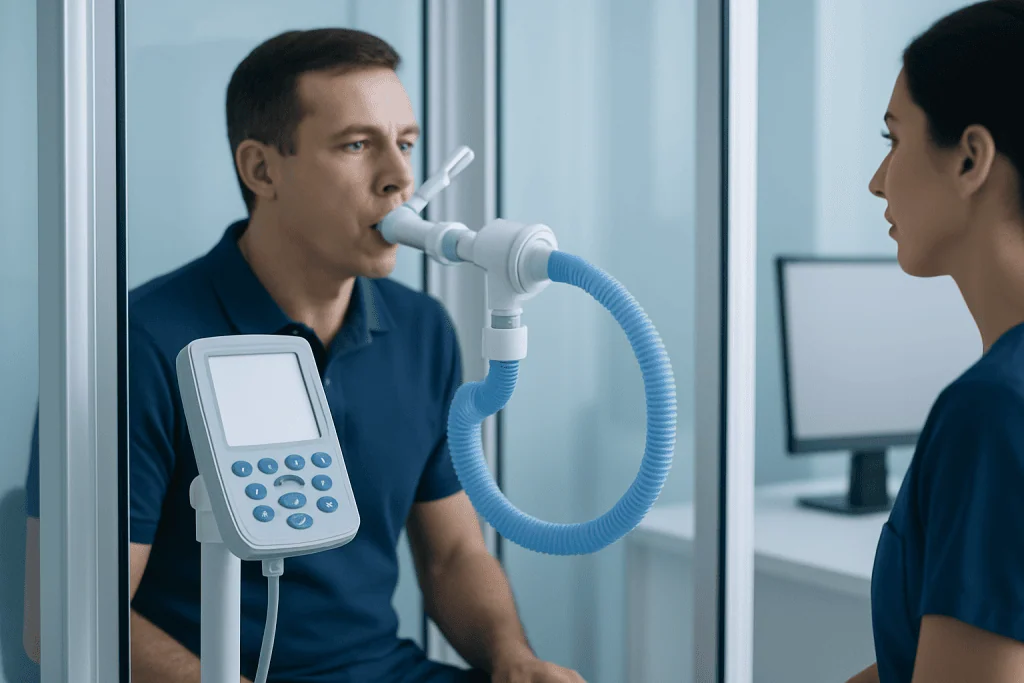
A technician or respiratory staff member will explain the test and show you how to seal your lips around a mouthpiece. You may wear a nose clip so that air does not escape through your nose. You will be asked to breathe normally, take a deep breath, blow out as hard and fast as you can, or continue breathing in a specific pattern depending on the measurement being taken.
It is normal to repeat each breathing effort several times. This is not because you did something wrong; repeat attempts help the team confirm consistent and reliable results. The technician will coach you with clear instructions, and you can ask to pause if you feel lightheaded, tired or anxious.
Some patients receive an inhaled bronchodilator during the appointment and then repeat part of the test after waiting for it to take effect. This helps your doctor compare your baseline breathing with your breathing after medication. Other patients may have additional measurements, such as lung volumes or diffusion capacity, which involve slightly different breathing patterns but remain non-surgical and usually well tolerated.
Comfort, safety and language support
Many people feel nervous before a breathing test because it asks for effort and coordination. The test team is used to guiding first-time patients and will demonstrate the technique step by step. You do not need to perform perfectly on the first try; the team’s role is to help you produce the best, safest and most reliable results possible.
During the test, tell the technician if you feel dizzy, chest discomfort, unusual shortness of breath, severe coughing, nausea or panic. Mild breathlessness or temporary lightheadedness can happen after forceful breathing, but symptoms should be communicated promptly. The appointment can usually be paused, and the clinical team can decide what is appropriate.
For international patients in Istanbul or other Turkish locations, language support can make the experience much calmer. Acibadem International can help arrange interpreter assistance, direct you through hospital registration, and coordinate between departments if your pulmonary function test is part of a same-day specialist consultation or imaging plan.
Understanding your results and next steps
Your results are usually interpreted by a qualified physician in the context of your age, height, sex, symptoms, medical history and previous results. You may see numbers such as FEV1, FVC, FEV1/FVC ratio, total lung capacity or diffusion capacity. These values are tools for your doctor; they are not meant to be interpreted in isolation without your clinical picture.
The report may help your doctor identify patterns such as airflow limitation, restriction, bronchodilator response or reduced gas transfer. It may also be used to monitor known lung disease, assess treatment response, evaluate surgical fitness, or decide whether further tests are needed. Sometimes a normal result is also useful because it helps narrow the search for other causes of symptoms.
Before you leave, ask when and how the report will be shared, whether you need a pulmonology consultation, and whether the results should be translated or sent to your doctor at home. If you are returning to another country soon, the international patient team can help you understand how to access reports and coordinate follow-up documents.
Step by step
- Share your medical background before the appointment. Send recent reports, medication lists and previous lung test results if available. This helps the team plan the correct type of pulmonary function test and identify any safety considerations before you arrive.
- Confirm medication instructions. Ask specifically about inhalers, nebulizers, allergy medicines and breathing treatments. Never stop medication on your own; follow the instructions given by your doctor or testing team.
- Prepare for a comfortable test day. Wear loose clothing and avoid anything that restricts your chest or abdomen. Plan your meal timing so you are not overly full, and follow any guidance about smoking, vaping, caffeine or exercise.
- Arrive early for registration and interpretation. International patients should allow extra time for hospital entry, registration, document checks and finding the correct department. If an interpreter has been arranged, arriving early also helps keep the schedule smooth.
- Follow the technician’s coaching. You will be guided through each breathing pattern and may repeat the same effort several times. Repetition is part of quality control and helps your doctor receive reliable results.
- Speak up if you feel unwell. Tell the team if you feel dizzy, have chest discomfort, severe coughing or unusual breathlessness. The test can usually be paused while the team checks how you are feeling.
- Ask how results will reach you. Before leaving, confirm the expected report timing and whether a consultation is scheduled. If you are travelling home, ask how you can access digital copies and share them with your local doctor.
Your checklist
- Passport or official ID
- Appointment confirmation and hospital contact details
- Current medication list with inhaler names and doses
- All inhalers, spacers or nebulizer medicines you use
- Previous pulmonary function test results, if available
- Recent chest imaging reports or relevant specialist letters
- Comfortable, loose clothing
- Glasses or hearing aids if you need them for instructions
- Questions you want to ask about results and follow-up
Key takeaways
- A pulmonary function test is a non-invasive breathing assessment used to understand airflow, lung capacity and oxygen transfer.
- Good preparation mainly means confirming medication instructions, wearing comfortable clothing and bringing accurate medical information.
- Repeated breathing efforts are normal and help the team obtain reliable results.
- Tell the technician immediately if you feel dizzy, have chest discomfort or become unusually short of breath.
- International patient support can help with appointments, interpreters, hospital navigation and follow-up report access.
Frequently asked questions
Is a pulmonary function test painful?
No, the test is not usually painful and does not involve needles or surgery. You will breathe through a mouthpiece while following instructions from the technician. Some people feel temporarily tired, lightheaded or short of breath because the test requires strong breathing effort.
How long does a pulmonary function test in Turkey take?
Many appointments take around 30 to 90 minutes, depending on which measurements are needed and whether medication is given during the test. Extra time may be needed for registration, interpretation, consultation or additional tests on the same day. International patients should avoid booking a very tight schedule immediately afterward.
Can I use my inhaler before the test?
It depends on the reason for the test and the type of inhaler. Some patients are asked to pause certain inhalers for a specific period, while others should continue their usual medication. Do not stop or delay treatment unless your doctor or the testing team has clearly instructed you.
What should I avoid before a breathing test?
Your care team may advise you to avoid smoking, vaping, heavy meals, strenuous exercise, caffeine or certain inhalers before the test. The exact timing varies, so follow the instructions provided for your appointment. If you could not follow an instruction, tell the technician before starting.
Will I get my results immediately?
The test data may be available quickly, but final interpretation usually needs physician review. Your report should be considered alongside your symptoms, history and any imaging or blood tests. Ask before you leave when the report will be ready and how it will be shared with you.
Can I have the test if I do not speak Turkish?
Yes, international patients can request language support. Acibadem International can help coordinate interpreter assistance so you understand the breathing instructions and appointment flow. It is best to request this before your visit so arrangements can be planned.
Is it safe to fly after a pulmonary function test?
Most people can continue normal activities after a routine pulmonary function test, including travel, unless their doctor advises otherwise. If you have significant symptoms, recent surgery, oxygen needs or an unstable condition, discuss your travel plan with your physician. Always seek medical advice if you feel unwell after the appointment.
Add us as a Preferred Source to see more of our trusted health content across Google Search, AI Overviews and Discover.
More Patient Guides

At Acibadem, How to Prepare for Blood Tests, Scans, and Pre-Op Checks
Blood tests, scans, and pre-op checks at Acibadem in Turkey help confirm you are ready for treatment and avoid delays on the…
8 min read
Medical Test Results in Turkey: How to Understand the Next Step in Your Plan
Medical test results in Turkey usually lead to a clear next-step plan: review findings, confirm urgency, ask for copies, and arrange follow-up…
8 min read
Blood Tests and Scans Before Treatment in Turkey: Why They May Be Repeated
Blood tests and scans before treatment in Turkey may be repeated to confirm safety, compare methods, and meet hospital standards before your…
9 min read